
FUPA and Menopause: Why It Changes and What Helps
Page Contents
- What changes at perimenopause and beyond
- Why oestrogen decides where fat is stored
- Why the mons pubis in particular
- It is not only fat, and that matters
- What the menopause does not explain
- How menopausal change compares with the other common causes
- What makes a measurable difference
- Resistance training, not more cardio
- Protein and overall intake
- Sleep, alcohol and cortisol
- One measurement worth tracking
- Where HRT fits
- When to speak to your GP
- Frequently asked questions
- Does the menopause cause a FUPA?
- Why has my FUPA appeared when my weight has not changed?
- Can I lose a menopausal FUPA?
- Will HRT get rid of it?
- Is a fuller mons pubis after the menopause normal?
This guide is general information about body changes around the menopause. It is not medical advice and it does not replace an assessment by your GP or a menopause specialist.
Plenty of women reach their late forties and notice that the soft fullness above the pubic bone has changed. It may sit lower, feel softer, or have appeared where there was nothing before, and the usual explanations do not fit. The scales may read the same. Nothing about the diet has changed. What has changed is the hormonal instruction telling the body where to put fat.
The menopause does not create a FUPA out of nothing. What it does is rewrite the rules of fat storage, thin the tissue that used to hold the mons pubis taut, and do both at a stage of life when muscle mass is already falling. For a lot of women the result is a suprapubic fat pad that looks fuller than it used to, even when body weight has barely moved. This guide explains the mechanism, separates what the menopause genuinely accounts for from what it does not, and sets out what makes a measurable difference.
What changes at perimenopause and beyond
The menopause itself is a single point in time, defined in the UK as twelve consecutive months without a period. The average age in Britain is around 51, according to the NHS. The years of change on either side of it matter more for body composition than the date does.
Perimenopause is the transition, and it commonly runs for four to eight years. During it, the ovarian follicle pool depletes, oestradiol output becomes erratic rather than simply low, and follicle stimulating hormone rises as the brain tries to push the ovaries harder. Progesterone falls earlier and more steadily than oestrogen, because cycles start going anovulatory before they stop altogether.
This is not a gradual dimmer switch. Oestradiol can spike above premenopausal levels in one cycle and crash in the next, which is why body changes often feel like they arrive in steps rather than a slow drift. Postmenopause, oestradiol settles at a low, stable level, and the main remaining source is not the ovary at all. It is adipose tissue, which converts androgens into oestrone through the enzyme aromatase.
Why oestrogen decides where fat is stored
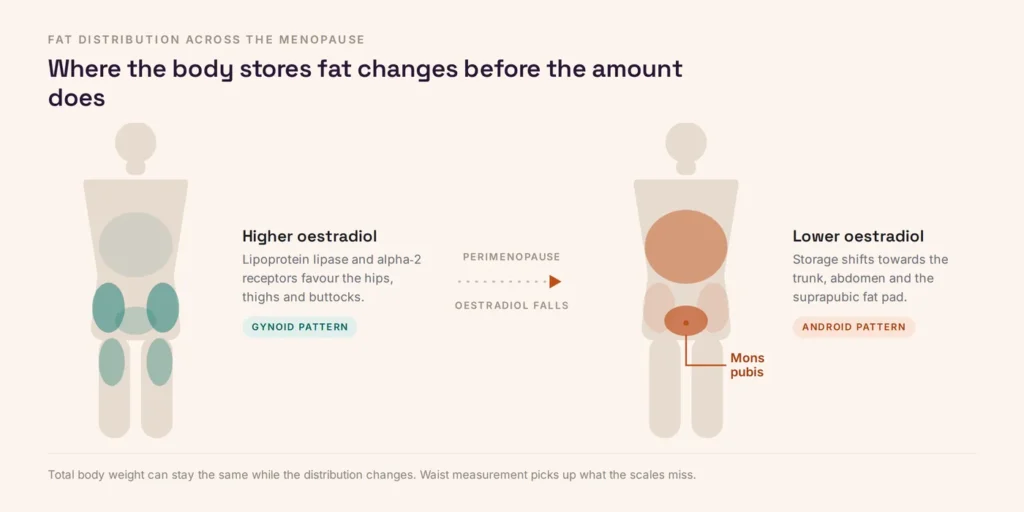
Before the menopause, women store fat in a gynoid pattern: hips, thighs, buttocks and the lower abdominal wall. Oestrogen drives this. It increases lipoprotein lipase activity in gluteofemoral fat, which is the enzyme that pulls circulating fat into storage, and it favours alpha-2 adrenoceptors in those same depots. Alpha-2 receptors block fat release. Beta receptors allow it. A depot rich in alpha-2 receptors is a depot that fills easily and empties reluctantly.
When oestradiol falls, that bias weakens. Storage shifts towards an android pattern, meaning the trunk and the abdomen. Research using DXA scanning consistently shows the android to gynoid ratio rising across the menopausal transition, and it rises independently of how much total weight a woman gains. Two women at identical weights, one premenopausal and one five years postmenopausal, will tend to carry that weight in different places.
Two things usually get conflated here. Visceral fat, the deep fat around the organs, does increase after the menopause, and that is the change with real cardiometabolic consequences. Subcutaneous fat in the lower abdominal wall also redistributes, and that is the change you can see and pinch. A fuller mons pubis is a subcutaneous change. Our guide to FUPA, hormones and genetics covers the receptor biology in more depth.
Why the mons pubis in particular
The mons pubis is a specialised fat pad sitting directly over the pubic symphysis, held in place by the fibrous attachments running through Camper’s and Scarpa’s fascia down to the pubic bone. It is anchored tissue, not loose tissue, which is why it holds a rounded shape rather than hanging. Our guide to where the FUPA sits maps the boundaries properly.
Three features make this pad respond sharply to the hormonal shift. It is a sex steroid sensitive depot, so it reacts to oestrogen withdrawal rather than ignoring it. It sits at the boundary between the gynoid depots that are emptying and the android depots that are filling, which means it can gain volume while the hips lose it. And the fascial attachments that hold it flat rely on collagen, which is itself oestrogen dependent.
That combination explains a pattern many women describe: the hips and thighs look less full than they did at 40, the waist has thickened, and the area above the pubic bone is more prominent than either. Nothing has gone wrong. The distribution map has been redrawn.
It is not only fat, and that matters
Skin and connective tissue change on their own timetable. Oestrogen receptors are present throughout the dermis, and oestrogen supports the fibroblasts that make type I and type III collagen as well as elastin. Collagen density in skin falls fastest in the years immediately around the menopause, which is why skin quality often seems to change abruptly rather than slowly. The commonly quoted figure of roughly a third lost in the first five years comes from a small older study and should be treated as an indication of pace rather than a precise number.
Less collagen and less elastin means less recoil. A fat pad of exactly the same volume will read as softer and lower when the tissue holding it has lost tension. This is why some women lose weight, see the measurement improve, and still feel the appearance has not changed much. Our guide to whether a FUPA goes away deals with that gap between measurement and appearance honestly.
Sarcopenia runs alongside it. Muscle mass declines from the fourth decade and the decline accelerates after the menopause. Less muscle means a lower resting metabolic rate, reduced glucose disposal and weaker abdominal wall support, all of which make the lower abdomen look softer regardless of what the fat itself is doing.
What the menopause does not explain
It is worth being precise, because attributing everything to hormones leads to the wrong plan.
The menopause does not explain rapid onset over a few weeks. It does not explain a firm, tender or asymmetrical swelling, which needs a GP appointment rather than a diet plan. It does not explain a fold of skin hanging over the pubic area, which is an apron belly or panniculus and has different causes, covered in our FUPA versus apron belly comparison. It does not explain changes that began well before perimenopause, and it does not make body composition unchangeable.
Equally, a caesarean scar can create a shelf that sits above the pubic bone and looks like a hormonal change but is not one. If you had a caesarean section, our guide to FUPA after pregnancy is the more relevant read. If the area looks larger than the rest of your body would suggest, why a FUPA can look so big works through the alternatives.
How menopausal change compares with the other common causes
| Feature | Menopause related | Weight gain | Post pregnancy | Post weight loss |
|---|---|---|---|---|
| Onset | Gradual over years, often in steps | Tracks the weight | Within months of delivery | Follows the loss |
| Body weight | Often stable or slightly up | Clearly up | Variable | Clearly down |
| Other areas | Hips and thighs may look flatter | Fuller everywhere | Waist and abdomen mainly | Loose skin in several places |
| Texture | Softer, less recoil | Firm and full | Soft, sometimes scarred | Loose, often crepey |
| Responds to fat loss | Partly, slowly | Yes | Partly | Limited |
What makes a measurable difference
Resistance training, not more cardio
This is the intervention with the strongest evidence and the one most often skipped. Progressive resistance training two or three times a week protects lean mass, improves insulin sensitivity and supports resting metabolic rate. It will not target the mons pubis, because spot reduction is not a real mechanism, but it changes the body composition backdrop that everything else sits against. Our guide to reducing a FUPA sets out the programming in detail.
Protein and overall intake
Protein requirements rise with age because older muscle responds less efficiently to the same dose. Around 1.2 to 1.6 grams per kilogram of body weight per day, spread across meals rather than loaded into dinner, supports lean mass retention during any deficit. A modest deficit works better than an aggressive one here, because aggressive deficits cost muscle at exactly the point when muscle is hardest to hold.
Sleep, alcohol and cortisol
Vasomotor symptoms fragment sleep, and fragmented sleep raises appetite, lowers insulin sensitivity and keeps cortisol elevated. Cortisol favours central fat storage, so poor sleep is not a soft factor here. Alcohol compounds it by worsening night sweats and adding calories that are not accounted for. Treating the sleep disruption often does more for body composition than adding another training session.
One measurement worth tracking
NICE advises keeping your waist measurement to less than half your height, guidance that sits in its overweight and obesity guideline, NG246. It is a better marker of central adiposity than BMI and it responds to the changes that matter. Measure at the midpoint between the lowest rib and the top of the hip bone, not at the narrowest point.
Where HRT fits
Hormone replacement therapy, also called menopausal hormone therapy, is prescribed in the UK under NICE guideline NG23, and the indication is symptom control. It is not a weight loss treatment and should not be started for body shape reasons.
That said, the evidence suggests HRT is associated with less visceral fat accumulation and a lower android to gynoid ratio than would otherwise occur, which is consistent with the hormone doing what it did before. Effects on total body weight are small and inconsistent across studies. If you are considering it, the conversation to have with your GP is about symptoms, personal and family history and cardiovascular risk, with body composition treated as a possible secondary effect rather than the goal.
Where conservative measures have plateaued and the appearance still bothers you, our FUPA surgery guide covers monsplasty and liposuction, and non-surgical options covers the device based treatments and their realistic limits.
When to speak to your GP
Book an appointment if the fullness appeared quickly, feels firm or tender, is clearly one sided, comes with a lump, or is accompanied by urinary symptoms, unexplained weight loss or changes in bowel habit. Also speak to your GP if menopausal symptoms are disrupting your sleep or daily function, because treating those properly tends to make everything else easier.
Frequently asked questions
Does the menopause cause a FUPA?
Not on its own. Falling oestradiol shifts fat storage from a gynoid pattern towards the trunk and reduces the collagen that keeps the area taut, so an existing suprapubic fat pad becomes more noticeable and a new one can appear at a stable body weight. Genetics, weight history and previous pregnancies still determine how much changes.
Why has my FUPA appeared when my weight has not changed?
Body weight is a total, not a map. The menopause redistributes fat rather than simply adding it, so the hips and thighs can lose volume while the abdomen and mons pubis gain it, with the scales showing nothing. Waist measurement usually picks up what weight misses.
Can I lose a menopausal FUPA?
Partly, and more slowly than before. Fat volume responds to a sustained calorie deficit combined with resistance training. The skin laxity component responds much less, so a realistic outcome is a smaller and better supported area rather than a flat one.
Will HRT get rid of it?
No. HRT is prescribed for symptom control and may limit further central fat accumulation, but it is not a treatment for the appearance of the mons pubis and should not be started for that reason.
Is a fuller mons pubis after the menopause normal?
Yes. It is one of the most common body changes women describe through the transition, and it reflects normal endocrine physiology rather than anything having gone wrong. Our hub on FUPA in women covers the full arc from puberty to postmenopause.