
Why Is My FUPA So Big? The Main Reasons
Page Contents
- What Does “FUPA” Actually Refer To
- Top Main Reasons a FUPA May Look So Big
- 3. Pregnancy and Postpartum Body Changes
- 4. Loose Skin After Significant Weight Loss
- 5. Aging and Reduced Skin Elasticity
- 6. Menopause and Changes in Body-Fat Distribution
- 7. A C-Section Scar or Lower-Abdominal Overhang
- 8. Posture and Clothing That Make the Area Look More Prominent
- Why Is My FUPA Big Even Though I Am Thin
- Why Did My FUPA Suddenly Get Bigger
- When Should I See a Healthcare Professional
- Conclusion
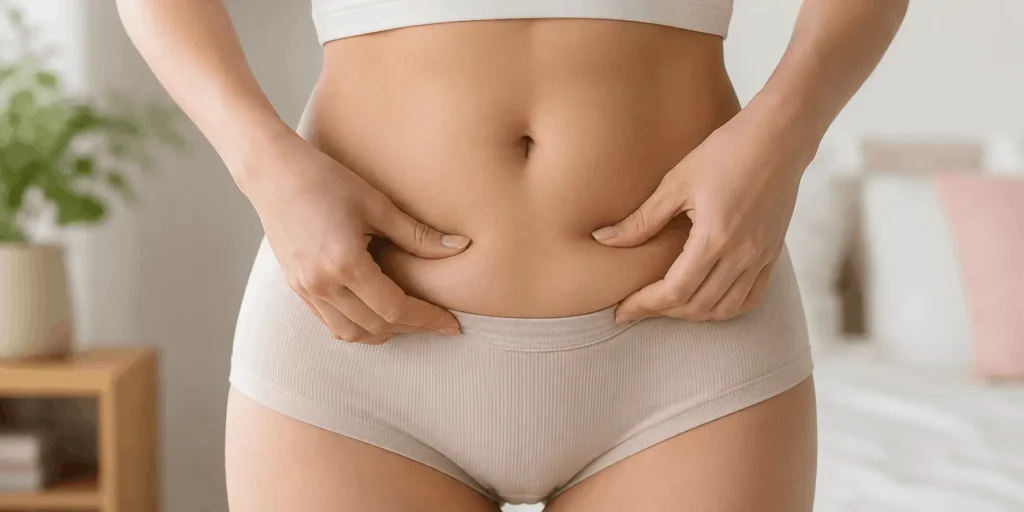
A noticeably large FUPA can be confusing. The fullness may come from body fat, loose skin or natural anatomy. Pregnancy, ageing and other changes in the lower abdomen can also affect its appearance.
“FUPA” is an informal term for fullness over the upper pubic area, not a medical diagnosis.
Its appearance varies greatly between people. Genetics, fat distribution, skin firmness and posture all play a part. Weight changes, menopause and C-section scarring can also affect the area. Our guide to what causes a FUPA covers each factor. The hormones and genetics guide explains the biological side. See a FUPA on a slim frame when body weight does not explain the fullness.
In many cases, the shape is a normal body variation and does not indicate poor health.
However, sudden swelling, pain, redness, a hard lump, or one-sided enlargement should not be ignored.
Understanding the likely cause is the first step toward choosing realistic, safe, and appropriate next steps.
“FUPA” is an informal acronym for “fat upper pubic area” or “fatty upper pubic area,” not a formal medical diagnosis. It usually describes visible fullness over the pubic bone, beneath the lower abdomen.
The anatomical structure in this location is the mons pubis, a mound containing fatty tissue that cushions the pubic bones.
Its size and shape naturally vary between people. However, people sometimes use “FUPA” loosely. They may mean fat, loose skin or an overhang across the mons pubis and lower abdomen.
It is not the vagina, bladder, or entire vulva, and appearance alone cannot identify the exact tissue involved.
A painful, firm, one-sided, or rapidly changing bulge should be medically evaluated rather than labelled as ordinary FUPA.
Pregnancy can make the upper pubic area look larger. The uterus expands and the abdominal wall stretches. Body fat also commonly increases to support pregnancy.
After birth, the skin, connective tissue, and abdominal muscles do not immediately return to their previous shape.
Diastasis recti means separation of the abdominal muscles. It can make the lower abdomen project forward. However, it is not the same as excess fat over the mons pubis.
After a caesarean birth, swelling and the position of the scar may temporarily or persistently change the contour where the abdomen meets the pubic area.
Recovery differs with genetics, number of pregnancies, weight changes, healing, and time since delivery. Persistent pain, redness, drainage, a firm lump, or sudden swelling requires medical assessment.
Significant weight loss can make the upper pubic area appear larger even as body size decreases.
Skin that has stretched over time may not fully contract after fat loss. Loose or folded tissue can remain around the lower abdomen and mons pubis.
The amount varies with age, genetics, duration of higher weight, total weight lost, and skin elasticity.
This fullness may be mostly skin, residual fat, or a combination of both, so further dieting does not always remove it.
Exercise can improve strength and body composition, but it cannot tighten substantial excess skin.
Ask a qualified clinician about chafing, rashes, discomfort or problems with washing and movement. They can assess whether supportive care or body-contouring surgery is appropriate.
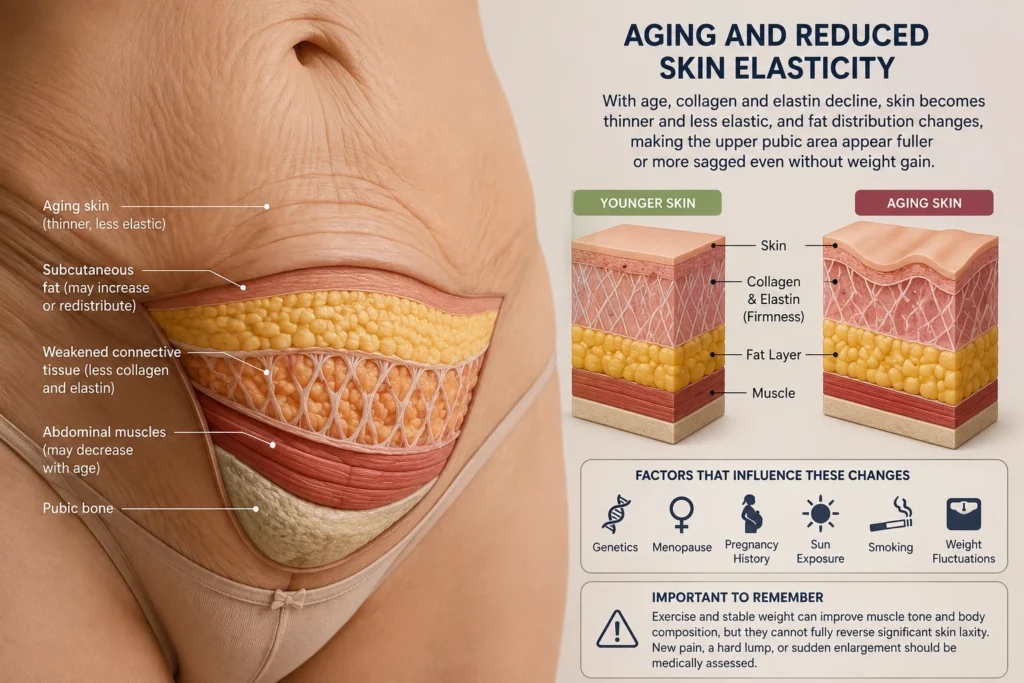
Aging can make the upper pubic area appear larger even without weight gain.
With age, skin becomes thinner and less elastic as collagen and elastin decline. Tissue around the lower abdomen and mons pubis may then sag or fold more visibly.
Body composition also changes. Muscle mass often decreases, while body fat levels and distribution can change. This can alter the shape of the abdomen and pubic region.
These changes vary widely and are influenced by genetics, menopause, pregnancy history, sun exposure, smoking, activity level, and previous weight fluctuations.
Exercise and stable weight can support muscle tone and body composition, but they cannot fully reverse substantial skin laxity. New pain, a hard lump, or sudden enlargement should be medically assessed.
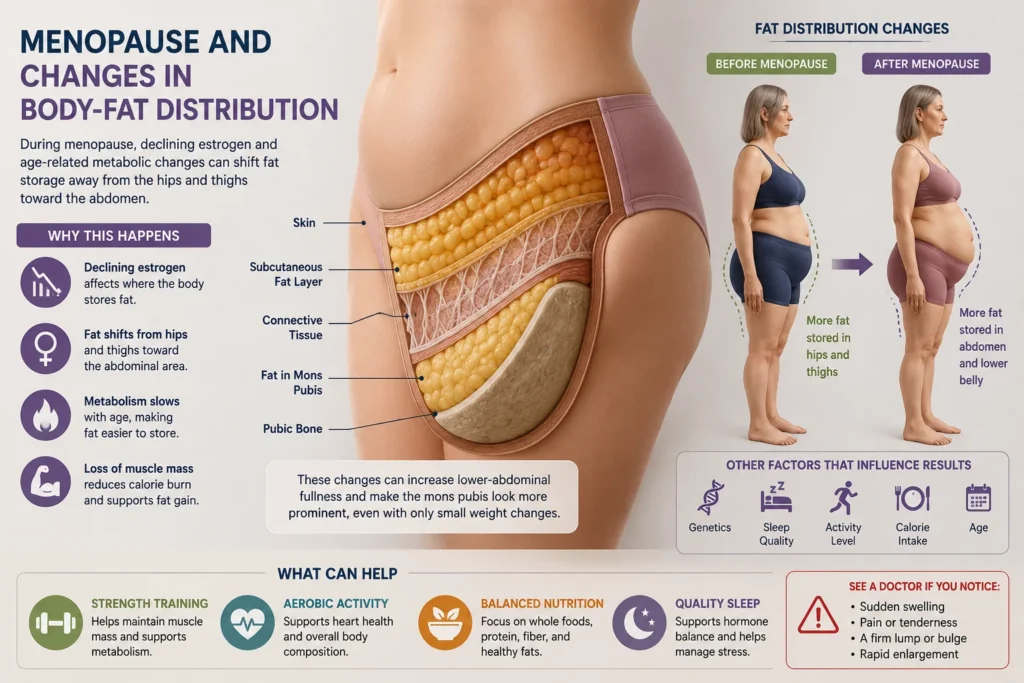
Menopause can make the upper pubic area appear fuller. However, it does not create a FUPA in everyone. Our guide to FUPA and the menopause explains the connection.
During menopause, oestrogen declines and metabolism changes with age. Fat storage can shift from the hips and thighs towards the abdomen.
This redistribution may increase lower-abdominal fullness and make the mons pubis look more prominent, even when body weight changes slightly.
Ageing, reduced muscle mass and disrupted sleep can also affect the result. Activity, genetics and calorie intake matter too. Menopause is not always the only cause.
Regular strength training, aerobic activity, balanced nutrition, and sleep can support body composition, although they cannot guarantee fat loss from one specific area.
Sudden swelling, pain, or a firm lump needs evaluation.
A C-section can change the contour where the lower abdomen meets the mons pubis, but the scar alone does not create a large FUPA.
During healing, scar tissue may attach to nearby skin and tissues. This can form an indented or tethered line. Skin or fat above it may then look more prominent.
Pregnancy-related stretching, residual abdominal fat, loose skin, and reduced muscle support often contribute more to the overhang than the incision itself.
Early postoperative swelling can temporarily enlarge the area and should improve.
The final appearance varies with healing, genetics, weight changes, and previous pregnancies.
Increasing pain, redness, warmth, discharge or fever need medical assessment. So do a growing lump and persistent swelling. These are more than concerns about appearance.
Posture and clothing can change how prominent the upper pubic area looks without changing the amount of fat or skin present.
An exaggerated forward pelvic tilt or increased lower-back curve may push the lower abdomen outward. This can make the mons pubis more noticeable from the side.
Returning to a neutral posture can improve alignment, but it will not remove fat or tighten loose skin.
Clothing can also alter the outline. Low-rise waistbands, tight seams, thin fabrics and undersized underwear may compress tissue and create a bulge.
Higher-rise, correctly fitted garments and structured fabrics may produce a smoother silhouette without changing anatomy.
Persistent pain, numbness, skin irritation, or pressure marks suggest the clothing is too restrictive and should not be ignored.
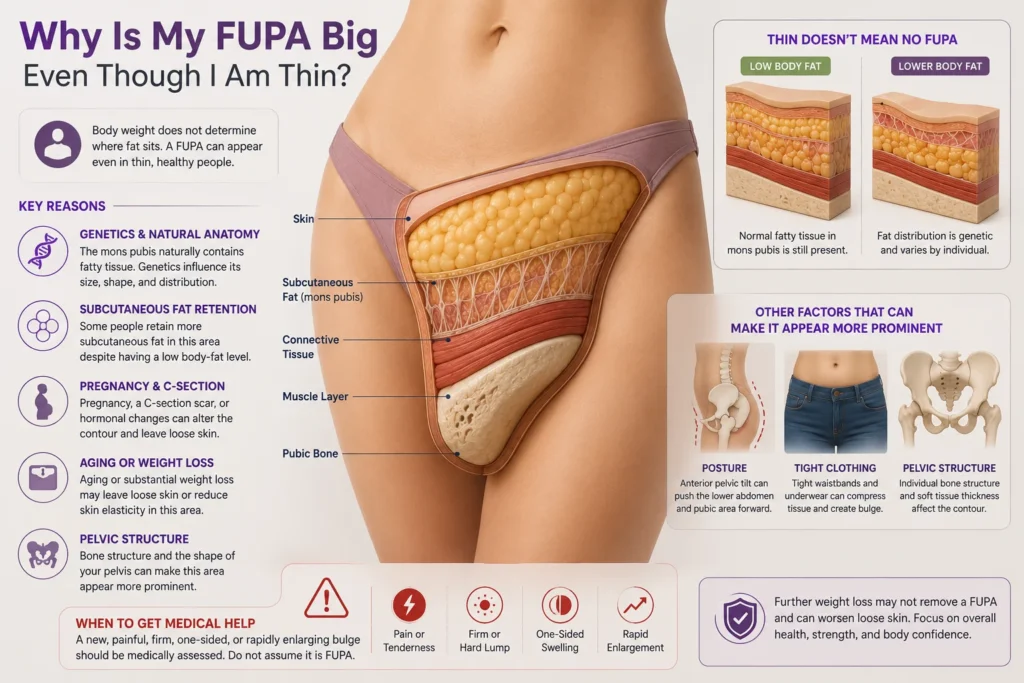
A FUPA can occur in a thin person because body weight does not determine where fat sits.
The mons pubis naturally contains fatty tissue, and genetics influence its size, shape, and distribution.
Some people retain more subcutaneous fat in this area despite having a low body-fat level.
Pregnancy, a C-section scar, ageing or major weight loss can affect this area. Loose skin or changes in contour may remain between the lower abdomen and pubic mound.
Pelvic structure, posture, and tight clothing can make normal tissue appear more prominent without increasing its size.
Further weight loss may not remove it and could worsen loose skin. A new, painful, firm, one-sided, or rapidly enlarging bulge should be medically assessed rather than automatically assumed to be FUPA.
A FUPA usually does not become substantially larger overnight because body fat accumulates gradually.
A sudden change may reflect temporary swelling, an injury or a new lump in the groin or pubic area. Changes after surgery or childbirth can also affect the area. Recent weight gain may contribute to fullness over time.
Hernias can create a bulge that becomes more noticeable when coughing, lifting, or standing and may shrink when lying down.
Infected hair follicles, cysts, abscesses or lymphatic swelling can also enlarge the area. They may cause tenderness, redness, warmth or skin changes.
Seek prompt medical assessment if the enlargement is painful, firm, one-sided or rapidly worsening. Fever, vomiting, drainage, trouble passing urine or severe abdominal pain also need prompt attention.
Do not assume every sudden pubic bulge is ordinary fat without examination.
A stable, soft upper-pubic fullness usually does not require medical treatment.
Arrange an assessment if the area enlarges suddenly, becomes painful, feels hard or fixed, appears mainly on one side, or continues changing without an obvious reason.
Seek care for redness, warmth, fever, drainage, broken skin, recurring rashes, or difficulty with hygiene, walking, urination, or sexual activity.
A bulge that becomes larger when coughing, lifting, or standing may be a hernia rather than fatty tissue.
Get urgent medical help for a painful groin bulge with severe abdominal pain or vomiting. A painful bulge that cannot be pushed back also needs urgent help. Trapped bowel is possible.
A clinician can examine the area, identify the cause, and recommend appropriate treatment instead of relying on appearance alone.
A large-looking FUPA may reflect natural anatomy, genes or weight changes. Pregnancy, menopause, ageing and loose skin can also play a part. Posture and tissue changes around a C-section scar may affect its appearance.
It does not automatically mean you are unhealthy or need to lose more weight.
Because targeted fat loss is not possible, extreme diets and exercises promising to remove fat from this area are misleading.
The most useful approach is to identify whether the fullness is fat, skin, swelling, or another type of bulge.
Seek medical advice if the area changes suddenly, becomes painful, feels hard, appears one-sided, or causes redness, fever, drainage, or urinary problems.