
FUPA Hormones and Genetics: Why It Runs in Families

Page Contents
- Oestrogen and gynoid fat distribution
- Which hormone drives which fat depot
- Why lower body fat is genuinely harder to shift
- The genetic component
- Stress, insulin and what they do not explain
- Across the life stages
- Thyroid and other medical factors
- Does ethnicity make a difference?
- Testosterone in Men: Why Age Alone Is Not the Full Story
- Hormonal Drivers Versus Lifestyle Drivers
- What this means practically
- When a hormone test is worth asking for
- Short-Term Hormone Swings Versus Long-Term Patterns
- What can change within days
- What changes over months and years
- How to judge progress fairly
- When to see your GP
- Frequently asked questions
- Is a FUPA caused by hormones or by weight?
- Can hormonal contraception cause or worsen it?
- Does a FUPA run in families?
- Will it get smaller after menopause?
- Do men have the same hormonal pattern?
- Why does my FUPA stay when everything else gets smaller?
- Can my period make my FUPA look bigger?
- When is the best time of the month to measure a FUPA?
A FUPA is one of the clearest everyday illustrations of something researchers have known for decades: where the body stores fat is decided largely by hormones and genetics, not by effort. Two people at the same weight, eating and training identically, can carry that weight in completely different places, and the mons pubis is one of the depots where that difference shows most plainly.
This guide covers the hormonal mechanisms, the genetic component, why lower body fat is biologically harder to shift, and what that means practically. For the broader picture, see our main causes guide.
Oestrogen and gynoid fat distribution
Oestrogen directs fat storage toward the hips, thighs and lower abdomen rather than the waist and internal organs, a pattern researchers call gynoid distribution. The mons pubis sits at the lower edge of that zone, which is why a FUPA tends to become established from puberty onward as oestrogen rises, and why it is generally more prominent in women.
The mechanism is not mysterious. Oestrogen influences the activity of lipoprotein lipase, the enzyme that determines how readily a fat cell takes up circulating fat, and it does so differently in different depots. Higher activity in the lower body means fat arriving in the bloodstream is preferentially stored there.
Which hormone drives which fat depot
| Hormone | Pushes fat toward | Typical context |
|---|---|---|
| Oestrogen | Hips, thighs, mons pubis | Puberty onward, pregnancy |
| Testosterone | Abdomen, viscera | Male pattern, falls with age |
| Cortisol | Abdomen and viscera | Chronic stress, poor sleep |
| Insulin | Abdomen and viscera | Insulin resistance, PCOS |
This table explains something people often find confusing: a FUPA and a growing waistline can move independently, because they are driven by different signals. If the waist is expanding while the mons stays much the same, cortisol and insulin are the more likely drivers, not oestrogen.
Why lower body fat is genuinely harder to shift
Fat cells release stored fat through receptors on their surface. Beta adrenergic receptors promote release; alpha-2 adrenergic receptors inhibit it. The proportion of the two varies by depot, and subcutaneous fat in the lower body carries a higher ratio of the inhibitory alpha-2 receptors than abdominal fat does.
The practical consequence is that when the body is in a calorie deficit and releasing fat, lower body stores including the mons pubis respond more slowly than abdominal stores. This is a real biological difference, not a failure of effort, and it is why a FUPA frequently remains visible on someone who has lost fat everywhere else.
Fat cell number matters too. Adipose tissue can expand by cells enlarging, called hypertrophy, or by producing more cells, called hyperplasia. Cell number established during childhood and adolescence stays broadly stable through adult life, which is part of why some people have a more prominent mons pubis at every weight they have ever been.
The genetic component
Twin and family studies put a substantial proportion of the variation in fat distribution down to heredity, independent of overall body fat. Genome-wide association studies have linked specific genes, among them KLF14, LRP5, TBX15 and RSPO3, to the balance between lower body and abdominal fat storage.
These are distinct from genes such as FTO, which influence appetite and total body fat rather than its distribution. That distinction matters: you can inherit a tendency toward a prominent mons pubis without inheriting any tendency toward a higher weight at all, which is exactly the experience of people who are lean everywhere else and still have one. Our guide to that covers it.
If your mother or grandmother carried weight in this pattern, the odds that you will are meaningfully higher, and no amount of training changes the distribution rule itself.
Stress, insulin and what they do not explain
Cortisol, released under sustained stress and poor sleep, and insulin resistance both drive fat toward the abdomen and around the organs rather than toward the mons pubis. Polycystic ovary syndrome, which involves insulin resistance and raised androgens, is associated with a more central pattern of fat storage rather than a more gynoid one.
This is worth knowing because stress and sleep advice is offered indiscriminately for every body composition question. It is good advice for health and for visceral fat. It is not a targeted lever for a FUPA.
Across the life stages
- Puberty. Rising oestrogen establishes the gynoid pattern, and the mons pubis develops as a distinct fat pad.
- Pregnancy. Oestrogen and progesterone rise substantially, adding hormonal fat storage in this area on top of the mechanical stretching from the growing uterus. Our postpartum guide covers what happens afterward.
- Hormonal contraception. Oestrogen containing methods may modestly influence distribution in some people, though individual variation is large and the evidence is mixed.
- Perimenopause and menopause. Falling oestrogen shifts storage away from gynoid areas and toward the abdomen. The mons may become softer or lower rather than larger, while the waist increases. Hormone replacement therapy has been shown to reduce post-menopausal abdominal fat gain, though it is prescribed for menopausal symptoms rather than for body composition. Our guide to FUPA and the menopause covers this transition on its own.
Thyroid and other medical factors
An underactive thyroid slows metabolic rate and can contribute to generalised weight gain, though it does not target this area specifically. Cushing’s syndrome, a rare condition involving very high cortisol, produces a distinctive central pattern. Some medications, including certain antidepressants, antipsychotics and corticosteroids, affect weight and distribution.
None of these are common explanations for a FUPA on their own. They are worth raising with a GP if the change has been rapid, is out of keeping with your eating and activity, or comes with other symptoms such as fatigue, cold intolerance or menstrual changes.
Does ethnicity make a difference?
Average fat distribution patterns do vary between population groups, and research on waist to hip ratio and gynoid fat finds real differences by ancestry alongside far larger variation between individuals of any background. The mechanisms are the same everywhere; what differs is the average setting, and individual variation swamps group averages in practice.
Testosterone in Men: Why Age Alone Is Not the Full Story
The table above lists testosterone as the male-pattern driver, but the mechanism is worth spelling out, because it explains why some men respond to weight loss alone and others need a GP. Falling testosterone shifts fat storage toward the abdomen and the mons pubis, and fat tissue then converts some of that testosterone into oestradiol via an enzyme called aromatase, which lowers testosterone further and reinforces the same storage pattern.
Age-related decline of roughly one per cent a year from the early thirties accounts for only part of this. In men without significant weight gain, testosterone typically holds up much better into later life, which means accumulated body fat itself is often doing more of the work than birthdays are. This is also why the pattern is frequently reversible: losing fat lowers aromatase activity and commonly raises testosterone without any medication at all.
Where testosterone has fallen enough to cause symptoms rather than just shift fat distribution, clinicians define it against a specific threshold rather than a vague sense of tiredness. Our guide to FUPA and testosterone covers the UK diagnostic threshold, the blood tests involved, and when TRT is and is not the right next step.
Hormonal Drivers Versus Lifestyle Drivers
| Type | Examples | Responds to Lifestyle Change? |
|---|---|---|
| Hormonal, fixed pattern | Oestrogen-driven gynoid storage, genetic predisposition (KLF14, LRP5, TBX15, RSPO3) | No, sets where fat goes rather than how much |
| Hormonal, reversible | Age-related and obesity-related low testosterone, insulin resistance | Often, via sustained weight loss |
| Lifestyle | Total calorie balance, alcohol intake, sleep quality, activity level | Yes, directly |
| Medical, needs a GP | Symptomatic hypogonadism, PCOS, thyroid dysfunction, Cushing’s syndrome | Needs diagnosis and treatment first |
Sorting a driver into the wrong column wastes effort. Chasing lifestyle fixes for a fixed hormonal or genetic pattern will not change where fat sits, and ignoring a reversible or medical driver means missing an intervention that would actually help.
What this means practically
Three things follow from all of the above. First, a FUPA is not evidence of anything you did. Second, targeted exercise cannot override a distribution rule set by hormones and genetics, because spot reduction is not how fat release works. Third, overall fat loss does still reduce the mons pubis, just more slowly and later than it reduces the waist, which is why patience matters more here than intensity.
Our reduction guide covers what genuinely helps, and the styling guide covers the immediate problem while the slow part happens.
When a hormone test is worth asking for
A prominent mons pubis on its own is not a reason for blood tests. It is normal anatomy shaped by normal hormones, and testing an otherwise well person usually finds nothing to act on.
It becomes reasonable to ask a GP when the change is out of keeping with everything else, or when other symptoms sit alongside it:
- Rapid change in body shape without a change in eating or activity.
- Periods that have become irregular, very heavy or have stopped.
- Persistent fatigue, cold intolerance, hair thinning or dry skin, which point toward thyroid function.
- Excess hair growth, acne or difficulty conceiving, which point toward PCOS.
- Symptoms of perimenopause alongside a clear change in where weight sits.
What a GP might check in those situations is thyroid function, and depending on the picture, markers relating to PCOS or to menopause. None of these tests are ordered to explain a FUPA. They are ordered to explain the symptoms around it, and the body shape change is one clue among several.
If the question behind the search is really whether any of this is normal, our guide to that answers it directly, and our guide for women covers how the hormonal picture plays out across a lifetime.
Short-Term Hormone Swings Versus Long-Term Patterns
What can change within days
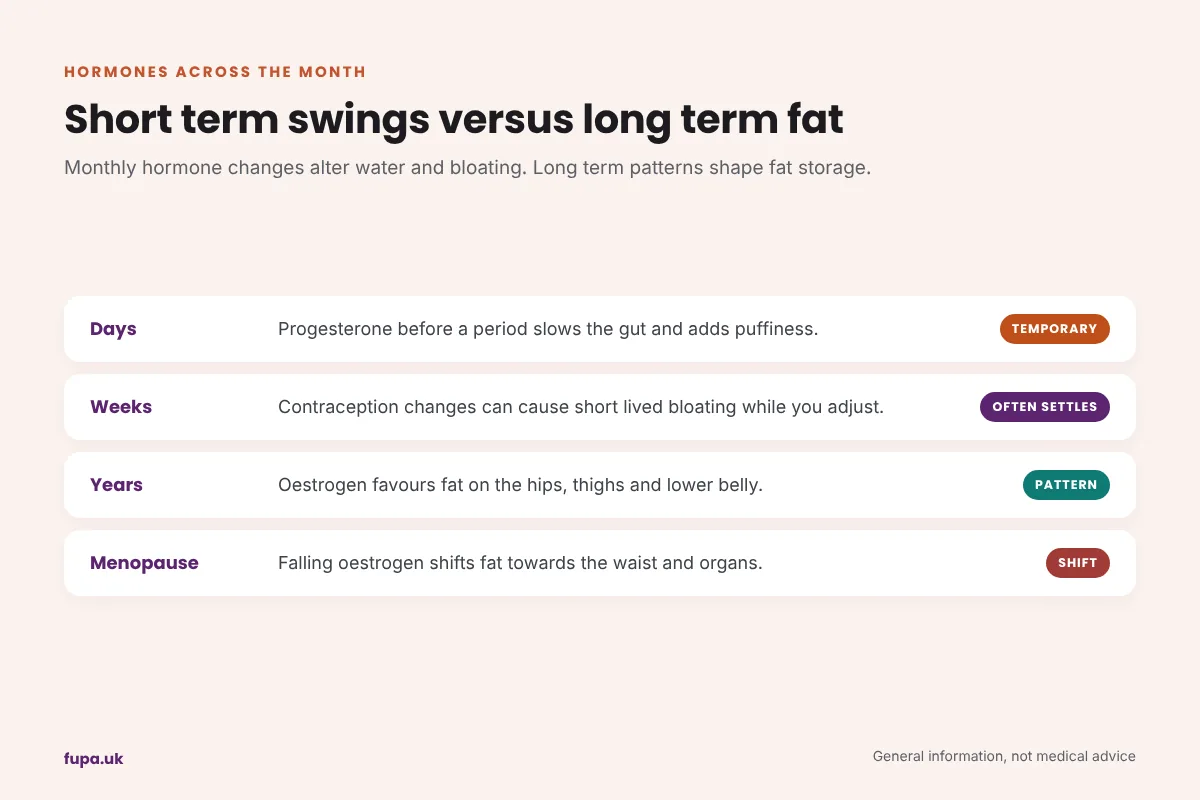
Hormones do not only shape where fat is stored over years. They also change how the lower belly looks from one week to the next. In the days before a period, progesterone can slow the gut and hormone shifts can increase water retention. The result is extra fullness and bloating that settles once a period starts.
What changes over months and years
Long-term hormone patterns work much more slowly. Oestrogen favours fat storage on the hips, thighs and lower abdomen during the reproductive years. Falling oestrogen around the menopause shifts more fat towards the waist. These patterns change the fat pad itself, not just how full it feels.
How to judge progress fairly
Because of these swings, a single measurement can mislead you. Measure the lower belly at the same point in each cycle, at the same time of day. Compare month to month rather than day to day.
For a closer look at these monthly changes, our guide to your FUPA and your menstrual cycle explains why it can look bigger before a period and what helps.
When to see your GP
Bloating that does not settle after a period, or that comes with pain, a change in bowel habit, weight loss or bleeding after sex, should be checked by your GP. Persistent bloating is not something to put down to hormones without a check.
Frequently asked questions
Is a FUPA caused by hormones or by weight?
Both. Hormones and genetics decide where fat is stored; overall weight decides how much there is to store. That is why a FUPA can persist at a low body weight and why it often runs in families.
Can hormonal contraception cause or worsen it?
Oestrogen containing methods may modestly favour gynoid fat storage in some people, but the effect is small and varies widely between individuals.
Does a FUPA run in families?
Yes. Fat distribution is substantially heritable, and genes including KLF14, LRP5, TBX15 and RSPO3 have been linked to lower body versus abdominal storage, separately from genes affecting overall weight.
Will it get smaller after menopause?
Often the mons becomes softer or lower rather than larger as oestrogen falls, while abdominal fat increases. Skin laxity also increases, which can change the shape more than the volume.
Do men have the same hormonal pattern?
No. Testosterone favours abdominal and visceral storage, which is why a FUPA is generally less prominent in men, though falling testosterone with age can make it more noticeable. Our guide for men covers it.
Why does my FUPA stay when everything else gets smaller?
Lower body subcutaneous fat carries a higher proportion of alpha-2 adrenergic receptors, which inhibit fat release. The tissue responds to a deficit more slowly than abdominal fat does, so it is usually the last to change rather than resistant to change.
Can my period make my FUPA look bigger?
Yes, for a few days. Hormone changes before a period can cause bloating, water retention and a slower gut, which add fullness to the lower belly. This usually eases once bleeding starts. The fat pad itself does not grow during this time.
When is the best time of the month to measure a FUPA?
Choose the same point in each cycle, such as the week after your period ends, and measure at the same time of day. This avoids premenstrual bloating making it look as if you have gained fat.