
FUPA Surgery Before and After: What Changes to Expect

Page Contents
- The result depends on the starting point, not the procedure
- Three starting points, three different outcomes
- Fat dominant cases: what liposuction changes
- A flatter profile that emerges slowly
- Fat and skin cases: what monsplasty changes
- Profile, overhang and a permanent scar
- The functional change photographs miss
- Combined with a tummy tuck
- The biggest change and the longest recovery
- A realistic timeline
- Stage by stage across the three procedures
- Week-by-week swelling and shape timeline
- How to read a surgeon’s before and after photographs
- Seven features a useful FUPA surgery before and after comparison needs
- Red flags in a gallery
- What the photographs never show
- The parts of recovery that stay off camera
- Scar position and how it fades
- Documenting your own progress
- Start before the operation
- What to measure and photograph
- What can limit or change the result
- Five things that can alter the outcome
- The adjustment period nobody photographs
- The early dip
- When to speak to a GP
- Photographs as one part of choosing a surgeon
- Checks that matter more than a gallery
- Before and after without surgery
- Fat loss as its own before and after
- Devices, appearance and budget
- Frequently asked questions
- Why do before and after photos look better than what I might get?
- How long until I see my own final result?
- Will the scar be visible in normal clothing?
- Can I ask to see photos of patients similar to me?
- Does age affect the result?
- Is it normal to feel disappointed in the first few weeks?
Searching for FUPA surgery before and after photographs usually means one question: what will I actually look like. This page does not host clinic marketing images, because they are selected, lit and posed to sell a procedure and they tell you very little about your own likely outcome. What it does instead is set out what genuinely changes with each procedure, on what timeline, how to read a surgeon’s photographs properly, and how to document your own progress so you can judge the result fairly.
Our surgery guide covers the procedures in full, and the monsplasty and liposuction guides go into each individually.
This page is general information, not medical advice. Individual results vary and only a surgeon who has examined you can set realistic expectations for your case.
The result depends on the starting point, not the procedure
The most common mistake when looking at before and after images is comparing procedures rather than starting points. The same operation produces completely different visible changes depending on whether the FUPA was mostly fat with elastic skin, or mostly loose skin after weight loss or pregnancy.

Three starting points, three different outcomes
| Starting point | Usual procedure | What visibly changes | Scar |
|---|---|---|---|
| Fat, skin still elastic | Mons liposuction | Flatter, less projecting profile | Two small nicks |
| Fat plus loose skin | Monsplasty | Flatter profile, overhang removed, area lifted | Low horizontal line |
| Loose skin across the whole abdomen | Abdominoplasty with mons lift | Whole lower abdomen reshaped | Hip to hip |
Skin quality decides which row you sit in. After a large weight loss the skin rarely springs back, which is why a FUPA after weight loss is usually steered towards skin excision.
Fat dominant cases: what liposuction changes
A flatter profile that emerges slowly
Where the mons pubis was mostly fat and the skin retracts well, liposuction produces a flatter, more defined contour that emerges as swelling resolves across two to three months. Because skin was never the problem, this tends to be the most consistently satisfying category of result. The change is usually described as subtle by other people and obvious to the person themselves, which is worth knowing before expecting anyone to comment.
NHS guidance on liposuction recovery describes a compression garment for several weeks, numbness settling within six to eight weeks, and swelling that can take up to six months to clear. The mons is small, so most people see their shape sooner, but six months is the honest outer limit.
Fat and skin cases: what monsplasty changes
Profile, overhang and a permanent scar
Here the visible difference includes both a flatter profile and the removal of an overhang, set against a permanent scar. The scar is positioned low enough to sit under most underwear, and it is red or pink for several months before fading over a year or more.
The functional change photographs miss
People in this group tend to report the largest functional improvement rather than purely aesthetic: clothing fits differently, waistbands stop cutting in, and skin irritation in the fold usually resolves. That functional change is rarely visible in a photograph, which is part of why photographs alone are a poor way to evaluate the procedure.
Combined with a tummy tuck
The biggest change and the longest recovery
When a mons lift is carried out alongside a full abdominoplasty, the change extends up the abdomen, which is why these are the most dramatic before and after pairs in any clinic gallery. They also come with the longest recovery and the largest scar, and they are usually performed on people whose starting point involved substantial weight loss or several pregnancies. Our tummy tuck guide covers when that is the right conversation.
The NHS tummy tuck page advises four to six weeks off work and exercise, a pressure garment for around six weeks, and a scar that fades over twelve to eighteen months. It also lists lasting numbness, fluid above the scar and the chance of a second operation. Our guide to FUPA surgery risks covers each in turn.
A realistic timeline
Stage by stage across the three procedures
| Stage | Liposuction | Monsplasty | Abdominoplasty |
|---|---|---|---|
| Peak swelling | Days 2 to 4 | Days 2 to 5 | Days 3 to 7 |
| Looks worse than before | Weeks 1 to 3 | Weeks 1 to 4 | Weeks 1 to 6 |
| First clear improvement | Around week 6 | Weeks 6 to 8 | Weeks 8 to 12 |
| Final shape | Around 3 months | Around 6 months | 6 months plus |
| Scar mature | Not applicable | 12 to 18 months | Up to 24 months |
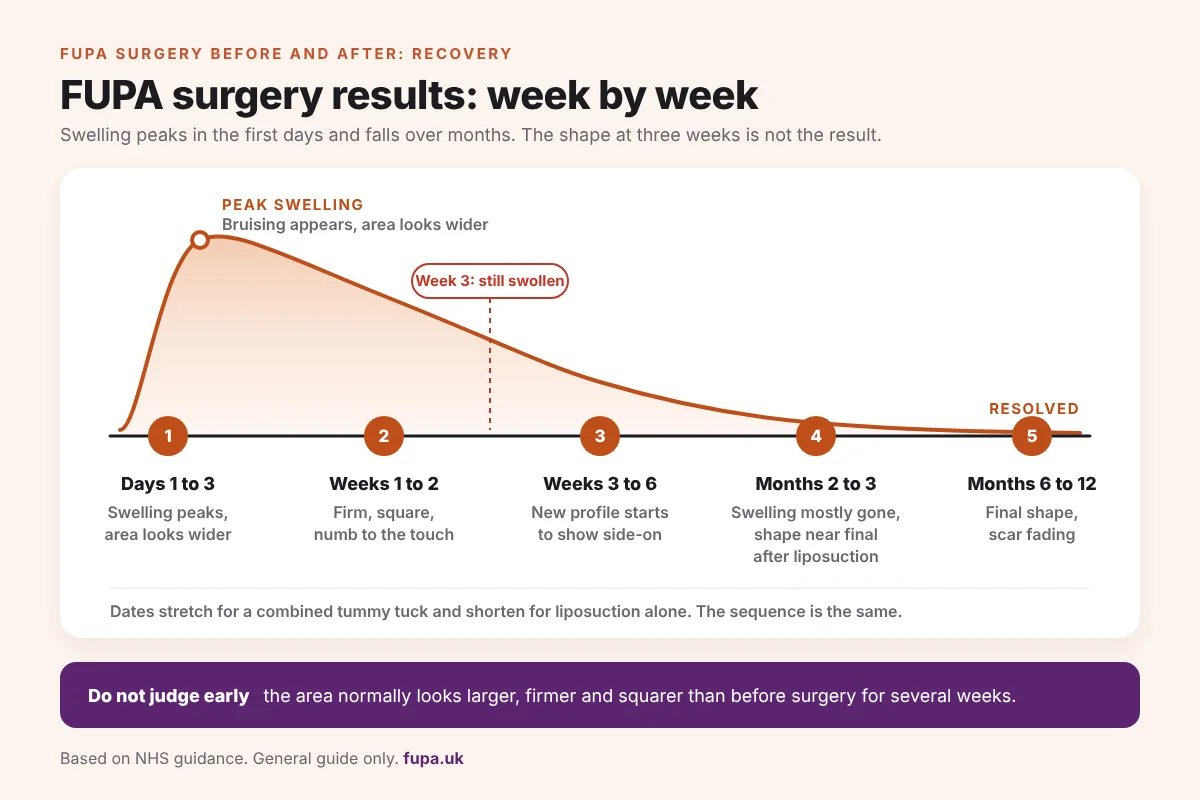
The row worth dwelling on is the second. It is normal for the area to look larger, firmer and squarer than it did before surgery for several weeks. Judging the outcome at three weeks is the single most common cause of unnecessary distress after this operation.
Week-by-week swelling and shape timeline
| Period | Swelling | What the shape looks like | What you will usually be doing |
|---|---|---|---|
| Days 1 to 3 | Rising to its peak, bruising appears | Puffy, tight, often wider than before | Resting, short indoor walks, garment on |
| Weeks 1 to 2 | High, starting to soften | Firm, square, numb to the touch | Stitches checked, light activity, garment on |
| Weeks 3 to 6 | Falling steadily, firm patches remain | New profile starts to show side-on | Desk work, gentle exercise from about week four |
| Months 2 to 3 | Mostly gone, evening tightness | Near final after liposuction, still refining after excision | Garment finished, normal exercise returning |
| Months 6 to 12 | Resolved | Final shape, scar fading from red to pale | Full activity, scar care and sun protection |
How to read a surgeon’s before and after photographs
Seven features a useful FUPA surgery before and after comparison needs
Useful photographs share a set of features. Missing any of them makes a comparison unreliable.
- Identical angle and distance. A camera moved slightly closer flattens or exaggerates a profile.
- Identical lighting. Overhead light creates shadow under a curve. Front light removes it. That alone can fake a result.
- Identical posture. Weight on both feet, arms in the same place, pelvis in a neutral tilt rather than tucked.
- Same underwear, or none. A different waistband height changes the apparent shape completely.
- A stated interval. A photograph at six weeks and one at twelve months are different claims.
- Several patients, not one. A gallery with a single case is a selected best result.
- A comparable starting point. Ask specifically to see patients whose anatomy resembled yours.
It is entirely reasonable to ask a surgeon for photographs of a patient whose starting point looked like yours, and a reasonable surgeon will expect the question.
Red flags in a gallery
Three things should make you cautious: skin that looks smoother or paler in the after image, which usually means editing; an after photograph with no date, since early swelling can briefly flatter a contour; and a slouched before image next to an after image standing tall. None proves dishonesty, but each is a reason to ask for the unedited originals and the timing.

What the photographs never show
The parts of recovery that stay off camera
Numbness across the treated skin, which can last months. The firmness of healing tissue under the hand. A seroma being drained at week three. The scar at its reddest. The weeks of compression garments. None of this appears in a gallery, and all of it is part of the actual before and after experience.
Scar position and how it fades
A monsplasty scar runs horizontally across the top of the mons, usually in the natural crease where the lower abdomen meets the pubic area, so standard underwear covers it. With an abdominoplasty, the line continues towards each hip. Galleries show the scar hidden or at the pale, flat stage many months later. The in-between stage is raised, pink or red, and sometimes itchy. NHS advice is that scars fade and flatten over up to two years, and should be kept out of the sun for at least a year, with SPF 30 or higher when exposed. Gentle massage once the wound has closed, and silicone gels from a pharmacist, are the usual measures. Ask to see a scar at three months as well as at eighteen.
Documenting your own progress
Start before the operation
Take your own photographs before surgery, because memory of the starting point fades faster than you would expect and people routinely conclude that nothing changed when a great deal did.
Use the same spot, the same time of day, the same light, the same underwear and the same three angles: front, side and three quarter. Stand naturally rather than sucking in. Repeat at two weeks, six weeks, three months and six months. Photographing at the same point in your cycle removes another source of variation, since fluid retention changes the lower abdomen noticeably.
What to measure and photograph
- Front, side and three quarter photographs, phone propped at hip height in the same place each time.
- A tape reading around the lower abdomen at the level of the pubic bone, snug but not pulled tight.
- A second reading across the hips, so you can tell a local change from general weight shift.
- Your weight on the same scales at the same time of morning, since a two kilogram swing is visible on its own.
- A one line note on how the area feels: numb, tight, sore or normal.
What can limit or change the result
Five things that can alter the outcome
- Weight gain. Remaining fat cells still enlarge, so the area can become fuller again.
- Pregnancy. Stretches repaired tissue and can undo a skin excision result entirely.
- Smoking. Slows healing and worsens scarring.
- Skin quality. Age, sun damage and previous stretching all limit how well skin retracts after liposuction.
- Expectations set from other people’s photographs rather than your own anatomy.
The adjustment period nobody photographs
The early dip
Feeling flat, tearful or oddly disappointed in the first fortnight is common after cosmetic surgery, and it is usually a combination of anaesthetic, disrupted sleep, swelling and the gap between expectation and the early result. It generally lifts as swelling falls.
When to speak to a GP
If dissatisfaction with the area was severe enough to dominate daily life before surgery, that rarely resolves through the operation alone, and a good surgeon will raise it during assessment. Talking to a GP about it is a reasonable step rather than an overreaction.
Photographs as one part of choosing a surgeon
Checks that matter more than a gallery
Check the GMC specialist register, confirm the clinic’s Care Quality Commission registration in England, ask how many of this exact procedure the surgeon performs each year, and, if you can, speak to a former patient. Photographs support that picture. They do not replace it. Our guide to choosing a FUPA surgeon turns those checks into questions to take to a consultation.
The same checks matter twice over if you are tempted by a package deal overseas. Our guide to FUPA surgery abroad vs the UK sets out what Turkish quotes leave out, when it is safe to fly home and who treats complications once you are back.
Before and after without surgery
Fat loss as its own before and after
Worth saying plainly, because the comparison is rarely offered: a sustained fat loss phase produces its own before and after on a FUPA, with no scar, no anaesthetic and no cost. It is slower, less predictable in where the change lands, and it does nothing for loose skin, but for a fat dominant FUPA it can reach a similar endpoint. Our reduction guide covers what actually works and over what timescale.
Devices, appearance and budget
Non-surgical devices sit between the two, with a smaller and less certain change than surgery. Our guide to those covers what the published evidence supports, which is less than most clinic galleries imply. If you are not yet sure whether your own FUPA is fat dominant or skin dominant, the appearance guide explains how to tell, and that single fact predicts your result more than any other.
Budget is the other half of the decision, and our cost guide sets the surgical and non-surgical totals side by side.
Frequently asked questions
Why do before and after photos look better than what I might get?
Clinics select their best cases, and lighting, angle and posture can exaggerate a difference substantially. Treat a gallery as a starting point for questions rather than a prediction.
How long until I see my own final result?
Around three months after mons liposuction, and closer to six months after monsplasty or a combined tummy tuck, once swelling has settled and the scar has begun to mature.
Will the scar be visible in normal clothing?
A monsplasty scar is positioned to sit under standard underwear. It can show in very low cut swimwear, and it is more noticeable during the first months while it is still red.
Can I ask to see photos of patients similar to me?
Yes, and you should. A flattering result on someone with elastic skin tells you nothing useful if your own FUPA involves significant skin laxity.
Does age affect the result?
Indirectly. Skin elasticity falls with age, which affects how well skin retracts after liposuction. It is one of the factors that pushes a recommendation toward skin excision instead.
Is it normal to feel disappointed in the first few weeks?
Very. Swelling makes the area look larger and firmer than before surgery for several weeks, and most surgeons advise against judging anything until at least six to eight weeks have passed.