
FUPA vs Gunt: What’s the Difference?
Page Contents
- The two terms compared
- Where the term “gunt” came from
- The anatomical difference
- Why the two get confused
- Tone and how each term is received
- Do the causes differ?
- Does the clinical approach differ?
- What actually helps, regardless of which term you use
- Which one are you actually looking at?
- Gunt vs a beer belly
- Dressing for Either Shape
- The same rules work for both
- Waistbands that sit above the fullest point
- Where a belt helps and where it does not
- Fabrics and hems
- Frequently asked questions
- Is a gunt the same thing as a FUPA?
- Which term is ruder?
- Why does this site use FUPA instead of gunt?
- Can you have a FUPA without a gunt?
- Do doctors use either of these terms?
- Does treatment differ between the two?
- Do the same clothes work for a gunt and a FUPA?
These two slang terms are often used interchangeably online, but they describe overlapping rather than identical areas, and one is considerably cruder than the other. This guide covers exactly what each term refers to, where the boundary between them sits, and why the distinction matters if you are trying to understand what your own body is actually doing.
For the FUPA side specifically, see our main guide and our guide to the term’s meaning and history.
The two terms compared
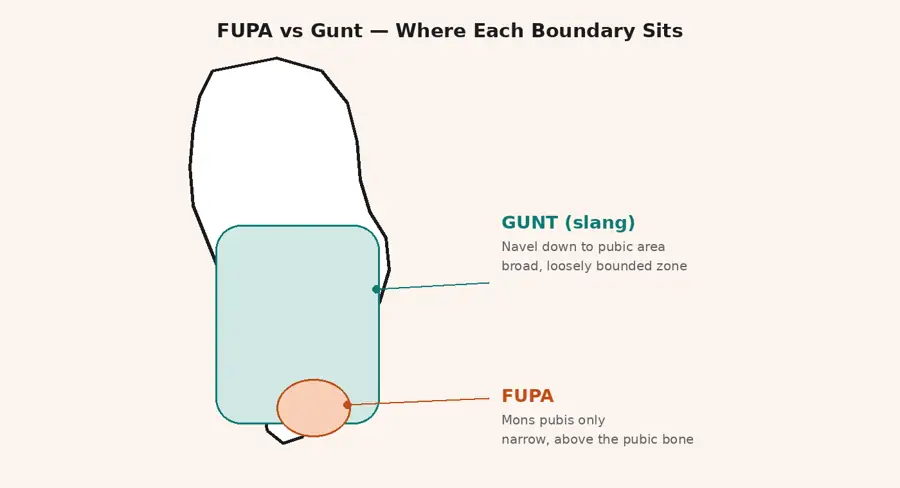
FUPA refers specifically to fat sitting on the mons pubis, the area directly above the pubic bone. “Gunt” refers to a somewhat larger, less precisely bounded area that extends from roughly the navel down to the pubic area, effectively combining the lower belly with the FUPA area into one region. In practice, FUPA is the narrower, more specific term, and gunt is the broader, less anatomically precise one that can include FUPA as part of what it describes.
| FUPA | Gunt | |
|---|---|---|
| Area described | Mons pubis only, above the pubic bone | Navel down to the pubic area, loosely bounded |
| Anatomical precision | Maps to a real structure | None, it is a coined blend |
| Clinical equivalent | Mons pubis, suprapubic fat pad | No equivalent term |
| Tone | Neutral to mildly crude, often self applied | Consistently mocking, rarely self applied |
| Usual cause | Genetics, oestrogen, pregnancy, weight | General lower abdominal weight gain |
| Used by clinicians | No, but understood | No |
Where the term “gunt” came from
Gunt is a portmanteau of “gut” and a vulgar slang word for female genitalia, and it first appeared in online slang and internet forums in the early 2000s, slightly earlier than the mainstream spread of FUPA. From its earliest recorded uses, it was explicitly mocking, typically describing an overweight woman’s midsection in a deliberately crude and unflattering way, and it has never been meaningfully softened or reclaimed the way FUPA has been in more recent years. Because of this, gunt is generally considered a cruder, more overtly derogatory term than FUPA, even though both originated as unflattering internet slang.
Body-shape terminology has proliferated well beyond these two words, and most of the newer coinages follow the same pattern: a vague, often unflattering label attached to a region that has no single agreed boundary. “Dad bod,” “muffin top,” and “love handles” all work the same way, describing a general impression rather than a specific structure, which is part of why arguments about which term applies to which body inevitably go in circles. Anchoring any of these descriptions to an actual anatomical landmark, the pubic bone, the navel, the iliac crest, is the only way to make the comparison meaningful rather than a matter of opinion.
The anatomical difference
FUPA has a fairly specific anatomical reference point: it describes fat sitting directly over the pubic symphysis, bounded roughly by the pubic hairline above and the top of the genitals below. Gunt is defined far more loosely, typically as the area between the navel and the pubic region, which spans the lower abdomen as well as the mons pubis. This means gunt effectively describes a combination of lower abdominal fat and FUPA together, rather than a single, distinct fat pad. Someone can have a FUPA without what most definitions of gunt would describe, if their lower abdomen above it is flat, but it is difficult to have a pronounced gunt without also having some fullness in the FUPA area specifically, since the terms overlap at that lower boundary.
Why the two get confused
Because gunt’s boundary includes the FUPA area, and because both terms describe fat in the general vicinity of the lower torso, people often use them as if they were synonyms, especially in casual or joking contexts online. The confusion is made worse by the fact that neither term has a firm clinical definition the way “mons pubis” or “panniculus” do, so their exact boundaries depend on whoever happens to be using them at the time. In practice, most people using either term loosely mean roughly the same thing: visible fullness across the lower abdomen and pubic area, without much concern for where a precise anatomical line would fall.
Tone and how each term is received
FUPA has moved, unevenly, toward more neutral or even self-deprecating use over the past decade, particularly on platforms like TikTok and Instagram, and it is now the term used in most clinical marketing and body-positive content on this exact topic. Gunt has not undergone the same shift. It remains more consistently used as an insult or as deliberately crude humour, including in some well-documented cases aimed at specific public figures, and is less likely to appear in body-positive or self-affirming contexts than FUPA. This is the main practical reason this site, and most similar resources, default to using FUPA rather than gunt when discussing this area: it is the less crude of the two terms in current use, even though its own origins were also unflattering.
Do the causes differ?
Not meaningfully. Whatever term is used, the underlying biology is the same: genetics and hormones, particularly oestrogen, largely decide how much fat is stored in the lower abdomen and mons pubis area, covered in more detail in our guide to hormones and genetics. Because gunt describes a larger combined area, a pronounced gunt by most informal definitions usually reflects a somewhat greater overall degree of lower-abdominal and mons fat than a FUPA alone would, but it is a difference of extent and area covered rather than a different underlying cause.
Does the clinical approach differ?
No, because neither term is a clinical one. A doctor or surgeon assessing this area works from the actual anatomy present, typically describing it in terms of mons pubis fat, lower abdominal fat, skin laxity, and muscle separation, rather than adopting either slang term. If someone requests treatment for what they call their “gunt,” a surgeon will still need to assess how much of that description is mons pubis fat specifically, how much is lower abdominal fat, and whether any skin overhang is present, since these different components would be addressed differently; see our surgery guide for how that assessment typically works.
What actually helps, regardless of which term you use
Since both terms ultimately describe fat storage in the lower torso, the practical guidance is the same either way. Overall fat loss reduces the total volume proportionally, though not necessarily at an even rate across the whole area; see our reduction guide. Clothing and styling choices that work with a high waistline and structured fabric, covered in our styling guide, address the visual appearance of both the lower abdomen and the FUPA area together. Surgical options differ depending on which specific component, fat, skin, or muscle, is actually present, which is why an accurate description of what is actually there matters more than which slang term was used to describe it.
Which one are you actually looking at?
The distinction is easier to settle on your own body than in a definition. Stand side on to a mirror and find the firm ridge of the pubic bone with your fingers.
- If the fullness sits above that ridge and below the navel, contained between the two groin creases, that is the mons pubis. It is a FUPA in the strict sense.
- If the fullness begins higher, around or above the navel, and continues down as one continuous curve, that is general lower abdominal fat. Slang calls it a gunt; there is no clinical name for it because it is not a distinct structure.
- If there is a fold of skin that hangs over the pubic area from higher up, that is a panniculus, and it is a third thing again. Our apron belly comparison covers it.
The reason this matters is practical rather than pedantic. A discrete mons pubis fat pad can persist on a lean body and often responds slowly, because lower body subcutaneous fat is biologically more resistant to release. General lower abdominal fat usually reduces in step with overall fat loss. Same effort, different timelines, and knowing which you have prevents a lot of unnecessary frustration.
Our appearance guide goes through the variations in more detail, and the full comparison guide sets every type of lower belly fat side by side.
Gunt vs a beer belly
A beer belly is a third term worth separating from both of these, since it points to a different part of the torso entirely. Where gunt and FUPA both sit low, on and below the navel, a beer belly describes fat higher up, filling the upper abdomen around and above the navel and pushing outward from behind the muscle wall rather than sitting just under the skin.
The composition differs too. A beer belly is largely visceral fat, wrapped around the organs, which is why it tends to feel firm and resistant to a pinch. Gunt and FUPA are both mostly subcutaneous fat, the soft, pinchable layer that sits closer to the surface, which is one reason diet alone reshapes a beer belly faster than it reshapes either of the lower two.
Men over forty often carry a firm upper belly and a softer lower gunt or FUPA at the same time, since the two zones develop somewhat independently. Our full FUPA vs beer belly comparison covers the anatomy, causes and a simple home pinch test for telling the two areas apart.
Dressing for Either Shape
The same rules work for both
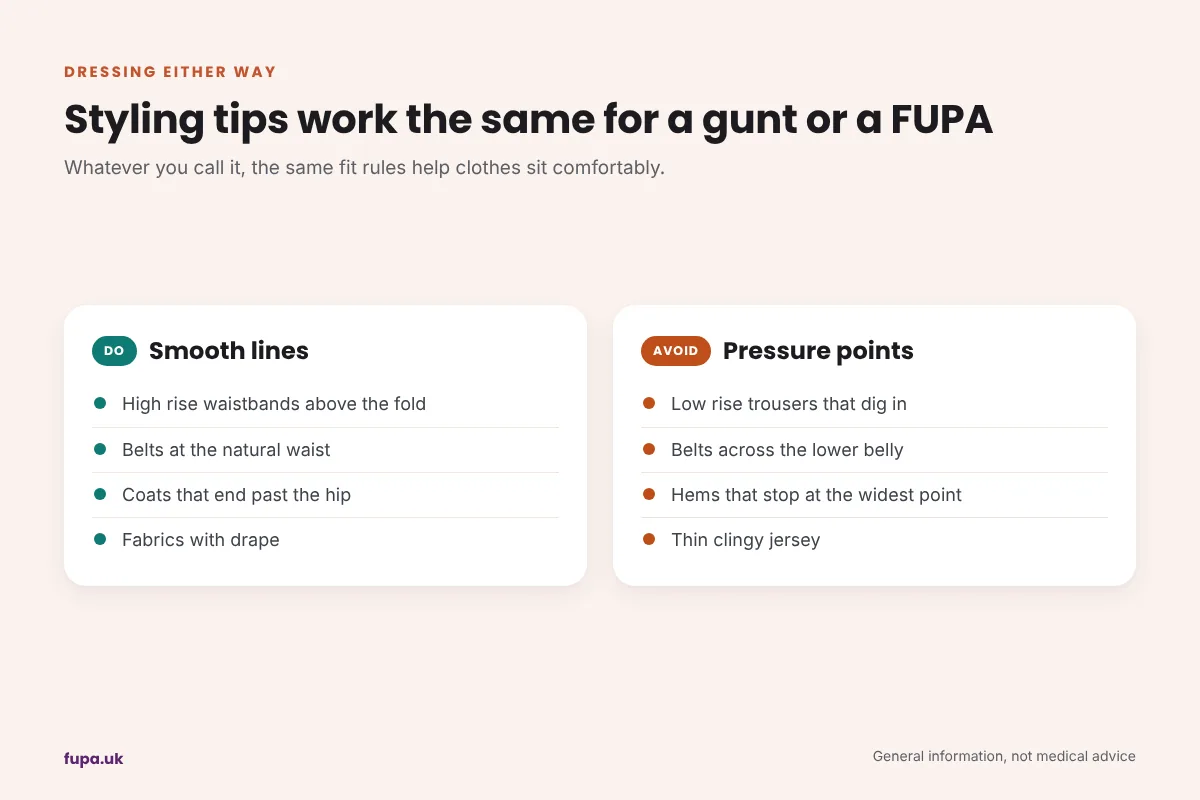
Whether you call it a gunt or a FUPA, the styling problem is the same. A line drawn across the fullest part of the lower belly draws the eye to it. Clothes that skim past that point, or hold it smoothly, make it less obvious.
Waistbands that sit above the fullest point
Mid and low rise waistbands tend to land on the lower belly and create a fold. A high rise waistband sits above it and smooths the line. A wider, soft waistband also spreads pressure and is less likely to roll down.
Where a belt helps and where it does not
A belt worn at the natural waist defines your shape above the lower belly. A belt worn low on the hips does the opposite and frames the widest part. Medium width belts are the most flexible choice for most outfits.
Fabrics and hems
Thin, clingy jersey shows every contour. Ponte, crepe and heavier cotton skim the body instead. Tops and coats that end past the hip, rather than at it, avoid drawing another line across the area.
Frequently asked questions
Is a gunt the same thing as a FUPA?
Not exactly. Gunt describes a broader area from roughly the navel to the pubic region, while FUPA refers specifically to fat on the mons pubis. Gunt effectively includes the FUPA area as part of a larger region.
Which term is ruder?
Gunt is generally considered the cruder and more consistently derogatory of the two terms, since it has never been meaningfully softened the way FUPA has in more recent, casual use.
Why does this site use FUPA instead of gunt?
FUPA is the more widely used, less crude term in current search and social media use, and it is closer to the clinical anatomy this site focuses on.
Can you have a FUPA without a gunt?
Yes. If the lower abdomen above the pubic area is relatively flat, someone can have a noticeable FUPA without the broader lower-abdominal fullness that most definitions of gunt describe.
Do doctors use either of these terms?
No. Clinicians describe the actual anatomy present, such as mons pubis fat, abdominal fat, or a panniculus, rather than using either slang term.
Does treatment differ between the two?
Treatment depends on the specific tissue present, fat, skin, or muscle, and where it sits, rather than on which slang term someone used to describe the area beforehand.
Do the same clothes work for a gunt and a FUPA?
Yes. Both describe fullness on the lower belly, so the same fixes help: high rise waistbands, belts at the natural waist rather than the hips, smooth mid weight fabrics and hems that fall past the hip.