
FUPA Meaning and Slang: Where the Term Actually Came From
Page Contents
- What FUPA stands for
- Where the term came from
- From insult to reclaimed word
- The clinical vocabulary
- Related slang, and what each one actually means
- British and American usage
- Which word to use where
- Talking to a doctor about it
- Should you ever say FUPA?
- Why the word gets in the way of good information
- From the Word to Useful Next Steps
- Choosing the right word for the setting
- If you want to reduce it
- If you want to dress around it
- If you want medical advice
- Frequently asked questions
- Is FUPA a rude word?
- What does FUPA actually stand for?
- When did FUPA become a popular term?
- Is there a more polite way to refer to the mons pubis area?
- Is FUPA the same as an apron belly?
- Why do some people find the term offensive?
- How is FUPA pronounced?
- What is the medical term for a FUPA?
- Is the word FUPA used in the UK?
FUPA is one of those internet acronyms almost everyone recognises and very few people can explain, partly because its origin is cruder than the version most publications now use. This page covers where the word came from, how its meaning and tone have shifted, how it relates to the clinical vocabulary, and which term is worth using in which setting.
If you want the anatomy and the causes rather than the word history, the main guide covers those in full. If the focus is on tone and etiquette rather than origin, our guide to whether the word is offensive works through that in detail.
What FUPA stands for
The version used across this site, and the one most publications now prefer, is fat upper pubic area, describing fat sitting on the mons pubis above the pubic bone. The original acronym as it first circulated online was cruder, using a vulgar word for female genitalia in place of pubic area. Both readings are still in use depending on where you meet the term, though the sanitised one has largely taken over in mainstream and editorial use.
It is pronounced as a word rather than spelled out, roughly foo-pah, which is part of why it reads as slang rather than as a medical abbreviation. The plural, where anyone needs one, is FUPAs.
Each letter of the sanitised acronym points at something specific. F names the fat itself, U places it upper, P narrows the region to pubic, and A gives you the area as a whole. Losing any one letter changes what the word describes, which is partly why the acronym has outlived looser slang from the same era.

Where the term came from
The acronym traces to early 2000s internet slang, appearing on message boards and user-submitted slang dictionaries from around 2005 with a distinctly mocking tone. It was typically used to describe a bulge visible through fitted clothing, and it was an insult rather than a description.
It stayed in fairly niche corners of the internet for most of a decade before meme culture carried it into wider circulation through the 2010s. By the late 2010s it was appearing in mainstream lifestyle publications, and by the 2020s in body positive and postpartum communities where people used it about themselves without embarrassment.
The route the word travelled mattered as much as the word itself. Because it moved from hostile forums to comedy scripts to Instagram captions, it collected new users at each stop who had never used it as an insult, which is how a jibe ends up as a caption on a body-positive post.
| Period | How the term was used |
|---|---|
| Mid 2000s | Message board slang, almost entirely as an insult |
| 2010s | Meme and self deprecating humour, wider circulation |
| Late 2010s | Mainstream lifestyle coverage, sanitised expansion adopted |
| 2020s | Neutral and reclaimed use, particularly in postpartum communities |
From insult to reclaimed word
The shift in tone is real but incomplete. Plenty of people now use FUPA about their own bodies matter of factly, in the same way other once-pejorative body words have been reclaimed. Equally, it can still land as body shaming depending on who says it, about whom, and in what tone. A word that started as mockery does not shed that entirely in twenty years.
For a site like this one the practical consequence is that both registers are needed: the slang term because it is what people search for and how they describe themselves, and the clinical term because it is what a doctor will use.
The Beyoncé Vogue interview of September 2018, in which she referred to her own postpartum FUPA with obvious warmth, is the moment most cultural histories mark as the term crossing from body-shaming shorthand into mainstream body-positive use.
The clinical vocabulary
| Clinical term | What it means |
|---|---|
| Mons pubis | The rounded fatty pad over the pubic bone. The anatomical name for the area a FUPA sits on |
| Mons veneris | The same structure, an older term used mainly in female anatomy |
| Suprapubic | Above the pubic bone. The adjective used to describe the region |
| Monsplasty | Surgery that reduces and reshapes the mons pubis |
| Panniculus | An overhanging apron of skin and fat, a different structure |
| Abdominoplasty | A tummy tuck, reshaping the whole lower abdomen |
None of these describe a condition. The mons pubis is normal anatomy present in every body, and a FUPA is simply the informal name for it being more prominent.
Reading the clinical terms alongside the slang is useful because they map onto slightly different things. The mons pubis is a specific anatomical landmark; a FUPA is a shape a lay observer notices; a suprapubic fat pad names the tissue that sits there. Same rough zone, three different reasons to talk about it.
Related slang, and what each one actually means
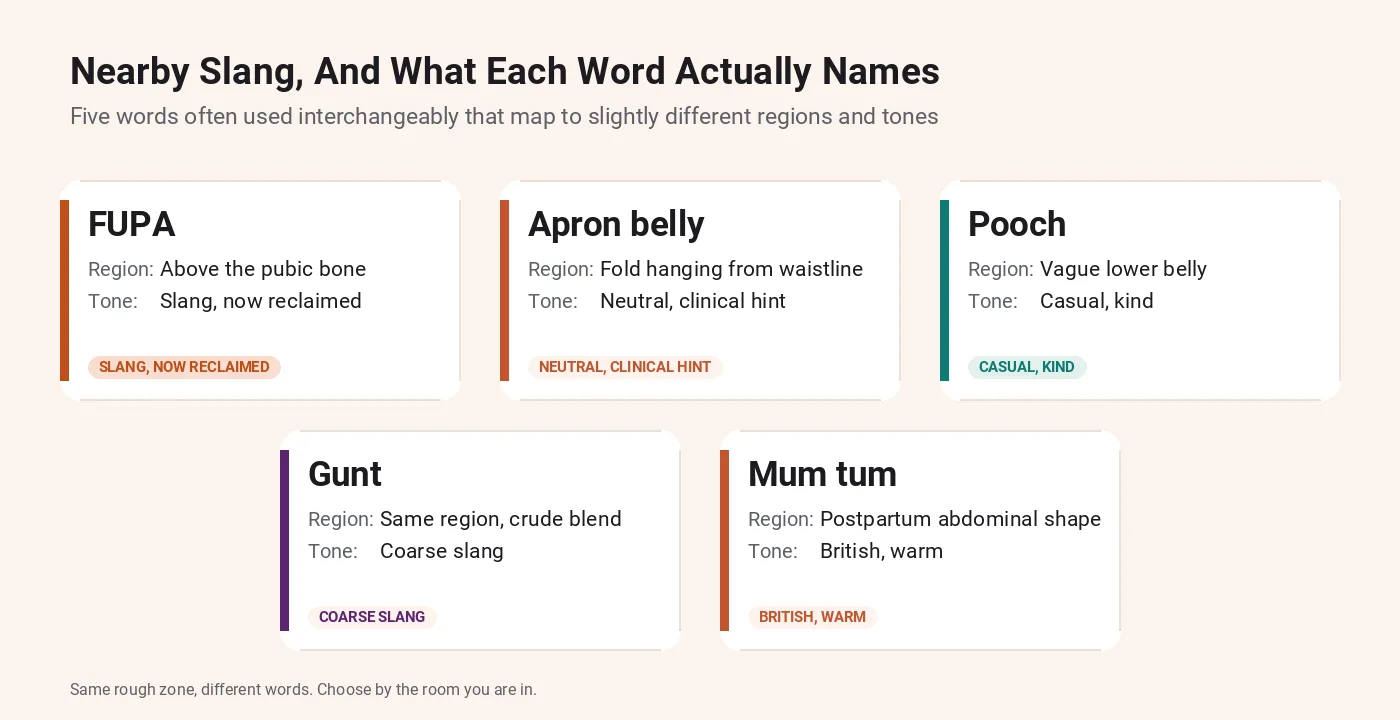
- Apron belly. A larger, heavier overhang of skin and fat from the waistline, hanging down over the pubic area. Different origin and different structure. The comparison guide covers it.
- Pooch. A softer, vaguer term for lower belly fullness generally, not specific to the mons pubis. Compared here.
- Gunt. A blend of two words, generally cruder in tone and used loosely for the same region. Compared here.
- Muffin top. Flesh spilling over a waistband at the sides rather than the front. A clothing effect at the flanks, not the mons.
- Mum tum. A British colloquialism for postpartum abdominal change generally, usually kinder in tone than the alternatives.
British and American usage
FUPA travelled from American internet culture and is understood on both sides of the Atlantic, but the surrounding vocabulary differs. British English tends toward mum tum and tummy, American English toward pooch and belly pooch. UK readers looking for medical information will also find the NHS uses none of these words, describing the anatomy directly instead.
Register drifts region by region as well as country by country. Northern British tabloids tend to reach for mum tum; London lifestyle press has largely moved to FUPA in captions; and midwifery leaflets in either country avoid all of the above, choosing lower abdomen or mons pubis instead.
Which word to use where
Word choice is almost always a room-reading exercise. FUPA works where people already use it about themselves; the clinical terms work where accuracy matters more than register; and a plain description of the mons pubis works nearly everywhere in between.
- With a GP or surgeon. Say mons pubis, or describe the location plainly as the mons pubis area just above the pubic bone. It removes ambiguity and it is the language that will come back at you in a letter.
- Searching online. FUPA will find far more relevant results than the clinical term, which mostly returns anatomy textbooks.
- Talking to friends or a partner. Whatever you are comfortable with. Many people prefer a neutral description to either extreme.
- About someone else. Best avoided entirely unless they have used it about themselves first.
Talking to a doctor about it
If the reason for the appointment is soreness, rash or infection in a skin fold, describing the symptom rather than the shape gets to the point faster: how long it has been happening, whether the skin is broken, whether it recurs. If the reason is a change in the mons pubis region, mention the timescale and whether your weight has changed. Our guide to irritation covers what is worth reporting, and our surgery guide covers the vocabulary used in a cosmetic consultation.
Should you ever say FUPA?
For yourself, in your own captions or conversations, the honest answer is yes if you want to. Reclamation is a real cultural move, and using the word about your own body has been the safest register since Beyoncé normalised it in the 2018 Vogue interview.
Applied to another person, especially without invitation, the answer flips. Even a kind version of the acronym reads as an unsolicited comment on someone else’s shape. In that situation the sibling guide on whether the word is offensive works through the decision in detail.
The safest rule is a simple one. Use FUPA about your own body, use mons pubis or lower belly when the room is more formal, and use suprapubic fat pad when clinical accuracy matters most. Silence is always a valid option when the body being discussed is not yours.
Why the word gets in the way of good information
There is a practical problem buried in all this. The word people use to search is not the word the reliable sources use, and the two vocabularies barely overlap.
Search for FUPA and you get styling advice, clinic marketing and social media. Search for mons pubis and you get anatomy references and surgical papers. Neither set answers the question most people actually have, which sits somewhere in between: what is this, is it normal, and what if anything changes it.
That gap is why so much of what circulates about the mons pubis area is either commercial or wrong. Waist trainers, targeted exercises and creams all market themselves into the slang side of the vocabulary, where there is little clinical writing to contradict them. Knowing both words lets you check a claim against the evidence rather than against an advert.
It also matters for men, who search the term far less often despite the anatomy being identical, and consequently find even less useful material. Our guide for men covers that. If you are still working out whether the term even applies to what you are looking at, the appearance guide is the clearer starting point.
From the Word to Useful Next Steps
Choosing the right word for the setting
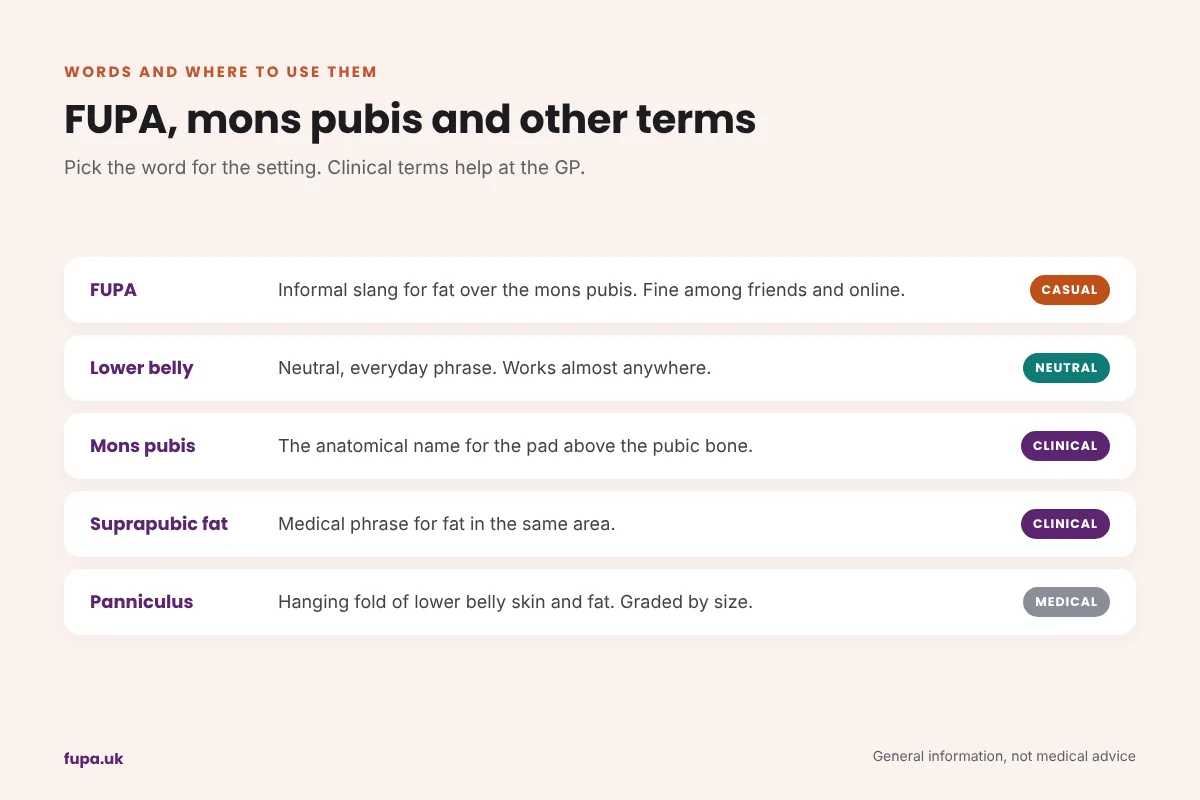
The same area has several names, and each one fits a different setting. FUPA works among friends and in search engines. Lower belly is neutral and polite. Mons pubis and suprapubic fat are the terms a doctor or nurse is likely to use and understand.
If you want to reduce it
A FUPA is a pad of fat, so it shrinks with overall fat loss rather than with targeted exercises. Diet sets the pace, and regular cardio and strength work support it. The lower belly is often the last area to change, so steady habits matter more than quick fixes.
If you are deciding how to train, our comparison of HIIT vs steady cardio for a FUPA sets out which style suits your time, joints and goals.
If you want to dress around it
Clothes cannot change the fat pad, but they can change the lines drawn across it. High rise waistbands, smooth fabrics and hems that fall past the hip all help. Our styling guide covers the main fixes.
If you want medical advice
Use the clinical words with your GP. Saying you have fullness over the mons pubis, and whether it is new, painful or changing, gives a clearer picture than slang. Your GP can then check for other causes, such as a hernia or a skin problem.
Frequently asked questions
Is FUPA a rude word?
It can be. The sanitised expansion, fat upper pubic area, is now the common form, but the original was crude and the term began as mockery, so tone and context still matter.
What does FUPA actually stand for?
Most often fat upper pubic area today. The original internet version replaced pubic area with a vulgar term for female genitalia, and both readings still circulate.
When did FUPA become a popular term?
It appeared in online slang around the mid 2000s, spread through meme culture in the 2010s, and reached mainstream and reclaimed use by the late 2010s and early 2020s.
Is there a more polite way to refer to the mons pubis area?
Yes. The clinical term is the mons pubis, which is the language doctors and surgeons use and the term this site uses on its medical pages.
Is FUPA the same as an apron belly?
No. A FUPA is fat over the pubic bone. An apron belly is a hanging fold of skin and fat originating at the waistline. They are often confused and are anatomically different.
Why do some people find the term offensive?
Because it began as an explicit insult and referenced a body part crudely. Even in its softened modern form, some people feel it reduces ordinary anatomy to a joke.
How is FUPA pronounced?
As a single word, roughly foo-pah, rather than spelled out letter by letter.
What is the medical term for a FUPA?
Doctors usually describe it as fat over the mons pubis, or suprapubic fat. When a fold of skin and fat hangs lower down from the abdomen, the clinical term is a panniculus. These terms are clearer to use at a GP appointment than slang.
Is the word FUPA used in the UK?
Yes. The term began in American internet slang, but it is now widely used and searched for in the UK. In everyday British speech, people also say lower belly, lower tummy or pubic mound.