
FUPA vs Other Belly Fat: How to Tell the Types Apart
Page Contents
- The quick answer
- What a FUPA is, in one paragraph
- Subcutaneous or visceral? The distinction that matters most
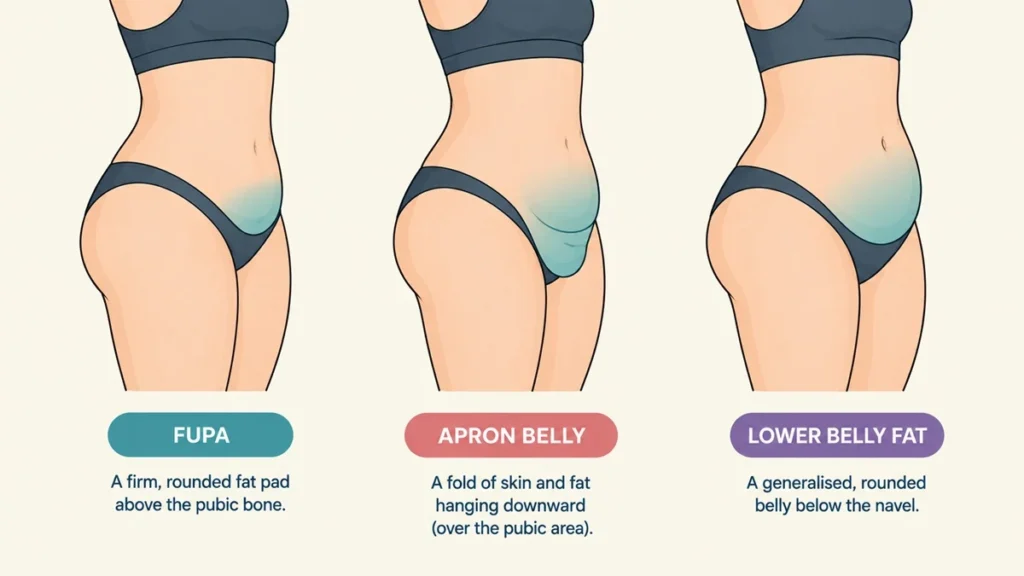
- FUPA vs apron belly
- FUPA vs lower belly pooch
- FUPA vs gunt
- FUPA vs muffin top and love handles
- FUPA vs diastasis recti and the B-belly
- What about loose skin?
- How to work out which one you have
- What to do next depends on the type
- Frequently asked questions
- Is a FUPA just belly fat?
- Can you have a FUPA and an apron belly at the same time?
- How do I know if my lower belly is fat or loose skin?
- Is a FUPA dangerous?
- Does a FUPA mean I am overweight?
If you have ever looked down and wondered whether the soft area low on your stomach is a FUPA, an apron belly, or just ordinary belly fat, you are asking a more useful question than it sounds. These words are not interchangeable. They describe different places on the body, different tissue, and in one case something that is not fat at all — and each one responds to something different.
This page is the map. It sets out every type of lower-belly change people confuse with a FUPA, explains the one distinction that matters most, and points you to the detailed guide for whichever one sounds like yours. If you are not yet sure what the term itself means, start with what a FUPA actually is and come back.
The quick answer
Most of the confusion clears up once you know two things about each type: where it sits, and what it is made of.
| Type | Where it sits | What it is |
|---|---|---|
| FUPA | Over the mons pubis, above the pubic bone, below the belly button | Subcutaneous fat pad |
| Apron belly (pannus) | Hangs down from the lower abdomen, sometimes over the pubic area or thighs | Fat and loose skin |
| Lower belly pooch | The whole area below the navel | Fat, weak abdominal wall, often bloating |
| Muffin top | Spills over the waistband at the sides, at or above the hip bones | Subcutaneous fat on the flanks |
| Visceral fat | Inside the abdominal cavity, around the organs | Fat you cannot pinch |
| Diastasis recti | Down the midline, from breastbone to navel | Muscle separation — not fat |
| Loose skin | Anywhere weight was lost quickly | Skin, with little fat underneath |
What a FUPA is, in one paragraph
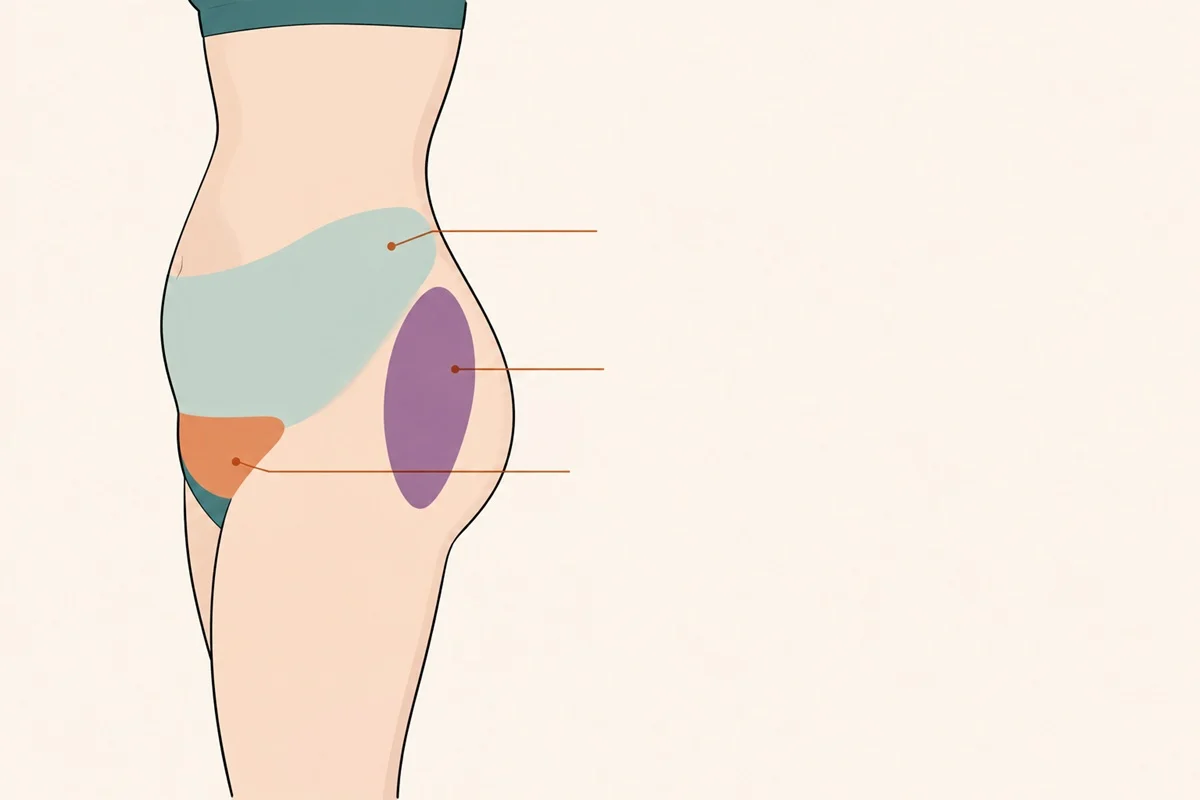
FUPA stands for fat upper pubic area. It is the pad of subcutaneous fat sitting over the mons pubis — the soft mound above the pubic bone and pubic symphysis, below the umbilicus. It is normal anatomy that everyone has to some degree, and it becomes more noticeable for reasons that have very little to do with willpower: genetics, hormonal shifts, pregnancy, ageing, and weight change all play a part. Our guide to what causes a FUPA covers each of these properly, and if yours seems more prominent than you expect for your size, there are specific reasons that happens.
Subcutaneous or visceral? The distinction that matters most
Before comparing names, it helps to sort belly fat into two categories, because they behave completely differently.
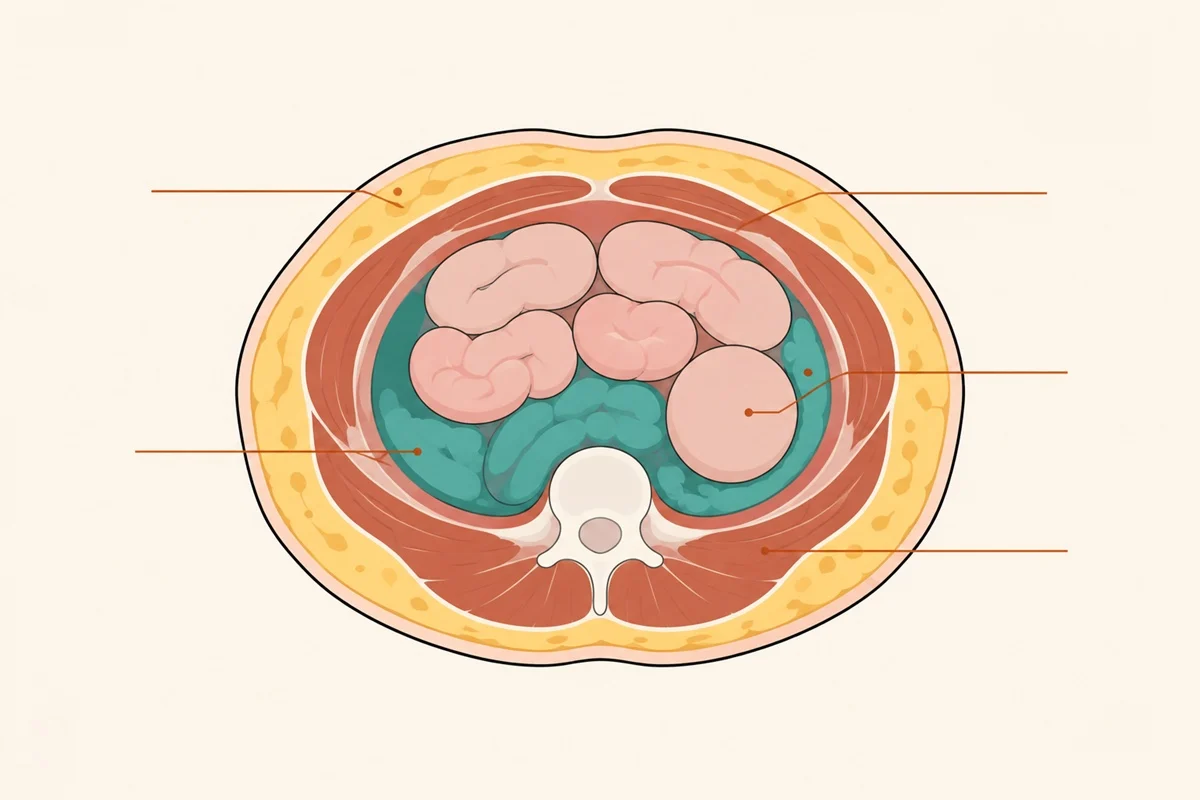
Subcutaneous fat sits between the skin and the abdominal wall. It is soft, it moves, and you can take hold of it between finger and thumb. A FUPA, a muffin top, love handles and most of what people call a pooch are all subcutaneous.
Visceral fat sits deeper, inside the abdominal cavity, packed around the organs. It makes the abdomen feel firm and push forward rather than hang, and it cannot be pinched. It also carries far more health significance than the subcutaneous kind — it is the fat associated with raised risk of type 2 diabetes and cardiovascular disease, which is why the NHS uses waist measurement rather than weight alone as a health marker.
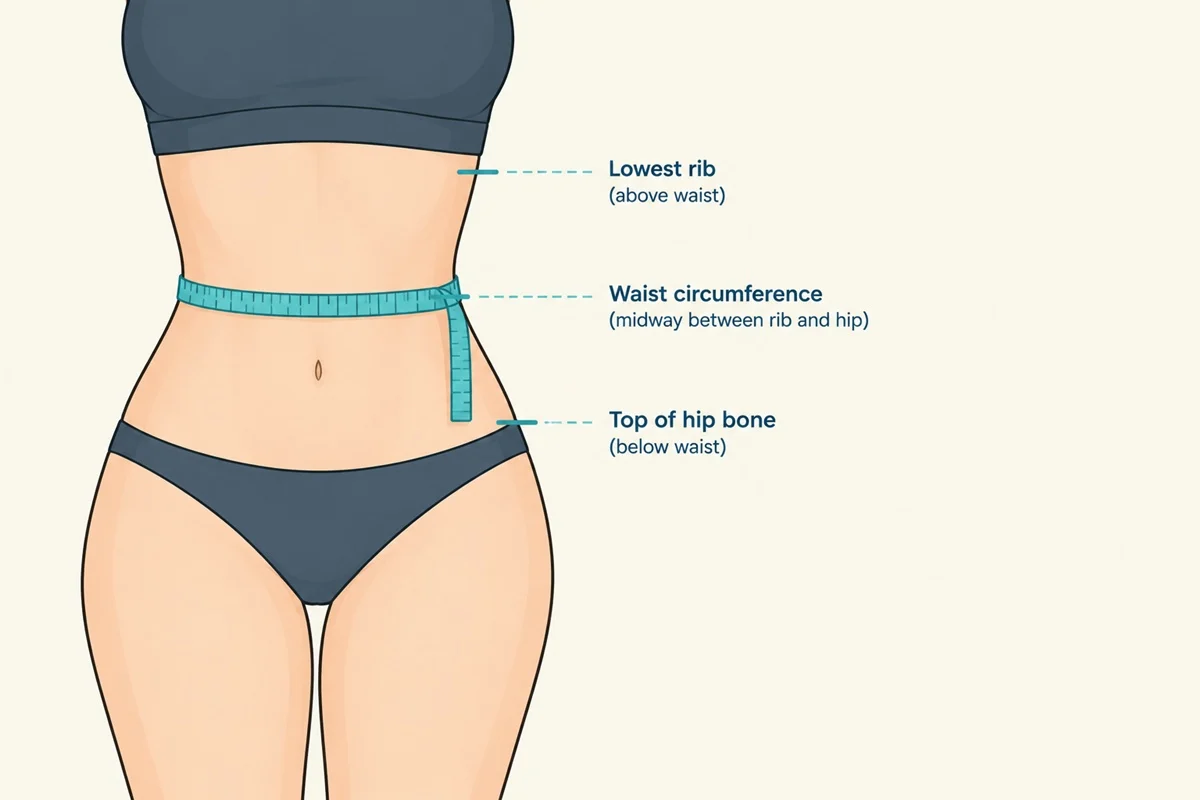
To measure yours, put a tape around the bare waist midway between the lowest rib and the top of the hip bone, breathe out normally, and read it. NHS guidance treats 80cm (31.5in) for women and 94cm (37in) for men as the point where risk starts rising, and 88cm (34.5in) and 102cm (40in) as high risk. This is a rough screen, not a diagnosis, and it is less reliable during pregnancy.
The practical upshot: a FUPA is a cosmetic and comfort concern for most people, while a firm, non-pinchable belly is worth raising with a GP.
FUPA vs apron belly
An apron belly — clinically a pannus or panniculus, sometimes called a mother’s apron — is a fold of skin and fat that hangs down from the lower abdomen. Clinicians grade it by how far it hangs, from barely covering the pubic area to reaching the knees.
The distinction is the skin. A FUPA is a fat pad in a fixed position; it may bulge, but it does not fold over on itself. An apron belly involves excess skin as well as fat, which is why it hangs, creates a crease that stays when you stand, and can lead to soreness, chafing or intertrigo where skin meets skin. That skin component also means it responds differently to treatment: fat can be reduced, but stretched skin does not shrink back on its own.
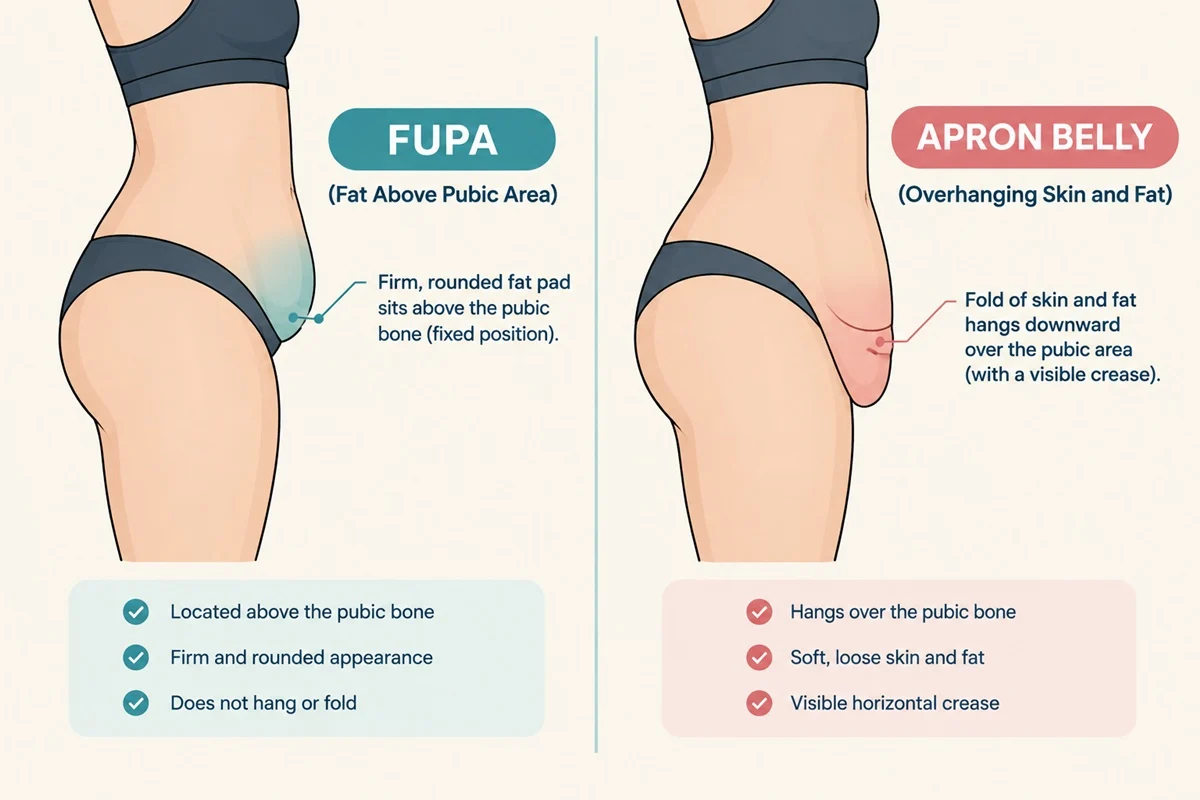
The two commonly appear together after major weight loss or pregnancy. Our full apron belly comparison goes through location, causes, symptoms and management side by side.
FUPA vs lower belly pooch
A pooch is the vaguer term of the two. It describes a general soft rounding of the whole lower abdomen below the navel, rather than the pubic pad specifically. Where a FUPA is anatomically defined — the tissue over the mons pubis — a pooch is a shape, and it usually comes from a mixture of things: subcutaneous fat, a weakened or stretched abdominal wall, posture, and often ordinary bloating that changes through the day.
That last point is the giveaway. A FUPA looks much the same morning and evening. A pooch that is largely bloating does not. Our detailed pooch breakdown covers how to tell which you are dealing with, including when both are present.
FUPA vs gunt
“Gunt” is internet slang rather than an anatomical term, and it is generally used unkindly. Our full FUPA vs gunt comparison sets out what the two words are actually pointing at. When people use it, they are usually describing the same area a FUPA occupies — often a larger or overhanging one. There is no clinical difference to explain, only a difference in tone. We use the neutral term throughout this site, because the anatomy is ordinary and the language does not need to be cruel.
FUPA vs muffin top and love handles
These two are the easiest to rule out, because the location is different. A muffin top is subcutaneous fat that spills over the waistband at the sides, sitting at or above the hip bones. Love handles describe much the same fat over the flanks and obliques. Both are lateral and relatively high; a FUPA is central and low, below the belly button and above the pubic bone.
If clothing is what brought you here — a waistband that sits badly, or a shape you would rather not emphasise — our guide to dressing around it and our notes on shapewear that actually works deal with the styling side.
FUPA vs diastasis recti and the B-belly
This one is not fat at all, which is why it is so often missed.
Diastasis recti is a separation of the two halves of the rectus abdominis down the linea alba, the connective tissue running from breastbone to navel. It is very common during pregnancy and in the postpartum period, and can persist long afterwards. Because the midline no longer holds firm, the abdomen domes or bulges outward, particularly when you sit up or strain — which reads as a lower-belly bulge even in someone with very little fat there.
A B-belly is the related shape: a horizontal crease across the middle of the abdomen giving it the outline of a letter B. It can come from diastasis recti, from a pannus, or occasionally from a hernia.
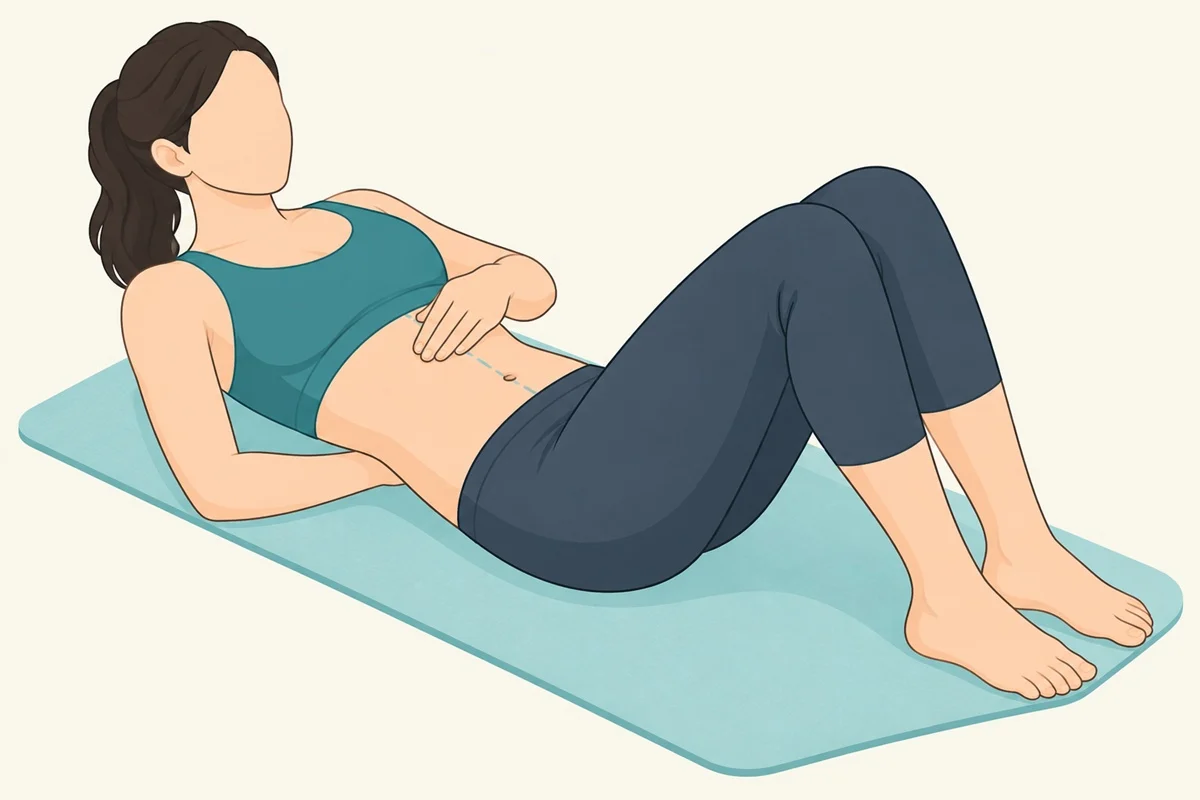
A rough self-check: lie on your back, knees bent, feet flat. Place your fingers flat just above the navel and lift your head and shoulders slightly. If you feel a gap or a soft ridge down the midline, that is worth a conversation with a GP or a women’s health physiotherapist. Abdominal exercises aimed at fat do not fix a muscle separation, and some of them make it look worse.
What about loose skin?
After significant or rapid weight loss, what remains at the lower abdomen is often skin rather than fat. It feels thin between the fingers, it does not have the dense springy quality of a fat pad, and it creases rather than bulges. This matters because it changes what will and will not help: skin does not respond to diet, exercise or fat-reduction treatments. It is worth being clear about which you have before spending money on anything.
How to work out which one you have
- Locate it. Is it central and low, over the pubic bone? Is it across the whole area under the navel? Or is it at the sides, over the hips? Location alone rules out most of the list.
- Pinch it. Soft and easy to take hold of means subcutaneous. Firm, forward and impossible to grasp suggests visceral fat.
- Check whether it hangs. Stand in front of a mirror. If there is a fold that drapes downward and a crease that stays put, you are looking at a pannus rather than a fat pad.
- Check the midline. The lie-down test above will tell you whether muscle separation is part of the picture.
- Check the day. If the shape changes noticeably between morning and evening, some of it is bloating, not tissue.
- Measure your waist. Whatever the shape, this is the number with health meaning attached to it.
See a GP rather than working it out alone if there is soreness, a rash, an odour or broken skin inside a fold; if there is a lump or bulge that appears when you cough or strain, which can indicate a hernia; if there is pain; or if your abdomen has changed size quickly without a change in weight.
What to do next depends on the type
Once you know which one you are dealing with, the route forward is fairly clear.
- A FUPA. Fat reduction is gradual and whole-body — spot reduction is not a thing that works. Our evidence-based reduction guide sets out what the research supports and what it does not.
- An apron belly. Skin is involved, so lifestyle change alone will only take you part of the way. Skin care inside the fold matters in the meantime.
- Bloating or a soft pooch. Look at digestion and daily patterns before assuming it is fat at all.
- Diastasis recti. Guided rehabilitation, not crunches. Ask about a referral to a women’s health physiotherapist.
- Visceral fat. This is the one with a genuine health case behind acting on it. Speak to your GP.
- None of the above, and it is really about clothes. That is a legitimate answer too, and the styling guide is where to go.
For everything else on this topic, our main FUPA guide links out to the full set.
Frequently asked questions
Is a FUPA just belly fat?
Not quite. It is belly fat in a specific place — the subcutaneous pad over the mons pubis, above the pubic bone. General belly fat covers a wider area and may include visceral fat, which sits deeper and behaves differently.
Can you have a FUPA and an apron belly at the same time?
Yes, and it is common after pregnancy or major weight loss. The fat pad and the hanging skin fold are separate features and can occur together.
How do I know if my lower belly is fat or loose skin?
Pinch it. Fat feels dense and springy and has depth to it; loose skin feels thin between the fingers and creases rather than bulging.
Is a FUPA dangerous?
Subcutaneous fat in the pubic area does not carry the health risk that visceral fat does. It becomes a medical issue mainly when a large fold causes skin irritation or pain, which is worth seeing a GP about.
Does a FUPA mean I am overweight?
No. A visible fat pad over the pubic area occurs across the whole range of body sizes, including in people who are lean elsewhere. Genetics and hormones influence where fat settles far more than overall weight does.