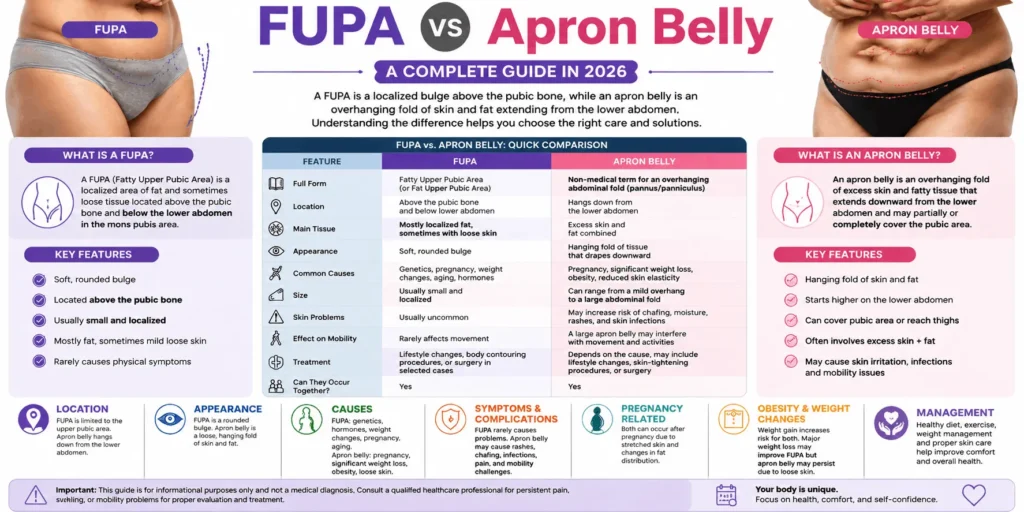
Fupa vs Apron Belly | A Complete Guide in 2026
A FUPA (Fatty Upper Pubic Area) and an apron belly are different body changes, even though people often confuse them because both affect the lower abdominal region.
A FUPA is a localized area of fat or loose tissue above the pubic bone, while an apron belly is an overhanging fold of skin and fat that extends downward from the lower abdomen and may partially or completely cover the pubic area.
A FUPA usually appears as a small, rounded bulge, whereas an apron belly varies from a mild overhang to a larger fold after pregnancy, significant weight loss, or obesity.
Understanding the difference is important because the causes, appearance, potential health concerns, and treatment options for these conditions are not always the same.
In this guide, you will learn about the difference between FUPA & Apron belly.
What Is a FUPA?
A FUPA, short for Fatty Upper Pubic Area or Fat Upper Pubic Area, refers to a localized area of fat and sometimes loose tissue located above the pubic bone and below the lower abdomen. This region includes the mons pubis, which naturally contains a layer of fatty tissue that cushions and protects the pubic bone.
A FUPA may become more noticeable because of genetics, pregnancy, childbirth, aging, weight gain, significant weight loss, hormonal changes, or reduced skin elasticity. It usually appears as a soft, rounded bulge rather than hanging downward.
A FUPA is a common body variation and is not considered a medical condition by itself, although some people may choose to reduce its appearance for personal comfort or cosmetic reasons.
What Is an Apron Belly?
An apron belly, also called a pannus or panniculus, is an overhanging fold of excess skin and fatty tissue that extends downward from the lower abdomen.
Unlike a FUPA, which is limited to the upper pubic area, an apron belly develops higher on the abdomen and can hang over the pubic region. Its size varies from a small lower abdominal overhang to a larger fold that may reach the upper thighs in more severe cases.
Pregnancy, significant weight loss, obesity, aging, and reduced skin elasticity are common factors that contribute to its development.
An apron belly is not an official medical diagnosis, but a large overhang may increase the risk of skin irritation, moisture buildup, chafing, and recurrent skin infections, making proper skin care and medical evaluation important when symptoms occur.
Location: FUPA vs. Apron Belly | Where Each Exists
The location is one of the clearest ways to distinguish a FUPA from an apron belly. A FUPA is located directly above the pubic bone and below the lower abdomen in the area known as the mons pubis. It is limited to the upper pubic region and usually appears as a localized bulge.
An apron belly, in contrast, begins higher on the lower abdomen and forms an overhanging fold of skin and fat that extends downward. Depending on its size, it may partially or completely cover the pubic area and, in more severe cases, reach the upper thighs.
Although they occupy nearby areas, their anatomical location and the way the tissue is distributed are different, making location an important feature when telling them apart.
Appearance: FUPA vs. Apron Belly
A FUPA and an apron belly have distinct appearances, although they can sometimes occur together.
A FUPA usually appears as a soft, rounded bulge above the pubic bone. It remains localized to the upper pubic area and does not typically hang downward. Its size may range from barely noticeable to more prominent, depending on factors such as body fat, skin elasticity, and genetics.
An apron belly, however, appears as an overhanging fold of excess skin and fat that extends downward from the lower abdomen. The fold may partially or completely cover the pubic area and, in more severe cases, reach the upper thighs.
While a FUPA creates localized fullness, an apron belly is characterized by loose, hanging abdominal tissue rather than a rounded pubic bulge.
Causes: FUPA vs. Apron Belly
A FUPA and an apron belly can share some of the same contributing factors, but they develop in different ways.
A FUPA is primarily caused by localized fat accumulation and, in some people, loose skin above the pubic bone. Genetics, pregnancy, childbirth, weight gain, significant weight loss, aging, hormonal changes, and reduced skin elasticity can all make this area more noticeable.
An apron belly, however, develops when excess abdominal skin and fat hang downward, most commonly after pregnancy, obesity, or major weight loss that leaves stretched skin behind.
While both conditions may occur after changes in body weight, a FUPA is generally limited to the upper pubic area, whereas an apron belly results from a larger amount of excess abdominal tissue and skin laxity.
Symptoms and complications: FUPA vs. Apron Belly
A FUPA usually causes few, if any, physical symptoms and is often a cosmetic concern rather than a medical problem. Some people may notice mild discomfort in tight clothing or feel self-conscious about its appearance.
In contrast, an apron belly is more likely to cause physical complications because excess skin can create deep skin folds. These folds may trap moisture, increasing the risk of chafing, unpleasant odor, rashes, fungal or bacterial skin infections, and skin sores if not properly cared for.
A large apron belly may also contribute to lower back pain, difficulty with movement, exercise, personal hygiene, or finding comfortable clothing. For either condition, sudden pain, rapid swelling, a hard lump, bleeding, or signs of infection should be evaluated promptly by a qualified healthcare professional.
Risk factors: FUPA vs. Apron Belly
A FUPA and an apron belly share several risk factors, but certain factors are more strongly associated with one than the other. Weight gain can increase the likelihood of both conditions by increasing fat accumulation in the lower abdomen.
Pregnancy and childbirth may contribute to either condition because they stretch the abdominal wall and skin.
Significant weight loss, particularly after bariatric surgery or prolonged obesity, is more likely to result in an apron belly because excess skin may remain after fat loss. Genetics influence where the body stores fat, making some people more prone to developing a FUPA even at a healthy weight.
Aging, hormonal changes, and reduced skin elasticity can also make both conditions more noticeable by altering fat distribution and skin firmness over time.
Pregnancy-related changes: FUPA vs. Apron Belly
Pregnancy can contribute to both a FUPA and an apron belly, but the underlying changes are not identical.
During pregnancy, the growing uterus stretches the abdominal muscles, skin, and connective tissues to accommodate the developing baby.
After childbirth, some women notice a FUPA because fat distribution, loose skin, or changes around the mons pubis make the upper pubic area appear fuller.
An apron belly is more likely to develop when the stretched abdominal skin and underlying tissue do not fully retract, creating a fold that hangs downward from the lower abdomen.
Factors such as multiple pregnancies, significant pregnancy-related weight changes, age, genetics, skin elasticity, and conditions like diastasis recti can influence the extent of these postpartum body changes.
Obesity and major weight loss: FUPA vs. Apron Belly
Obesity and major weight loss can contribute to both a FUPA and an apron belly, but they affect each condition differently. During obesity, excess body fat may accumulate throughout the abdomen, including the upper pubic area, making a FUPA more prominent.
An apron belly is more likely to develop when excess abdominal fat stretches the skin over time, allowing the lower abdomen to hang downward. After significant weight loss, overall body fat often decreases, but stretched skin may not fully contract.
As a result, a FUPA may become less noticeable if it was mainly caused by fat, whereas an apron belly can persist because of excess loose skin. The extent of these changes depends on factors such as age, genetics, skin elasticity, the amount of weight lost, and how long excess weight was present.
Skin vs. fat differences: FUPA vs. Apron Belly
One of the main differences between a FUPA and an apron belly is the amount of fat versus excess skin involved. A FUPA is primarily a localized collection of fatty tissue above the pubic bone, although some people may also have mild loose skin, particularly after pregnancy or significant weight loss.
In contrast, an apron belly usually involves both excess fat and stretched skin that hangs downward from the lower abdomen. In people who have lost a large amount of weight, loose skin often becomes the more prominent feature of an apron belly even after much of the fat has been reduced.
This distinction is important because excess fat may respond to overall weight loss, whereas significant loose skin often requires different management and may not improve with exercise or diet alone.
Diagnosis and terminology: FUPA vs. Apron Belly
Neither FUPA nor apron belly is an official medical diagnosis. FUPA is a commonly used term that refers to fullness above the pubic bone, while apron belly is a non-medical term for an overhanging fold of abdominal skin and fat.
Healthcare professionals usually describe an apron belly using medical terms such as abdominal pannus or panniculus, particularly when it causes skin problems or affects daily activities.
Diagnosis is typically based on a physical examination, medical history, and the location and characteristics of the tissue. Imaging tests are not usually necessary unless another condition, such as a hernia or abdominal mass, is suspected.
Correct terminology helps distinguish normal body variations from medical conditions and supports appropriate treatment planning when symptoms or complications are present.
Lifestyle Management: FUPA vs. Apron Belly
Lifestyle changes can support the management of both a FUPA and an apron belly, although the results depend on whether excess fat, loose skin, or both are present.
A balanced diet, regular physical activity, strength training, adequate sleep, and maintaining a stable body weight can improve overall body composition and reduce excess body fat over time.
However, these habits cannot selectively reduce fat from the upper pubic area or remove significant loose skin. For people with an apron belly, daily skin care is equally important because keeping skin folds clean and dry can help reduce chafing, irritation, and infections.
Wearing well-fitting, supportive clothing may improve comfort for both conditions. Lifestyle management promotes long-term health, even when cosmetic changes are gradual or limited.
Conclusion
A FUPA and an apron belly may affect nearby areas, but they are not the same. A FUPA is a localized bulge above the pubic bone, while an apron belly is a hanging fold of skin and fat extending from the lower abdomen.
Their causes can overlap, including pregnancy, weight changes, aging, genetics, and reduced skin elasticity. Lifestyle habits may help reduce excess body fat and improve comfort, but they cannot target one area or remove loose skin.
Persistent pain, rashes, infections, swelling, or mobility problems should be assessed by a healthcare professional for appropriate guidance and treatment.