
How Men Can Lose a FUPA
Page Contents
- What Is a FUPA in Men?
- Visceral Fat vs Subcutaneous Fat: Why the Lower Belly Is Stubborn
- Genetics and Where Men Store Fat
- Waist-to-Height Ratio: A Better Test Than BMI
- Diet: Calorie Deficit, Protein and Alcohol
- Resistance Training: Why Lifting Matters More Than Sit-Ups
- Cardio and NEAT: The Movement That Adds Up
- Sleep, Stress and Cortisol
- A 12-Week Plan by Phase
- Tracking Progress Without Obsessing Over the Scale
- When It Is Loose Skin, Not Fat
- Supplements and Shortcuts: What the Evidence Actually Supports
- When to See a GP
- Frequently Asked Questions
- How long does it take to lose a FUPA as a man?
- Can you lose a FUPA without losing weight elsewhere?
- Do ab exercises get rid of a FUPA?
- Is a FUPA in men linked to low testosterone?
- What waist size counts as a FUPA risk in men?
- Does alcohol really affect lower belly fat specifically?
This guide is general information about lower belly fat in men. It is not medical advice and does not replace an assessment by your GP if you have health concerns.
What Is a FUPA in Men?
A FUPA in men sits just above the groin, below the navel. It is soft tissue that pushes forward over the waistband even in men who train regularly, and it is different from a general beer belly, which sits higher and further round the middle. Our FUPA in Men hub covers causes such as testosterone and genetics in more depth; this guide focuses on what actually helps to reduce it.
Two tissues make up a male FUPA: subcutaneous fat sitting just under the skin, and, in some men, a small amount of loose skin left after previous weight loss. Unlike surgical routes covered separately, this guide is about fat loss through diet, training and lifestyle.
Visceral Fat vs Subcutaneous Fat: Why the Lower Belly Is Stubborn
Men tend to store fat viscerally, around and between the organs, as well as subcutaneously under the skin. Visceral fat sits deeper in the abdomen and is more responsive to calorie deficit and exercise, while the last layer of subcutaneous fat around the lower belly and flanks tends to be the slowest to shift, a pattern driven by alpha-2 adrenoceptor density in that fat tissue, which blunts the signal to release fat for use as energy.
This is why men often see their waist shrink steadily for weeks, then plateau with a stubborn pouch remaining just above the groin. It is not a sign that training or diet has stopped working; it reflects how that specific fat depot behaves hormonally.
Genetics and Where Men Store Fat
Fat distribution is not just down to diet and training; genetics play a real role in where a given man tends to store fat first and lose it last. Research has linked variants in genes such as KLF14, LRP5, TBX15 and RSPO3 to differences in body fat distribution between individuals. This does not mean the lower belly is unchangeable; it means two men following the same plan may see the change happen at different rates and in a different order, which is normal rather than a sign either approach has failed. Our wider guide to FUPA hormones and genetics covers this in more depth.
Waist-to-Height Ratio: A Better Test Than BMI
BMI does not separate fat from muscle, so a muscular man can register as overweight while a low-muscle man with visible lower belly fat can register as normal. NICE guidance (NG246) recommends waist-to-height ratio as a simple screening tool instead: keep your waist circumference below half your height.
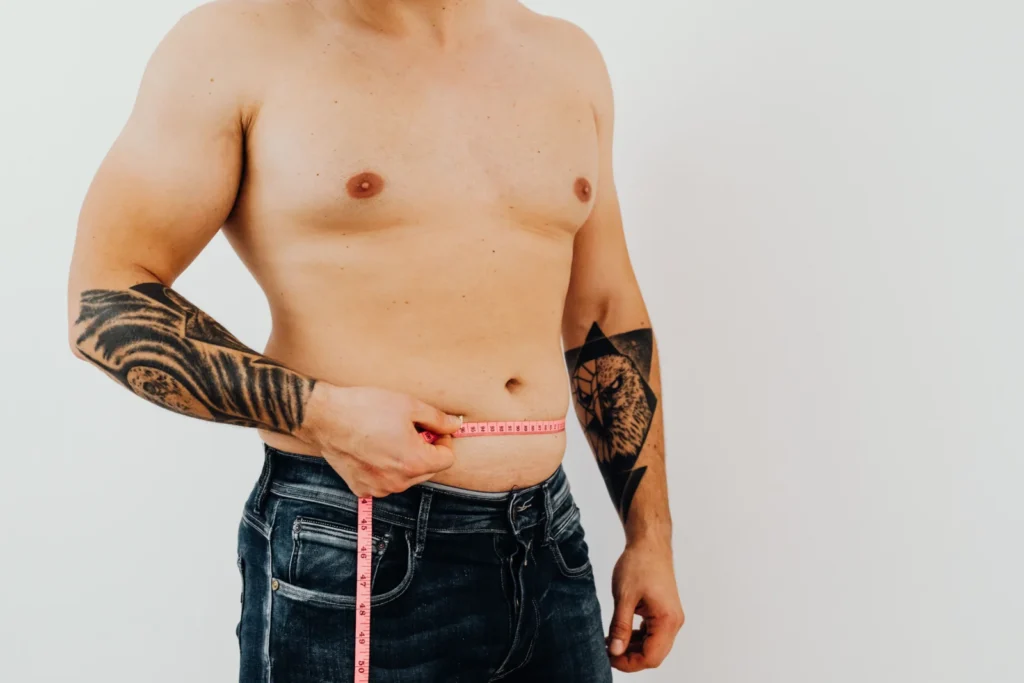
To measure, wrap a tape measure around your waist at the level of your navel, standing relaxed, and divide by your height in the same units. A ratio at or above 0.5 is linked to higher risk of type 2 diabetes and cardiovascular disease, independent of your BMI, and is a more honest marker of central fat than the number on the bathroom scale.
Diet: Calorie Deficit, Protein and Alcohol
As with any part of the body, fat loss requires a sustained calorie deficit; no food or supplement removes fat from one area alone, a point covered more broadly in our hub on how to get rid of a FUPA. A deficit of 300 to 500 calories a day is generally enough to lose fat steadily without excessive muscle loss, provided protein intake is adequate.
Aim for around 1.6g of protein per kilogram of bodyweight a day. Protein preserves muscle during a deficit, keeps you fuller for longer, and has a higher thermic cost than fat or carbohydrate, meaning more of the calories you eat from protein are used just digesting it.
Alcohol is worth auditing honestly. A pint of regular lager runs to roughly 2 to 2.5 UK units and 180 to 240 calories, and beyond the calories, alcohol suppresses fat oxidation for several hours after drinking, meaning your body burns proportionally more of what you drank and less of your own stored fat while it clears the alcohol first. Cutting back on regular drinking is one of the highest-leverage, least discussed changes for lower belly fat in men. See our FUPA diet guide for a fuller look at what the evidence and NHS guidance support.
Resistance Training: Why Lifting Matters More Than Sit-Ups
Spot reduction, the idea that ab exercises burn fat specifically from the belly, is not supported by the evidence: crunches and planks strengthen the muscles underneath but do not preferentially burn the fat covering them. What resistance training does is build and preserve muscle mass across a calorie deficit, which keeps your metabolic rate higher and improves the definition that becomes visible as fat comes down.
A simple structure that works for most men: two to four full-body resistance sessions a week, built around compound lifts (squats, deadlifts, presses, rows), progressing the weight or reps gradually over weeks. Direct core work (planks, dead bugs, hanging leg raises) is useful for strength and posture but should sit alongside, not instead of, full-body training and diet. Our FUPA exercises guide covers a fuller weekly routine and common exercise mistakes in more detail.
Cardio and NEAT: The Movement That Adds Up
Cardio (running, cycling, rowing) adds to your calorie deficit without eating into recovery from resistance training if kept moderate; two to three sessions a week of 20 to 40 minutes is a reasonable starting point. Equally important, and easy to overlook, is NEAT (non-exercise activity thermogenesis): the calories burned walking, standing, fidgeting and general daily movement, which for many desk-based men is the single biggest lever available. A daily step target of 8,000 to 10,000 steps is a practical, sustainable way to raise NEAT without adding formal training time.
The reason NEAT matters so much for lower belly fat is that it works quietly in the background every day, unlike a single training session that ends after an hour. A desk-based man who raises his daily steps from 4,000 to 9,000 can add a meaningful weekly calorie deficit purely from incidental movement, on top of whatever structured training and diet changes he makes.
Sleep, Stress and Cortisol
Poor sleep and chronic stress raise cortisol, which is linked to preferential fat storage around the abdomen and can also increase appetite and cravings the following day. Adults generally need 7 to 9 hours of sleep; consistently getting less makes fat loss harder even when diet and training are otherwise on track. Simple sleep habits (a consistent bedtime, reduced screen use before bed, limiting caffeine after early afternoon) are a legitimate part of a FUPA reduction plan, not an afterthought.
A 12-Week Plan by Phase
| Weeks | Focus | What to do |
|---|---|---|
| 1 to 4 | Foundations | Set a 300 to 500 calorie daily deficit, hit 1.6g/kg protein, start 2 to 3 resistance sessions a week, walk 8,000 steps daily, measure waist-to-height ratio as your baseline. |
| 5 to 8 | Consistency | Progress resistance training to 3 to 4 sessions a week, add 2 sessions of moderate cardio, review alcohol intake, re-measure waist every 2 weeks rather than daily. |
| 9 to 12 | Refinement | Adjust the deficit if progress has stalled for over 2 weeks, prioritise sleep consistency, keep resistance training volume steady rather than adding more, and reassess whether loose skin or remaining fat is the main issue. |
Tracking Progress Without Obsessing Over the Scale
Bodyweight fluctuates day to day with water, food and sodium, so weigh at the same time each week and look at the trend over several weeks rather than a single reading. Waist-to-height ratio, progress photos taken in the same light and pose, and how clothes fit are all more informative for lower belly fat specifically than scale weight alone. If you are short on time, our guide to losing a FUPA fast covers what is realistically possible on an accelerated timeline.
When It Is Loose Skin, Not Fat
If you have lost a significant amount of weight and the lower belly still hangs forward when you press and release the skin, with fat loss otherwise visible elsewhere, loose skin rather than fat may be the main issue. Diet and training will not remove excess skin; that is a separate, structural consideration, and surgical options for men are covered in our FUPA surgery guide.
Supplements and Shortcuts: What the Evidence Actually Supports
No supplement, belt, cream or device targets fat loss from the lower belly specifically. Caffeine and green tea extract have modest, short-lived effects on metabolic rate at best. The evidence consistently points back to calorie deficit, adequate protein, resistance training and sleep as the factors that actually move the needle; anything promising fast, localised fat loss without those is not supported by good evidence.
When to See a GP
See your GP if lower belly fat has increased rapidly without a change in diet, if it comes with symptoms such as fatigue, low libido or reduced muscle mass, which can point to low testosterone, or if your waist-to-height ratio stays above 0.5 despite sustained effort, since this is linked to health risks worth discussing directly with a healthcare professional.
Frequently Asked Questions
How long does it take to lose a FUPA as a man?
With a consistent calorie deficit, most men notice a visible change in 8 to 12 weeks, though the exact timeline depends on your starting point and how much fat needs to come off. The lower belly is often one of the last areas to change because of how that fat depot responds to fat-mobilising hormones.
Can you lose a FUPA without losing weight elsewhere?
No. Spot reduction is not supported by evidence: a calorie deficit reduces fat across the body according to your individual pattern of fat distribution, not from one chosen area first.
Do ab exercises get rid of a FUPA?
Ab exercises strengthen the muscles under the fat but do not burn fat from that specific area. They are useful alongside a calorie deficit and full-body resistance training, not as a replacement for either.
Is a FUPA in men linked to low testosterone?
Low testosterone is associated with increased central and visceral fat storage in some men, partly because fat tissue itself increases conversion of testosterone to oestrogen via the aromatase enzyme. If you have other symptoms of low testosterone, a GP blood test can check this.
What waist size counts as a FUPA risk in men?
Rather than a fixed waist size, NICE guidance uses waist-to-height ratio: keeping your waist below half your height is the recommended target regardless of your overall height.
Does alcohol really affect lower belly fat specifically?
Alcohol does not target the lower belly directly, but it adds calories, is linked to higher visceral fat with regular heavy drinking, and temporarily slows down your body’s use of stored fat for energy while it processes the alcohol first. Cutting back on regular drinking is one of the more effective, underused changes for men trying to reduce lower belly fat.