Mons Pubis Anatomy: What It Is, Why It Stores Fat and How It Changes
Page Contents
- What Is the Mons Pubis?
- Where Exactly Is It?
- Mons Pubis Anatomy: The Layers From Skin to Bone
- Mons Pubis Anatomy: Nerves, Blood Supply and Lymph
- Nerves
- Blood Supply and Drainage
- What Does the Mons Pubis Do?
- Why the Mons Pubis Stores Fat
- It Is a Subcutaneous Fat Depot
- Oestrogen and the Gynoid Pattern
- Receptors and Genetics
- From Mons Pubis to FUPA
- Mons Pubis vs FUPA vs Apron Belly vs Lower Belly Pooch
- How the Mons Pubis Changes Through Life
- Puberty
- Pregnancy and After Birth
- Weight Gain and Weight Loss
- Menopause
- Ageing in Men
- What Is a Normal Size?
- When a Mons Pubis Change Is a Medical Concern
- Can You Change the Size or Shape of the Mons Pubis?
- Frequently Asked Questions
- Is the mons pubis the same as a FUPA?
- Do men have a mons pubis?
- Why does my mons pubis stick out when I am slim?
- Does the mons pubis shrink after menopause?
- Can exercise reduce mons pubis fat?
- When should I see a doctor about swelling in my pubic area?
- The Bottom Line
The mons pubis is the rounded pad of fat that sits over the pubic bone, just above the genitals. Everyone has one. In women it is often fuller and more noticeable, and it is sometimes called the mons veneris. In men it is usually flatter and is simply known as the pubic fat pad. Understanding mons pubis anatomy helps explain why this small area stores fat so readily, why it changes shape over a lifetime, and how it links to what people call a FUPA.
This guide is general information, not medical advice. If you notice a new lump, sudden swelling or pain in the pubic area, speak to your GP or call NHS 111.
What Is the Mons Pubis?
The name comes from Latin. “Mons pubis” means “mount of the pubic region”. The older term “mons veneris” means “mount of Venus”, after the Roman goddess of love. Anatomy textbooks describe it as a mound of fatty tissue lying directly in front of the pubic symphysis.
In women, the mons forms the top part of the vulva. Lower down, it divides and continues as the two labia majora, the outer skin folds.
In men, the same fat pad sits above the base of the penis. Pubic hair in men often spreads upwards towards the belly button in a diamond shape. In women, the hairline across the top is usually flatter, which gives the familiar triangular outline.
Where Exactly Is It?
Picture a triangle on the lower front of your body. Its edges are:
- Top: the lower abdomen, roughly at the level of the pubic hairline.
- Sides: the inguinal creases, the folds where your thighs meet your torso.
- Bottom: the labia majora in women, or the base of the penis in men.
The pubic bone sits behind it. Our guide to where the FUPA sits on the body maps the area in plain terms.
Mons Pubis Anatomy: The Layers From Skin to Bone
The mons is a stack of tissues. From the surface inwards, the layers are:
- Skin. The hair-bearing surface, rich in sweat and oil glands.
- Superficial fatty layer (Camper’s fascia). The soft fat that gives the mons its rounded shape. It is continuous with the fat of the lower abdomen.
- Deep membranous layer (Scarpa’s fascia). A thinner, tougher sheet of connective tissue. It carries on downwards into the genital region, where it becomes the membranous layer of the perineum. Surgeons use it as an anchor point during lifting procedures.
- Suspensory ligament. A fibrous band from the front of the pubic bone. In women, it supports the clitoris. In men, it supports the penis.
- Pubic symphysis and pubic bone. The bony base beneath it all.
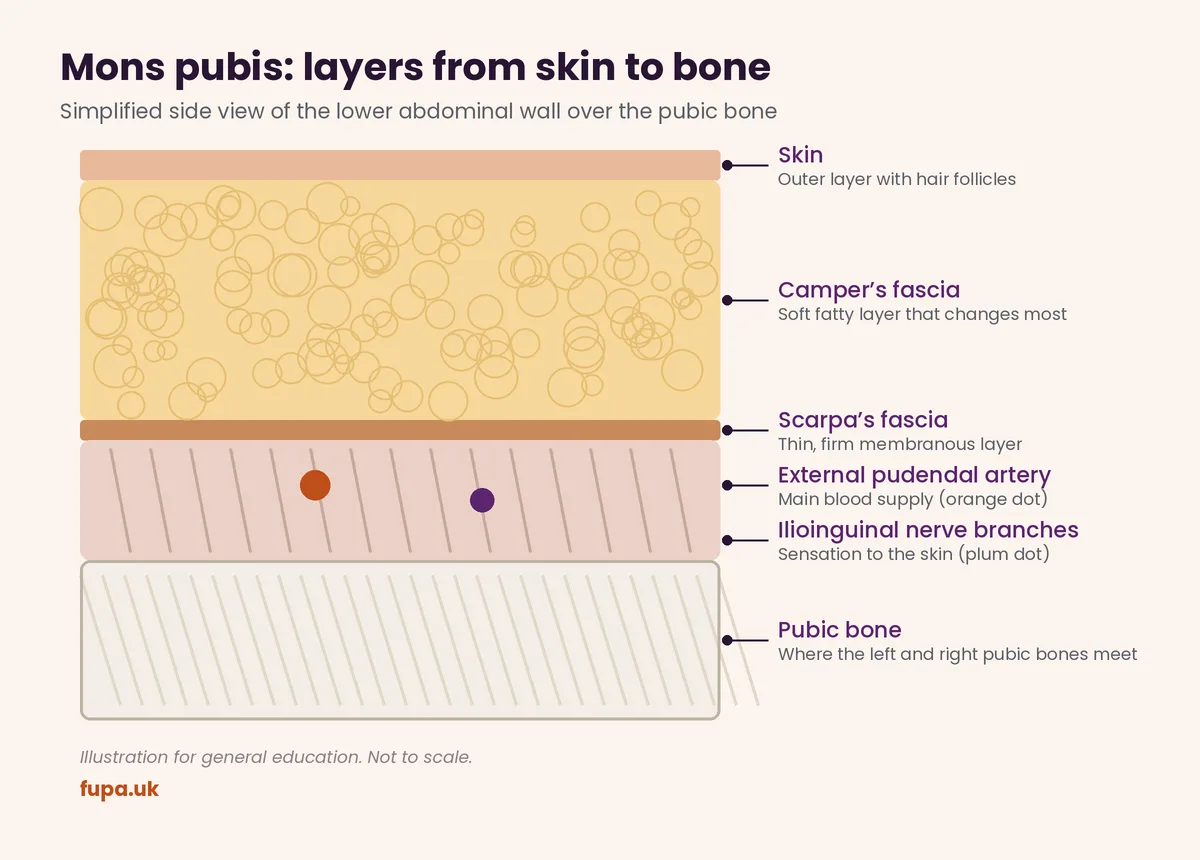
Of these layers, the Camper’s fatty layer changes most over time. Scarpa’s fascia acts like an internal sling. When it stretches or loosens, the whole mons can drop. Doctors call this mons ptosis.
Mons Pubis Anatomy: Nerves, Blood Supply and Lymph
Nerves
The front of the vulva and the mons get their feeling from two nerves that start in the lumbar plexus, a network of nerves in the lower back:
- the ilioinguinal nerve, which gives off branches called the anterior labial nerves in women and anterior scrotal nerves in men
- the genital branch of the genitofemoral nerve
The back part of the genital region is supplied by a different nerve, the pudendal nerve.
Blood Supply and Drainage
Blood reaches the mons mainly through the external pudendal arteries, which branch off the femoral artery at the top of the thigh. Blood drains through the external pudendal veins into the great saphenous vein. Lymph fluid drains to the superficial inguinal lymph nodes in the groin.
What Does the Mons Pubis Do?
The mons has a few practical roles:
- Cushioning. The fat pad softens contact between the pubic bones of two people during sex.
- Protection. It adds padding over the pubic symphysis, which has little natural cover.
- Scent. The skin holds many sweat and oil glands. Some textbooks suggest these glands release chemical signals, or pheromones, that play a role in attraction. In humans, this remains a theory rather than a proven fact.
Why the Mons Pubis Stores Fat
It Is a Subcutaneous Fat Depot
Fat under the skin is called subcutaneous fat. Fat packed around the organs is visceral fat. The mons is a subcutaneous depot, and it links directly to the fat of the lower abdomen.
Oestrogen and the Gynoid Pattern
Before menopause, many women store fat in a “gynoid” pattern. That means fat goes to the hips, thighs, buttocks and lower abdomen, including the mons. Oestrogen drives much of this pattern. Anatomy references note that the mons is fuller when oestrogen is higher and thins when it falls. Men tend towards an “android” pattern, with more fat around the waist and inside the abdomen.
Receptors and Genetics
Fat cells carry receptors for hormones such as oestrogen. Genes also shape where your body lays down fat. That is why two people with the same weight can have very different pubic contours. Read more in our article on how hormones and genetics shape a FUPA.
From Mons Pubis to FUPA
“FUPA” is a casual term for a fuller or overhanging mons pubis and lower belly. It is not a medical diagnosis. A FUPA forms when the Camper’s fatty layer thickens, the skin loosens, or both happen together. For the full definition, read what a FUPA is and why it forms.
Mons Pubis vs FUPA vs Apron Belly vs Lower Belly Pooch
| Feature | Mons pubis | FUPA | Apron belly (pannus) | Lower belly pooch |
|---|---|---|---|---|
| What it is | Normal fat pad over the pubic bone | Enlarged or sagging mons and lower belly | A fold of skin and fat that hangs from the lower abdomen | Soft bulge between the belly button and pubic area |
| Medical term? | Yes | No, informal | Yes, “pannus” or “panniculus” | No, informal |
| Main location | Directly over the pubic symphysis | Mons and area just above it | Lower abdomen, can hang over the mons and thighs | Below the belly button, above the mons |
| Main cause | Normal anatomy, hormones | Fat gain, loose skin, genetics | Major weight gain or loss, pregnancy | Fat, stretched muscles or bloating |
| Common treatment | None needed | Fat loss, liposuction, monsplasty | Panniculectomy or abdominoplasty | Fat loss, core rehab, sometimes tummy tuck |
If the bulge sits higher up, our comparison of a FUPA versus a lower belly pooch helps you tell them apart.
How the Mons Pubis Changes Through Life

Puberty
The NHS says puberty usually starts between ages 8 and 13 in girls and 9 and 14 in boys. In girls, rising oestrogen also adds fat to the mons, hips and thighs. That is why the mons often becomes more rounded in the teenage years.
Pregnancy and After Birth
Pregnancy brings weight gain, fluid retention and stretching of the abdominal wall. The skin over the lower belly and mons can lose some of its elasticity. A caesarean scar can also create a fold just above the mons that makes it look fuller. Our guide to FUPA changes after pregnancy explains what tends to improve and what may not.
Weight Gain and Weight Loss
The mons gains fat along with the rest of the lower abdomen. After large weight loss, the fat may shrink but the skin may not tighten fully. This can leave the mons looking lower or looser than before.
Menopause
In the UK, the average age of menopause is 51, according to the NHS. As oestrogen falls, the mons pad tends to thin. Pubic hair often becomes sparser. At the same time, fat storage tends to shift towards the waist and abdomen. The result can be a flatter mons that sags, sitting under a fuller tummy.
Ageing in Men
Men also see changes with age. Belly fat can push the mons forward. In men with a large pubic fat pad, the penis may look shorter because part of the shaft is buried in fat.
What Is a Normal Size?
There is no single normal size for the mons pubis. Its fullness depends on body fat, hormones, age, pregnancy history and genes. A rounded pubic area is normal in adults, so size alone is not a reason for concern.
When a Mons Pubis Change Is a Medical Concern
Most changes in the mons are gradual and harmless. Some are not. See your GP if you notice sudden swelling, a new lump, skin changes or pain in the pubic area. Conditions a doctor may look for include:
- Lipoma. The NHS describes these as soft, squishy fatty lumps under the skin. They are usually harmless, but a GP should check any new lump.
- Hernia. An inguinal or femoral hernia causes a bulge in the groin that may grow when you cough or strain. A hernia that turns painful, firm or cannot be pushed back needs urgent care.
- Lymphoedema. Fluid build-up can cause the pubic area and genitals to swell.
- Infection or abscess. Red, hot, painful skin, often around hair follicles, may need treatment.
- Skin irritation. Chafing, rashes and fungal infections can develop in skin folds, especially under an overhanging belly.
For everyday soreness and rubbing in this area, see our advice on FUPA pain and skin irritation.
Can You Change the Size or Shape of the Mons Pubis?
Yes, though the right approach depends on whether the issue is mostly fat, mostly loose skin, or both.
- Overall fat loss. A steady calorie deficit, regular activity and good sleep can shrink fat everywhere, including the mons.
- Liposuction. This removes fat from the Camper’s layer through small cuts. It suits people with good skin tone. Read more about FUPA liposuction, including risks and recovery.
- Monsplasty. Also called a mons lift, this surgery removes excess skin and fat and lifts the area by anchoring tissue to deeper structures. See our full guide to monsplasty surgery.
Cosmetic procedures are rarely available on the NHS. Choose a surgeon registered with the General Medical Council who is on its specialist register for plastic surgery.
Frequently Asked Questions
Is the mons pubis the same as a FUPA?
No. The mons pubis is a normal anatomical structure that everyone has. “FUPA” is an informal term used when the mons and the lower belly above it look fuller or hang lower than a person would like. Every FUPA involves the mons, but a normal mons is not a FUPA.
Do men have a mons pubis?
Yes. Men have the same pad of fat over the pubic bone, though it is usually flatter. It sits above the base of the penis and carries pubic hair. Weight gain can enlarge it in men too, and a very full pad can make the penis appear shorter.
Why does my mons pubis stick out when I am slim?
The mons is partly structural fat, so it does not disappear with weight loss. Genes, hormones and the shape of your pelvis also affect how far it projects. A visible mons in a slim person is common and usually normal. Sudden enlargement or a new lump should be checked by a GP.
Does the mons pubis shrink after menopause?
It often does. Falling oestrogen tends to thin the fat pad, reduce pubic hair and loosen the skin. At the same time, more fat may settle around the waist. This combination can make the mons look flatter but lower, sitting beneath a fuller tummy.
Can exercise reduce mons pubis fat?
Exercise helps reduce overall body fat, which can include the mons. However, you cannot burn fat from one spot by working the muscles beneath it. Core training strengthens the abdominal wall but does not remove the fat layer above it. Diet and total activity matter most.
When should I see a doctor about swelling in my pubic area?
See your GP if you notice a new lump, swelling that appears quickly, a bulge that grows when you cough, redness, heat or pain. Seek urgent help if a groin bulge becomes painful and firm, or if you also feel sick or cannot pass wind.
The Bottom Line
The mons pubis is a normal fat pad that sits over the pubic bone in both women and men. It is built from skin, a soft fatty layer, a firmer fascial sling and supporting ligaments. Oestrogen, genes and weight all shape how much fat it holds. It changes through puberty, pregnancy, weight shifts and menopause, so a different shape later in life is expected. Most changes are harmless, but any new lump, sudden swelling or pain deserves a GP visit.