
Do Squats Shrink a FUPA? What Leg Day Really Does to Your Lower Belly
Page Contents
- The Short Answer: Squats Help, But Not in the Way Most People Think
- Why You Cannot Squat Fat Off One Spot
- What Squats Actually Do for a FUPA
- They Use More Energy Than Smaller Moves
- They Build Muscle That Keeps Working
- They Train the Glutes That Change Your Posture
- They Teach Your Core to Brace
- Squats vs Crunches vs Cardio for Lower Belly Fat
- The Best Squat Variations for a FUPA
- A 4-Week Leg Day Plan That Supports FUPA Loss
- Why Your FUPA Can Look Bigger After You Start Squatting
- How Long Until Squats Show on Your Lower Belly?
- When Squats Are Not the Whole Answer
- Frequently Asked Questions
- Do Squats Burn Lower Belly Fat?
- How Many Squats a Day to Lose a FUPA?
- Are Squats Better Than Crunches for a FUPA?
- Can Squats Make My FUPA Bigger?
- Do Weighted Squats Work Better Than Bodyweight Squats?
- Can Men Lose a FUPA With Squats?
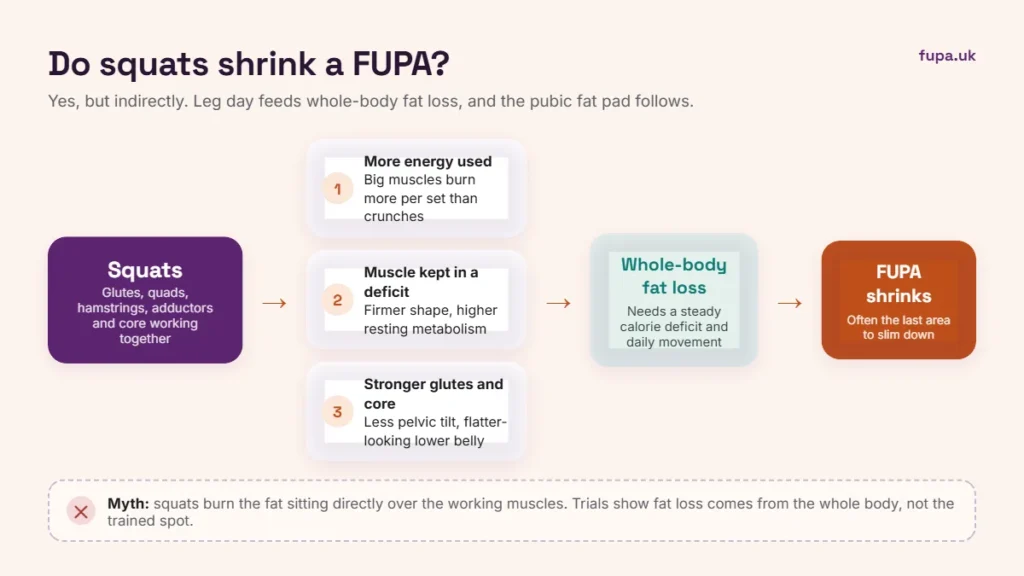
Squats will not burn fat off your pubic area on their own, but they are one of the most useful moves you can do while you lose a FUPA. No exercise can pick where your body takes fat from, and a squat is no exception to that rule.
What squats do well is work the biggest muscles you own. That raises the energy you use, builds muscle that stays active all day, and trains the glutes and core that shape how your lower belly sits.
This guide explains what leg day really does to the fat upper pubic area, what two key studies found, and how to use squats inside a plan that works. For the full picture, start with our guide on how to get rid of a FUPA.
The Short Answer: Squats Help, But Not in the Way Most People Think
A FUPA is a pad of subcutaneous fat over the mons pubis, the soft mound in front of the pubic bone. It shrinks when your whole body loses fat, which happens when you use more energy than you eat.
Squats help you reach that calorie deficit and keep muscle while you are in it. They do not send a signal to the fat just above them, because fat is released into the blood and burned wherever the body needs fuel.
So the honest answer is yes, squats can help shrink a FUPA over time. They just do it indirectly, through body fat, muscle and posture, rather than by melting the lower belly fat sitting over the working muscles.
Why You Cannot Squat Fat Off One Spot
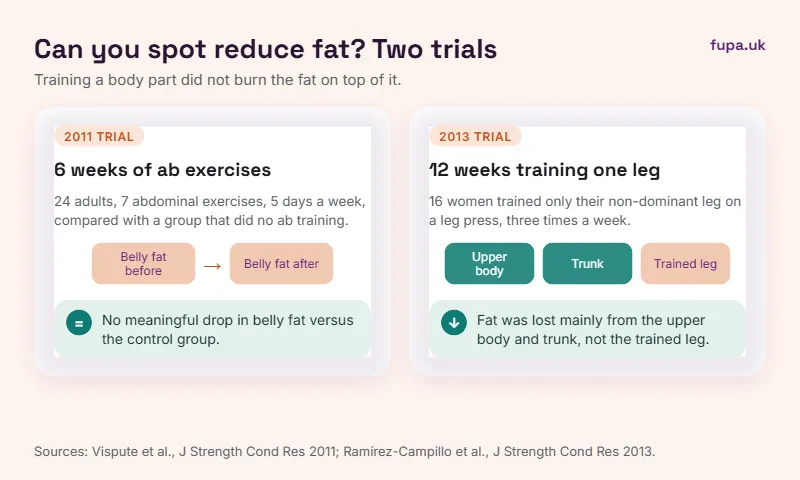
The idea that working a muscle burns the fat on top of it is called spot reduction. It sounds logical, but controlled trials have tested it several times, and the results point the same way almost every time.
In a 2011 trial, 24 adults did seven abdominal exercises five days a week for six weeks. The researchers found no meaningful drop in belly fat compared with a group that did not train their abs.
A 2013 study trained only one leg of 16 women for 12 weeks. The fat they lost came mostly from the upper body and trunk, not from the leg doing all the work, which is the clearest sign that fat loss is whole-body.
Genes and hormones also decide where fat goes first and last. Oestrogen and fat cells in the lower belly that respond slowly to fat-burning signals explain why the FUPA is often the last place to slim down.
What Squats Actually Do for a FUPA
They Use More Energy Than Smaller Moves
A squat moves the quadriceps, glutes, hamstrings, adductors and calves at once, with the core bracing to hold your spine. More muscle working means more energy used per set than a crunch or a leg raise.
The calories from one session are modest, so do not treat squats as a fat burner. Their value comes from repeating them week after week, adding load, and pairing them with daily walking and sensible eating.
That combination creates the steady calorie deficit your body needs to release fat from every store, including the suprapubic fat pad that forms a FUPA. Our FUPA diet guide covers the eating side.
They Build Muscle That Keeps Working
Resistance training builds and protects muscle. A 2022 review of 58 trials found that strength training alone lowered body fat percentage, fat mass and visceral fat in healthy adults, even without a diet plan attached.
Muscle also matters most when you are eating less. Without strength work, a good share of the weight you lose can come from muscle, which leaves you softer and makes the lower belly look no flatter.
Squats, lunges and hip hinges protect the largest muscle mass in your body. That keeps your resting metabolic rate higher and your shape firmer while the fat layer over the pubic area slowly thins.
They Train the Glutes That Change Your Posture
Weak glutes and tight hip flexors often go with anterior pelvic tilt, where the pelvis tips forward. That tilt pushes the lower belly out and can make a small FUPA look much bigger than it is.
Deep squats, hip thrusts and glute bridges strengthen the muscles that pull the pelvis back towards neutral. Many people see a flatter lower tummy within weeks, long before much fat has actually gone.
If you stand with an arched lower back, read our guide to FUPA and posture and try its two-minute wall test before judging how much of your bulge is really fat.
They Teach Your Core to Brace
A heavy squat forces the deep core to brace. The transverse abdominis, obliques and pelvic floor tighten together to control intra-abdominal pressure and keep your trunk upright under the bar or dumbbell.
That bracing will not remove fat, but it builds the strength that holds the lower abdomen in during the day. It is the same deep core work that helps a belly that pushes forward after pregnancy.
Breathe in before you lower, brace as if about to cough, and breathe out as you stand. Never hold your breath hard if you have high blood pressure or pelvic floor symptoms.
Squats vs Crunches vs Cardio for Lower Belly Fat
Each type of training plays a different role in shrinking a FUPA. Used together, they cover energy use, muscle, posture and heart health, which no single move can manage by itself.
| Training | Burns fat directly over the FUPA? | What it does well | Where it falls short |
|---|---|---|---|
| Squats and leg strength work | No | Builds large muscles, protects muscle in a deficit, strengthens glutes and posture | Modest calories per session |
| Crunches and leg raises | No | Strengthens the abdominal muscles under the fat | Small muscles, very low energy use |
| Walking and steady cardio | No | Adds daily energy use with little recovery cost | Does little for muscle or shape |
| HIIT | No | High energy use in a short time | Hard to recover from if done every day |
The pattern is clear. None of them targets pubic fat, so the best plan mixes strength work with plenty of movement, as our guide on walking to lose a FUPA explains.
The Best Squat Variations for a FUPA
You do not need a barbell. Pick one or two of these, learn the form, and add weight or reps slowly. Stop any move that causes sharp pain, doming of the tummy or pelvic pressure.
| Variation | Main muscles | Why it suits a FUPA plan | Form cue |
|---|---|---|---|
| Goblet squat | Quads, glutes, core | Holding the weight in front forces an upright chest and a strong brace | Elbows inside knees at the bottom |
| Sumo squat | Adductors, glutes | Wide stance trains the inner thighs and hips, and suits tight ankles | Knees track over the toes |
| Box squat | Quads, glutes | Gives a safe depth target for beginners and heavier bodies | Sit back, touch, stand without rocking |
| Bulgarian split squat | Glutes, quads, hip flexors | Stretches the hip flexors that feed pelvic tilt | Tuck the tail bone slightly under |
| Hip thrust (partner move) | Glutes | Strongest glute builder for pulling the pelvis back to neutral | Ribs down, squeeze at the top |
If a round lower belly makes deep squats awkward, a wider stance and a box behind you help. Our FUPA exercises guide adds core moves that pair well with these.
A 4-Week Leg Day Plan That Supports FUPA Loss
This beginner outline follows the NHS advice for adults: strength work on at least two days a week and 150 minutes of moderate activity spread across the week.
| Week | Strength (2 days) | Daily movement |
|---|---|---|
| 1 | Box squat 3 x 10, glute bridge 3 x 12, dead bug 3 x 8 each side | Walk 20 to 30 minutes most days |
| 2 | Goblet squat 3 x 10, hip thrust 3 x 10, plank 3 x 20 seconds | Build to 7,000 steps a day |
| 3 | Goblet squat 4 x 8 heavier, split squat 3 x 8 each leg, side plank 3 x 20 seconds | Add one brisk hill walk |
| 4 | Sumo squat 4 x 8, hip thrust 4 x 10, dead bug 3 x 10 each side | Aim for 8,000 to 10,000 steps |
Keep protein at every meal, sleep seven to nine hours, and weigh yourself weekly rather than daily. Progress on the lower belly follows total fat loss, so track the waist and hips too.
Why Your FUPA Can Look Bigger After You Start Squatting
Some people panic when their lower belly looks fuller after a few weeks of leg day. This is common and usually temporary, and it rarely means the training is adding fat to the pubic area.
Hard training causes short-term water retention in the muscles, and bigger meals to fuel sessions can add bloating. Growing glutes and thighs can also change how your jeans sit, pushing the waistband into the fold.
Judge progress over eight to twelve weeks, not after one session. If your weight is steady but the bulge changes day to day, read our guide on FUPA vs bloating.
How Long Until Squats Show on Your Lower Belly?
Posture and core control improve first, often within four to six weeks. Strength rises quickly too, so the same weight will feel lighter well before you see much change in the mirror.
Visible fat loss over the pubic area usually takes longer. A safe pace is about 0.5 to 1 kg a week, and because the FUPA tends to go last, it often takes three to six months of steady work.
How much fat you have, your age, hormones and pregnancy history all change that timeline. Our guide on whether a FUPA goes away explains the realistic range for each cause.
When Squats Are Not the Whole Answer
Squats cannot tighten stretched skin. If what you pinch is thin and loose rather than soft and thick, the cause may be skin laxity after weight loss or pregnancy, which exercise alone will not fix.
Our guide to loose skin vs fat in the lower belly shows how to tell the two apart. Surgery such as a monsplasty is only worth discussing once your weight has been stable.
See your GP or a women’s health physiotherapist first if squatting causes pelvic pressure, leaking, tummy doming or pain. These can point to diastasis recti or pelvic floor weakness that needs a tailored plan.
Frequently Asked Questions
Do Squats Burn Lower Belly Fat?
Not directly. Squats burn energy and build muscle, which supports whole-body fat loss. Lower belly fat shrinks as part of that process, but the body decides the order, and the pubic area is often last.
How Many Squats a Day to Lose a FUPA?
There is no magic number. Two or three strength sessions a week with three to four sets of 8 to 12 hard reps work better than hundreds of easy daily squats, alongside a calorie deficit.
Are Squats Better Than Crunches for a FUPA?
For fat loss, yes. Squats use far more muscle, so they burn more energy and protect more muscle in a deficit. Crunches still help core strength, so a good plan can include both.
Can Squats Make My FUPA Bigger?
No. Squats do not add fat to the pubic area. Short-term bloating, water in the muscles or a waistband sitting differently over bigger glutes can make it look fuller for a few weeks.
Do Weighted Squats Work Better Than Bodyweight Squats?
Usually, once your form is solid. Adding load builds more muscle and strength over time. Beginners can start with bodyweight or box squats, then move to a dumbbell or kettlebell within a few weeks.
Can Men Lose a FUPA With Squats?
Yes, in the same way as women. Heavy leg training also supports healthy testosterone, which helps men store less fat low on the belly. Our guide on how men can lose a FUPA covers the details.