
Is the Word FUPA Offensive?
Page Contents
- What Does FUPA Actually Stand For?
- Where The Word FUPA Came From
- Is FUPA Actually Offensive?
- Using FUPA About Yourself Versus Someone Else
- Beyoncé, Amy Schumer And The Term’s Reclamation
- Body Positivity Versus Body Neutrality On FUPA
- Clinical Alternatives: Mons Pubis, Panniculus, Suprapubic Fat Pad
- FUPA In UK Workplaces And Professional Settings
- FUPA In Clinical Consultations And NHS Care
- FUPA On Social Media And In The Press
- How To Respond If Someone Calls You A FUPA
- Kinder Alternatives To Say Instead
- Frequently Asked Questions
- Is It Rude To Say FUPA?
- What Is The Medical Word For FUPA?
- Did Beyoncé Really Use The Word FUPA?
- Should I Use FUPA At Work?
- Is FUPA A Slur?
- What Can I Say Instead Of FUPA To My GP?
What Does FUPA Actually Stand For?
The acronym FUPA is a colloquial abbreviation that most often stands for Fat Upper Pubic Area, sometimes written as fatty upper pubic area. It describes the soft subcutaneous fat cushion sitting above the pubic bone.
Because it is an informal term, its meaning drifts by context. In beauty blogs and social captions it is a four-letter acronym for a body area; in common usage it names a lower abdomen contour.
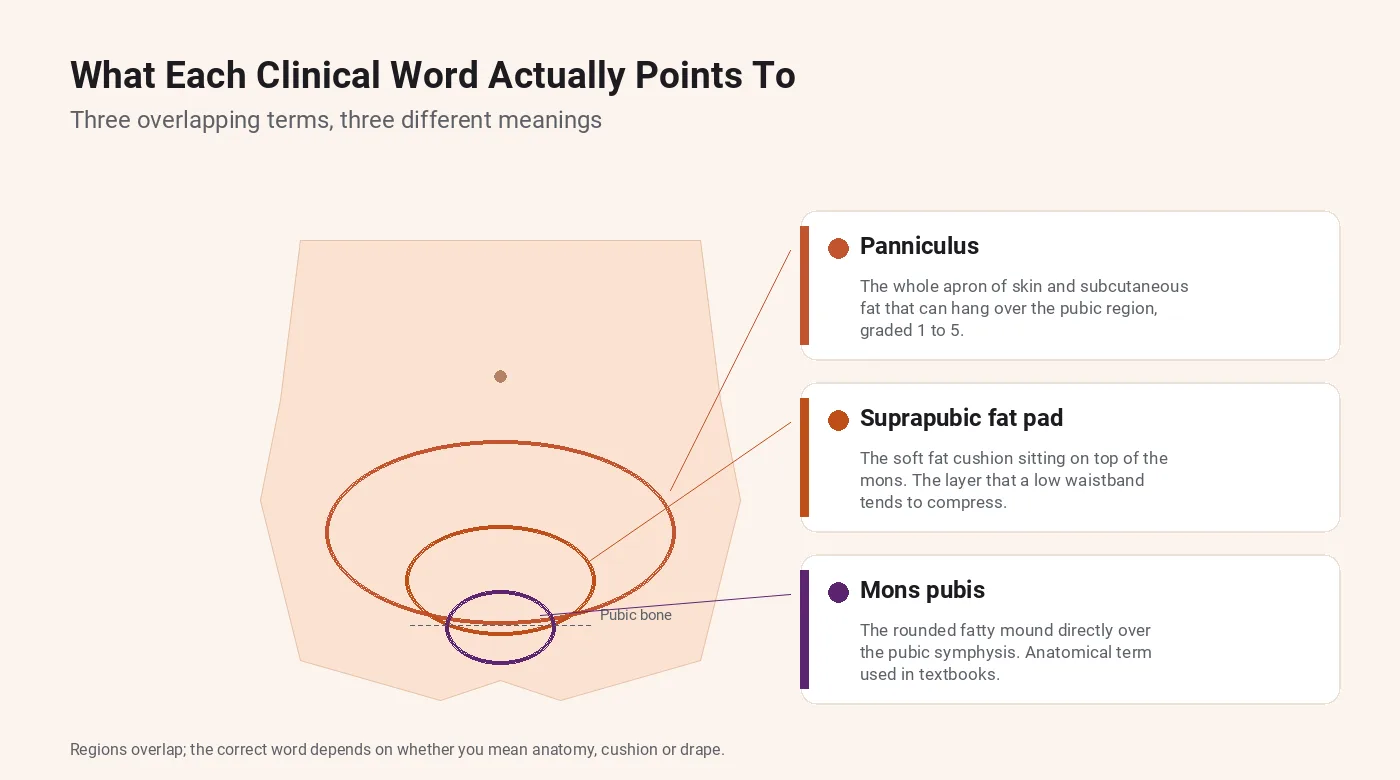
The soft tissue pad in question sits above the pubic bone, right over the pubic symphysis. It is not the belly, nor the hips; it is the discrete cushion that a low waistband can compress.
Where The Word FUPA Came From
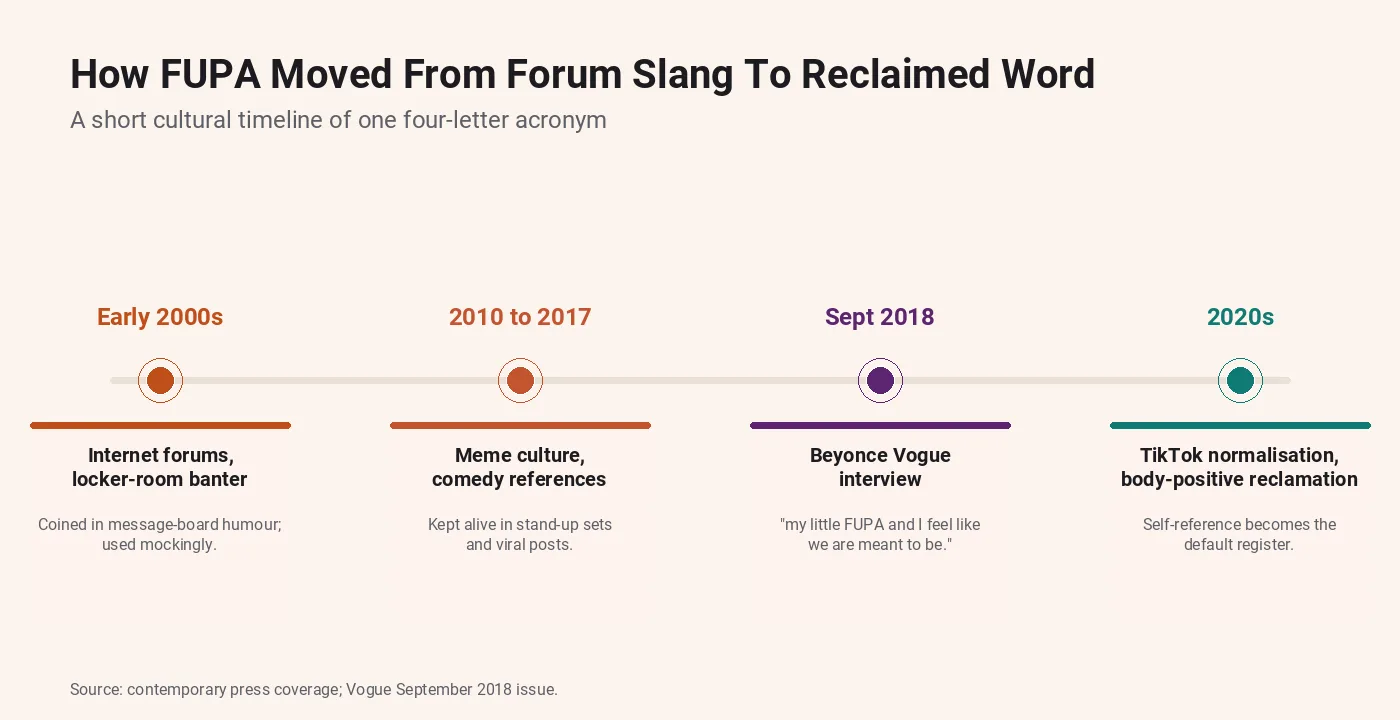
The word rose from early 2000s internet forums and locker-room slang, a piece of message-board humour that spread through edgy internet culture. Its earliest print traces sit in hip-hop and comedy references of that era.
For a decade it was largely a mockery to reclamation journey stalled at mockery. Meme culture kept it alive through the 2010s, and eventually TikTok normalisation carried it into the informal register of everyday captions.
Its arc is a neat case study in cultural evolution: a colloquial coinage that started as a jibe, moved through a decade of shift in meme culture, and became a proud self-identifier on major platforms.
Is FUPA Actually Offensive?
The honest answer is context-dependent. Tone matters, register matters, and the intent of the speaker matters. The same word can be an inside joke between friends or an act of body-shaming aimed at a stranger.
Applied to yourself it often reads as playful self-deprecation or a genuine reclaimed term. Applied to another person without invitation it slides into mocking language, which is why the same acronym can feel very different.
Two useful tests apply here: is the reference an insult or an endearment in this relationship to the listener, and is there implied consent to use the term. In-group versus out-group dynamics decide almost every case.
Using FUPA About Yourself Versus Someone Else
Self-describing clearly carries agency over language. When a woman writes “my FUPA and I are having a moment” on Instagram, that is first-person use, an exercise of body autonomy, and the safer usage by default.
Pointed at another person without permission it becomes a second-person offence, or worse, third-party gossip. Even a compliment in that direction can read as an unsolicited comment about someone else’s shape, and cross personal boundaries.
The respectful default is simple: use the word freely about your own body, and reach only for a description that someone else has chosen for themselves when writing or speaking about them. Self-reference first, always.
Beyoncé, Amy Schumer And The Term’s Reclamation
The mainstream reclamation moment is easy to date. In the Beyoncé Vogue September 2018 interview, discussing her postpartum body, Beyoncé told the magazine, “my little FUPA and I feel like we are meant to be.”
That was a body-positive celebrity moment with real cultural weight. It sat inside a magazine cover story and recast the acronym as something a Grammy-winner could claim without any embarrassment. A cultural pivot point followed.
Amy Schumer stand-up references, magazine round-ups and years of media coverage pushed the term further. Combined with mass-media normalisation, the celebrity endorsement effect dragged FUPA out of pure jibe territory and into ordinary body vocabulary.
Body Positivity Versus Body Neutrality On FUPA
The body positivity movement encouraged people to call their FUPA beautiful. Body neutrality, associated with psychologist Susan Albers, offers a middle path: a person’s value is not tied to how a body part looks anyway.
Neutrality is useful here because it side-steps toxic positivity and forced affirmation. You do not have to call your FUPA cute; you can simply describe it, apply functional appreciation, and refuse to grade appearance-based value.
The descriptive versus judgmental language distinction matters most in health writing. Neutral vocabulary, size-inclusive framing and honest self-acceptance protect mental health impact far better than forced enthusiasm about a body part you did not choose.
Clinical Alternatives: Mons Pubis, Panniculus, Suprapubic Fat Pad
In medical terminology, the tissue behind the slang word lives under several anatomical labels. The pad above the pubic symphysis is the mons pubis, historically the mons Veneris, enlarged in puberty by oestrogen sensitivity.
Where lower abdominal fat and lax skin hang as an apron, doctors use panniculus, graded on a panniculus grading 1 to 5 scale. Clinics also call this layer subcutaneous fat pad or suprapubic fat pad.
These sit in a formal clinical register you will meet in a GP consultation, on plastic surgery consent forms, in aesthetic medicine language and across dermatology vocabulary. Learning them helps you speak to clinicians without embarrassment.
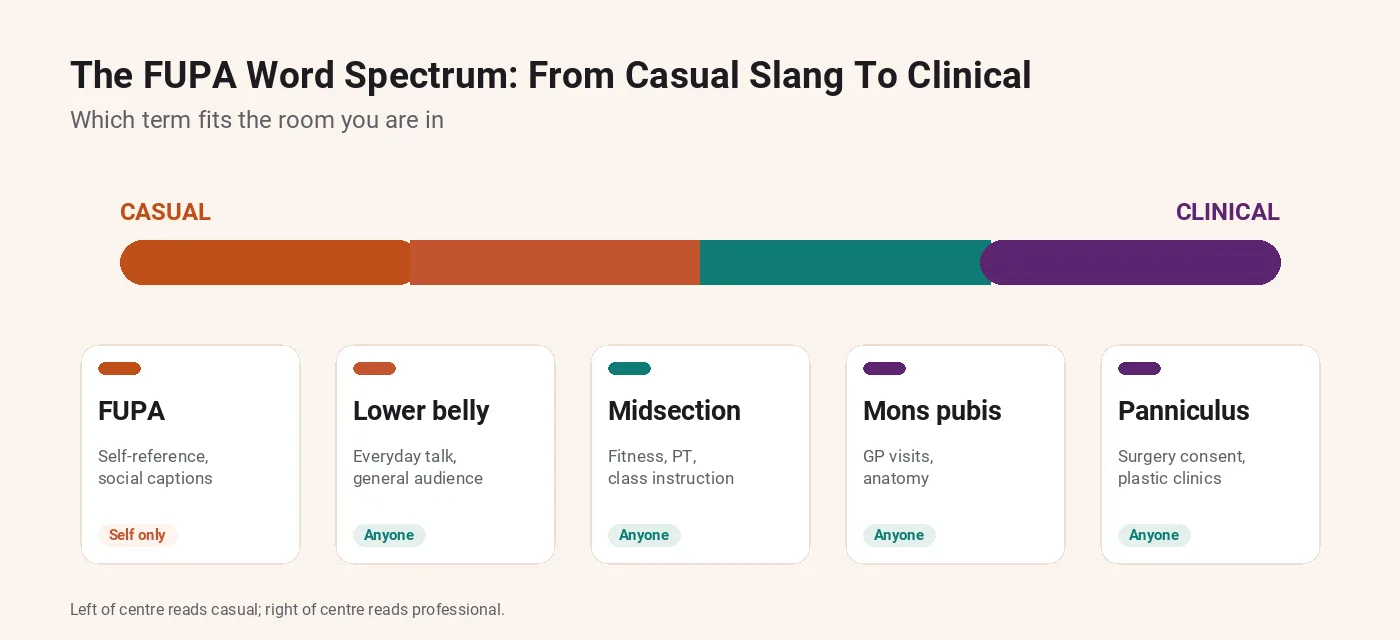
| Situation | Register | Preferred word |
|---|---|---|
| Instagram caption about your own body | Casual, first-person | FUPA |
| Speaking to a stranger you have just met | Neutral | Lower belly, midsection |
| GP or midwife appointment | Clinical | Mons pubis, lower tummy |
| Cosmetic surgery consent form | Formal clinical | Panniculus, suprapubic fat pad |
| Fitness class or personal trainer session | Neutral fitness | Core, midsection |
| Body-positive social post | Reclaimed | FUPA (self-reference only) |
| UK broadsheet or client-facing copy | Editorial | Lower abdomen |
FUPA In UK Workplaces And Professional Settings
In a workplace language context FUPA rarely lands well. The word breaks a professional register, invites HR policy questions and, aimed at a colleague, risks turning banter versus bullying debates into a grievance under ACAS guidance.
Dignity at work policies treat unwelcome appearance-based comments as harassment risk. Under the Equality Act 2010 protected characteristics cover age, sex, disability and more; body shape is not itself protected, though harm often falls nearby.
For client-facing communication, editors and managers usually swap the slang for “lower abdomen” or “midsection”. This keeps the meaning, drops the mockery, and matches the tone readers expect from a UK health or lifestyle brand.
FUPA In Clinical Consultations And NHS Care
NHS inclusive language guidance asks clinicians to use person-first language and non-stigmatising terminology when describing weight or body. FUPA fails that test cleanly, so midwifery language and GP appointment vocabulary avoid the word almost entirely.
For an obesity talk, NICE CG189 obesity guidance frames the conversation around waist circumference and long-term health risk, not slang. A pre-operative consultation uses weight and body descriptors from cosmetic surgery consent forms, not TikTok.
Good patient-centred communication and trauma-informed care mean the clinician mirrors words the patient uses first. If a patient says FUPA, the doctor may follow; the clinician does not lead with slang for safeguarding tone reasons.
FUPA On Social Media And In The Press
On social platforms the tone is mostly self-directed. Instagram captions and TikTok trends carry playful hashtag reclamation, while Reddit threads treat the word as ordinary vocabulary for describing lower-belly weight change and postpartum body shape.
The tabloid picture is uglier. Tabloid headlines, paparazzi culture and celebrity photo shaming have often weaponised the term against women in beach shots. Editorial style guides in the UK broadsheet press generally avoid the word entirely.
Comment-section discourse shows the real risk: even when the original post is kind, algorithmic amplification pushes cruel replies right up. Associated Press guidance and modern respectful reporting manuals point away from FUPA towards neutral descriptors.
How To Respond If Someone Calls You A FUPA
Start by naming the behaviour without heat. A short, calm assertive response such as, “please do not comment on my body,” is often enough. Boundary-setting phrases work better than any explanations, leaving you in control.
If humour is easier, humour deflection works: “thanks, I grew it myself.” If the moment is unsafe, the walk-away option comes first. In an office, follow the workplace reporting route and, if needed, the ACAS grievance process.
Repeated comments deserve a friend or family conversation. If words are eroding your mood, mental health support matters: Mind and Samaritans signposting is free, your GP can arrange a therapy referral, and self-compassion practice helps.
Kinder Alternatives To Say Instead
For everyday conversation, “lower belly”, “tummy” and “pelvic area” cover almost every situation. For fitness talk, “midsection” or “core” carry the same meaning without the loaded slang, and match how UK personal trainers usually speak.
For discussing pregnancy and recovery, “postpartum shape” or “post-baby body” feel natural without dragging in a jibe. For clinicians, use “mons pubis” (clinical), “panniculus” (clinical) or “suprapubic fat pad” (clinical) where clinical accuracy matters more.
Two simple habits keep things kind. The first-person only rule: use FUPA about yourself if you like it. The silence-is-fine principle: if any alternative feels forced, saying nothing about a stranger’s body is always better.
Frequently Asked Questions
Is It Rude To Say FUPA?
Rudeness lives in context and tone and intent, not in the letters. Said about your own body, the word reads as playful; aimed unbidden at another person, it slides into body-shaming risk almost every time.
Setting matters as much as speakers. Between friends, in a self versus other joke about the same person, the word can be affectionate. In a stranger-facing setting, close friends versus strangers etiquette flips it quickly.
The single reliable test is this: would that person choose the word for their own body. If yes, carry on; if not, or if you are unsure, pick a plainer word and move quietly on.
What Is The Medical Word For FUPA?
The pad of fat above the pubic bone has more than one clinical register name. Anatomy textbooks use mons pubis, which is the correct anatomical term for the mound over the pubic symphysis in adults.
When the lower belly hangs as a fold, doctors use panniculus, often with a specific grade to describe its size and reach. Subcutaneous fat is the general layer name that sits beneath the skin here.
Cosmetic clinics also use suprapubic fat pad, particularly on plastic surgery consent forms where accuracy matters. All three words describe overlapping tissue; the right choice depends on whether you mean anatomy, volume or the drape.
Did Beyoncé Really Use The Word FUPA?
Yes. In the Vogue September 2018 issue, in a postpartum interview on how her body changed after twins, Beyoncé used the word. The direct quote reads, “my little FUPA and I feel meant to be.”
The context matters. She was discussing acceptance of a body that had carried children, not delivering a joke at anyone’s expense. That framing made the line a widely-shared reclamation moment rather than any punchline.
It was widely cited in the mainstream press, in body-image essays and in commentary on postpartum recovery. It is why many British readers first met the acronym without the mocking tone that had shadowed it.
Should I Use FUPA At Work?
Very cautiously. UK workplaces run on a fairly restrained workplace register, and unsolicited comments on colleagues’ bodies sit close to conduct that falls under the Equality Act 2010 and standard HR sensitivity in most employers.
For client-facing tone, drop the slang. In an internal chat with colleagues who share the joke, self-reference is usually fine. Applied to anyone else, even lightly, it is the sort of comment people quietly remember.
For safer, more grown-up wording, editors use the safer alternatives listed above: “lower abdomen”, “midsection” or “pelvic area”. Those swap the acronym for a plain description and keep the meeting, email or brief comfortably professional.
Is FUPA A Slur?
No, not by any recognised slur definition. A slur normally targets a protected characteristic such as race, religion, sexuality or disability. FUPA describes a body area, not a person’s identity, with no legally protected class attached to it.
It sits nearer to an appearance-based insult or a body-shaming category term. That still hurts and can amount to harassment when repeated at work, but the legal handle is usually harassment policy, not slur laws.
Because the word is not a slur, treating it as taboo overshoots. The sensible position is to notice tone, setting and target, and to keep it inside self-directed use where it lands with least harm.
What Can I Say Instead Of FUPA To My GP?
For GP-friendly wording, a short plain description works best. “The lower part of my tummy just above the pubic bone” is instantly clear, medically neutral, and gets the doctor looking at the right area quickly.
If you want something briefer, “lower tummy” or “mons area” are both accepted. “Pubic area fat pad” is a longer phrasing that some patients prefer because it sounds explicitly medical and avoids the slang entirely.
Do not feel obliged to explain. Your GP has heard every version, uses technical labels internally, and will re-word your description for the notes. A calm sentence and pointing to the area is quite enough.