
FUPA and Sugar: Does Cutting Sugar Shrink Lower Belly Fat?
Page Contents
- Key Takeaways
- FUPA and Sugar: What the Evidence Shows
- Sugar works through calories
- Swapping sugar for other carbohydrates changed nothing
- Why the average looks small
- Can Sugar Go Straight to Your FUPA?
- No food targets one spot
- Spot reduction does not work either
- Visceral fat versus the fat pad
- What feeding trials add
- Which Sugars Count?
- Free sugars
- Sugars you do not need to cut
- The daily limit
- Where Free Sugar Hides in a UK Diet
- Drinks come first
- Foods that look healthy
- Alcohol and mixers
- How to Read a Food Label for Sugar
- The per 100 g rule
- Traffic light labels
- Other names for sugar
- Total sugar is not the same as free sugar
- A Realistic Plan to Cut Sugar for a FUPA
- Start with drinks
- Cut back in steps
- Rebuild breakfast and snacks
- Keep the calorie deficit in view
- Aim for less, not zero
- Sugar, Blood Sugar and Insulin
- What happens after a sugary snack
- When insulin resistance is part of the picture
- Cravings, stress and sleep
- Sweeteners: A Useful Swap or a Trap?
- What UK guidance says
- The World Health Organization view
- Sugar alcohols and bloating
- How Long Before a FUPA Looks Smaller?
- Early changes are often water and gas
- Fat loss takes months
- Pair it with movement
- When fat loss is not the whole story
- Frequently Asked Questions
- Does sugar cause a FUPA?
- Will cutting sugar get rid of my FUPA?
- How much sugar can I have a day?
- Is fruit bad for a FUPA?
- Are diet drinks better than sugary drinks for belly fat?
- Why has my lower belly not changed after cutting sugar?
- The Bottom Line
- Cut the sugar that adds calories quietly
Sugar gets blamed for almost every kind of belly fat. So what is the real link between a FUPA and sugar? A FUPA is a pad of fat over the mons pubis, the soft area just above the pubic bone. Cutting sugar can help it shrink, but it works in one main way: by lowering the total calories you eat. Sugar does not travel to the lower belly on its own, and removing it does not pull fat from that spot first.
This guide covers what the research shows, which sugars count and how to cut back without a strict ban. It sits within our wider guide on how to get rid of a FUPA.
This guide is general information, not medical advice. If you have diabetes, a history of disordered eating, or take medicine that affects blood sugar, speak to your GP or a registered dietitian before you change your diet.
Key Takeaways
- Sugar does not build a FUPA directly. It adds to your total calorie intake, and extra fat is stored where your body already prefers to keep it.
- In trials where people ate freely, cutting sugar led to a small average weight loss. When sugar was swapped for other carbohydrates with the same calories, weight did not change.
- Sugary drinks are the best place to start. They add calories without filling you up.
- The NHS limit for adults is 30 g of free sugars a day, about seven sugar cubes. Sugar in whole fruit, vegetables and plain milk does not count towards it.
- Expect the lower belly to change slowly. Track a tape measure, not just the scales, and give it months rather than weeks.
FUPA and Sugar: What the Evidence Shows
Sugar works through calories
The clearest summary comes from a review that pooled randomised trials and cohort studies, published in the BMJ in 2013. In trials where adults ate as they liked, those who cut sugar lost an average of about 0.8 kg. Those who added sugar gained a similar amount.
Swapping sugar for other carbohydrates changed nothing
The same review looked at trials where sugar was replaced with other carbohydrates and calories stayed the same. Body weight did not change. In other words, sugar has no special fattening power of its own. It adds weight because it is easy to eat or drink a lot of it without feeling full.
Why the average looks small
An average hides a wide range. Two cans of full sugar cola a day leave far more room to cut than one spoon of sugar in tea. Many of the trials were also short.
Can Sugar Go Straight to Your FUPA?
No food targets one spot
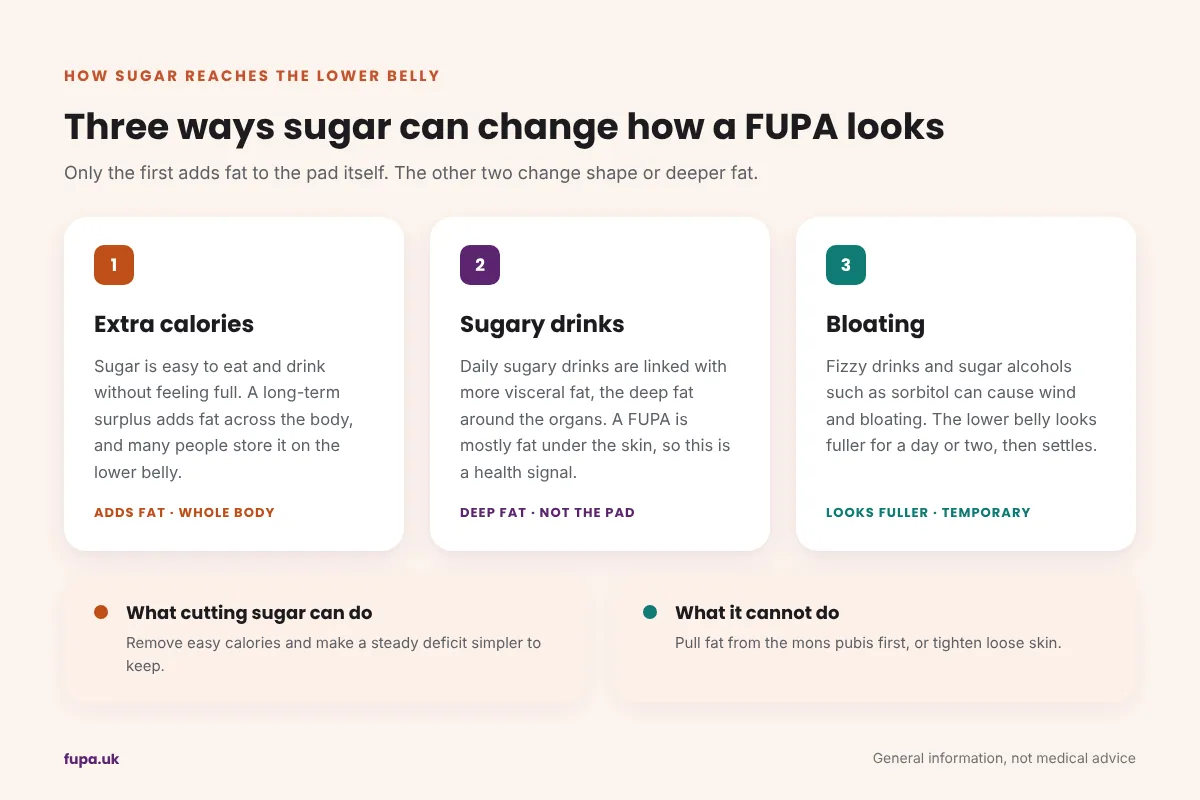
Fat from any food is stored in a pattern set by your genes, sex hormones and age. Many women store fat on the hips, thighs and lower abdomen, and the mons pubis sits inside that zone. The anatomy of the mons pubis explains why this pad has room to grow when you gain weight.
Spot reduction does not work either
The reverse is also true. Cutting sugar does not drain fat from the FUPA first. When you lose fat, your body draws on stores across the whole body. For many people the lower belly is one of the last places to change. Our guide to common FUPA myths covers this belief and others like it.
Visceral fat versus the fat pad
Some research links sugary drinks with deep belly fat. An analysis from the Framingham Heart Study, published in 2016, followed just over 1,000 adults for six years using CT scans. People who had at least one sugary drink a day gained more visceral fat than people who had none. Diet drinks showed no such link.
Visceral fat wraps around the organs inside the abdomen. A FUPA is mostly subcutaneous fat, which sits under the skin. So this is a good reason to cut sugary drinks. It does not show that sugar builds the pad itself.
What feeding trials add
A small US trial published in 2009 gave overweight adults drinks sweetened with either fructose or glucose for ten weeks. Both groups gained a similar amount of weight. The fructose group gained more deep abdominal fat. The doses were large, about a quarter of daily energy. The result speaks to heavy sugary drink habits, not a normal diet.
Which Sugars Count?
Free sugars
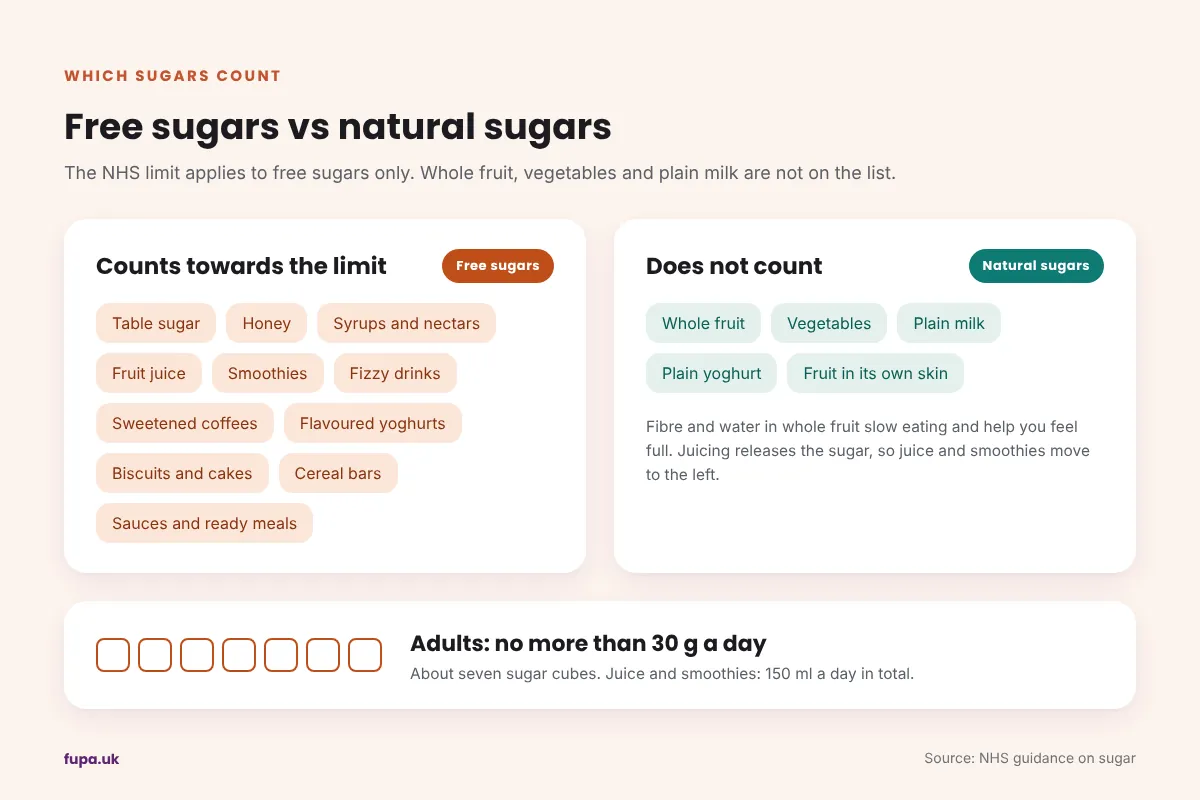
NHS advice focuses on free sugars. These are sugars added to food or drink by you, a cook or a manufacturer. They also include the sugar in honey, syrups, nectars and unsweetened fruit juice, smoothies and purées.
Sugars you do not need to cut
Sugar found naturally in whole fruit, vegetables and plain milk is not a free sugar. Whole fruit comes with fibre and water, which slow you down and help you feel full. The NHS says there is no need to cut down on these.
The daily limit
Adults should have no more than 30 g of free sugars a day, which is about seven sugar cubes. This keeps free sugars to no more than 5% of daily energy. A standard 330 ml can of full sugar cola holds around 35 g, which is more than the whole daily limit in one drink.
Fruit juice and smoothies count too. The NHS suggests keeping them to a combined 150 ml a day, drunk with a meal.
Where Free Sugar Hides in a UK Diet
Drinks come first
Sugary drinks are the easiest place to cut. They add calories without making you feel full, so most people do not eat less later to make up for them. Fizzy drinks, energy drinks, sweetened coffees, juice and smoothies all count.
Foods that look healthy
Flavoured yoghurts, granola, cereal bars, shop bought smoothies, cooking sauces and ready meals can hold more sugar than you expect. Some low fat products add sugar to replace lost flavour, so a lower fat label does not always mean fewer calories.
Alcohol and mixers
Cider, cocktails, alcopops and sweet mixers add sugar on top of the calories already in the alcohol. Our guide to alcohol and a FUPA covers how drinking affects the lower belly.
How to Read a Food Label for Sugar
The per 100 g rule
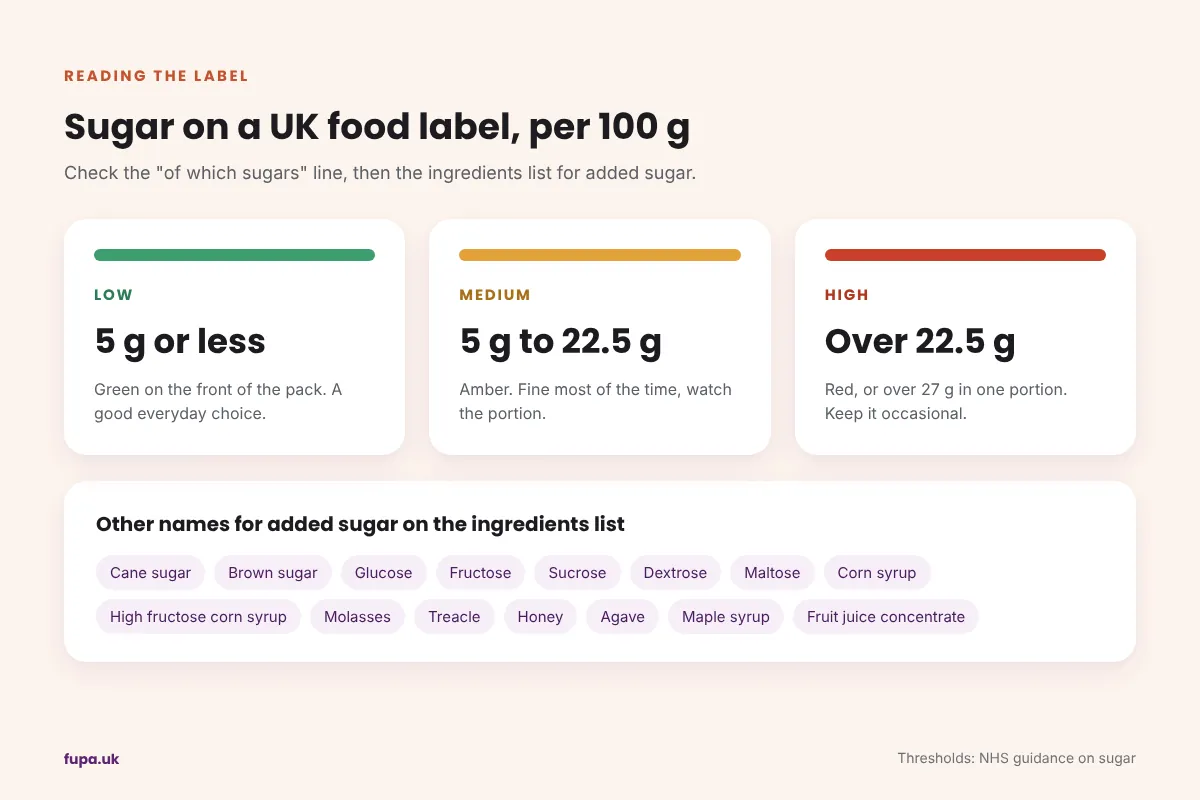
Look at the “of which sugars” line under carbohydrate. The NHS guide to sugar sets these thresholds for food: more than 22.5 g per 100 g is high, and 5 g or less per 100 g is low. Anything in between is medium.
Traffic light labels
Many UK packs use red, amber and green colours on the front. Red means high, amber means medium and green means low. A food can also show red for sugar if one portion has more than 27 g. Aim for mostly green and amber, and keep red items as occasional choices.
Other names for sugar
Ingredients are listed by weight, heaviest first. If sugar appears near the top, the product is likely to be high in it. Watch for these names: cane sugar, brown sugar, glucose, fructose, sucrose, dextrose, maltose, corn syrup, high fructose corn syrup, molasses, treacle, honey, agave, maple syrup and fruit juice concentrate.
Total sugar is not the same as free sugar
The label shows total sugars, including those from milk and fruit. This is why plain yoghurt or a fruit salad can show a sugar figure even with nothing added. Use the ingredients list to see whether any sugar has been added.
A Realistic Plan to Cut Sugar for a FUPA
Start with drinks
Swap sugary drinks for water, sparkling water, plain milk or sugar free versions. If you like squash, choose no added sugar and dilute it well. This one change often removes more free sugar than any other step.
Cut back in steps
If you take sugar in tea or coffee, reduce it by half a spoon each week. Many people find their taste adjusts within a few weeks. The same works for cereal and porridge.
Rebuild breakfast and snacks
Choose unsweetened wholegrain cereal or plain oats and add fruit for sweetness. Pick plain yoghurt and add berries. Protein at each meal helps you stay full for longer. Our guide to protein for FUPA fat loss shows how much to aim for.
Keep the calorie deficit in view
Cutting sugar only helps if the calories you save are not replaced. A large bowl of pasta in place of a chocolate bar can cancel the benefit. Our calorie deficit guide explains how to set a sensible target, and the FUPA diet guide covers meal structure.
Aim for less, not zero
A slice of birthday cake or a square of chocolate fits inside a 30 g limit. The goal is a lower daily average that you can keep up for months. A rule you break every weekend is harder to sustain than a modest one you keep.
Sugar, Blood Sugar and Insulin
What happens after a sugary snack
When you eat sugar, your blood glucose rises and your pancreas releases insulin. Insulin moves glucose into your cells for energy and helps store any extra. This is normal after any meal with carbohydrate.
When insulin resistance is part of the picture
In insulin resistance, cells respond less well to insulin, so the body makes more of it. This is linked with weight gain around the middle and with type 2 diabetes. Cutting free sugars and refined carbohydrates is part of standard advice for lowering that risk. Our guide to insulin resistance and a FUPA explains the signs and the tests your GP can arrange.
Cravings, stress and sleep
Sugar cravings are often stronger when you are tired or stressed. Short sleep tends to raise appetite for sweet foods, so fixing sleep may help more than willpower. See our guide to sleep and a FUPA.
Sweeteners: A Useful Swap or a Trap?
What UK guidance says
Sweeteners sold in the UK must be assessed for safety before they are approved. The NHS lists sugar free and diet drinks as a better choice than full sugar ones. Swapping a full sugar can for a diet version removes its sugar calories straight away.
The World Health Organization view
In 2023 the World Health Organization advised against using non-sugar sweeteners as a long-term way to control body weight. This was a conditional recommendation, based on mixed evidence. A sensible middle path is to use diet drinks as a bridge away from sugary ones. Then move towards water over time.
Sugar alcohols and bloating
Sugar free sweets, mints and some protein bars use sugar alcohols such as sorbitol, maltitol and xylitol. In larger amounts these can cause wind and bloating. A bloated lower belly can look like a bigger FUPA for a day or two. Our guide to FUPA vs bloating shows how to tell the two apart.
How Long Before a FUPA Looks Smaller?
Early changes are often water and gas
If you cut fizzy drinks or sugar free sweets, the lower belly may look flatter within days. That is less gas and bloating, not fat loss.
Fat loss takes months
The NHS suggests aiming to lose 0.5 kg to 1 kg a week. The FUPA usually shrinks later than the waist or face. Use a tape measure at the same point each month, and take a photo in the same light. Our guide on how to measure a FUPA walks you through it.
Pair it with movement
Diet changes work best alongside regular activity. Daily walking and two strength sessions a week help you keep muscle while you lose fat. Our guide to walking to lose a FUPA is a simple place to start.
When fat loss is not the whole story
After pregnancy or large weight loss, some of the fullness may be loose skin rather than fat. No diet change will tighten stretched skin. Our guide to loose skin vs fat on the lower belly explains the difference and the options for each.
Frequently Asked Questions
Does sugar cause a FUPA?
Not directly. Sugar adds calories, and a long-term calorie surplus leads to fat gain across the body. Where that fat goes depends on your genes, hormones and age. For many women the lower belly is a common storage site. So extra sugar can add to a FUPA as part of overall weight gain.
Will cutting sugar get rid of my FUPA?
Cutting sugar can help if it lowers your total calorie intake. Trials show a small average weight loss when people cut sugar and eat freely. A FUPA usually shrinks slowly and late, and loose skin or genetics may leave some fullness behind. Combine sugar cuts with a calorie deficit, protein and regular exercise.
How much sugar can I have a day?
The NHS advises adults to have no more than 30 g of free sugars a day, about seven sugar cubes. Free sugars include added sugar, honey, syrups and fruit juice. Sugar inside whole fruit, vegetables and plain milk does not count towards this limit.
Is fruit bad for a FUPA?
No. Whole fruit contains natural sugar along with fibre and water, which help you feel full. The NHS does not ask you to cut it. Fruit juice and smoothies are different because juicing releases free sugar, so keep them to 150 ml a day in total.
Are diet drinks better than sugary drinks for belly fat?
Swapping a sugary drink for a diet version removes its sugar calories. A large study found daily sugary drinks were linked with more deep belly fat, while diet drinks were not. The World Health Organization advises against relying on sweeteners for long-term weight control, so water and unsweetened drinks are the best long-term choice.
Why has my lower belly not changed after cutting sugar?
The calories saved may have been replaced by other foods, or the change may be too recent to show. The lower belly is often the last area to slim down. Check your total intake, track your waist monthly, and allow at least two to three months before you judge the result.
The Bottom Line
Cut the sugar that adds calories quietly
The link between a FUPA and sugar runs through calories. Sugar does not land on the mons pubis by itself, and cutting it does not empty that spot first. What it can do is remove easy calories, most of all from sugary drinks, and make a calorie deficit simpler to keep. Stay under 30 g of free sugars a day, keep whole fruit, read labels, and pair the change with protein, walking and strength work. Then give the lower belly time. Our guide to whether a FUPA goes away explains what to expect over the coming months.