
FUPA Surgery Risks and Complications: What to Ask Before You Book

Page Contents
- Which Operations Treat a FUPA?
- Monsplasty, liposuction and tummy tuck
- General Risks of Any Operation
- Anaesthesia
- Bleeding and haematoma
- Infection
- Blood clots: DVT and PE
- Complications Specific to FUPA Surgery
- Seroma
- Wound breakdown and scarring
- Asymmetry, uneven contour and over-resection
- Numbness and fat necrosis
- Labial or scrotal swelling
- How Common Are These Risks?
- What Raises Your Risk?
- Smoking
- BMI and diabetes
- Recent weight loss and combined procedures
- How Surgeons Reduce the Risk
- Warning Signs After Surgery: When to Call 111 or 999
- Call your clinic or NHS 111
- Call 999 or go to A&E
- UK Safety Checks Before You Book
- GMC Specialist Register and CQC
- BAAPS and BAPRAS
- The cooling-off period
- Surgery abroad
- Questions to Ask Before You Book
- Frequently Asked Questions
- What are the main risks of FUPA surgery?
- How common is a seroma after FUPA surgery?
- Is monsplasty safer than a tummy tuck?
- When should I call 111 or 999 after surgery?
- How do I check a surgeon in the UK?
- How long should I wait before booking surgery?
- The Bottom Line
Surgery is the only option that removes loose skin from the pubic area, but it carries real risks. This guide explains the main FUPA surgery risks in plain language: general surgical risks, complications specific to the mons pubis, what raises your chances of a problem and the warning signs to watch for at home. It ends with UK safety checks and questions to ask before you book.
This guide is general information, not medical advice. Your surgeon should explain your personal risks. If you feel unwell after surgery, contact your clinic, call NHS 111 or, in an emergency, call 999.
For every option, cost and recovery time in one place, see our FUPA surgery guide.
Which Operations Treat a FUPA?
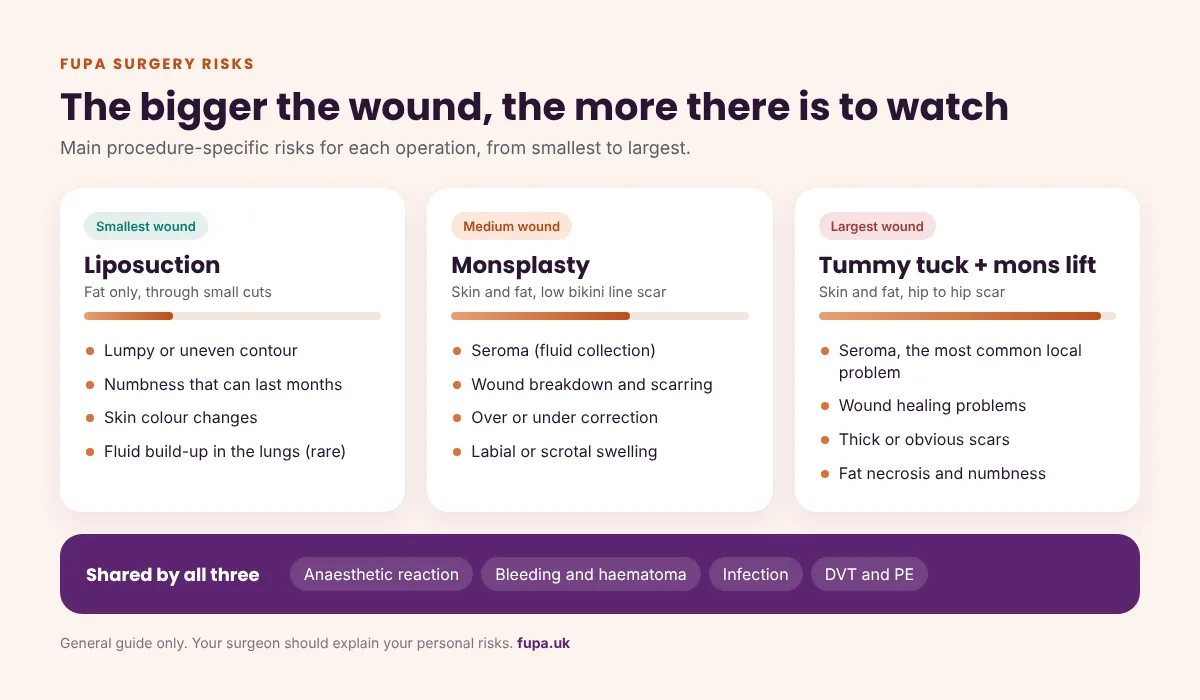
Three operations are commonly used, and each leaves a different wound with a different risk profile.
Monsplasty, liposuction and tummy tuck
- Monsplasty (mons lift): removes a strip of skin and fat and lifts the pubic area, with a low scar along the bikini line. See our monsplasty guide.
- Liposuction: removes fat through small cuts but does not remove skin. See our guide to FUPA liposuction.
- Tummy tuck with a mons lift: removes loose skin and fat from the lower abdomen, often with a mons lift in the same operation. See our guide to a tummy tuck for a FUPA.
General Risks of Any Operation
The NHS lists a small risk of heavy bleeding, blood clots, infection and a very rare allergic reaction to the anaesthetic for any operation.
Anaesthesia
Feeling sick and groggy is common for a day or so after a general anaesthetic. Serious reactions are rare. Tell the anaesthetist about every medicine and allergy.
Bleeding and haematoma
Bruising is normal. A haematoma is a collection of blood under the skin that causes swelling, tightness and pain, often on one side. A large one may need a return to theatre.
Infection
Signs include spreading redness, heat, increasing pain or pus, sometimes with a high temperature. Most infections settle with antibiotics. Keep the wound near the warm groin crease clean and dry.
Blood clots: DVT and PE
A deep vein thrombosis (DVT) is a clot in a deep vein, usually in the leg. If part breaks off and reaches the lungs, it becomes a pulmonary embolism (PE), which can be life threatening. Long operations, obesity, immobility and flying add to the risk.
Complications Specific to FUPA Surgery
The mons pubis sits low, close to the groin creases and genitals, which shapes the problems surgeons see most.
Seroma
A seroma is a pocket of clear fluid under the skin, felt as a soft, sloshing swelling. Larger ones are drained with a needle. It is the most common local complication after a tummy tuck.
Wound breakdown and scarring
The wound can open in places where skin is under tension or blood supply is poor, which slows healing and can widen the scar. Monsplasty and tummy tuck scars are permanent. Most fade over a year, but some stay thick or raised.
Asymmetry, uneven contour and over-resection
One side can end up slightly different from the other, and the NHS lists lumpy, uneven results after liposuction. Removing too much tissue can leave the mons flat or pulled too high, which is hard to correct.
Numbness and fat necrosis
Numbness over the lower tummy and pubic area is common at first and usually improves, although the NHS notes it can last for months after liposuction. Fat necrosis is fat that dies after losing its blood supply, leaving a firm lump that is usually harmless.
Labial or scrotal swelling
Swelling drains downwards, so it can collect in the labia or scrotum for the first week or two. It usually settles, but a sudden, painful swelling on one side may be a haematoma and needs a call to your clinic.
How Common Are These Risks?
Good numbers exist for tummy tuck and liposuction. Monsplasty has far less data: a 2023 study in the Journal of Plastic, Reconstructive and Aesthetic Surgery called the research sparse, though it found no major complications in 105 patients.
| Complication | Most linked to | How common |
|---|---|---|
| Any major complication | Tummy tuck | 4.0% overall; 3.1% for a tummy tuck alone |
| Any major complication | Liposuction alone | 0.7% |
| Haematoma | All three | About 1.2% after tummy tuck; 0.15% after liposuction alone |
| Infection | All three | About 1% after tummy tuck; 0.1% after liposuction alone |
| Blood clot (DVT or PE) | Long or combined operations | About 0.8% suspected or confirmed after tummy tuck; 0.06% confirmed after liposuction alone |
| Seroma | Tummy tuck, monsplasty | 10.9% after tummy tuck, pooled from 143 studies |
| Wound problems, uneven contour | Varies by procedure | Listed by the NHS as occasional |
| Numbness, labial or scrotal swelling | All three | Common early on and usually temporary |
The major complication figures come from US insurance databases covering 25,478 tummy tucks and 31,010 liposuction procedures. They count only problems needing an emergency visit, a hospital stay or another operation within 30 days, so minor problems are more common.
What Raises Your Risk?
Smoking
Smoking cuts blood flow and oxygen to healing skin and slows wound healing. NHS hospital advice recommends stopping at least eight weeks before an operation where possible.
BMI and diabetes
In the large tummy tuck study, a BMI of 30 or more raised the risk of major complications by about 30%. Diabetes showed no significant effect there, but surgeons still want blood sugar well controlled.
Recent weight loss and combined procedures
If your weight is still falling, the result can change, so most surgeons want a stable weight first. Our guide to a FUPA after weight loss explains the timing. Adding other procedures to a tummy tuck raised the risk of a major complication by 50%.
How Surgeons Reduce the Risk
Common steps a careful surgeon takes include:
- A full health check, plus a review of smoking, blood thinners and supplements.
- A clot risk assessment, with compression stockings, early walking and sometimes blood thinning injections.
- Drains or special stitches that close the space under the skin to cut seroma risk.
- Limiting how much is removed in one session.
- Compression garments, clear wound care advice, follow-up visits and a contact number for any hour.
For what to expect at each stage of healing, see FUPA surgery before and after.
Warning Signs After Surgery: When to Call 111 or 999
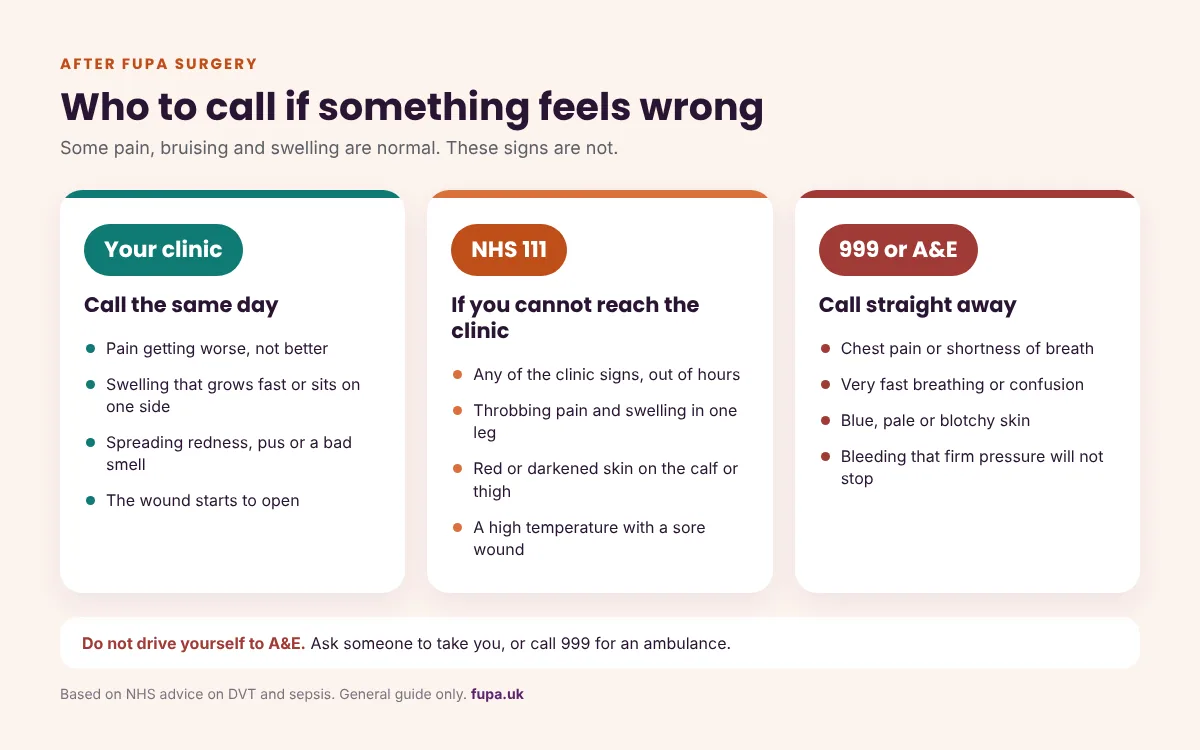
Some pain, bruising and swelling are expected. Use your clinic’s number first for anything that worries you.
Call your clinic or NHS 111
- Pain that is getting worse rather than better.
- A swelling that grows quickly, feels tight or appears on one side.
- Spreading redness, pus, a bad smell or the wound opening.
- Throbbing pain and swelling in one leg, which the NHS says may be a DVT.
Call 999 or go to A&E
- Leg pain or swelling with shortness of breath or chest pain.
- Very fast breathing, confusion or slurred speech.
- Blue, pale or blotchy skin, or a rash that does not fade when pressed.
- A very high or very low temperature with shivering, or symptoms you think might be sepsis.
- Heavy bleeding that does not stop with firm pressure.
Do not drive yourself to A&E. Ask someone to take you, or call 999 for an ambulance.
UK Safety Checks Before You Book
GMC Specialist Register and CQC
Check the General Medical Council (GMC) register to confirm your surgeon is on the Specialist Register, ideally in plastic surgery, with no restrictions. In England, clinics and hospitals providing cosmetic surgery must be registered with the Care Quality Commission (CQC).
BAAPS and BAPRAS
Membership of the British Association of Aesthetic Plastic Surgeons (BAAPS) or the British Association of Plastic, Reconstructive and Aesthetic Surgeons (BAPRAS) is a useful extra check. BAAPS states that all its members are fully trained plastic surgeons on the GMC Specialist Register.
The cooling-off period
The GMC’s guidance for doctors who offer cosmetic interventions says the operating doctor must seek your consent personally and give you the time and information you need to decide. Royal College of Surgeons standards for cosmetic surgery, welcomed by the CQC, add a two-stage consent process with a cooling-off period of at least two weeks.
Surgery abroad
The NHS advice on cosmetic surgery abroad warns that overseas clinics may not offer follow-up care to UK standards. It advises against flying for 5 to 7 days after liposuction and 7 to 10 days after a tummy tuck, because air travel and surgery both raise clot risk. Our guide to FUPA surgery costs in the UK shows what a UK package usually includes.

Questions to Ask Before You Book
Take this checklist to your consultation.
- Are you on the GMC Specialist Register, and in which specialty?
- How many of these operations do you do each year?
- Is the hospital registered with the CQC, and what is its rating?
- Which operation suits my FUPA, and why not the others?
- What are my personal risks, and your own rates of seroma, infection and wound problems?
- How will you reduce my risk of blood clots?
- Who do I call at night or at the weekend if something goes wrong?
- What follow-up is included, and what would revision surgery cost?
Not sure surgery is the answer? Read our guide to loose skin vs fat in the lower belly.
Frequently Asked Questions
What are the main risks of FUPA surgery?
All FUPA operations carry the general risks of surgery: bleeding, haematoma, infection, blood clots and reactions to the anaesthetic. Specific risks include seroma, wound breakdown, scarring, uneven contour, numbness, fat necrosis and swelling of the labia or scrotum. Your surgeon should explain how likely each one is for you.
How common is a seroma after FUPA surgery?
A 2021 review of 143 studies found seroma in 10.9% of people after a tummy tuck. Rates for monsplasty alone are not well reported. Surgeons use drains or special stitches to lower the risk, and most seromas are drained in clinic without long-term harm.
Is monsplasty safer than a tummy tuck?
A monsplasty is usually a smaller operation with a shorter wound, so it is likely to carry less risk. Small studies report few major complications, but the data is limited. A tummy tuck had a 4% major complication rate in a large US database, rising when procedures were combined.
When should I call 111 or 999 after surgery?
Call your clinic first for worsening pain, a growing swelling or signs of infection. Call NHS 111 if you cannot reach the clinic or think you have a DVT. Call 999 for chest pain, shortness of breath, confusion, heavy bleeding or symptoms that might be sepsis.
How do I check a surgeon in the UK?
Search the GMC register to confirm the surgeon is on the Specialist Register with no restrictions. Check that the hospital or clinic is registered with the CQC and read its latest report. Membership of BAAPS or BAPRAS is a helpful extra sign of specialist training.
How long should I wait before booking surgery?
The GMC says doctors must give you the time and information you need to decide. Royal College of Surgeons standards set a cooling-off period of at least two weeks between consultation stages. Your weight should also be stable, and you should stop smoking well before surgery.
The Bottom Line
FUPA surgery risks are real but often manageable. Liposuction alone has a low rate of major complications, a tummy tuck carries more, and seroma is common after skin removal. You can lower your own risk by stopping smoking, reaching a stable weight, choosing a specialist plastic surgeon in a CQC registered hospital and taking time to decide. Learn the warning signs before your operation.