
Fat-Dissolving Injections for a FUPA: UK Safety, Cost and Results

Page Contents
- What Are Fat-Dissolving Injections?
- Deoxycholic acid: Belkyra and Kybella
- Phosphatidylcholine and “lipodissolve” mixes
- Cosmetic-grade products such as Lemon Bottle
- How Fat-Dissolving Injections Work
- Why it is not selective for fat
- Why results take weeks
- Do Fat Dissolving Injections for FUPA Work?
- When they might help
- When they will not help
- What the Evidence Shows
- Studies on body areas
- Weighing it up
- UK Regulation and Safety
- Licensed medicines versus cosmetic products
- The licensing scheme for England
- Reported harms
- Side Effects and Who Should Avoid Them
- Common side effects
- Who should avoid them
- How Many Sessions You Need
- UK Cost of Fat-Dissolving Injections
- Alternatives for a FUPA
- Non-surgical options
- Surgical options
- Questions to Ask Before You Book
- Frequently Asked Questions
- Can fat-dissolving injections get rid of a FUPA?
- Are fat-dissolving injections licensed in the UK?
- How much do fat-dissolving injections cost in the UK?
- How many sessions will I need?
- What are the main side effects?
- Is the procedure available on the NHS?
- The Bottom Line
UK clinics sell fat-dissolving injections as a quick fix for stubborn pockets of fat. So are fat dissolving injections for FUPA fat worth trying? They may help a small, soft fat pocket in carefully chosen people. However, they are not licensed for the pubic area, they do nothing for loose skin and product quality varies widely. This guide covers how they work, the evidence, UK safety rules, typical prices and the alternatives.
This guide is general information, not medical advice. See your GP first if you notice a new lump or skin change in the pubic area.
For every option in one place, see our FUPA surgery and removal guide.

What Are Fat-Dissolving Injections?
The phrase covers several products. Each one is injected into the fat layer to destroy fat cells, which the body then clears. Their ingredients, evidence and legal status differ a great deal.
Deoxycholic acid: Belkyra and Kybella
Deoxycholic acid is a bile acid the body makes to break down dietary fat. A synthetic version is sold as Belkyra in the UK and Europe and as Kybella in the US. In the UK it is a prescription-only medicine, and its licence covers one use only: moderate to severe fat under the chin in adults. The NHS medicines awareness service lists the Belkyra licensed indication as submental fat, and the product information states that safety and effectiveness outside that area have not been established.
Phosphatidylcholine and “lipodissolve” mixes
Older treatments, often called lipodissolve or injection lipolysis, combine phosphatidylcholine with sodium deoxycholate. Brazil banned these mixes for cosmetic use in 2002, and the MHRA and the US Food and Drug Administration (FDA) have discouraged them.
Cosmetic-grade products such as Lemon Bottle
Newer brands, including the widely promoted Lemon Bottle, are often sold as cosmetic products rather than licensed medicines. So they do not have to meet medicine standards. In April 2025 the General Pharmaceutical Council (GPhC) warned pharmacy teams that such products may not fully disclose their ingredients, may have little or no clinical safety data and had been linked to reports of serious harm.
How Fat-Dissolving Injections Work
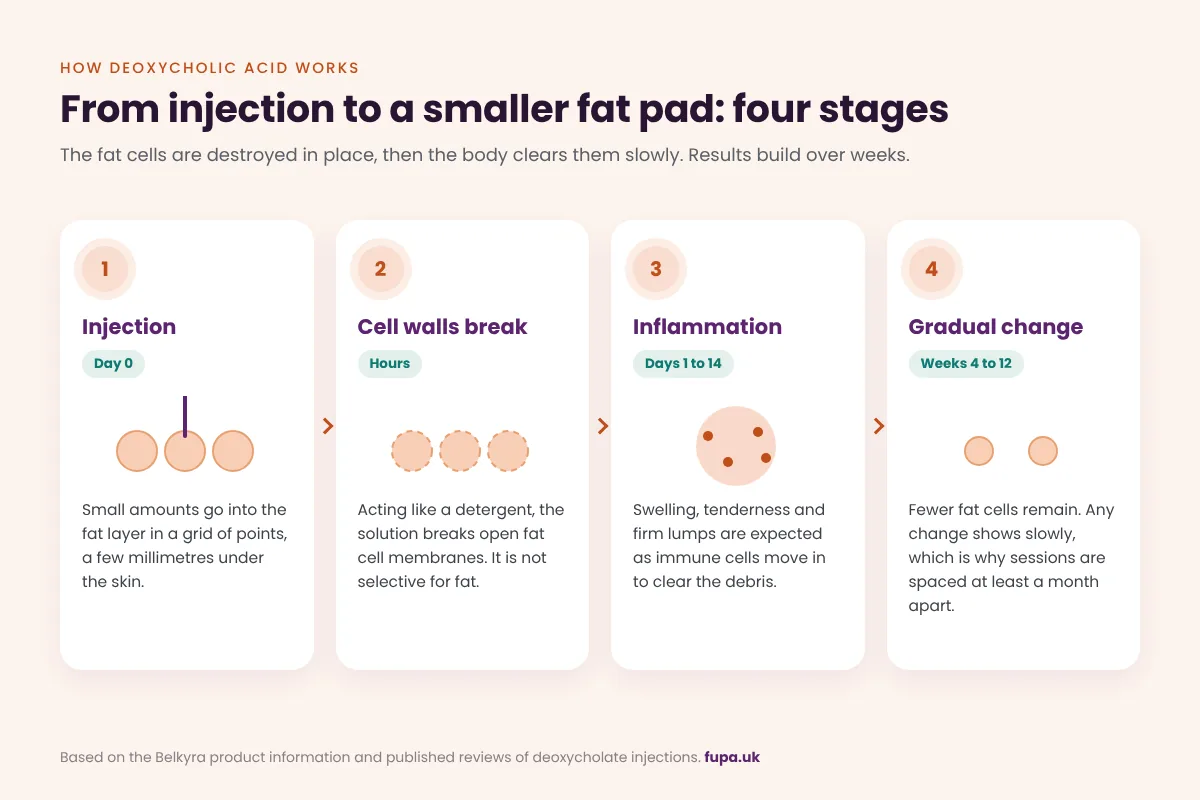
Deoxycholic acid behaves like a detergent. Once injected into fat, it breaks open the walls of the cells it touches. Immune cells then move in over the following days and clear the debris.
Why it is not selective for fat
A 2022 review in Frontiers in Endocrinology looked at 41 mostly small studies and found that deoxycholate is largely non-selective. It can harm any cell it reaches, including skin, blood vessels and nerves. So injection depth and placement matter, and a trained medical injector is essential.
Why results take weeks
Swelling, firmness and tender lumps are part of the expected inflammatory response. Any reduction only shows once that settles, usually over several weeks. Remaining fat cells can still grow if you gain weight.
Do Fat Dissolving Injections for FUPA Work?
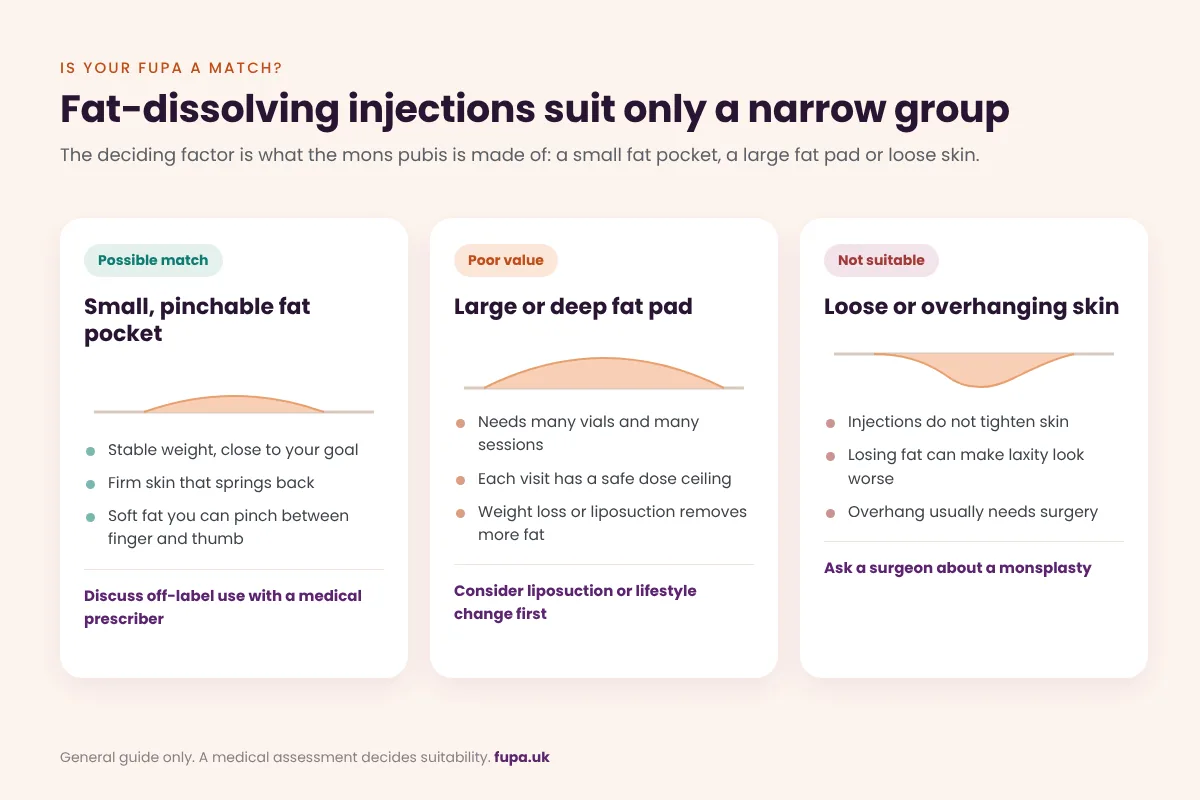
A FUPA is the mons pubis: fat and skin over the pubic bone. Whether injections help depends on what yours is made of.
When they might help
A small, pinchable fat pocket with firm skin is the best match. Use on the mons pubis is off-label. This means a prescriber uses the medicine outside its licence and takes extra responsibility for that choice.
When they will not help
- Loose or overhanging skin. Injections do not tighten skin. Removing fat under lax skin can leave it looking looser.
- A large or deep fat pad. Each session has a dose ceiling, so a big area needs many vials and many visits.
Our guide to loose skin vs fat in the lower belly shows how to check yours.
What the Evidence Shows
Deoxycholic acid has large, controlled trials for the chin only. Evidence for the body is much thinner.
Studies on body areas
A 2019 systematic review in the Journal of Drugs in Dermatology found only ten relevant papers on deoxycholic acid outside the chin. They reported similar safety and satisfaction to chin use, but most were small case series, and the authors called for larger studies. None of the reviewed papers focused on the mons pubis.
Weighing it up
- The way deoxycholic acid destroys fat is well understood.
- Body results come mainly from small reports, often without a comparison group.
- Cosmetic-grade products may have no published trials at all.
A modest change in a small pocket is plausible, but nobody can promise a visible result.
UK Regulation and Safety
Licensed medicines versus cosmetic products
Belkyra is a prescription-only medicine, so it needs a face-to-face assessment and a prescription from a qualified prescriber such as a doctor, nurse prescriber or pharmacist prescriber. Many other fat dissolvers are sold as cosmetics. In June 2025 the Chartered Trading Standards Institute said products like Lemon Bottle fall outside MHRA oversight.
The licensing scheme for England
The Health and Care Act 2022 gave the government power to license non-surgical cosmetic procedures in England. A consultation ran in 2023, and the government’s consultation response followed in August 2025, proposing green, amber and red tiers by risk. As of October 2026, the scheme is not yet in force and no start date has been set. Scotland passed its own licensing law in March 2026.
Reported harms
In December 2023 the FDA warned that unapproved fat-dissolving injections had caused serious infections, permanent scarring, skin deformities, cysts and painful lumps. The Belkyra product information also warns that poor technique can cause skin ulceration, necrosis (tissue death) and scarring, and that injecting into a blood vessel can damage it.
Side Effects and Who Should Avoid Them
Even with a licensed product and a skilled injector, side effects are common. The Belkyra product information lists these as common at the injection site.
Common side effects
- Swelling, which can last several days.
- Bruising and bleeding at the injection points.
- Pain, burning or tenderness.
- Numbness in the treated skin.
- Firm nodules or lumps, which usually settle.
- Nerve injury, which in chin trials caused a temporary uneven smile.
Who should avoid them
- Anyone pregnant, and those breastfeeding unless a doctor advises otherwise.
- People with an infection or broken skin over the area.
- People with a BMI of 30 or more, a group the Belkyra product information excludes.
- Anyone with a hernia, an unexplained lump or previous surgery in the area until a doctor has checked it.
- Anyone with body dysmorphic disorder.
A lump that feels different from the surrounding fat may not be a FUPA at all. Our guide to telling a FUPA from a lipoma explains when to see your GP first.
How Many Sessions You Need
For the chin, Belkyra allows up to six sessions spaced at least four weeks apart, with a dose ceiling at each visit. Clinic pages for the stomach often suggest 3 to 6 sessions, again about four to six weeks apart.
| Detail | Typical published guidance |
|---|---|
| Sessions | Up to 6 for the chin; often 3 to 6 for body areas |
| Spacing | At least 4 weeks apart |
| Swelling | Several days, sometimes longer |
| When results show | Gradually, over weeks after each session |
UK Cost of Fat-Dissolving Injections
As a guide, published UK clinic price pages checked in October 2026 showed:
- Most single-area sessions starting from about £100 to £250.
- Body areas listed from about £199, with larger areas priced up to £399, at one clinic.
- One clinic charging £400 per vial for the abdomen, with 3 to 6 sessions suggested.
Treat these as typical published prices, not quotes. Ask which exact product is used, because a very low price often means a cosmetic-grade product rather than a licensed medicine. For a comparison with surgical prices, see our guide to FUPA surgery costs in the UK.
Alternatives for a FUPA
The right choice depends on whether your FUPA is mostly fat, skin or both.
| Option | Main target | Treats loose skin? | Typical downtime |
|---|---|---|---|
| Fat-dissolving injections | Small fat pocket | No | Swelling for days |
| Fat freezing and other devices | Fat | No | Little or none |
| Emsculpt | Abdominal muscle | No | None |
| Liposuction | Fat | No | About 3 to 7 days |
| Monsplasty | Fat and skin | Yes | About 2 weeks |
Non-surgical options
Fat freezing and radiofrequency devices treat small fat pockets without needles. Our guide to non-surgical FUPA removal compares them in detail. Muscle toning is a different approach, covered in our guide to Emsculpt for a FUPA.
Surgical options
Liposuction removes more fat, more predictably, and suits people with good skin tone. Read our guide to liposuction for a FUPA. If loose skin is the main issue, a monsplasty removes excess skin and fat and lifts the area.
Questions to Ask Before You Book
- Which exact product will you use? Ask to see the box.
- Who will prescribe and inject it? Ask for their professional registration, such as the GMC, NMC or GPhC.
- Is this off-label for the pubic area? A good prescriber will say so and explain why.
- Am I a good candidate? Expect questions about your weight, health and pregnancy plans.
- How many sessions and what total cost? Get it in writing.
- What happens if something goes wrong? Ask who you call out of hours.
Walk away from same-day discounts or any promise of a flat pubic area.
Frequently Asked Questions
Can fat-dissolving injections get rid of a FUPA?
They may reduce a small, soft fat pocket on the mons pubis, but they cannot remove a large fat pad or loose skin. Use in the pubic area is off-label in the UK, and evidence for body areas comes mainly from small studies. Nobody can promise a visible change.
Are fat-dissolving injections licensed in the UK?
Only deoxycholic acid sold as Belkyra is a licensed prescription medicine, and its licence covers fat under the chin in adults. Many other fat dissolvers are sold as cosmetic products. These do not have to meet medicine standards and may have little or no safety data.
How much do fat-dissolving injections cost in the UK?
Published UK clinic prices checked in October 2026 mostly started at about £100 to £250 per session. One clinic listed body areas from about £199 to £399, and another charged £400 per vial for the abdomen. Several sessions are usually needed, so ask for a written total.
How many sessions will I need?
Clinic pages for the stomach often suggest 3 to 6 sessions, spaced about four to six weeks apart. For the chin, Belkyra allows up to six sessions at least four weeks apart. Results build gradually after each session as swelling settles and the body clears the destroyed fat cells.
What are the main side effects?
Swelling, bruising, pain, numbness and firm lumps are common at the injection site and usually settle. Rarer risks include nerve injury, infection, skin ulceration and scarring, especially with poor technique or unlicensed products. Seek medical help if the skin darkens, blisters, oozes or becomes increasingly painful.
Is the procedure available on the NHS?
No. Fat-dissolving injections for a FUPA are a private cosmetic treatment, and the NHS does not usually fund cosmetic procedures. Speak to your GP if your FUPA causes pain, skin problems or recurrent infection, or if you notice a new lump in the area.
The Bottom Line
Fat dissolving injections for FUPA fat are a narrow option. Deoxycholic acid destroys fat cells, but its UK licence covers the chin only and many clinic products are not licensed medicines. For a small, soft pocket with firm skin, a medically qualified prescriber may discuss off-label treatment. For a larger fat pad, liposuction removes more. For loose skin, a monsplasty is the answer. Check the product, the prescriber and the full cost before you commit.