
FUPA Surgery Abroad vs the UK: Turkey Costs, Risks and Aftercare

Page Contents
- Why People Consider FUPA Surgery Abroad
- The price gap that drives the decision
- What a package usually includes
- What FUPA Surgery in Turkey Costs Once You Add Everything
- The quoted price versus the realistic total
- Where the saving really ends up
- Regulation: Who Checks the Surgeon and the Clinic
- UK standards: the GMC and the CQC
- Turkey: Ministry of Health licensing and JCI
- FUPA Surgery Abroad: What the Official Figures Say About Risk
- Foreign Office and BAAPS numbers
- Why complications surface after you get home
- Flying After FUPA Surgery: Timing and Clot Risk
- The NHS waiting times
- How that shapes your trip
- Aftercare Gaps and Who Treats Complications Back Home
- NHS emergency care is not revision surgery
- The cost of paying twice
- Insurance and Travel Insurance Exclusions
- What a standard policy will not cover
- Specialist cover and clinic guarantees
- What to Check Before Booking FUPA Surgery Abroad
- Surgeon and hospital checks
- Consultation, cooling-off and paperwork
- A Decision Checklist: Abroad or the UK?
- When the UK makes more sense
- When abroad can be a reasonable choice
- Frequently Asked Questions
- Is FUPA surgery in Turkey safe?
- How much cheaper is FUPA surgery abroad really?
- Will the NHS fix problems after surgery abroad?
- How soon can I fly home after a monsplasty or tummy tuck?
- Does travel insurance cover cosmetic surgery abroad?
- What qualifications should a surgeon abroad have?
- The Bottom Line
- Decide on the surgeon, not the price
FUPA surgery abroad is marketed hard to UK patients. Clinics in Turkey advertise monsplasty, pubic liposuction and tummy tucks at roughly half the UK price, often bundled with a hotel, a driver and a sea view. For someone who has saved for years to change a lower belly that diet and exercise did not shift, the appeal is obvious.
The headline price is only one part of the decision, though. Regulation, consultation quality, aftercare and what happens if something goes wrong all differ between a UK hospital and a package trip. This guide sets out how FUPA surgery in Turkey compares with the UK on cost, risk and recovery, using NHS, Foreign Office and surgeon association guidance rather than clinic marketing.
This guide is general information, not medical advice. Costs, risks and recovery times vary from person to person. Speak to your GP and to a qualified plastic surgeon before you book any procedure, in the UK or overseas.
Why People Consider FUPA Surgery Abroad
The price gap that drives the decision
In the UK, private mons liposuction typically costs between £3,000 and £8,500, a standalone monsplasty starts around £4,000 and a full abdominoplasty runs from £5,000 to £10,000. Our full UK price breakdown explains what those figures include. Turkish clinic listings, by contrast, show monsplasty from roughly £800 to £4,500 and tummy tucks from about £1,700 to £5,300 at recent exchange rates. Those listings vary widely by surgeon, city and what the quote covers, so treat them as a starting point rather than a fixed price.
What a package usually includes
Most packages bundle the surgeon’s fee, the anaesthetist, the hospital stay, airport transfers and several hotel nights. Flights are usually excluded, and so is any care once you land back in the UK. That last gap matters more than any other line on the quote, as the sections below explain.
What FUPA Surgery in Turkey Costs Once You Add Everything
The quoted price versus the realistic total
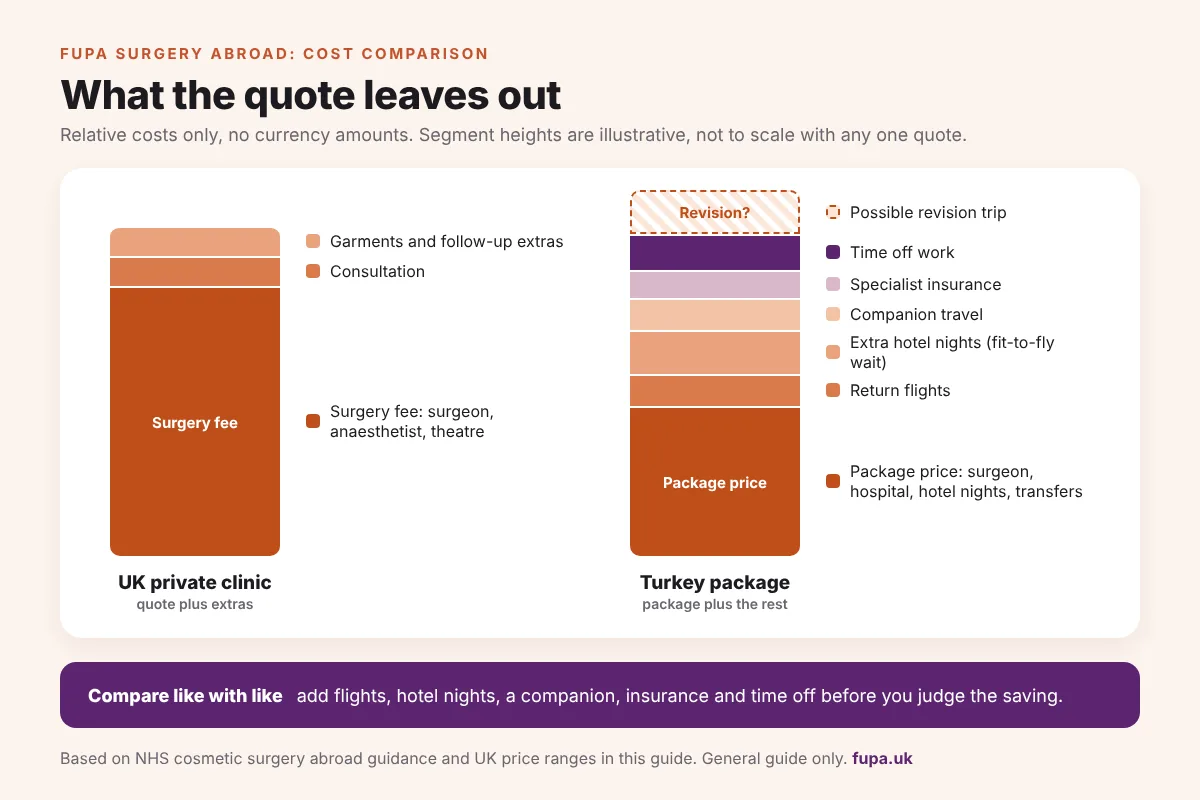
A fair comparison adds the costs that a UK quote never needs. Return flights, extra hotel nights while you wait to be fit to fly, a companion’s travel, specialist insurance and unpaid time off work all land on top of the package. If you later need a revision, you either pay for a second trip or pay a UK surgeon at full price. The table below compares the two routes across the factors that matter most.
| Factor | UK private clinic | Turkey package |
|---|---|---|
| Quoted price (monsplasty) | From around £4,000 | Roughly £800 to £4,500, varies widely |
| Quoted price (tummy tuck) | £5,000 to £10,000 | Roughly £1,700 to £5,300, varies widely |
| Regulation | GMC specialist register, CQC inspected premises in England | Turkish Ministry of Health licensing; some hospitals hold JCI accreditation |
| Consultation | Two in-person consultations and a cooling-off period, normally 2 weeks | Often a video or WhatsApp call, first in-person meeting the day before surgery |
| Aftercare | Surgeon responsible for follow-up; check-ups at the same clinic | Check-ups end when you fly; remote messaging at best |
| Complication handling | Return to the operating surgeon | NHS A&E for emergencies; revision means a second trip or a UK fee |
| Flying | Not required | Wait 5 to 7 days after liposuction, 7 to 10 days after a tummy tuck (NHS) |
| Realistic total | Quote plus £100 to £250 consultation and garments | Package plus flights, 7 to 10 hotel nights, companion, insurance, time off, contingency |
Where the saving really ends up
For a tummy tuck, a £4,000 package can become £6,000 to £7,000 once two return flights, ten hotel nights, a companion and lost earnings are added. That still undercuts many UK quotes, but the margin shrinks from “half price” to “somewhat cheaper”, and the figure assumes nothing goes wrong. Our guide to a tummy tuck for a FUPA covers what the UK fee buys.
Regulation: Who Checks the Surgeon and the Clinic
UK standards: the GMC and the CQC
In the UK, any doctor performing cosmetic surgery must hold General Medical Council registration, and plastic surgeons appear on the GMC specialist register. Premises in England that carry out surgery are registered with and inspected by the Care Quality Commission. Those systems give you a public record to check and a complaints route if care falls short. Our guide to choosing a FUPA surgeon in the UK explains exactly what to look up.
Turkey: Ministry of Health licensing and JCI
Turkey licenses hospitals through its Ministry of Health, and the ministry publishes a list of approved providers on its HealthTurkiye site. Some large private hospitals also hold Joint Commission International accreditation, an independent standard focused on hospital systems and safety. Neither tells you how good an individual surgeon is at monsplasty. The Foreign Office keeps a list of medical practitioners in Turkey but states clearly that it does not endorse the competence of anyone on it.
FUPA Surgery Abroad: What the Official Figures Say About Risk
Foreign Office and BAAPS numbers
The UK Foreign, Commonwealth and Development Office reports that seven British nationals died in Turkey in 2025 following medical procedures, and its earlier statements put the total at 22 deaths since January 2019. The British Association of Aesthetic Plastic Surgeons has tracked the problem from the other end. Its 2022 audit found a 44 per cent rise in patients needing corrective surgery after procedures abroad, with abdominoplasty accounting for three quarters of those cases. A later BAAPS study, covering September 2022 to 2024, logged almost 200 UK patients treated for complications after overseas cosmetic surgery, at an estimated £1.8 million cost to the NHS. The FCDO Turkey health advice page is updated regularly and is worth reading in full.
Why complications surface after you get home
Infection, wound breakdown and seromas tend to appear in the second and third week, which is exactly when most package patients have already flown. Tummy tucks carry the longest incision and the highest rates of these problems, and a monsplasty sits in a warm, moist area where wounds heal slowly. Our page on FUPA surgery risks and complications lists the warning signs. Not every trip ends badly, but the risk profile is different, and the figures above come from bodies with no clinic to sell.
Flying After FUPA Surgery: Timing and Clot Risk
The NHS waiting times
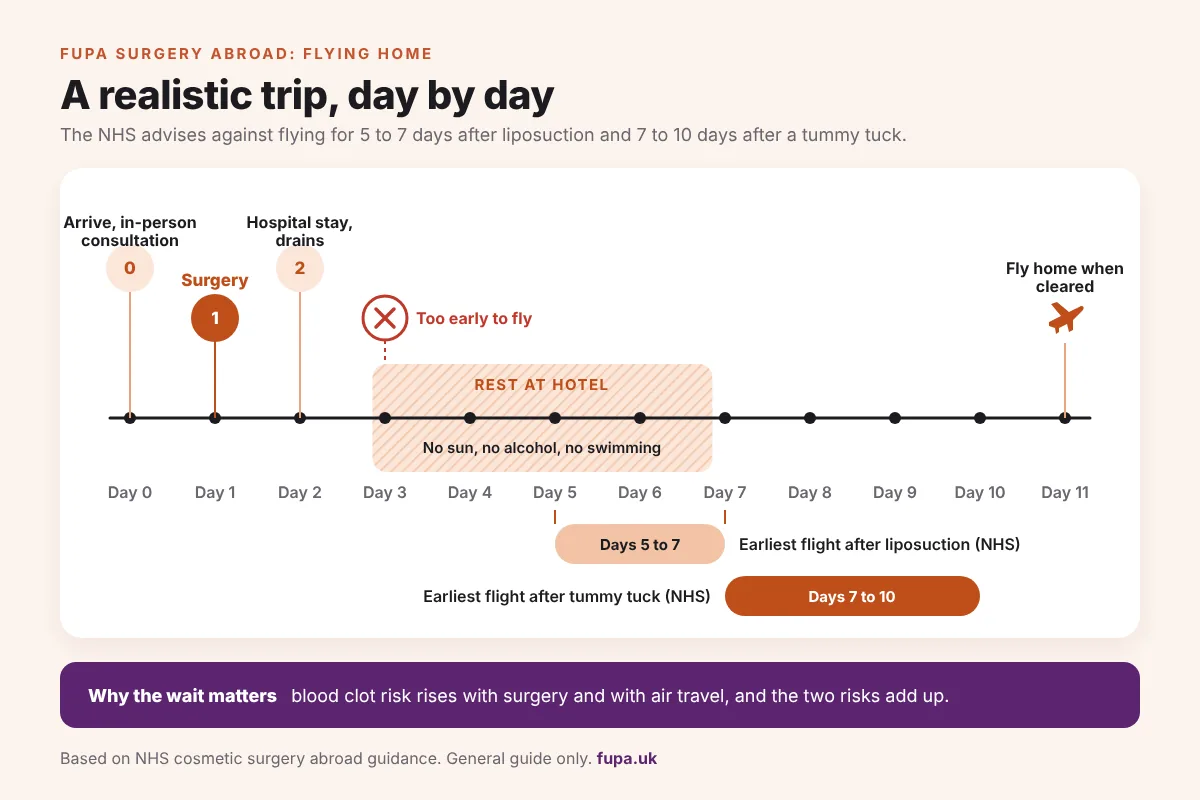
Air travel and major surgery each raise the risk of a deep vein thrombosis, and together the risk compounds. The NHS advises against flying for 5 to 7 days after liposuction and for 7 to 10 days after a tummy tuck. A monsplasty with skin removal sits closer to the tummy tuck end of that range. Clinics that book your return flight for day three are cutting against that guidance, however persuasive the sales call. The NHS guidance on cosmetic surgery abroad also warns that a holiday straight after surgery is not realistic.
How that shapes your trip
Plan on eight to twelve nights for a tummy tuck and six to eight for liposuction alone. You will spend most of them resting in a hotel room, avoiding sun, alcohol and swimming. Build in a buffer, because if a drain stays in or a wound needs checking, you cannot simply catch your booked flight.
Aftercare Gaps and Who Treats Complications Back Home
NHS emergency care is not revision surgery
If you develop a fever, a spreading red wound or sudden calf pain after cosmetic surgery abroad, the NHS will treat you. That is emergency care, and no hospital will turn you away. The NHS is not obliged to finish, correct or improve private work, though. Asymmetry or a disappointing contour will not be fixed on the NHS, and your GP will often have no operation notes and no contact with the surgeon.
The cost of paying twice
A UK surgeon asked to revise someone else’s operation usually charges more than for the original procedure, because scarred tissue is harder to work with. BAAPS estimated the average NHS cost of treating a returning patient at about £15,000 in 2022. Even where the NHS covers the emergency, the patient still pays for any cosmetic correction. Before booking, ask the clinic in writing what it will do if a revision is needed, who pays for the second trip and what time limit applies.
Insurance and Travel Insurance Exclusions
What a standard policy will not cover
Standard travel insurance normally excludes travel for elective surgery, and it excludes complications of planned procedures almost without exception. Your GHIC or EHIC card is not valid in Turkey in any case. The Foreign Office also states that it cannot pay medical bills, cannot arrange repatriation and cannot help with disputes about the quality of care. If you have no specialist cover, the cost of an extended hospital stay or a medical flight home falls entirely on you.
Specialist cover and clinic guarantees
A small number of insurers sell policies designed for cosmetic surgery abroad. Read the complication clause carefully: some pay only for treatment in the destination country, some cap repatriation and most exclude anything the clinic deems cosmetic rather than medical. Clinic “guarantees” are usually promises to re-operate at their own hospital, which leaves you paying for flights and hotel again. Ask for the insurer’s name and policy wording, not a verbal assurance.
What to Check Before Booking FUPA Surgery Abroad
Surgeon and hospital checks
The NHS advises two consultations with the operating surgeon before any procedure, not with a sales coordinator. For a trip to Turkey, insist on at least one detailed video consultation with the surgeon in person, followed by an in-person review before the operation with the right to walk away. Confirm the surgeon’s specialty qualification, how many monsplasty or FUPA liposuction operations they perform each year, and whether the hospital appears on the Turkish Ministry of Health list.
Consultation, cooling-off and paperwork
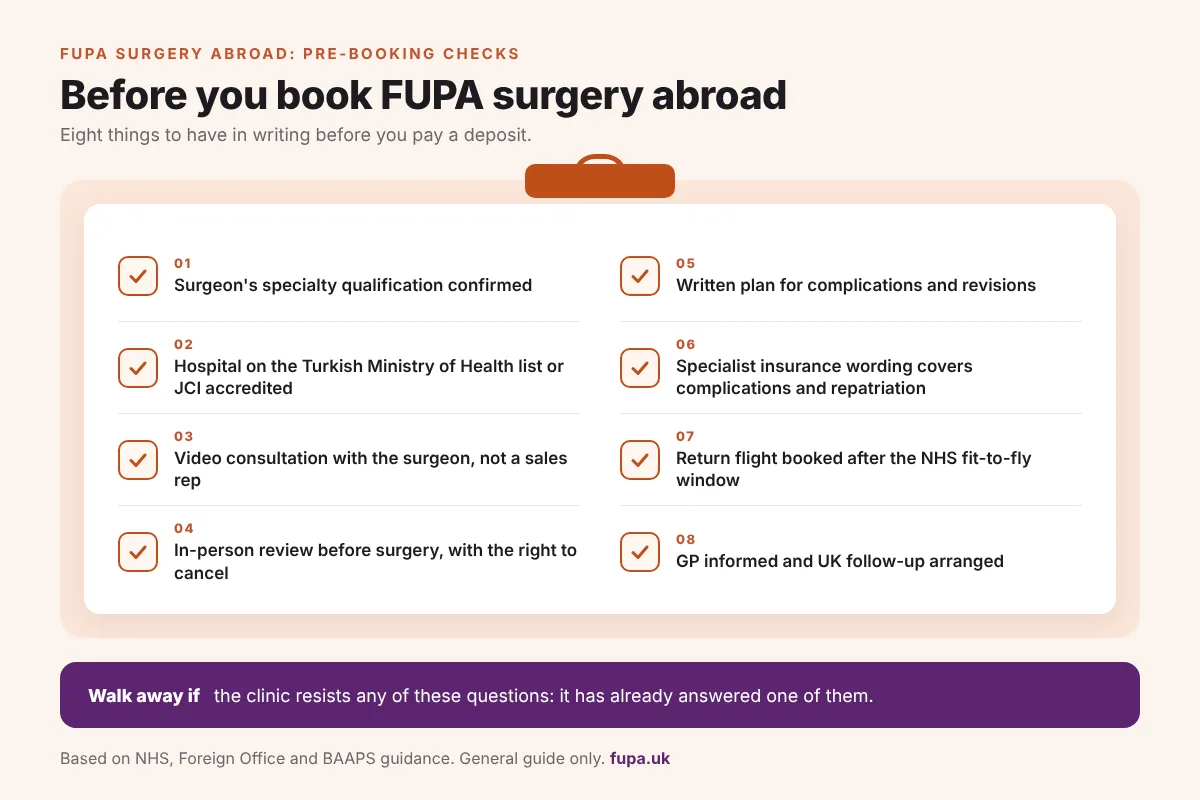
UK practice gives a cooling-off period of normally two weeks between consultation and surgery. Package trips compress that to a day or less, which removes the time most people need to reconsider. Use this list before you pay a deposit:
- Tell your GP you are considering FUPA surgery abroad and ask about any conditions that raise your risk.
- Get the full procedure, surgeon name, hospital name and inclusions in writing before paying anything.
- Ask for the written complications and revision policy, including who pays for a second trip.
- Read the insurance wording yourself, with the complication and repatriation clauses highlighted.
- Book the return flight no earlier than the NHS fit-to-fly window for your procedure.
- Arrange a UK plastic surgeon or nurse-led clinic for wound checks within a week of landing.
- Request your operation notes, implant or technique details and medication list in English before you leave.
A Decision Checklist: Abroad or the UK?
When the UK makes more sense
Stay in the UK if you have had major weight loss and need a combined procedure, because a FUPA after weight loss often involves loose skin, a large tummy tuck and a longer recovery. The same applies if you have diabetes, a clotting history, a BMI above the clinic’s stated limit, a previous abdominal surgery or no companion who can travel. If you cannot take two weeks off work or fund a second trip, a surgeon you can see on a Tuesday afternoon is the safer choice.
When abroad can be a reasonable choice
FUPA surgery abroad is most defensible for a small, single procedure such as mons liposuction in an otherwise healthy, non-smoking adult with a normal BMI, who can stay the full recommended period, has specialist insurance and has arranged UK follow-up in advance. Even then, the decision should rest on the surgeon’s record rather than the hotel. If you are weighing the trade-off, it helps to understand what FUPA surgery before and after results look like, so your expectations match what any competent surgeon, in any country, can deliver. Our FUPA surgery hub covers every option side by side.
Frequently Asked Questions
Is FUPA surgery in Turkey safe?
Many Turkish hospitals perform cosmetic surgery to a high standard, and many UK patients return satisfied. The risk lies less in the operating theatre than in compressed consultations, early flights and absent aftercare. The Foreign Office recorded seven British deaths after medical procedures in Turkey in 2025, so research the surgeon and hospital thoroughly before you commit.
How much cheaper is FUPA surgery abroad really?
Quoted prices in Turkey are often half the UK figure, sometimes less. Once you add flights, 7 to 10 hotel nights, a companion, specialist insurance and time off work, the saving on a tummy tuck typically shrinks to a few thousand pounds. If a revision is needed, the saving can disappear entirely.
Will the NHS fix problems after surgery abroad?
The NHS will treat genuine emergencies such as infection, wound breakdown or a suspected blood clot, and nobody is refused that care. It will not revise, finish or improve the cosmetic result of private surgery. Correction of scarring or asymmetry means paying a UK surgeon privately, usually at a higher price than the original operation.
How soon can I fly home after a monsplasty or tummy tuck?
The NHS advises against flying for 5 to 7 days after liposuction and 7 to 10 days after a tummy tuck. A monsplasty that removes skin should be treated like the longer window. Air travel after surgery raises clot risk, so wear compression stockings, walk the aisle and follow your surgeon’s written fit-to-fly advice.
Does travel insurance cover cosmetic surgery abroad?
Standard travel insurance does not cover elective surgery or its complications, and the GHIC and EHIC cards are not valid in Turkey. You need a specialist medical travel policy, and you should read the complication and repatriation clauses before paying a deposit. The Foreign Office cannot pay bills or arrange a flight home.
What qualifications should a surgeon abroad have?
Look for a specialist qualification in plastic, reconstructive and aesthetic surgery, membership of a recognised national plastic surgery society and a hospital that appears on the Turkish Ministry of Health approved list. Ask how many monsplasty or pubic liposuction procedures the surgeon performs each year, and confirm that this person, not a colleague, will operate.
The Bottom Line
Decide on the surgeon, not the price
FUPA surgery abroad can cost less and can go well, but the saving comes from stripping out exactly the things that protect you: a proper consultation, a cooling-off period, local follow-up and a surgeon who answers the phone when a wound opens. If you go, go for a named surgeon with a verifiable record, stay for the full NHS fit-to-fly window, buy specialist insurance and arrange UK follow-up before you fly. If any of those is not possible, the UK option is cheaper than it looks.