
12 FUPA Myths That Stop You Getting Results
Page Contents
- Key Takeaways
- Myth 1: You Can Spot-Reduce a FUPA With Lower-Ab Exercises
- Why people believe it
- What is actually true
- Myth 2: Only Overweight People Get a FUPA
- Why people believe it
- What is actually true
- Myth 3: You Have to Cut Carbs Completely
- Why people believe it
- What is actually true
- Myth 4: A Waist Trainer Will Shrink It for Good
- Why people believe it
- What is actually true
- Myth 5: Hundreds of Squats a Day Will Burn It Off
- Why people believe it
- What is actually true
- Myth 6: Fat Burners and Detox Teas Target Lower Belly Fat
- Why people believe it
- What is actually true
- Myth 7: If the Scales Have Not Moved, Nothing Is Working
- Why people believe it
- What is actually true
- Myth 8: A FUPA Is Permanent Once You Have One
- Why people believe it
- What is actually true
- Myth 9: Cardio Is All You Need, and Weights Make It Bigger
- Why people believe it
- What is actually true
- Myth 10: Whatever Is Left After Weight Loss Must Be Fat You Can Still Diet Away
- Why people believe it
- What is actually true
- Myth 11: Hormones and Genetics Mean Effort Is Pointless
- Why people believe it
- What is actually true
- Myth 12: Surgery Is the Only Real Fix
- Why people believe it
- What is actually true
- FUPA Myths vs Facts: Summary Table
- What Actually Works
- A modest deficit, strength work and daily movement
- Measure the region, judge the trend
- Frequently Asked Questions
- Is it true that you cannot spot-reduce a FUPA?
- Do waist trainers get rid of a FUPA?
- Can a slim person have a FUPA?
- Why has my FUPA not changed even though I have lost weight?
- Do fat-burning supplements or detox teas work on lower belly fat?
- When does FUPA surgery become the sensible option?
- The Bottom Line
- Replace the myths with a plan
Most of the advice about shrinking a FUPA is repeated so often that it starts to sound like fact. Do a hundred crunches, cut out bread, buy a waist trainer, drink a detox tea, and the pad above your pubic bone will melt away. These FUPA myths are not just harmless noise. They send people down routes that cannot work, and when the results fail to arrive, the usual conclusion is that nothing works at all.
This guide takes twelve of the most common FUPA myths and sets each one against what is actually known about how fat is stored and lost in the lower belly. Some of the myths contain a grain of truth that has been stretched too far. Others are simply wrong. In every case, the section tells you why the belief took hold and what to do instead.
This guide is general information, not medical advice. If you are worried about pain, swelling or a lump in the lower abdomen, or you are planning a large change to your diet or activity, speak to your GP first.
Key Takeaways
- Fat leaves the body as a whole, not from the muscle you train, so no exercise targets the mons pubis directly.
- A FUPA depends on genetics, hormones and body fat together, which is why slim people have them and why diet alone does not always finish the job.
- Waist trainers, supplements, detox teas and most gadgets change nothing permanent in the fat pad.
- A modest calorie deficit, regular strength training and patience over months is the approach the NHS and NICE advice supports.
- When the pinch is thin and the fold stays, the problem is skin, and surgery becomes the honest conversation.
Myth 1: You Can Spot-Reduce a FUPA With Lower-Ab Exercises
Why people believe it
It feels logical. Train the muscle under the fat and the fat above it should burn. Fitness videos lean on this idea, with “lower belly burner” routines promising to target the pad above the pubic bone in ten minutes a day. The burn you feel in the muscle after leg raises seems to confirm that something is happening right there.
What is actually true
Working a muscle uses energy drawn from the whole body, not from the fat sitting over it. Studies that trained one limb or one side of the abdomen for weeks found fat loss spread across the body rather than at the trained site. Lower-ab work builds the muscle and improves posture, which can make the area look flatter, but the fat pad itself responds only to an overall energy deficit. The FUPA exercise guide explains which movements are still worth doing and why.
Myth 2: Only Overweight People Get a FUPA
Why people believe it
Most lower belly content shows larger bodies, so the pad above the pubic bone gets filed under “excess weight” in people’s minds. If you are slim and still have one, the assumption is that you must be doing something wrong.
What is actually true
The mons pubis is a fat pad everyone has. How prominent it looks depends on where your body prefers to store fat, how the pubic bone sits, how much the skin has been stretched by pregnancy or weight changes, and your hormone pattern. A FUPA on a skinny person is common and usually down to distribution rather than total fat. Being a healthy weight makes a FUPA smaller, but it does not guarantee a flat profile.
Myth 3: You Have to Cut Carbs Completely
Why people believe it
Low-carb diets produce a fast early drop on the scales, often two or three kilograms in the first week. People feel their lower belly looks flatter almost immediately and credit the absence of bread and pasta.
What is actually true
That early drop is mostly water. Each gram of stored glycogen holds roughly three grams of water, so emptying your carbohydrate stores flushes fluid and bloating, not fat. Over months, trials comparing low-carb and low-fat diets at the same calorie level show similar fat loss. NHS weight management advice does not ask anyone to remove a food group; it asks for a sustainable calorie deficit built around whole foods. The FUPA diet guide shows how to eat carbohydrates and still lose lower belly fat.
Myth 4: A Waist Trainer Will Shrink It for Good
Why people believe it
Put a waist trainer on and the lower belly is immediately smoother. Wear it for a month and the before and after photos look convincing. Marketing adds the claim that the compression “trains” the fat to disappear or reshapes the waist permanently.
What is actually true
Compression moves soft tissue while the garment is on and makes you sweat underneath it. Neither action removes fat cells or changes where fat is stored. The slimmer look lasts as long as the garment is worn, and tight waist trainers worn for hours can restrict breathing and irritate the skin in the fold. Shapewear is a legitimate styling tool, which is why we cover the best waist trainer for a FUPA as a clothing choice, not a treatment.
Myth 5: Hundreds of Squats a Day Will Burn It Off
Why people believe it
Squat challenges are everywhere, and squats are genuinely a good exercise. Because they work the hips, glutes and thighs close to the mons, the assumption is that the lower belly fat sits in the firing line.
What is actually true
A set of bodyweight squats burns a small number of calories, and fat loss is still whole-body. Squats earn their place because they build muscle, and more muscle raises the amount of energy you use at rest. That is a slow, indirect route to a smaller FUPA, not a direct one. A programme of compound lifts two or three times a week, which is what the NHS physical activity guidance recommends for adults, does far more than a squat challenge. See do squats shrink a FUPA for a realistic view of what they can and cannot do.
Myth 6: Fat Burners and Detox Teas Target Lower Belly Fat
Why people believe it
Adverts for “belly fat” supplements and “flat tummy” teas promise results in days, and the testimonials show lower stomachs that look dramatically flatter. The language borrows from science, mentioning metabolism, thermogenesis and toxins.
What is actually true
Most detox teas are laxatives or diuretics. The flatter stomach comes from emptying the bowel and losing water, both of which return within days. Caffeine-based fat burners raise energy use by a small amount that rarely survives contact with a biscuit. No supplement sold in the UK has been shown to remove fat from the mons pubis specifically. The NHS warns that some unlicensed slimming products contain ingredients that are unsafe, so anything bought online without a clear ingredient list deserves real caution.
Myth 7: If the Scales Have Not Moved, Nothing Is Working
Why people believe it
The bathroom scales are the only measuring tool most people own, and they give one clear number. When that number stalls for a fortnight, the natural reading is that the plan has stopped working and it is time to change everything.
What is actually true
Body weight swings by one to two kilograms a day with water, salt, glycogen and, if you menstruate, the point in your cycle. If you have started strength training, you may be adding muscle while losing fat, which can hold the scales still while your trousers fit better. The lower belly is also often the last region to show change. A soft tape at the lower waist fold, a ruler against the pubic bone and fortnightly photos tell you far more. The guide to how to measure a FUPA sets out the whole system.
Myth 8: A FUPA Is Permanent Once You Have One
Why people believe it
Many people have tried to lose it before and failed, usually with one of the approaches above. After two or three failed attempts, “my body just stores fat there” starts to feel like a settled fact rather than a working theory.
What is actually true
Fat stored over the mons pubis behaves like fat anywhere else: it shrinks when the body is in a sustained energy deficit. It tends to shrink later and more slowly than fat on the face or arms, which is where the sense of permanence comes from. What can be permanent is stretched skin, which is a different issue with a different solution. Most people who follow a steady plan for three to six months see the pad reduce, as the guide to whether a FUPA goes away explains.
Myth 9: Cardio Is All You Need, and Weights Make It Bigger
Why people believe it
Cardio burns visible calories on a treadmill display, so it looks like the direct route to fat loss. Meanwhile, the fear that lifting weights will “bulk” the midsection keeps many people, women in particular, away from the squat rack.
What is actually true
Cardio helps create the deficit, and walking to lose a FUPA is a perfectly good starting point. But cardio alone, especially when combined with a strict diet, costs muscle as well as fat, which lowers resting energy use and makes the next plateau arrive sooner. Strength training protects muscle, improves how the lower abdomen holds itself and does not add bulk to the fat pad. NHS guidance asks adults for at least 150 minutes of moderate activity each week plus strengthening work on two days, and that combination is exactly what lower belly fat responds to.
Myth 10: Whatever Is Left After Weight Loss Must Be Fat You Can Still Diet Away
Why people believe it
After losing a lot of weight, the mons can still look full or hang slightly, and it is natural to assume that another stone would finish the job. Clinics and forums are full of people who kept dieting into a weight that was too low for them while the fold stayed exactly where it was.
What is actually true
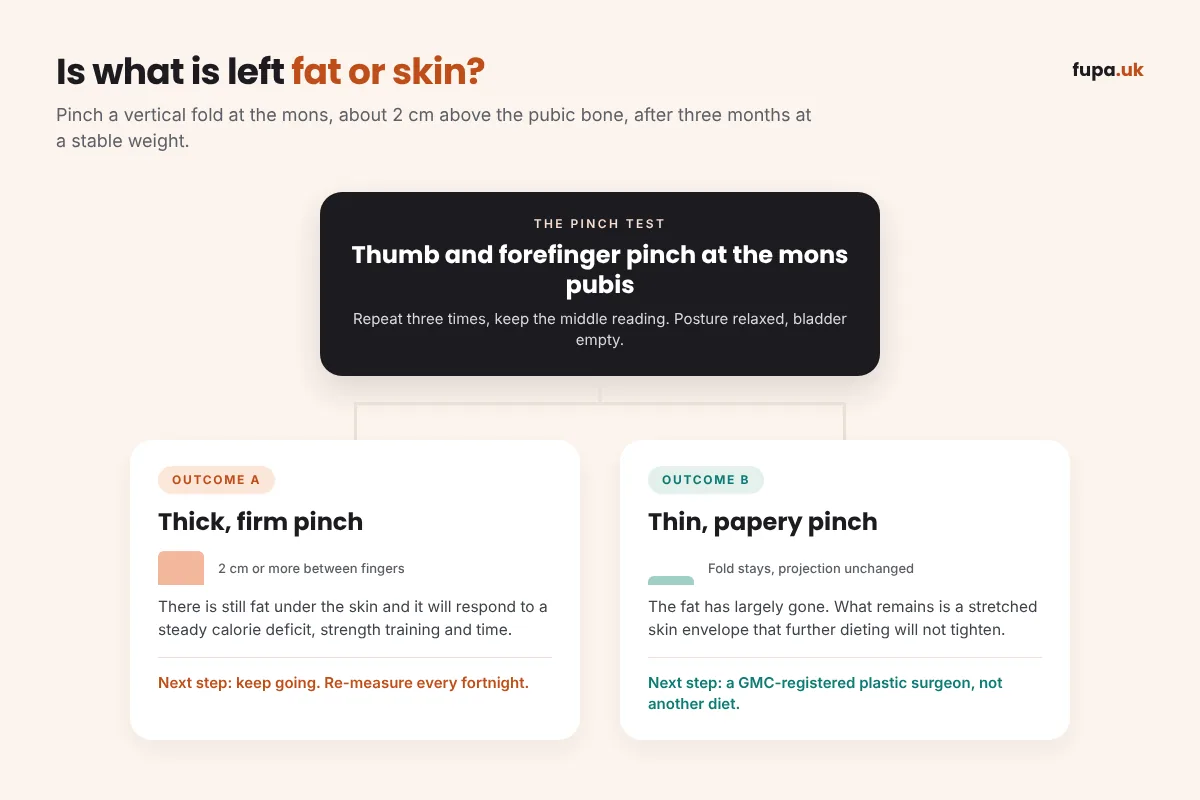
Skin that has been stretched by pregnancy or long-term weight gain does not always shrink back when the fat underneath leaves. If the pinch at the mons feels thin and papery, your weight has been stable for a few months and the fold has not changed, the remaining bulk is mostly skin and not something more dieting will fix. The comparison of loose skin vs fat in the lower belly shows how to tell them apart, and FUPA after weight loss explains what happens at that stage.
Myth 11: Hormones and Genetics Mean Effort Is Pointless
Why people believe it
Mothers and daughters often share the same lower belly shape, and anyone with PCOS, insulin resistance or menopause symptoms will have read that their hormones push fat to the middle. Put those two facts together and it is easy to conclude that the FUPA is decided for you.
What is actually true
Genetics and hormones set where your body prefers to store fat; they do not set how much fat you carry. Someone with a strong lower-belly pattern will keep a slightly fuller mons at any given weight, but the pad still shrinks when fat is lost overall. Conditions such as PCOS and insulin resistance make the deficit harder to hold, not impossible, and they are reasons to talk to a GP rather than to stop trying. The guide to FUPA hormones and genetics covers what each factor can and cannot change.
Myth 12: Surgery Is the Only Real Fix
Why people believe it
Dramatic monsplasty and liposuction photos make the surgical route look like the one route that definitely works, and the frustration of failed diets pushes people towards it earlier than they need to. The opposite belief exists too: that fat-freezing or injections do the same job without a scalpel.
What is actually true
Surgery is the right answer for a specific situation: stable weight, a fat pad that has stopped responding, or loose skin that no diet can tighten. For a FUPA that is mostly fat in someone who has not yet held a steady deficit, reputable surgeons will ask you to do that first, partly because results are better at a stable weight. Non-surgical options such as cryolipolysis give partial reduction at best. If you do reach the point where surgery is sensible, the FUPA surgery cost guide sets out realistic UK prices, and the NHS does not fund the procedure for cosmetic reasons, so the full cost is private.
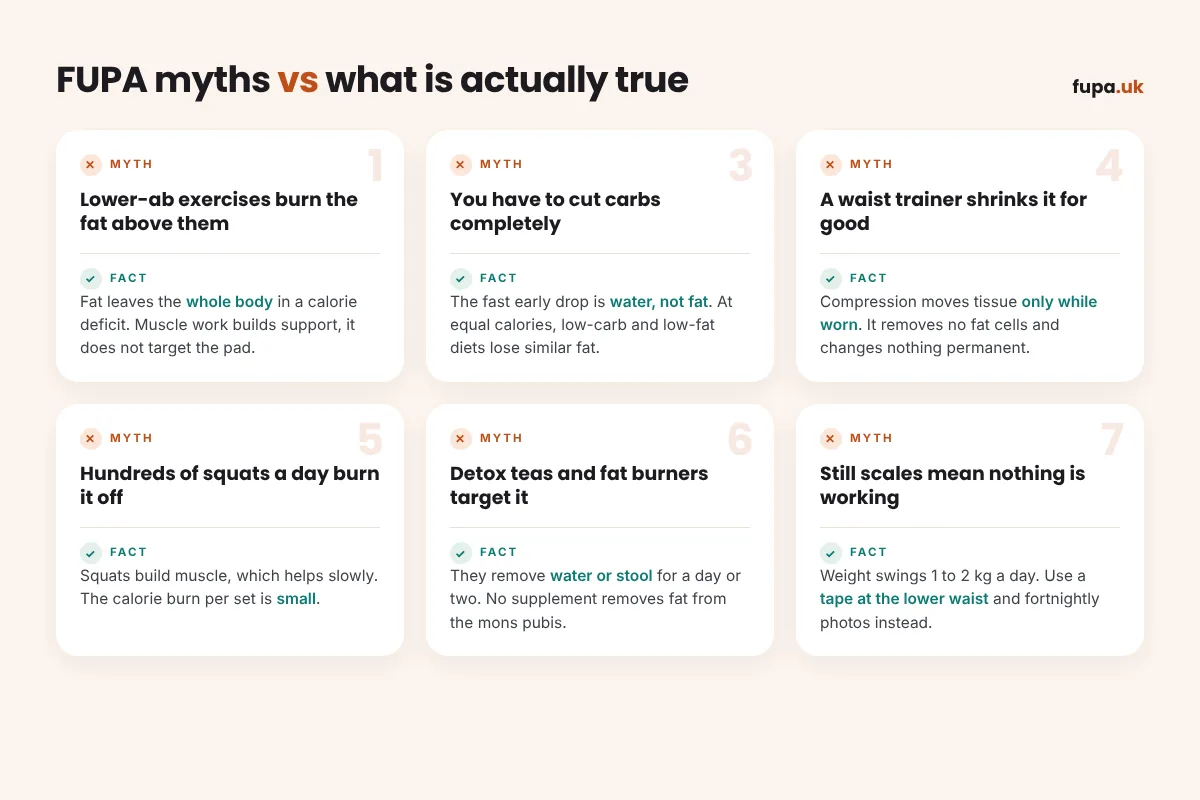
FUPA Myths vs Facts: Summary Table
| Myth | What is actually true | What to do instead |
|---|---|---|
| Lower-ab exercises burn the fat above them | Fat loss is whole-body; muscle work does not target the pad | Train the whole body and hold a calorie deficit |
| Only overweight people get a FUPA | Distribution, bone shape, hormones and skin all play a part | Judge by your own trend, not by someone else’s body |
| Carbs must go completely | Early loss is water; fat loss depends on total calories | Keep whole-food carbs and cut a modest amount overall |
| Waist trainers shrink it permanently | Compression moves tissue only while it is worn | Use shapewear for styling, not treatment |
| Hundreds of squats burn it off | Squats build muscle; the calorie burn is small | Lift compound movements two or three times a week |
| Fat burners and detox teas target it | They remove water or stool, not fat | Spend the money on food and a tape measure |
| Still scales mean nothing is working | Water, cycle and muscle gain hide fat loss | Measure the lower waist and mons fortnightly |
| A FUPA is permanent | Fat responds, slowly; only stretched skin may stay | Give a steady plan three to six months |
| Cardio only; weights bulk it | Cardio alone costs muscle; weights do not add bulk to fat | Combine 150 minutes of activity with two strength days |
| What remains after weight loss is diet-able fat | A thin pinch with a persistent fold is skin | Do the pinch test before cutting calories further |
| Genetics make effort pointless | Genes set where fat goes, not how much you carry | Expect a fuller mons at any weight, but expect it to shrink |
| Surgery is the only fix | It suits stable weight and loose skin, not an untried diet | Exhaust the free route, then get a GMC-registered opinion |
What Actually Works
A modest deficit, strength work and daily movement
The NHS targets a loss of 0.5 kg to 1 kg a week, which in practice means eating around 500 to 600 fewer calories a day than you burn. The calorie deficit for a FUPA guide walks through the numbers, and adequate protein keeps muscle while you lose. Add two or three full-body strength sessions a week and brisk walking on most days, the pattern set out in the NHS physical activity guidelines.
Measure the region, judge the trend
Take a lower waist circumference, a ruler reading at the pubic bone and a pinch every two weeks under the same conditions. Expect roughly 1 cm to 2 cm a month at the lower waist on a steady plan, with the mons a month or two behind. If three months pass at a stable weight with a thin pinch and no change in the fold, the honest next step is a consultation with a GMC-registered plastic surgeon rather than another diet.
Frequently Asked Questions
Is it true that you cannot spot-reduce a FUPA?
Yes. Exercise draws energy from fat stores across the whole body, not from the fat over the muscle being worked. Lower-ab exercises strengthen and support the area, which can improve how it looks, but the fat pad itself only shrinks with an overall calorie deficit held over months.
Do waist trainers get rid of a FUPA?
No. A waist trainer compresses soft tissue and makes you sweat while it is on, which can look slimmer for the day. It does not remove fat cells or change where fat is stored, and worn tightly for long periods it can restrict breathing and irritate the skin in the fold.
Can a slim person have a FUPA?
Yes, and it is common. The mons pubis is a fat pad everyone has, and its size depends on genetic fat distribution, pubic bone shape, hormones and whether the skin has been stretched. A slim person with a lower-belly storage pattern can have a visible FUPA at a healthy weight.
Why has my FUPA not changed even though I have lost weight?
The lower belly is usually one of the last regions to respond, so it can lag the rest of the body by a month or two. If your weight has been stable for three months and a pinch at the mons feels thin, the remaining bulk is most likely stretched skin rather than fat, which diet cannot fix.
Do fat-burning supplements or detox teas work on lower belly fat?
No. Detox teas are mostly laxatives or diuretics that remove water and stool for a day or two, and caffeine-based fat burners raise energy use by a small amount at best. No supplement has been shown to remove fat from the mons pubis, and some unlicensed products sold online contain unsafe ingredients.
When does FUPA surgery become the sensible option?
When your weight has been stable for several months, the fat pad has stopped responding, or the problem is loose skin rather than fat. Reputable UK surgeons usually ask for a year of stable weight first, and the NHS does not fund the procedure for cosmetic reasons, so budget for the full private cost.
The Bottom Line
Replace the myths with a plan
Almost every FUPA myth fails for the same reason: it promises a shortcut to a region of the body that does not take shortcuts. What works is slower and less dramatic, a modest deficit, regular strength training, daily movement and measurements taken fortnightly so you can see progress that the scales miss. Give that plan three to six months before you judge it. If the fat has gone and a fold remains, that is not a failure of effort, it is a different problem with a surgical answer, and our full guide to getting rid of a FUPA covers both routes.