
FUPA or Lipoma? How to Tell a Lump From Normal Lower Belly Fat

Page Contents
- What a FUPA Is Made Of
- What a Lipoma Is
- FUPA or Lipoma: How They Feel Different
- Side-by-Side Comparison
- Other Lumps That Can Appear Over the Mons Pubis
- Hernia
- Swollen Lymph Nodes
- Cysts, Boils and Ingrown Hairs
- Painful Fatty Lumps: Angiolipoma and Dercum’s Disease
- Red Flags: When a Lump Needs Checking Quickly
- What Happens at the GP
- Treatment Options for a Lipoma
- Can Weight Loss Shrink a Lipoma?
- Frequently Asked Questions
- Can a FUPA have a lump in it?
- How can I tell if a lump is a lipoma or just fat?
- Is a lipoma in the lower belly dangerous?
- How do I know if a lump above my pubic bone is a hernia?
- Will the NHS remove a lipoma?
- Do lipomas go away with weight loss?
- The Bottom Line
Most lower belly fullness is ordinary fat. Sometimes, though, you run a hand over your FUPA and find a smooth, rounded lump that feels separate from the rest. Very often that is a lipoma, a harmless lump of fat cells in its own thin wrapper. This guide explains how a lipoma differs from the suprapubic fat pad, which other lumps can form over the mons pubis and groin, the red flags that need a quick check, and what your GP will do.
This guide is general information, not medical advice. It cannot diagnose a lump. If you find a new lump in your lower belly or groin, especially one that is growing, hard, fixed or painful, speak to your GP.
What a FUPA Is Made Of
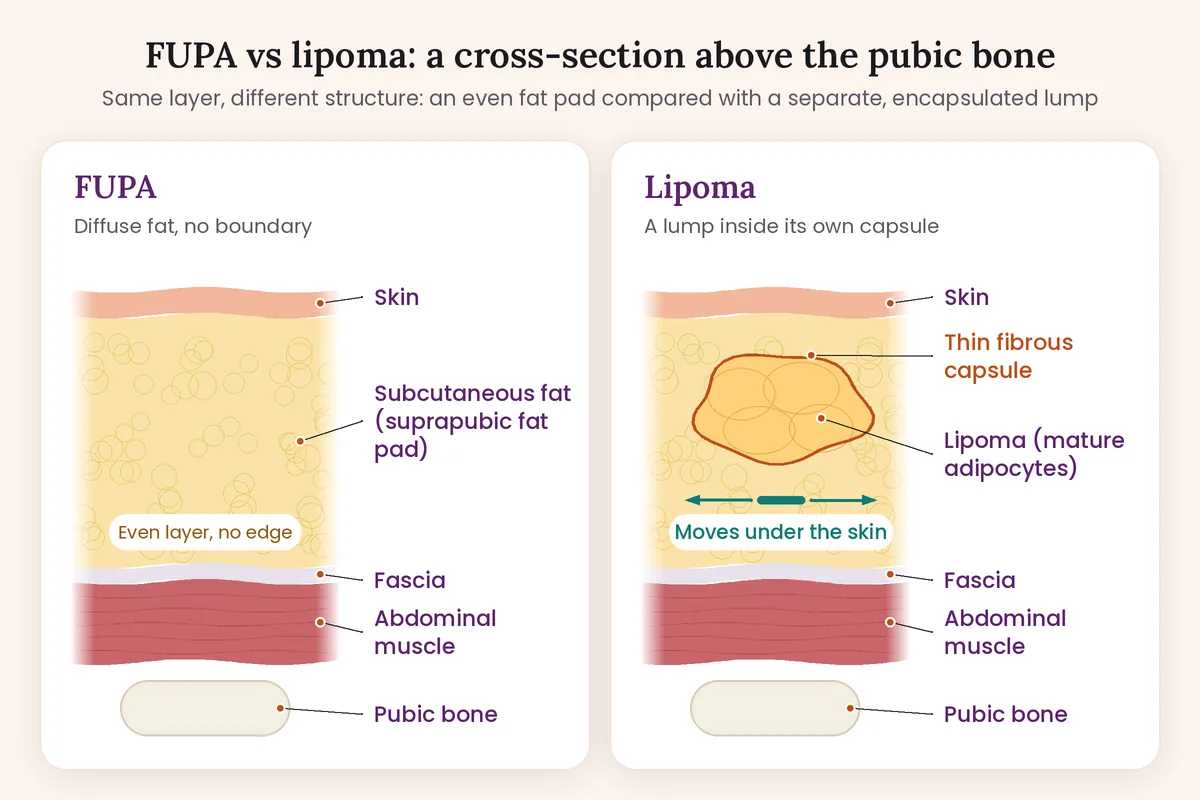
A FUPA is the pad of subcutaneous fat over the pubic bone and just above it, often called the suprapubic fat pad. It sits under the skin and over the lower abdominal muscles, and it blends into the fat of the lower abdomen and the mons pubis without a clear edge. Our guide to mons pubis anatomy covers its layers in detail.
Normal FUPA fat is diffuse. It is made of adipocytes (fat cells) in a loose framework of connective tissue, spread evenly from side to side. Pinch it and you pick up a roll, not a ball. It grows and shrinks with your body weight and changes shape when you sit, stand or lie down.
What a Lipoma Is
A lipoma is a benign, slow-growing lump made of mature adipocytes, the same type of fat cell found in a FUPA. The difference is organisation. A lipoma is usually wrapped in a thin fibrous capsule, which gives it a defined edge and lets it move as a single unit under the skin.
Lipomas are very common. They usually appear between about 40 and 60, affect both sexes equally, and are more frequent with obesity, type 2 diabetes or raised blood fats. Most sit in the subcutaneous layer, the same layer as a FUPA, so the two can lie right next to each other. The NHS guide to lipomas describes them as soft, squishy lumps that range from the size of a pea to a few centimetres across, and that may move slightly when pressed.
They are most common on the shoulders, back, arms and thighs, but can form wherever there is fat, including the lower abdomen and mons pubis.
FUPA or Lipoma: How They Feel Different
Touch cannot diagnose a lump, but a few features usually separate a lipoma from the fat around it:

- Edges. A FUPA has no edge you can trace. A lipoma usually has a rounded border you can feel all the way around.
- Movement. A lipoma tends to slip under your fingers as one piece. Normal fat moves with the skin and the tissue around it.
- Texture. Lipomas often feel soft, doughy or slightly rubbery, and sometimes lobulated. The suprapubic fat pad feels evenly soft.
- Symmetry. A FUPA spreads across both sides of the midline. A lipoma is usually a single lump on one spot.
- Weight change. A FUPA shrinks as you lose body fat. A lipoma tends to stay the same size.
If you are unsure whether you feel a lump or simply a fold, our guide to loose skin vs fat in the lower belly explains the pinch and lie-down checks.
Side-by-Side Comparison
| Feature | FUPA (suprapubic fat pad) | Lipoma |
|---|---|---|
| What it is | Normal body fat over the pubic bone | Benign growth of fat cells |
| Structure | Diffuse layer, no wrapper | Usually enclosed in a thin fibrous capsule |
| Shape | Broad, even fullness across the midline | Rounded or oval lump, often on one side |
| Feel | Evenly soft, pinches into a roll | Soft to rubbery, defined edge |
| Movement | Moves with the skin and posture | Slides under the skin as one unit |
| Size | Changes with body weight | Grows slowly or stays the same |
| Pain | Usually painless, may chafe | Usually painless |
| Treatment | Fat loss, liposuction or surgery if wanted | Often none; surgical excision if needed |
Other Lumps That Can Appear Over the Mons Pubis
A lipoma is not the only possibility, and some of the alternatives need more prompt attention.
Hernia
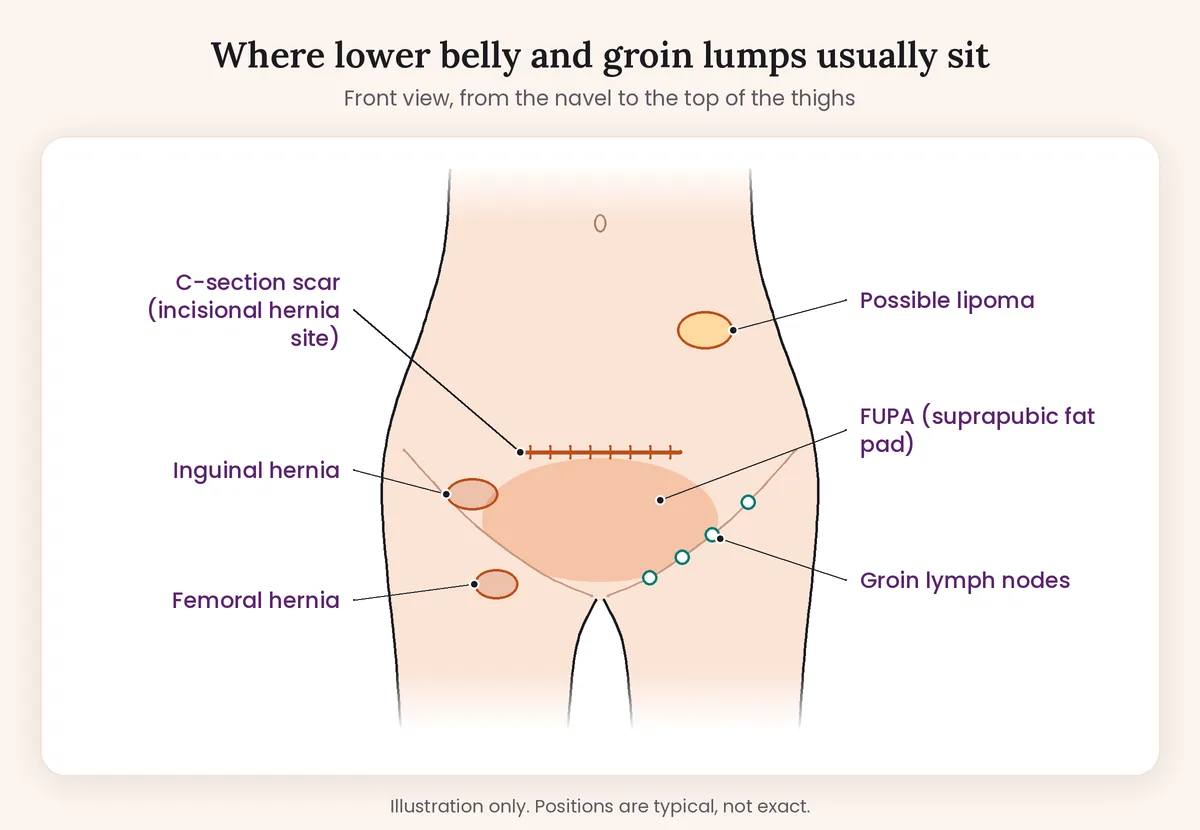
A hernia is the main differential to rule out: fat or bowel pushing through a weak spot in the abdominal wall. An inguinal hernia appears in the groin, just above the crease at the top of the thigh, and a femoral hernia sits slightly lower, at the top of the inner thigh. An incisional hernia can bulge through an old scar, such as a caesarean section scar, which runs right under a FUPA. Our article on a FUPA after a C-section explains how that scar shapes the fat pad above it.
The classic sign of a hernia is a lump that grows when you cough, strain or stand, and shrinks when you lie down. A lipoma does not do this. The NHS hernia page advises getting urgent advice if a hernia becomes painful or you have a swollen tummy, nausea or vomiting, or constipation. A groin or belly lump that suddenly becomes painful, tense or cannot be pushed back, especially with vomiting or being unable to pass wind, needs same-day help: call 999 or go to A&E if the pain is severe.

Swollen Lymph Nodes
Lymph nodes lie along the groin crease rather than over the pubic bone. They often swell for a week or two after an infection or a cut on the leg and feel like small, firm beans. A node that stays swollen beyond about two weeks, keeps growing or feels hard and fixed should be checked by a GP.
Cysts, Boils and Ingrown Hairs
Epidermoid cysts sit in the skin itself and may have a small central dot. Ingrown hairs, folliculitis and boils are common on the mons pubis because of shaving and friction, and are usually red, tender and close to the surface. Recurrent painful lumps in the groin folds can be a sign of hidradenitis suppurativa. For skin problems in this area, see our guide to FUPA pain and irritation.
Painful Fatty Lumps: Angiolipoma and Dercum’s Disease
Most lipomas do not hurt. One variant, the angiolipoma, contains extra small blood vessels and is often tender. Rarely, many painful fatty lumps develop across the trunk and upper limbs. This can be Dercum’s disease (adiposis dolorosa), a rare condition that mainly affects women after the menopause, most of whom live with obesity. Persistent pain in the suprapubic fat pad is worth raising with your GP.
Red Flags: When a Lump Needs Checking Quickly
Lipomas very rarely become cancerous. Soft tissue sarcomas are uncommon, but liposarcoma, one of the most common types in adults, can look like a lipoma at first. See your GP promptly if a lump:
- is getting bigger
- is larger than about 5 cm, roughly the size of a golf ball
- feels hard, or is fixed and does not move
- is painful, red or hot
- seems to sit deep, under the fat or within muscle
- has come back after being removed
The NHS lists a lump that is painful, red, hot, hard, immovable or growing as reasons to see a GP. NICE guidance on suspected cancer recommends that adults with an unexplained lump that is increasing in size should be considered for an urgent ultrasound scan within two weeks.

Most lumps with one of these features still turn out to be benign.
What Happens at the GP
Your GP will ask how long the lump has been there and whether it has changed or hurts. They will feel its size, edges and depth, and check whether it bulges when you cough, which helps rule out a hernia.

Many lipomas are diagnosed from examination alone. If there is doubt, the usual first test is an ultrasound, which shows whether the lump is a typical subcutaneous lipoma and whether it sits above or below the fascia. If it is deep, large or unusual, the next step is usually an MRI scan, and sometimes a biopsy. Worrying lumps are referred urgently to a specialist sarcoma service.
Treatment Options for a Lipoma
A small, painless lipoma that is not growing usually needs no treatment. The NHS generally only removes one if it is growing or causing symptoms, so cosmetic removal is usually private.

- Surgical excision. The lump is cut out, usually under local anaesthetic, along with its capsule. Removing the whole capsule makes recurrence uncommon. The tissue may be sent to a laboratory to confirm the diagnosis.
- Liposuction. A smaller incision, but the capsule may be left behind, so recurrence is more common.
- Watchful waiting. Many people keep an eye on a confirmed lipoma and act only if it changes.
Liposuction of a FUPA has a different goal: it reduces the diffuse fat pad rather than removing a single growth. Our guide to FUPA liposuction covers that operation.
Can Weight Loss Shrink a Lipoma?
Not reliably. A calorie deficit shrinks adipocytes throughout your fat stores, including the suprapubic fat pad, but a lipoma tends to keep its size. That is why some people only notice one after losing weight: the fat that hid it has gone. A lump that appears as your FUPA shrinks is still worth showing to your GP.

For more on how the FUPA compares with other kinds of lower belly fullness, read our guide to FUPA vs other belly fat.
Frequently Asked Questions
Can a FUPA have a lump in it?
Yes. A FUPA is ordinary subcutaneous fat, and a lipoma can form within or beside it. Hernias, swollen lymph nodes and skin cysts can also appear over the mons pubis and groin. Any new, distinct lump should be checked by a GP.
How can I tell if a lump is a lipoma or just fat?
A lipoma usually has a rounded edge you can trace, feels soft or rubbery, and slides under the skin as one piece. Normal FUPA fat has no edge and spreads evenly across both sides. Only an examination, and sometimes an ultrasound, can confirm it.
Is a lipoma in the lower belly dangerous?
Lipomas are benign and almost never become cancerous. A lump that is growing, larger than about 5 cm, hard, fixed, deep or painful needs a prompt GP review to rule out a sarcoma or a hernia.
How do I know if a lump above my pubic bone is a hernia?
A hernia usually gets bigger when you cough, strain or stand, and shrinks or disappears when you lie down. Inguinal and femoral hernias sit in the groin rather than in the middle of the mons pubis. Sudden pain, vomiting or a lump that cannot be pushed back needs urgent help.
Will the NHS remove a lipoma?
Usually only if it is growing or causing symptoms because of its position. Removal for appearance alone is not routinely funded.
Do lipomas go away with weight loss?
Generally not. Weight loss shrinks normal fat cells, but a lipoma tends to keep its size and may become easier to feel. The only reliable way to remove one is surgery.
The Bottom Line
A FUPA is an even, diffuse layer of fat over the pubic bone. A lipoma is a separate, encapsulated lump of fat cells that usually feels soft and mobile. Most lipomas are harmless, but the lower belly and groin can also host hernias, swollen lymph nodes and, rarely, a sarcoma. If a lump is new, growing, hard, fixed, deep or painful, see your GP, who can examine it and arrange an ultrasound if needed.