FUPA After a C-Section: Why It Happens and What Helps
Page Contents
- What Is a FUPA After a C-Section?
- Why It Happens: Skin, Fat, Scar Tethering and Diastasis Recti
- How to Tell Which Cause Is Yours
- Will It Go Away on Its Own?
- What Helps Without Surgery
- Surgical Options and Who Suits Them
- Frequently Asked Questions
- Is a C-Section Shelf the Same as a FUPA?
- Is a C-Section Shelf a Hernia?
- Why Does It Look Worse When I Sit Down?
- Can Exercise Alone Get Rid of a C-Section Overhang?
- How Soon After a C-Section Can I Have a Tummy Tuck?
- Will a Tummy Tuck Remove My C-Section Scar?
This guide is general information about body changes after a caesarean birth. It is not medical advice and does not replace an assessment by your GP, midwife or a pelvic health physiotherapist.
What Is a FUPA After a C-Section?
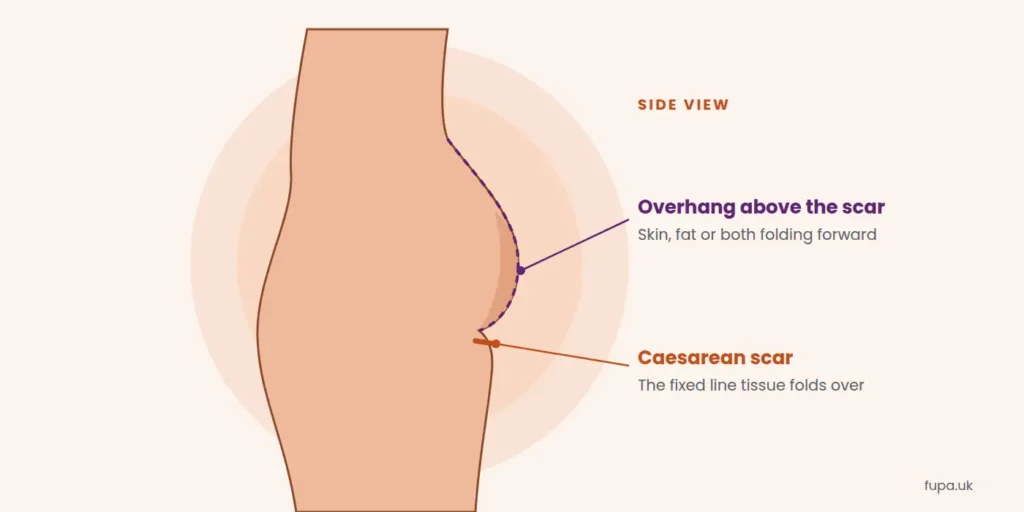
A FUPA after a C-section is a soft fold of tissue sitting above the caesarean scar. Women also call it a C-section shelf, C-section pouch, C-section overhang or mum tum, and it rarely causes pain.
The fold mixes excess skin, residual fat and scar pulled inwards. Because the scar line runs low, near the bikini line, tissue above it hangs forward, creating a shelf-like appearance instead of a smooth curve.
In many countries, one in three births is a caesarean section, making this lower abdominal bulge common after birth. Larger versions, called a hanging belly, belly overhang or apron belly, are usually a cosmetic concern.
Why It Happens: Skin, Fat, Scar Tethering and Diastasis Recti
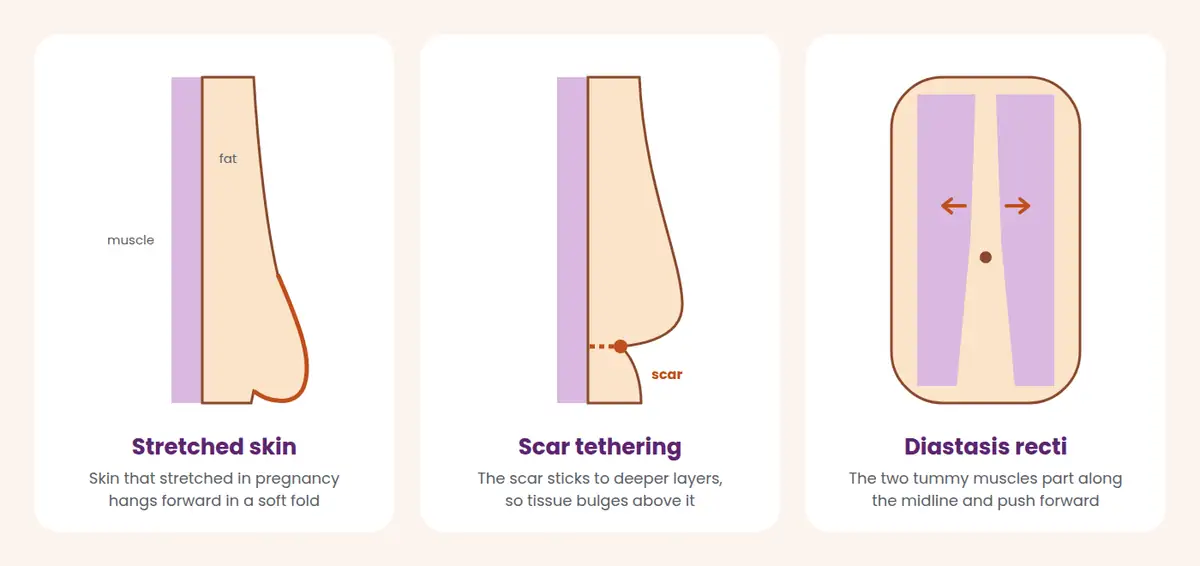
Pregnancy stretches the skin, and hormonal changes reduce skin elasticity, so stretched skin may not retract fully. The rectus abdominis muscles also part along the linea alba, leaving overstretched connective tissue and lasting skin laxity.
Even a 10 cm incision cuts through skin, fat, muscle and the uterine wall, usually as a horizontal incision, although an emergency C-section may need a vertical incision. Deep abdominal scar tissue then forms underneath.
Scar adhesion can fix that tissue to deeper layers, creating a tethered scar that works like a fixed band or fixed anchoring point. Diastasis recti, or rectus diastasis, pushes forward as abdominal muscle separation develops.
How to Tell Which Cause Is Yours
Most shelves are multi-factorial, combining fat accumulation in the lower abdomen, soft-tissue redistribution and scar changes, shaped by genetics and previous pregnancies. Working out the dominant problem helps you choose treatment that fits your body.
Scar tethering gives a localised bulge above an indented scar or tight scar, more prominent when sitting or bending. A midline bulge that worsens with straining or sit-ups, plus reduced core strength, suggests diastasis recti.
During clinical assessment, a physiotherapist or surgeon checks each anatomical layer: scar mobility, scar quality, skin excess above the belly button and fat distribution. Physical examination is enough, with imaging reserved for a suspected hernia.
| Sign | Mostly fat | Stretched skin | Scar tethering | Diastasis recti |
|---|---|---|---|---|
| How it feels | Thick and pinchable | Thin, soft fold | Bulge above a tight or indented scar | Soft gap along the midline |
| Sitting or bending | Rolls forward | Folds over | Looks much worse | Little change |
| Straining or sit-ups | No change | No change | No change | Domes or bulges |
| Responds to weight loss | Yes | No, may look looser | No | No |
| Usual next step | Diet and activity | Time, then a surgical opinion | Scar massage, physio or scar revision | Pelvic health physiotherapy |
Will It Go Away on Its Own?
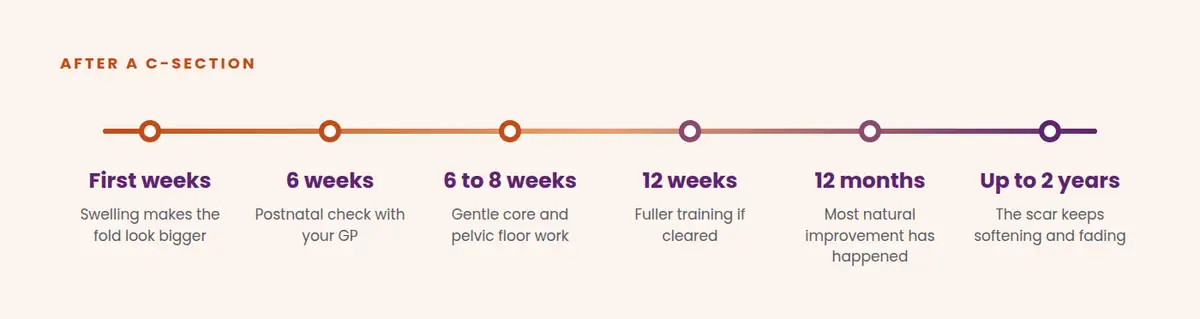
Swelling in the first weeks makes most postpartum body changes look larger. The usual 6-week recovery period ends with the NHS postnatal check, yet gradual flattening often continues as muscles recover and the skin tightens.
Most natural improvement happens within the first 12 months. Scar healing continues for up to two years as colour and firmness change. For some women the shelf fades over months or years; others keep it.
A mild overhang made mostly of swelling or fat responds to time and patience. A persistent shelf caused by marked skin laxity or scar tethering is less likely to disappear, and may need targeted treatment.
What Helps Without Surgery
After medical clearance, scar massage improves blood flow and may soften adhesions. Physical therapy with a physiotherapist can add scar mobilisation or myofascial release, plus postural training to correct sway back posture common after birth.
Postnatal-safe core exercise starts around 6-8 weeks with abdominal bracing, pelvic floor and transverse abdominis. Core strengthening moves through pelvic tilts, glute bridge, marches, bent knee fall outs, cat/cow, open books and lower trunk rotations.
A balanced diet with protein, fibre, vitamin C and zinc supports healing. Citrus fruit, berries, bone broth, fish and shellfish add nutrients and antioxidants. Hydration also helps, but no food directly rebuilds collagen or elastin.
Surgical Options and Who Suits Them
A full abdominoplasty, or tummy tuck, removes excess skin and fat, adding muscle repair, known as diastasis repair. A mini abdominoplasty treats tissue below the belly button. A body lift suits laxity around the hips.
Scar revision releases a tethered scar and needs 3-4 weeks to recover, compared with 6-8 weeks recovery after a tummy tuck. Liposuction, fat freezing, radiofrequency skin tightening and radiofrequency microneedling rarely correct a true shelf.
Surgery is often not medically necessary, so NHS funding is rare. A specialist plastic surgeon wants a stable weight for 3 months, a BMI under 30 and willingness to stop smoking 2 weeks before surgery.
Frequently Asked Questions
Is a C-Section Shelf the Same as a FUPA?
Not exactly. FUPA is slang for fat in the upper pubic area and it can affect anyone. A C-section shelf is a specific overhang forming above a caesarean scar after birth, at any body weight.
Both are non-medical umbrella terms and often overlap. A woman may have a scar overhang sitting on top of a pubic fat pad, which explains why people use the two phrases interchangeably in everyday conversation.
The distinction matters for treatment. A general FUPA responds mainly to fat loss, while a shelf may also involve scar tissue or stretched skin that needs a different approach, sometimes surgery, before its shape changes.
Is a C-Section Shelf a Hernia?
Usually not. A hernia is a tissue protrusion, often fat or bowel, through fascial weakness in the abdominal wall. A shelf leaves the abdominal wall intact, with the bulge coming from skin, fat or scar.
A hernia lump often changes with coughing or straining and may shrink when you lie down. A shelf is a fixed bulge that keeps roughly the same shape in any position or during everyday activity.
See a GP if a lump is growing or firm. If it becomes severely painful, turns red or cannot be pushed back, call NHS 111 or seek urgent care, since trapped hernias need prompt treatment.
Why Does It Look Worse When I Sit Down?
Sitting or bending forward shortens the abdomen, so soft tissue gathers at the lowest available point. On a tummy with a caesarean scar, that point lies directly above the incision, so tissue bunches up there.
If the scar is tethered, it behaves like a fixed point that cannot glide with surrounding skin. The tissue above has nowhere to go, so skin folds collect along the lower boundary at the scar.
Standing hides much of the fold, so check yourself lying flat on your back too. Lifting your head, a gap in the middle of the tummy or a rounded early pregnancy bump suggests muscle separation.
Can Exercise Alone Get Rid of a C-Section Overhang?
Exercise helps, but rarely solves everything. Progressive exercise, moving from Kegels and wall push-ups to a wall sit and modified side plank by 12 weeks, builds muscle strength, core stability and posture, easing back strain.
Exercise cannot release a tethered scar and cannot remove excess skin. Loose skin folds when bending and does not tighten with exercise. A postpartum support band offers gentle compression for comfort and support, not reshaping.
Weight loss reduces the fat layer: whole grains, healthy fats, weight management and realistic weight loss goals help. Targeted fat loss is impossible, and with marked skin laxity, slimming may leave a more noticeable shelf.
How Soon After a C-Section Can I Have a Tummy Tuck?
Most surgeons advise waiting at least 6-12 months after a C-section, allowing postpartum healing to finish. A suitable candidate has an overhang unresolved after 12 months, and the NHS notes skin needs time to contract.
You should also plan no further pregnancies, because another pregnancy can stretch the abdomen again and undo the result. A registered surgeon will review your weight history, general health and expectations before agreeing to operate.
Plan your recovery carefully. You will wear a compression garment for about six weeks, and some clinics quote 2-3 weeks off work, while the NHS suggests 4 to 6 weeks away from work and exercise.
Will a Tummy Tuck Remove My C-Section Scar?
Often, yes. In a full or mini tummy tuck, the surgeon removes a section of lower abdominal skin, and the C-section scar frequently lies inside it, so scar removal happens as part of the operation.
You will still have a new scar, usually a lower scar running from hip to hip after a full procedure. It sits low, so underwear and swimwear normally cover it once the wound has healed.
The scar fades over time, and the NHS notes this can take 12-18 months. Silicone sheets, silicone scar cream, vitamin E or moisturiser may aid scar reduction, although stretch marks outside the removed skin remain.