
How to Measure a FUPA: Tracking Lower Belly Progress the Right Way
Page Contents
- Why the Scales Fail When You Measure a FUPA
- Whole-body weight hides regional change
- Fat loss and skin behave differently
- Find Your Landmarks First
- The four points you will use
- Mark them if you need to
- How to Measure a FUPA With a Tape and Ruler
- Measurement 1: lower abdominal circumference
- Measurement 2: mons projection
- Measurement 3: the pinch test
- Measurement 4: hip to lower waist ratio
- Where NICE Waist Guidance Fits In
- Keep your waist under half your height
- Why it measures the waist, not the mons
- How Often to Measure FUPA Progress
- Fortnightly, under the same conditions
- Match the point in your menstrual cycle
- Posture and breathing rules
- Photos and Clothing Cues
- Progress photos that can be compared
- Everyday clothing signals
- Smart Scales, DEXA and What They Cannot Say
- Bioimpedance scales
- DEXA scans
- A Printable FUPA Tracking Table
- What to record each fortnight
- Reading the trend, not the row
- What Realistic Change Looks Like
- Month by month with diet and training
- Comparing against the pannus
- When the Numbers Say Skin, Not Fat
- The pattern to look for
- The honest conversation about surgery
- Frequently Asked Questions
- How do I measure a FUPA at home without special equipment?
- What is a normal mons projection measurement?
- How much should my lower waist shrink per month?
- Does the NICE waist-to-height rule apply to a FUPA?
- Can a smart scale track FUPA fat loss?
- How do I know if my FUPA is loose skin rather than fat?
- The Bottom Line
- Measure the region, trust the trend
Stepping on the bathroom scales tells you almost nothing about your lower belly. The number can drop by two kilograms while the pad above your pubic bone looks exactly the same, and it can climb after a salty meal while your jeans sit better than they have in months. If you want to know how to measure a FUPA properly, you need tools that look at that one region rather than your whole body.
This guide sets out a simple, repeatable system: the landmarks, four tape and ruler readings, how often to take them, photos that can be compared, and what realistic monthly change looks like. It also explains the moment when your FUPA measurements start to say “skin, not fat”, because that shifts the conversation from diet to surgery.
This guide is general information, not medical advice. If you are worried about a lump, pain, or sudden swelling in the lower belly, speak to your GP.
Why the Scales Fail When You Measure a FUPA
Whole-body weight hides regional change
A FUPA sits over the mons pubis, the fatty pad in front of the pubic bone, and makes up a tiny fraction of your total mass. Your weight, by contrast, swings by one to two kilograms a day from water, glycogen, food in transit, and hormones. Those swings swamp any real change in one small region, so the scales can show “progress” that never reaches your lower belly, or hide progress that has.
Fat loss and skin behave differently
Weight also cannot separate fat, loose skin, muscle, and fluid. After pregnancy or a big weight loss, the fold can stay even while fat leaves, because the skin envelope has not shrunk. Learning how to measure a FUPA with a tape, a ruler, and a pinch lets you tell those situations apart, and each one has a different fix.
Find Your Landmarks First
The four points you will use
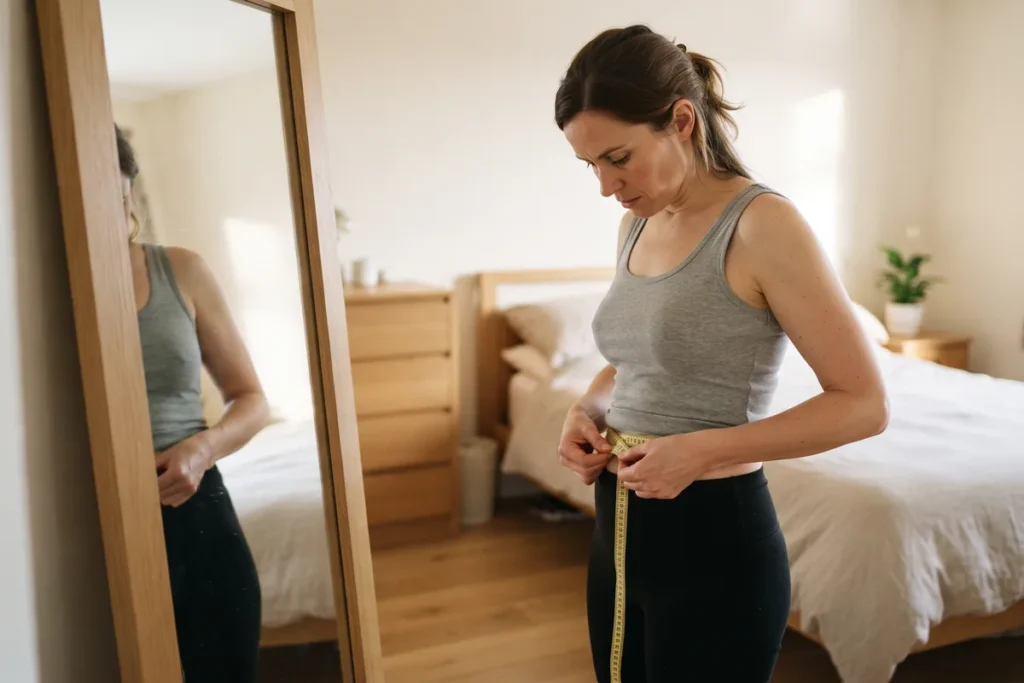
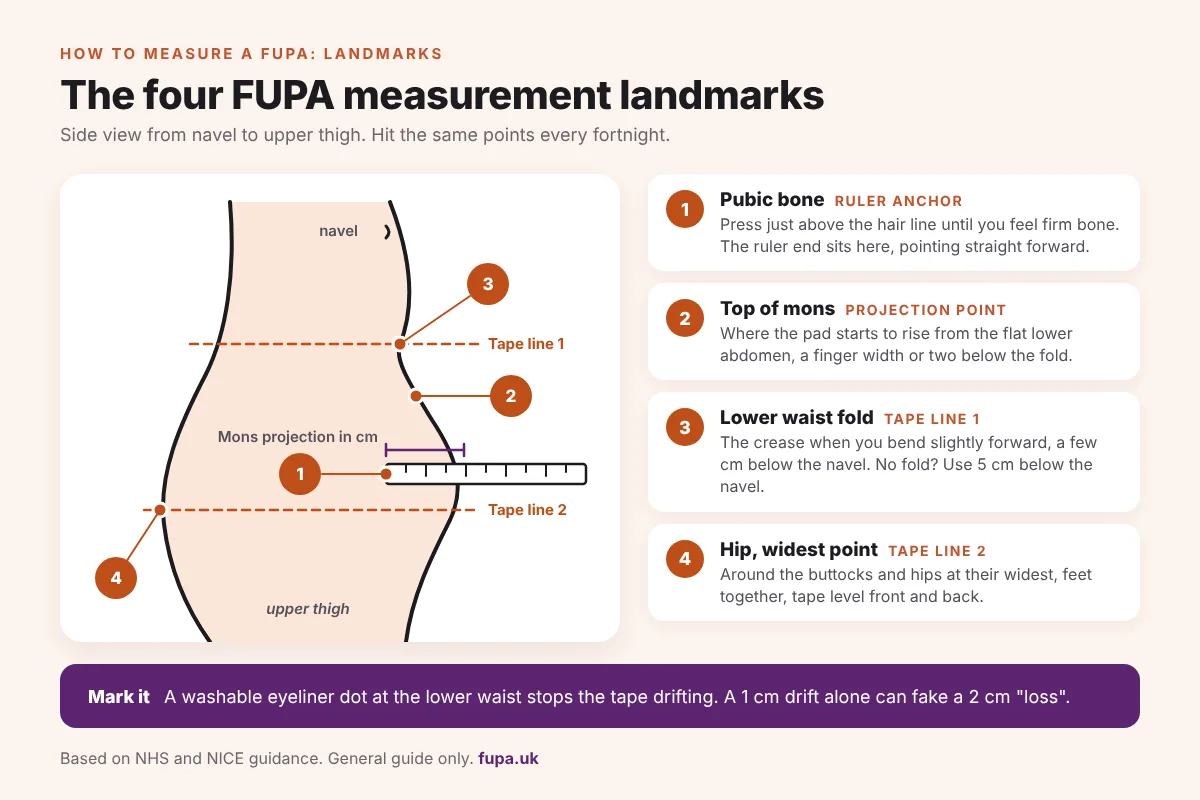
Every FUPA measurement depends on hitting the same points each time. Spend two minutes finding them before you pick up a tape.
- Pubic bone: press gently just above the top of your pubic hair line until you feel firm bone. This is the fixed anchor for the mons measurement.
- Top of the mons: the point where the fatty pad begins to rise away from the flat lower abdomen, usually a finger width or two below the fold.
- Lower waist: the natural crease or fold that forms when you bend slightly forward, typically a few centimetres below the navel. If you have no visible fold, use a point exactly 5 cm below the navel.
- Hip: the widest point around your buttocks and hips, taken with feet together.
Mark them if you need to
A washable eyeliner dot at the lower waist point removes the biggest source of error, which is drifting a centimetre up or down between sessions. That drift alone can fake a 2 cm “loss”. The guide to FUPA sizes and shapes shows how much the pad varies from person to person.
How to Measure a FUPA With a Tape and Ruler
Measurement 1: lower abdominal circumference
Stand tall with feet hip width apart. Wrap a soft tape around the lower waist landmark, keep it level all the way round, and pull it snug without denting the skin. Read it at the end of a relaxed exhale and record to the nearest 0.5 cm. This is the single best number for tracking the pad, because the tape crosses the fold itself.
Measurement 2: mons projection
Stand side-on to a mirror. Place the end of a rigid ruler flat against the pubic bone, pointing straight forward, parallel to the floor. Read the point where the most forward part of the mons meets the ruler. Most people record somewhere between 1 cm and 6 cm. This is the measurement that captures what you actually see in profile, and it is the one that decides how a FUPA looks in fitted clothes.
Measurement 3: the pinch test
Pinch a vertical fold of skin and fat on the mons between your thumb and forefinger, about 2 cm above the pubic bone. Note the thickness. Calipers give a number in millimetres and are more repeatable; fingers give a rough “thick, medium, thin” grade. Either way, repeat it three times and keep the middle reading. A thick pinch means fat. A thin pinch under a persistent fold points to skin, which we return to later.
Measurement 4: hip to lower waist ratio
Divide the lower waist circumference by the hip circumference. If the lower waist shrinks faster than the hips over several months, your lower belly is genuinely changing shape. If both fall at the same rate, you are losing weight everywhere and the FUPA is following along. Both count as progress; they just tell you different things.
- Empty your bladder and remove belts, shapewear and thick waistbands.
- Find and mark the landmarks.
- Take the lower waist, hip, projection and pinch readings in that order.
- Write each one down before taking the next.
Where NICE Waist Guidance Fits In
Keep your waist under half your height
NICE advises adults with a BMI under 35 to check their waist-to-height ratio and aim to keep their waist below half their height, because fat stored around the middle is linked to type 2 diabetes, high blood pressure and heart disease. The NICE announcement explains the reasoning. A 170 cm person, for example, would aim for a waist below 85 cm.
Why it measures the waist, not the mons
The standard waist measurement sits midway between the bottom rib and the top of the hip bone, as the World Cancer Research Fund guide describes. That line is well above the mons pubis. So a healthy waist-to-height ratio is a useful health marker, but it says nothing direct about the pad over the pubic bone. Record both, and treat the true waist as your health number and the lower waist as your FUPA number.
How Often to Measure FUPA Progress
Fortnightly, under the same conditions
Measure FUPA progress every two weeks, not every day. Daily tape readings bounce around with bloating and fluid and will only frustrate you. Take every session at the same time of day, ideally first thing in the morning, after emptying your bladder and before breakfast, wearing the same thin underwear.
Match the point in your menstrual cycle
If you menstruate, water retention in the days before a period can add a centimetre or more at the lower waist. Compare readings taken at the same cycle point, for example day five to day seven, and ignore any session that lands in the premenstrual week. Note the cycle day in your log so you can see the pattern over several months.
Posture and breathing rules
- Stand with weight even on both feet, knees soft, looking straight ahead.
- Do not suck in, push out, or arch the lower back. Anterior pelvic tilt alone can change projection by a centimetre.
- Read the tape at the end of a normal exhale, never while holding breath.
- Use the mirror to check the tape is level front and back.
Photos and Clothing Cues
Progress photos that can be compared
Photos catch what tape numbers miss, but only if everything except your body stays fixed. Shoot side-on and front-on, in the same underwear, same room, same light source and same time of day. Put the phone on a tripod at hip height and mark the floor where your feet go. A free grid overlay app lets you line up the pubic bone and navel against the same lines each time. Our FUPA before and after guide shows why lighting and angle alone can fake a transformation.
Everyday clothing signals
Clothes offer a slower but honest second opinion. Notice whether a gap opens at the back waistband of your usual jeans, whether the front still rolls, and whether a mid-rise now sits flat where it used to fold. These cues lag the tape by a few weeks, so keep one pair of non-stretch trousers as a fixed reference and try them on monthly.
Smart Scales, DEXA and What They Cannot Say
Bioimpedance scales
Smart scales pass a small current up one leg and down the other and estimate total body fat from the resistance. Readings move with hydration, foot placement and time of day, and reviews find them reasonable for weight but weak for composition. Above all, they cannot show where fat sits. A falling body fat percentage is encouraging, but it is not a FUPA measurement.
DEXA scans
A DEXA scan gives a regional breakdown, including a trunk region, and UK private clinics offer them for roughly £100 to £200. Even so, the trunk region covers the whole abdomen, not the mons alone. DEXA confirms that genuine fat loss is happening in your midsection, but it cannot replace the ruler for the one spot you care about.
A Printable FUPA Tracking Table
What to record each fortnight
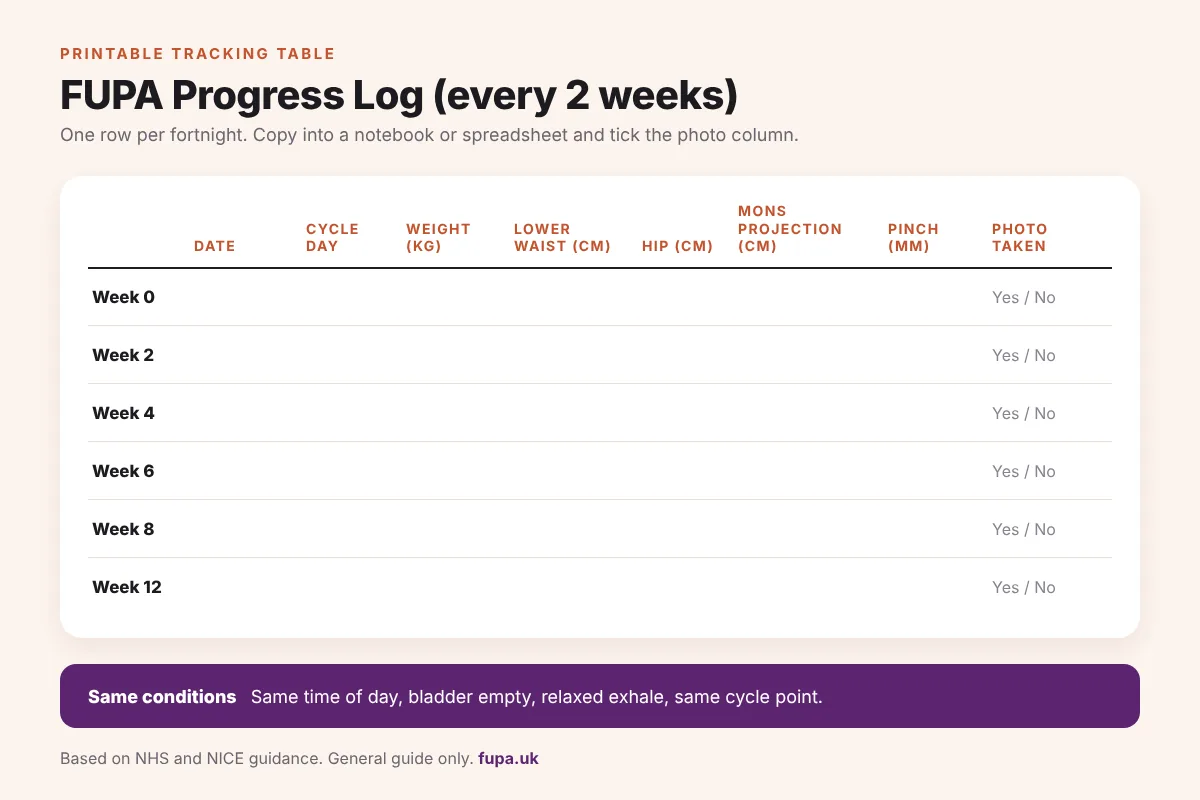
Copy this table into a notebook or spreadsheet. One row every two weeks is enough, and the photo column is a tick so you can match images to numbers later.
| Date | Cycle day | Weight (kg) | Lower waist (cm) | Hip (cm) | Mons projection (cm) | Pinch (mm or grade) | Photo taken |
|---|---|---|---|---|---|---|---|
| Week 0 | Yes / No | ||||||
| Week 2 | Yes / No | ||||||
| Week 4 | Yes / No | ||||||
| Week 6 | Yes / No | ||||||
| Week 8 | Yes / No | ||||||
| Week 12 | Yes / No |
Reading the trend, not the row
Look at three consecutive rows before you draw any conclusion. One odd reading usually means a bloated day or a tape placed too high. A steady 0.5 cm to 1 cm fall at the lower waist across six weeks is a real trend; a 2 cm jump in one fortnight is almost always noise.
What Realistic Change Looks Like
Month by month with diet and training
NHS weight management advice targets a steady 0.5 kg to 1 kg of whole-body loss per week. At that pace, most people see the lower waist shrink by roughly 1 cm to 2 cm a month, with the mons projection lagging behind by a month or two. The lower belly is often the last region to respond, so a flat line at the pubic bone in month one does not mean the plan is failing. The full approach is covered in how to get rid of a FUPA.
Comparing against the pannus
Some people track two folds: a small pad over the pubic bone and a larger overhang above it. These respond at different speeds and sometimes need different treatment. The piece on FUPA vs apron belly explains how to tell which one you are measuring, so you can log them on separate lines.
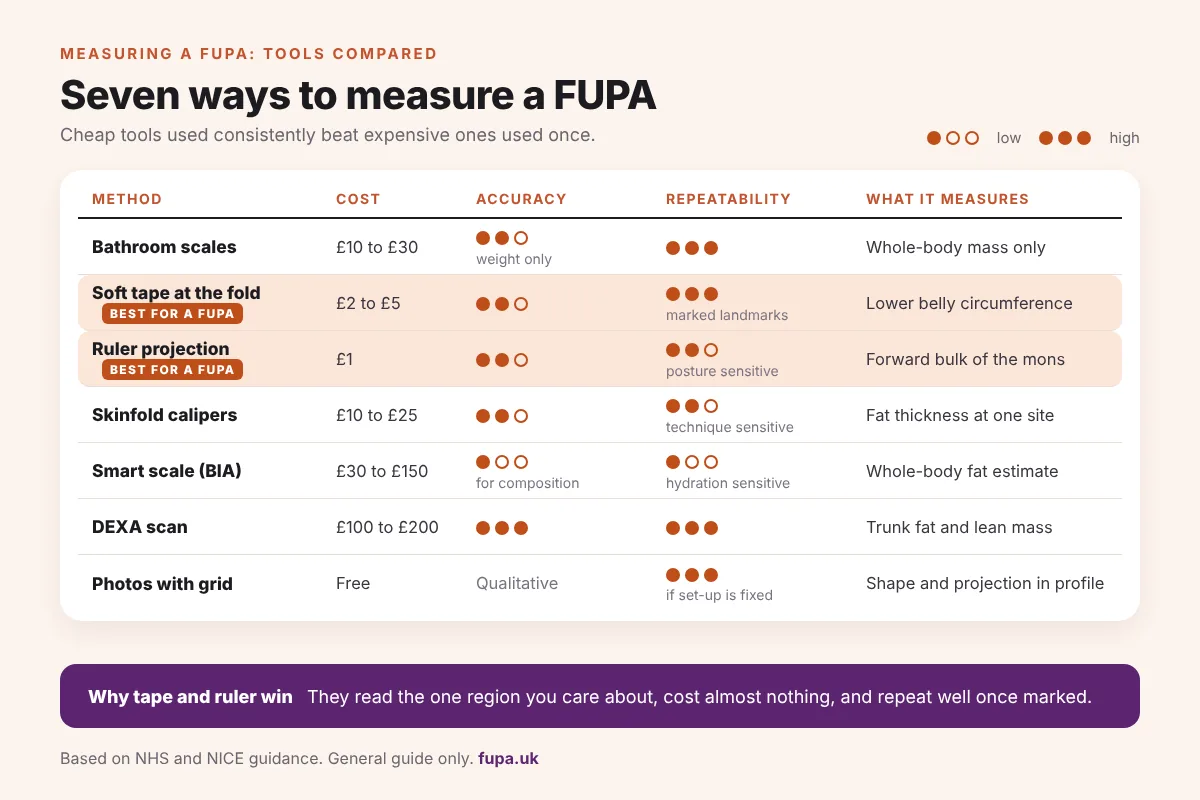
| Method | Typical cost | Accuracy | Repeatability | What it measures |
|---|---|---|---|---|
| Bathroom scales | £10 to £30 | Good for weight | High | Whole-body mass only |
| Soft tape at the fold | £2 to £5 | Moderate | High with marked landmarks | Lower abdominal circumference |
| Ruler projection | £1 | Moderate | Moderate, posture sensitive | Forward bulk of the mons |
| Skinfold calipers | £10 to £25 | Moderate | Moderate, technique sensitive | Fat thickness at one site |
| Smart scale (BIA) | £30 to £150 | Low for composition | Low, hydration sensitive | Estimated whole-body fat percent |
| DEXA scan | £100 to £200 per scan | High | High | Regional fat and lean mass, trunk level |
| Photos with grid | Free | Qualitative | High if set-up is fixed | Shape and projection in profile |
When the Numbers Say Skin, Not Fat
The pattern to look for
After a large weight loss or pregnancy, a specific pattern often appears in the log. The pinch becomes thin and the lower waist stops falling, yet the fold and the projection stay put. Your FUPA measurements are telling you the fat has largely gone and what remains is a stretched skin envelope. Our guide to a FUPA after weight loss describes this deflated stage in detail.
The honest conversation about surgery
When the lower waist has plateaued for three months at a stable weight, the pinch is thin, and the mons still projects, further dieting rarely helps and can leave you underweight elsewhere. At that point the realistic options are surgical. If the pinch is still thick and the projection is high, your measurements point to FUPA liposuction rather than more fat loss as the route that will actually change the profile. If the pinch is thin and the skin folds over, a monsplasty or lift is the usual answer instead. The surgery before and after guide shows what each procedure changes, and a consultation with a GMC-registered plastic surgeon can confirm which category you fall into.
Frequently Asked Questions
How do I measure a FUPA at home without special equipment?
You need a soft tape, a rigid ruler and a mirror. Measure the circumference at the lower waist fold, hold the ruler flat against the pubic bone to read how far the mons projects, and pinch the pad to gauge thickness. Take the readings fortnightly, first thing in the morning, after emptying your bladder, and record them in a simple table.
What is a normal mons projection measurement?
There is no clinical “normal” figure, because the mons pubis naturally varies with bone shape, hormones, and body fat. Many people measure between 1 cm and 6 cm from the pubic bone to the most forward point when standing relaxed. The useful number is your own trend over months, not a comparison against anyone else.
How much should my lower waist shrink per month?
With a steady calorie deficit and regular training, most people lose 1 cm to 2 cm at the lower waist each month while losing 0.5 kg to 1 kg a week overall. The mons projection usually follows one to two months later. Faster drops in a single fortnight are normally water or tape placement rather than fat.
Does the NICE waist-to-height rule apply to a FUPA?
Only indirectly. NICE suggests keeping your waist under half your height as a marker of health risk from abdominal fat. The waist it refers to sits midway between the ribs and hip bone, well above the mons. A healthy ratio is worth having, but it does not tell you how much fat sits over the pubic bone.
Can a smart scale track FUPA fat loss?
No. Bioimpedance scales estimate whole-body fat percentage from the resistance of a small current, and the readings move with hydration and foot placement. They cannot locate fat in one region. Use them for a rough overall trend if you like, but rely on the tape, ruler and photos for the lower belly itself.
How do I know if my FUPA is loose skin rather than fat?
Look at the pinch and the trend together. If the pinch between thumb and finger feels thin and papery, your weight has been stable for three months, and the fold or projection has not changed, the remaining bulk is mostly skin. Thick, firm pinches that slowly shrink point to fat. A plastic surgeon can confirm the difference in person.
The Bottom Line
Measure the region, trust the trend
Knowing how to measure a FUPA comes down to four cheap readings taken under fixed conditions: lower waist circumference, mons projection, pinch thickness and the hip ratio, backed by side-on photos. Log them fortnightly, ignore single readings, and judge progress over six to twelve weeks. When the pinch thins and the fold stays, the data has done its job, and the next step is a frank conversation about surgical options rather than another diet.