
FUPA and Alcohol: How Drinking Adds Fat to Your Lower Belly
Page Contents
- FUPA and Alcohol: Does Drinking Really Cause a FUPA?
- Where the FUPA Sits and Why It Stores Fat
- How Your Liver Prioritises Alcohol Over Fat Burning
- De Novo Lipogenesis and the Calorie Surplus
- Empty Calories: UK Drinks Compared
- Beer, Wine or Spirits: Which Is Worst for a FUPA?
- Alcohol, Cortisol and Stress-Driven Belly Fat
- Oestrogen, Aromatase and Testosterone in Men
- Alcohol and the FUPA in Women
- Visceral vs Subcutaneous Fat: What Drinking Changes
- Appetite, Late-Night Snacking and Poor Sleep
- Bloating or Fat? Telling the Difference
- How Much Alcohol Is Too Much? The UK 14-Unit Guideline
- Cutting Back to Shrink Your FUPA
- FUPA and Alcohol FAQs
- Does Alcohol Make Your FUPA Bigger?
- Which Alcohol Is Best If I Want to Lose My FUPA?
- How Long Does It Take to Lose an Alcohol FUPA?
- Can I Lose My FUPA Without Quitting Alcohol Completely?
- Is Alcohol Belly the Same as a FUPA?
- Does Alcohol Cause a FUPA in Men?
FUPA and alcohol are linked more closely than many realise. Admittedly, drinking rarely adds fat to one exact spot. Instead, it supplies empty calories, pauses fat burning and shifts hormones that encourage lower belly fat.
The FUPA is the suprapubic fat pad over the mons pubis. Because this pad stores fat readily, it often grows first and shrinks last. Consequently, drinkers notice the pubic fat pad swelling before the waist.
This guide explains ethanol metabolism, acetaldehyde, cortisol, oestrogen and testosterone in plain English. It also compares UK units and calories across common drinks. Please note, this is general information, not medical advice for your health.
FUPA and Alcohol: Does Drinking Really Cause a FUPA?
Alcohol does not create a FUPA on its own. However, it makes a calorie surplus easier to reach, and the body stores surplus energy somewhere. For many people, that storage site is the lower abdomen.
Observational studies show heavier drinkers carry more abdominal fat than light drinkers. Notably, binge drinking of four-plus drinks per session appears worse than one daily drink. Therefore, drinking pattern matters as much as weekly total.
Genetics decide where fat lands first. Some gain around the waist, while others gain on the mons pubis or hips and thighs. Even so, regular drinking adds fuel to whichever fat distribution pattern you inherited.
Where the FUPA Sits and Why It Stores Fat
The FUPA lies below the belly button and above the pubic bone. Anatomically, it covers the mons pubis, a cushion of subcutaneous fat resting on the pubic symphysis. Doctors call it the suprapubic fat pad.
This fat pad is unusually stubborn. Firstly, it holds many alpha-2 receptors, which slow fat release. Secondly, oestrogen encourages fat storage across the lower abdomen and hips. Hence, the suprapubic fat pad outlasts other stores.
Alcohol does not change this anatomy. Instead, it feeds the fat cells already present and blocks their emptying. Therefore, a drinker who carries a small FUPA may watch it thicken over months of weekend sessions.
How Your Liver Prioritises Alcohol Over Fat Burning
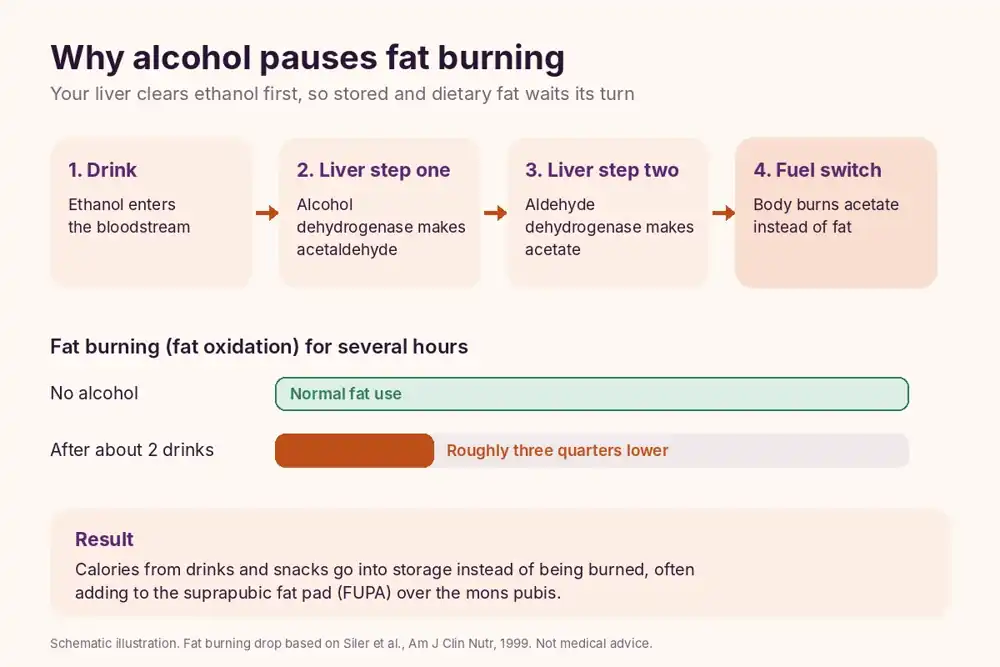
Your body cannot store ethanol, so the liver treats it as toxic and clears it first. Alcohol dehydrogenase converts ethanol into acetaldehyde, a toxin. Next, aldehyde dehydrogenase turns acetaldehyde into acetate, which enters the bloodstream.
Muscles and organs then burn acetate as their main fuel. Meanwhile, fat oxidation largely goes on hold. One well known study found fat burning fell by roughly three quarters for several hours after two drinks.
This fat oxidation pause explains why drinking with food is unhelpful. While your liver processes ethanol, dietary fat from crisps, chips or kebabs heads into storage. Unsurprisingly, plenty of that fat settles in the FUPA.
De Novo Lipogenesis and the Calorie Surplus
De novo lipogenesis means the liver builds new fat from non-fat fuels like sugar and alcohol. Heavy drinking increases this process slightly. However, the bigger problem is simple: alcohol adds energy without filling you up.
Each gram of alcohol supplies about 7 kcal, nearly as much as fat. Because one UK unit holds 8 grams of pure alcohol, every unit brings roughly 56 kcal before counting added sugar or carbohydrates.
Together, these effects create a calorie surplus. A surplus of 200 kcal daily can add several kilograms over a year. Consequently, weight gain shows up across the body, but noticeably around the suprapubic fat pad.
Empty Calories: UK Drinks Compared
Alcoholic drinks are classic empty calories. They provide energy but little protein, fibre or useful micronutrients. As a result, they do not satisfy hunger, so you rarely eat less food to make up for them.
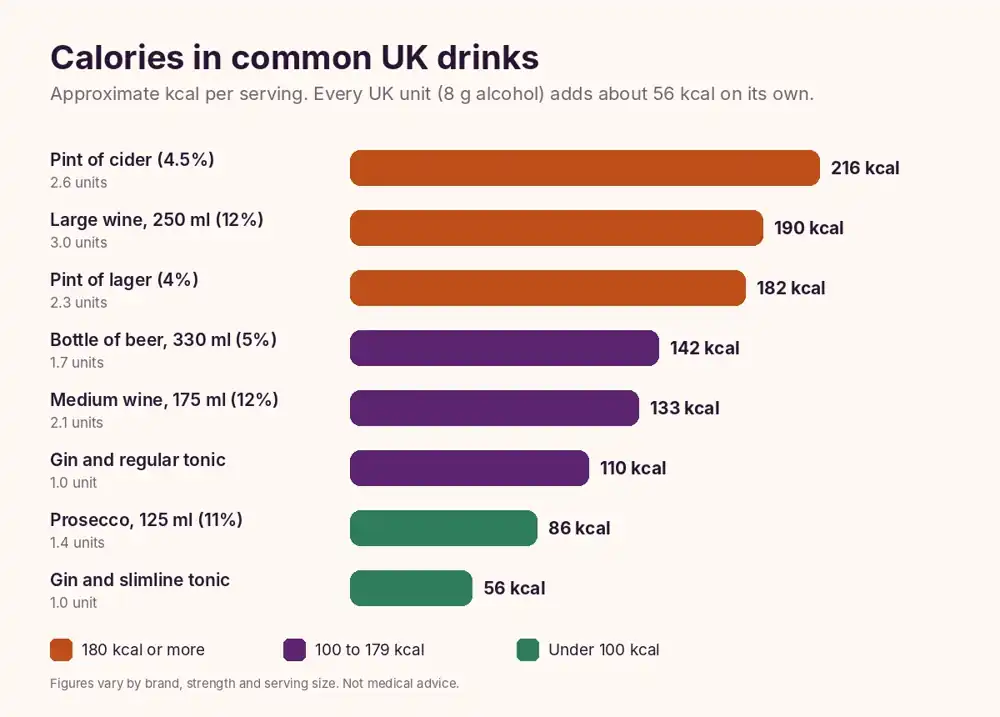
The table below shows typical UK units and kcal per serving. Figures are approximate, because ABV and serving size vary between brands. Nevertheless, they show how quickly a night out can rival a calorie budget.
| Drink | Serving | UK units | Approx. kcal | Roughly the same as |
|---|---|---|---|---|
| Cider (4.5% ABV) | Pint, 568 ml | 2.6 | 216 | A standard chocolate bar |
| Wine (12% ABV) | Large glass, 250 ml | 3.0 | 190 | A ring doughnut |
| Lager (4% ABV) | Pint, 568 ml | 2.3 | 182 | A slice of thin crust pizza |
| Beer (5% ABV) | Bottle, 330 ml | 1.7 | 142 | A small bag of crisps |
| Wine (12% ABV) | Medium glass, 175 ml | 2.1 | 133 | A slice of buttered toast |
| Gin (40% ABV) with regular tonic | 25 ml + 150 ml | 1.0 | 110 | A medium banana |
| Prosecco (11% ABV) | Flute, 125 ml | 1.4 | 86 | A chocolate digestive biscuit |
| Gin (40% ABV) with slimline tonic | 25 ml + 150 ml | 1.0 | 56 | A small apple |
| Alcohol-free beer (0.5% ABV) | Bottle, 330 ml | 0.2 | 65 | Two rich tea biscuits |
A pint of lager or a pint of cider often matches a chocolate bar. Meanwhile, a large glass of wine carries as many calories. Spirits look lighter, although mixers like tonic or cola add sugar.
Beer, Wine or Spirits: Which Is Worst for a FUPA?
The term beer belly suggests beer is uniquely fattening. In reality, total calories and units matter more than the drink itself. Nevertheless, beer and cider usually carry more carbohydrates per serving than wine or spirits.
Beer contains hops, which supply phytoestrogens, plant compounds that weakly mimic oestrogen. However, their effect on a FUPA is likely small beside the calories. Similarly, the wine belly is real, despite red wine’s healthy reputation.
Some claim resveratrol in red wine burns belly fat. Unfortunately, the amount in a glass is far too low to help. Meanwhile, spirits with slimline tonic contain the fewest calories, provided you avoid sugary cocktails.
Alcohol, Cortisol and Stress-Driven Belly Fat
Drinking raises cortisol, the main stress hormone. Studies show cortisol stays higher during heavy drinking and alcohol withdrawal. Because abdominal fat cells carry many cortisol receptors, raised cortisol favours fat storage across the lower abdomen.
Cortisol increases appetite, especially for salty and sugary foods. Therefore, a hangover breakfast often becomes a large fry-up. Over time, this pattern pushes insulin higher, which encourages fat storage around the mons pubis and waist.
Alcohol also disrupts REM sleep in the second half of the night. Poor sleep quality keeps cortisol elevated the next day. Consequently, the drink, sleep and cortisol cycle can feed visceral fat and the FUPA.
Oestrogen, Aromatase and Testosterone in Men
In men, regular heavy drinking lowers testosterone in two main ways. Firstly, ethanol is directly toxic to the testes. Secondly, alcohol boosts aromatase, the enzyme that converts testosterone into oestrogen, mainly inside existing fat tissue.
More oestrogen and less testosterone shift fat storage towards the lower belly. Extra belly fat contains more aromatase, which creates a loop. Therefore, a male FUPA can grow faster when drinking and weight gain combine.
Low testosterone also reduces muscle mass, which lowers daily calorie burning. So, you need even fewer calories to tip into a surplus. Cutting alcohol often helps testosterone recover within weeks, although results vary between men.
Alcohol and the FUPA in Women
Women generally reach higher blood alcohol levels than men after the same drink. That is because they have less body water and less alcohol dehydrogenase in the stomach. Therefore, identical drinks hit women’s metabolism harder.
Alcohol also raises oestrogen in women. Before menopause, oestrogen already favours fat on the hips, thighs and mons pubis. Consequently, regular drinking can thicken the pubic fat pad alongside the hips rather than the waist.
After menopause, falling oestrogen moves fat storage towards the abdomen. Combined with drinking, this shift can enlarge the FUPA and add visceral fat together. Moreover, hot flushes and poor sleep can worsen with evening drinking.
Visceral vs Subcutaneous Fat: What Drinking Changes
Subcutaneous fat sits under the skin, and you can pinch it. The FUPA is mostly subcutaneous fat. In contrast, visceral fat surrounds organs deep inside the abdomen and feels firm, pushing the whole belly outward.
Heavy drinking links more strongly to visceral fat than pinchable fat. However, visceral fat pushes the abdominal wall forwards. Consequently, the suprapubic fat pad sits further out and looks larger, when its thickness barely changes.
Visceral fat matters because it raises your risk of type 2 diabetes, heart disease and fatty liver disease. Waist circumference above half your height suggests excess visceral fat. Therefore, regular measuring offers a warning sign.
Appetite, Late-Night Snacking and Poor Sleep
Alcohol lowers inhibition and stimulates brain areas that drive hunger. Research shows drinkers often eat more at meals with alcohol, and choose saltier, fattier foods. Consequently, late-night snacking after the pub adds hidden calories quickly.
A night out might include crisps, peanuts and a takeaway on the way home. Together, these can add 1,000 kcal on top of the drinks. Much of that surplus ends up as lower belly fat.
The next morning, hangover cravings continue the problem. Low blood sugar and dehydration push people towards fried food and sugary drinks. Therefore, one heavy evening can raise calorie intake across two days, not just one.
Bloating or Fat? Telling the Difference
Not every swelling after drinking is fat. Alcohol irritates the gut lining, and fizzy drinks add gas. Consequently, alcohol bloating can make the lower belly look rounder the next morning, especially after beer or prosecco.
Bloating usually feels tight and changes through the day. In contrast, a FUPA feels soft, pinchable and stays the same size from morning to evening. Furthermore, bloating eases within one to three days without alcohol.
Water retention from salty snacks exaggerates the lower belly temporarily. However, if the swelling remains after two alcohol-free weeks, it is probably fat. Persistent pain, bloating or bowel changes deserve a conversation with your GP.
How Much Alcohol Is Too Much? The UK 14-Unit Guideline
The UK Chief Medical Officers advise drinking no more than 14 units a week on a regular basis. Furthermore, they suggest spreading those units over three or more days, with several drink-free days each week.
Fourteen units equals six pints of average-strength beer or six medium glasses of wine. In calorie terms, that is about 900 to 1,100 kcal weekly. Therefore, staying within the low-risk guideline still adds noticeable energy.
The NHS offers a units calculator to track your drinking. If you regularly exceed 14 units, cutting back usually helps your weight, sleep and blood pressure. Speak to your GP if cutting back feels hard.
Cutting Back to Shrink Your FUPA
You cannot spot reduce a FUPA with exercises alone. However, reducing alcohol makes a calorie deficit much easier. Because fat burning restarts sooner, the body can draw on stored fat, including the suprapubic fat pad.
Practical swaps help. For example, choose alcohol-free beer, alternate drinks with water, or use smaller 125 ml wine glasses. In addition, eat a high-protein meal before drinking, which reduces late-night snacking and slows alcohol absorption.
Pair these changes with strength training, walking and better sleep. Changes often appear within eight to twelve weeks. If a FUPA remains after weight loss, options like liposuction or monsplasty exist, though lifestyle comes first.
FUPA and Alcohol FAQs
Does Alcohol Make Your FUPA Bigger?
Yes, indirectly. Alcohol adds empty calories, pauses fat burning and raises cortisol. The surplus often settles in the suprapubic fat pad, thickening an existing FUPA.
Which Alcohol Is Best If I Want to Lose My FUPA?
Spirits with a zero-sugar mixer usually contain the fewest calories. However, total weekly units matter most, so drinking less beats switching drinks.
How Long Does It Take to Lose an Alcohol FUPA?
Bloating can settle within a week. However, fat loss from the FUPA usually takes eight to twelve weeks of a steady calorie deficit.
Can I Lose My FUPA Without Quitting Alcohol Completely?
Yes. Stay within 14 units a week, add drink-free days and count drinks in your calorie budget. Avoiding binge sessions helps most.
Is Alcohol Belly the Same as a FUPA?
No. An alcohol belly usually means visceral fat pushing the whole stomach outward. A FUPA is softer, pinchable fat over the mons pubis, although drinking can increase both.
Does Alcohol Cause a FUPA in Men?
It can. Alcohol lowers testosterone and boosts aromatase, which converts testosterone into oestrogen. Together with extra calories, this shift favours lower belly fat in men.