
FUPA and PCOS (Now PMOS): Why Hormones Put Fat on Your Mons Pubis and What Actually Shrinks It
Page Contents
- PCOS Has a New Name: What PMOS Means
- Does PCOS Cause a FUPA?
- How Insulin Resistance Drives Lower-Belly Fat
- Androgens and Where Your Body Stores Fat
- FUPA vs PCOS Belly: How to Tell Them Apart
- Lean PCOS and a Persistent FUPA
- Other Signs Your FUPA May Be Linked to PCOS
- Getting Diagnosed in the UK
- Eating to Improve Insulin Sensitivity
- Exercise That Actually Reduces a PCOS FUPA
- Medication: Metformin, GLP-1 Drugs and the Pill
- When Surgery Is Worth Considering
- FUPA and PCOS: Common Questions
- Can PCOS Make You Look Pregnant?
- Is a FUPA a Sign of PCOS?
- Can You Get Rid of a FUPA If You Have PCOS?
- Does Metformin Reduce Belly Fat in PCOS?
- Why Is a PCOS FUPA So Hard to Lose?
- Will PMOS Change My Diagnosis or Treatment?
This guide is general information about PCOS, now called PMOS, and how it affects fat around the pubic area. It is not medical advice and does not replace an assessment by your GP or a specialist.
A FUPA, or fat upper pubic area, is the fat cushion over the mons pubis. For women with polycystic ovary syndrome, this suprapubic fat pad can refuse to shrink despite genuinely consistent diet and training.
It is rarely willpower. PCOS, now called PMOS or polyendocrine metabolic ovarian syndrome, disrupts how the body handles sugar and hormones, and that hormonal imbalance shifts fat distribution towards the lower abdomen and pubic area.
Two drivers matter most: insulin resistance and raised androgens. Together they explain the stubborn lower belly fat people call PCOS belly or the lower belly pouch, and point to the treatments that make a difference. For the wider picture of how female hormones shape the area, see our guide to FUPA in women.
PCOS Has a New Name: What PMOS Means
In May 2026, a global consensus published in The Lancet renamed polycystic ovary syndrome as polyendocrine metabolic ovarian syndrome. The process took fourteen years and gathered views from over fourteen thousand patients and health professionals.
The change fixes an ovarian cysts misnomer: many women with the condition never actually develop cysts. “Polyendocrine” reflects several disrupted hormone systems, while “metabolic” recognises insulin resistance, diabetes risk and heart health as core features.
It is the same lifelong condition, affecting roughly one in eight women, now framed as a hormonal and metabolic disorder. A three-year transition runs until the 2028 International Guideline; Verity PCOS UK co-led the process, and the NHS guide to PMOS already uses the new name.
Does PCOS Cause a FUPA?
Not directly. The mons pubis fat pad exists in everyone, and PCOS does not create it. PCOS instead encourages weight gain and central adiposity, which enlarges the pad and the lower abdominal fat above it.
Research on PCOS focuses on visceral fat inside the abdomen, but subcutaneous fat under the skin also increases. As it builds, an abdominal apron, or panniculus, can fold over the pubic area and exaggerate it, which is why many women confuse a FUPA with an apron belly.
So PCOS is best seen as a contributing factor rather than a direct cause. The apple shape and larger waist circumference make an existing FUPA more noticeable, and harder to shift, than it would be.
How Insulin Resistance Drives Lower-Belly Fat
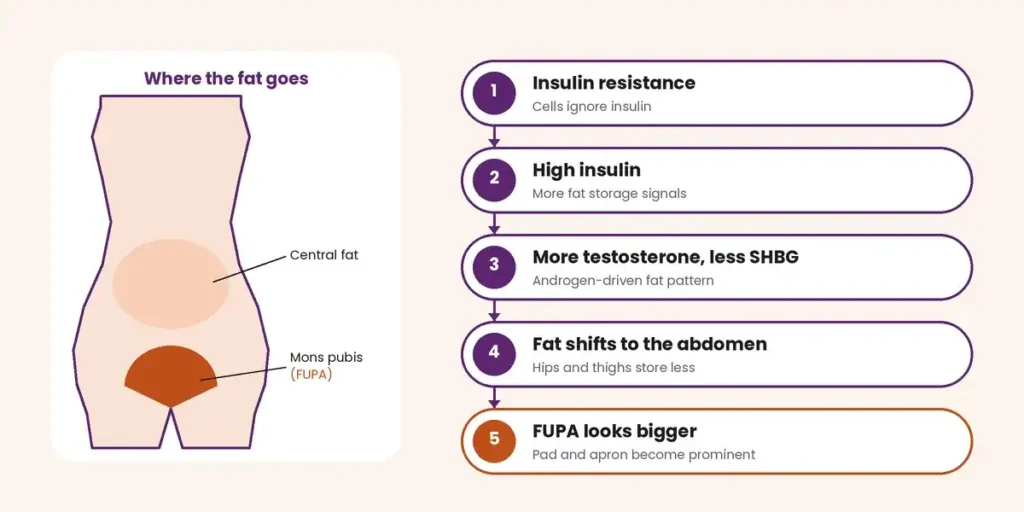
Insulin resistance appears in up to 80% of cases of PCOS. Cells stop responding properly to insulin, so the pancreas releases more, a state called hyperinsulinaemia, to keep blood glucose within a safe, normal range.
High insulin is a powerful signal for fat storage. It favours glucose converted to fat and stored around the midsection, while the same process raises type 2 diabetes risk and can progress quietly towards prediabetes.
It also creates a feedback loop. Abdominal fat releases signals that fuel inflammation and worsen insulin resistance, bringing cravings and fatigue. Left unchecked, this cluster can develop into full metabolic syndrome over the following years. Our guide to hormones, genes and the FUPA covers the other inherited factors involved.
Androgens and Where Your Body Stores Fat
Hyperandrogenism, meaning raised androgens such as testosterone, is a hallmark of PCOS. They shift fat away from a gynoid fat pattern, stored on the hips and thighs, towards an android fat pattern around the abdomen. A similar shift happens after the menopause, when oestrogen falls.
Insulin and androgens reinforce each other. Insulin stimulates ovarian testosterone production and lowers SHBG, or sex hormone binding globulin, the protein that normally keeps testosterone inactive. More free testosterone means stronger male-pattern fat storage centrally, as explained in our piece on testosterone and the FUPA.
Stress hormones add another layer. Cortisol, released by the adrenal glands under control of the HPA axis, favours abdominal storage. Some women with PCOS show altered cortisol handling, which may make lower-belly fat more persistent. Read more about how cortisol affects the lower belly.
FUPA vs PCOS Belly: How to Tell Them Apart
They often look similar but behave differently. A FUPA is a subcutaneous pad that feels soft and pinchable, sitting in a crease above pubic bone level. A classic PCOS belly is usually firm and round.
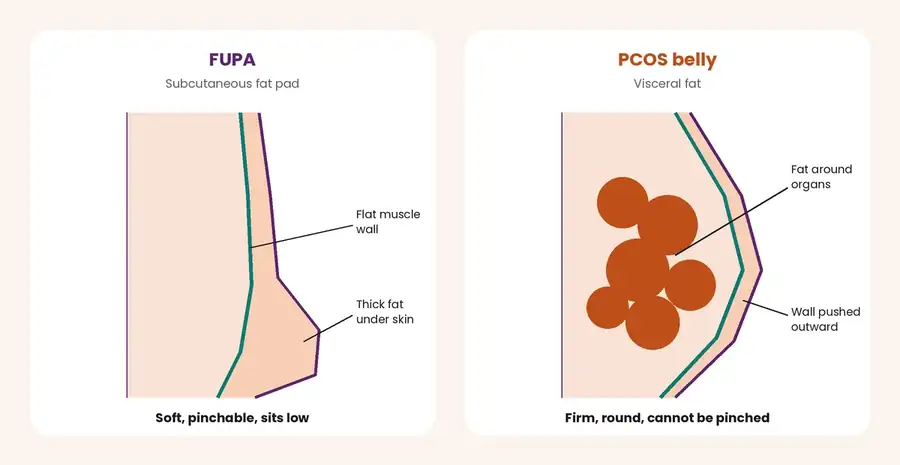
That firmness comes from visceral fat around organs, which you cannot grab. Try a pinch test: if you can hold the fat between finger and thumb, it is subcutaneous. Bloating adds swelling that changes daily, and our FUPA vs bloating guide shows how to separate the two.
When visceral fat, bloating and an overhang combine, some women describe a pregnant-looking belly. Measuring waist-to-hip ratio and waist-to-height ratio tracks this deeper fat better than the scale, and helps separate fat from temporary swelling.
| Feature | FUPA | PCOS belly |
|---|---|---|
| Where it sits | Low, over the pubic bone | Whole midsection, often above the navel too |
| How it feels | Soft and pinchable | Firm and round |
| Main fat type | Subcutaneous, under the skin | Visceral, around the organs |
| Changes through the day | Stays the same | Can swell with bloating by evening |
| Health signal | Mostly cosmetic | Linked to diabetes and heart risk |
| What shrinks it | Overall fat loss, then surgery if it persists | Better insulin sensitivity and fat loss |
Lean PCOS and a Persistent FUPA
Lean PCOS is common. Women with a normal BMI, even a healthy BMI by every standard chart, can still carry a noticeable FUPA, because the condition changes where fat goes rather than how much exists.
Studies have found higher visceral fat at normal weight in women with PCOS. Research suggests their gluteofemoral fat, around the hips and thighs, has limited lower-body fat expansion, so surplus energy spills towards the abdomen.
This fat spillover explains the “skinny fat” look, where body composition matters more than weight. Researchers describe a metabolic subtype, with higher insulin and BMI, and a reproductive subtype, where hormones dominate at lower weight. We cover this pattern in more depth in why slim people get a FUPA.
Other Signs Your FUPA May Be Linked to PCOS
A FUPA alone proves nothing, but companions raise suspicion. Irregular periods or oligomenorrhoea, meaning infrequent cycles, are most common. Hirsutism is another, including coarse belly hair where fine vellus hair turns into darker terminal hair.
Skin gives clues. Persistent acne, scalp hair thinning, velvety dark patches called acanthosis nigricans in the armpits or neck, and multiple skin tags all point towards insulin resistance and raised androgens working in the background.
Broader signs include unexplained weight gain, difficulty losing weight despite real effort, fertility problems, low mood and sleep apnoea, more frequent in PCOS. If several apply alongside a stubborn FUPA, a GP appointment is sensible.
Getting Diagnosed in the UK
Start with your GP. On the NHS, diagnosis follows the Rotterdam criteria, requiring two of three criteria: ovulatory dysfunction, clinical hyperandrogenism or raised blood androgens, and polycystic ovarian morphology seen on a pelvic ultrasound scan.
Blood tests usually check testosterone, SHBG and the free androgen index, alongside HbA1c for blood sugar and a lipid profile for cholesterol. Thyroid function and prolactin are measured too, because other conditions can mimic PCOS.
GPs follow NICE CKS PCOS guidance. If results are unclear, fertility is a concern or symptoms are severe, referral to a gynaecologist or endocrinologist is appropriate. Bring a symptom diary covering periods, skin and weight.
Eating to Improve Insulin Sensitivity
No single PCOS diet exists, but patterns that steady blood sugar help most. A low glycaemic index approach, or the Mediterranean diet, built on whole foods, lean protein, fibre and healthy fats, supports insulin sensitivity.
Cut back on processed carbohydrates, added sugar and alcohol, which spike insulin quickly. A modest calorie deficit with sensible portion control matters: a 5% weight loss can noticeably improve cycles, insulin levels and waist size.
An anti-inflammatory diet is a useful frame, but avoid extremes. No crash dieting: severe restriction raises cortisol, erodes muscle and usually rebounds. A registered dietitian can tailor carbohydrate levels to your glucose tolerance and routine, and our FUPA diet guide gives a practical starting plan.
Exercise That Actually Reduces a PCOS FUPA
The spot reduction myth should go first. Endless crunches strengthen the abdominal wall but do not burn the fat covering it. Fat leaves the FUPA when overall body fat falls, driven by consistent whole-body activity.
Full-body strength training is the priority. Resistance training with progressive overload builds muscle mass, and muscle is the largest site of glucose uptake, so every session improves insulin sensitivity for hours afterwards, even without weight change. See our best exercises for a FUPA for a full routine.
Add 150 minutes a week of moderate aerobic activity, such as brisk walking. Pilates and yoga help core control and may lower cortisol. Consistency beats intensity: a sustainable routine outperforms punishing sessions abandoned within weeks.
Medication: Metformin, GLP-1 Drugs and the Pill
Metformin, an insulin sensitiser, is commonly used off-label in the UK for PCOS. The combined oral contraceptive pill regulates cycles and lowers androgens, while anti-androgens such as spironolactone target hirsutism, though neither directly removes fat.
GLP-1 receptor agonists have changed the picture. Semaglutide (Wegovy) and tirzepatide (Mounjaro) produce substantial weight loss, including abdominal fat. Access comes through NHS weight management services for eligible patients, or privately with a valid prescription.
Supplements are marketed to women with PCOS. Inositol shows some promise for insulin and cycles, but supplements evidence remains limited and inconsistent. Discuss anything you plan to take with your GP, especially alongside prescribed medication.
When Surgery Is Worth Considering
If a FUPA remains after reaching a stable weight, surgery becomes a reasonable conversation. Monsplasty lifts and reduces the mons, liposuction for a FUPA removes pinchable fat, and abdominoplasty or apronectomy addresses loose skin and a hanging apron.
Surgeons want weight steady for six months and a BMI threshold met, often below 30 for cosmetic procedures. Where skin excess is the main issue, liposuction disappoints, because it removes fat but not stretched skin.
PCOS continues after surgery, so fat recurrence is possible without ongoing management. Book a surgeon consultation only with someone on the GMC register, operating in a CQC registered clinic. Keep realistic expectations about results.
FUPA and PCOS: Common Questions
Can PCOS Make You Look Pregnant?
Yes. Visceral fat behind the abdominal muscles can create an enlarged lower abdomen and a protruding stomach, often with the rest of the body unchanged. Bloating makes it look worse by evening.
Is a FUPA a Sign of PCOS?
No. A FUPA is not diagnostic and is common in women without PCOS, shaped by genetics, pregnancy and weight changes. If you also have other symptoms, such as irregular periods or excess hair, book a GP assessment.
Can You Get Rid of a FUPA If You Have PCOS?
Yes, with time. It shrinks through overall fat loss, helped by better insulin sensitivity and regular strength training. Medication support can help if progress stalls, and surgery for residual fat is the final option.
Does Metformin Reduce Belly Fat in PCOS?
Only slightly. It gives modest weight loss by easing insulin resistance and appetite, but it is not a weight-loss drug. Gastrointestinal side effects are common, and results are best combined with lifestyle changes.
Why Is a PCOS FUPA So Hard to Lose?
The insulin resistance cycle sends constant fat storage signals to abdominal fat. Raised androgens, cortisol from stress and a slower metabolism add to it, so progress is real but slower.
Will PMOS Change My Diagnosis or Treatment?
No. It is the same condition with new terminology, and existing prescriptions continue. Expect more metabolic monitoring, including diabetes screening, because PCOS raises cardiovascular risk.