
Stomach Vacuum for a FUPA: Can a Breathing Exercise Flatten Your Lower Belly?
Page Contents
- What Is a Stomach Vacuum Exercise?
- Which Muscles Does the Vacuum Exercise Train?
- Can a Stomach Vacuum Burn FUPA Fat?
- What a Vacuum Can Change About the Lower Belly
- How to Do a Stomach Vacuum: Step-by-Step Technique
- Five Positions From Easiest to Hardest
- A 12-Week Stomach Vacuum Progression Plan
- Common Technique Mistakes and How to Fix Them
- Who Should Avoid or Modify Stomach Vacuums
- Stomach Vacuums After Pregnancy and With Diastasis Recti
- Combining Vacuums With Fat Loss for a Smaller FUPA
- Pairing Vacuums With Other Lower Belly Exercises
- How Long Before You See Results?
- Stomach Vacuum and FUPA: FAQs
- Can Stomach Vacuums Get Rid of a FUPA?
- How Long Should I Hold a Stomach Vacuum?
- How Many Stomach Vacuums Should I Do Per Day?
- Is It Safe to Do Stomach Vacuums Every Day?
- Can I Do Stomach Vacuums With Diastasis Recti?
- When Is the Best Time to Do a Stomach Vacuum?
A stomach vacuum is a breathing-led core drill that draws your navel back towards your spine. Many people try it hoping to flatten a FUPA, the soft fat pad sitting just over the pubic bone.
The honest answer is mixed. Using a stomach vacuum for FUPA control trains the deep core muscles that hold your lower belly in, but it cannot melt the subcutaneous fat stored in the mons pubis.
This guide explains what the vacuum exercise really does, how to perform it safely, and how to pair it with fat loss. You will also learn who should skip it, including anyone pregnant or postnatal.
What Is a Stomach Vacuum Exercise?
A stomach vacuum is an isometric contraction, meaning the muscle tightens without your joints moving. You breathe out fully, then gently pull your belly button inwards and upwards, holding the hollow shape for several seconds.
Physiotherapists call the same movement the abdominal drawing-in manoeuvre, or ADIM. You may also see abdominal hollowing and stomach hollowing. All four terms describe one action: tightening the deepest muscle layer of your abdominal wall.
The drill has old roots. Yoga’s Uddiyana Bandha uses a similar upward abdominal lock. Bodybuilders Frank Zane and Arnold Schwarzenegger made the vacuum pose famous in the 1970s, and it later went viral on TikTok.
Which Muscles Does the Vacuum Exercise Train?
The main target is the transverse abdominis, often shortened to TVA. Its fibres run horizontally around your trunk like a corset, linking the lower ribs, the pelvis and the deep thoracolumbar fascia at the back.
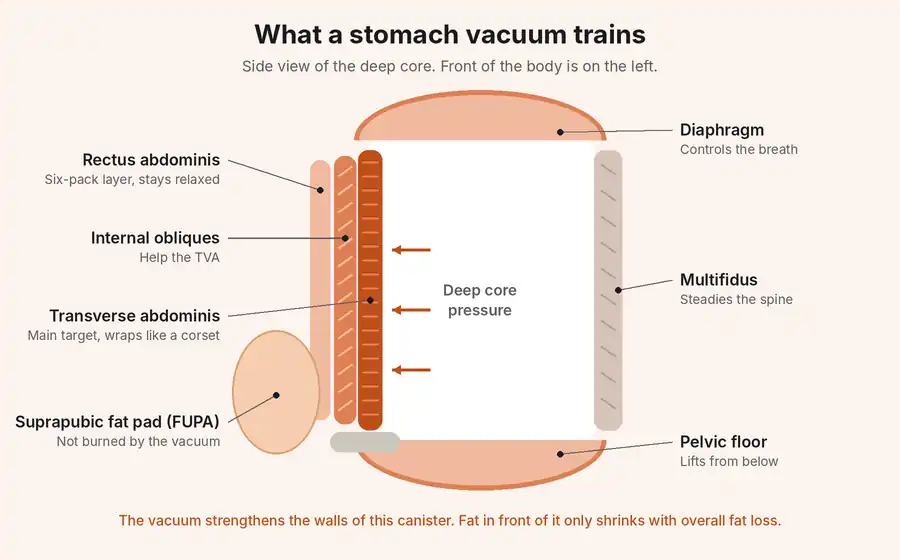
Helpers join in. The internal obliques sit above the TVA, the diaphragm controls the breath, the pelvic floor muscles lift from below, and the multifidus steadies each spinal segment. Together they form your deep core.
The rectus abdominis, the “six-pack” muscle, should stay fairly relaxed. That is why vacuums feel different from crunches. A 2022 study comparing five postures found the TVA and internal obliques switched on in every position.
Can a Stomach Vacuum Burn FUPA Fat?
No. A vacuum cannot burn the fat that forms a FUPA. Spot reduction, the idea that working one muscle strips the fat above it, is a myth that exercise research has repeatedly failed to support.
Your body draws on fat stores everywhere, guided by genes, hormones and energy balance. The suprapubic fat pad is often one of the last areas to shrink, especially after pregnancy or with oestrogen-driven fat storage.
Fat over the pubic area only reduces when you sit in a steady calorie deficit for weeks. A vacuum burns few calories, so it works as a support tool rather than a fat loss method.
What a Vacuum Can Change About the Lower Belly
A vacuum can improve how your lower belly sits, even when fat levels stay the same. A stronger TVA pulls a lax abdominal wall inwards, which can reduce the lower belly pooch many people notice.
It also helps posture. Better control over anterior pelvic tilt stops the pelvis tipping forward and pushing the stomach out. That shift can make a FUPA look smaller in fitted clothes or a side profile.
Set realistic goals before you start. Judge progress by core control, posture and waist circumference, not by a mirror check after one week, because fat stored in the mons pubis usually changes much more slowly.
| Can improve | Cannot change |
|---|---|
| Deep core strength and control | Fat stored in the mons pubis |
| Posture and pelvic position | Loose or overhanging skin |
| Lower belly bulge from a lax wall | Genetic fat distribution |
| Breath control and bracing | Body fat without a calorie deficit |
How to Do a Stomach Vacuum: Step-by-Step Technique
Stand tall with feet hip-width apart and a neutral spine. Place one hand on your lower belly, just below the navel. Breathe in through your nose for 3-5 seconds, letting your ribs widen gently sideways.
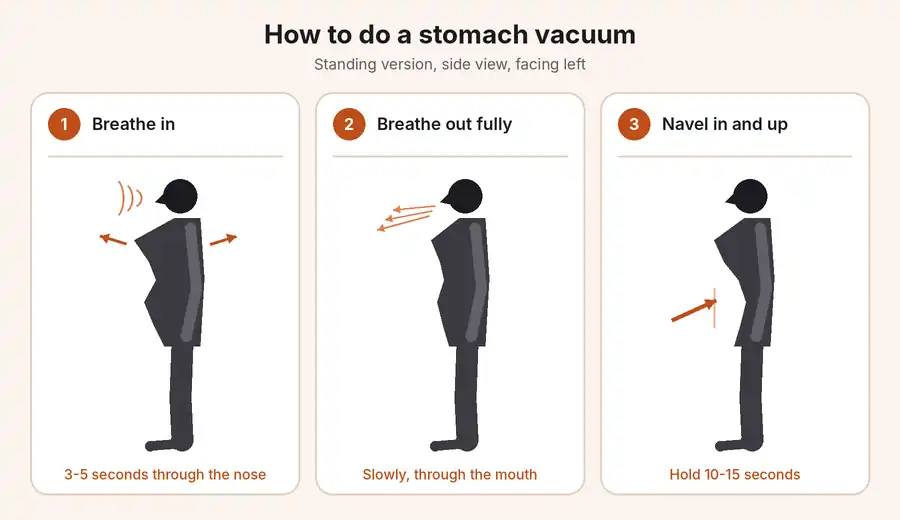
Next, breathe out slowly through your mouth until your lungs feel almost empty. As the air leaves, draw your belly button back towards your spine and slightly up, as though zipping up tight high-waisted jeans.
Hold the hollow for 10-15 seconds while taking small, shallow breaths into your chest. Release slowly, rest for 30 seconds, then repeat 3-5 times. Stop straight away if you feel any dizziness, pain or nausea.
Five Positions From Easiest to Hardest
Start lying on your back in hook lying, knees bent and both feet flat. This supine position removes gravity’s pull on your belly, so beginners can clearly feel the TVA working without straining other muscles.
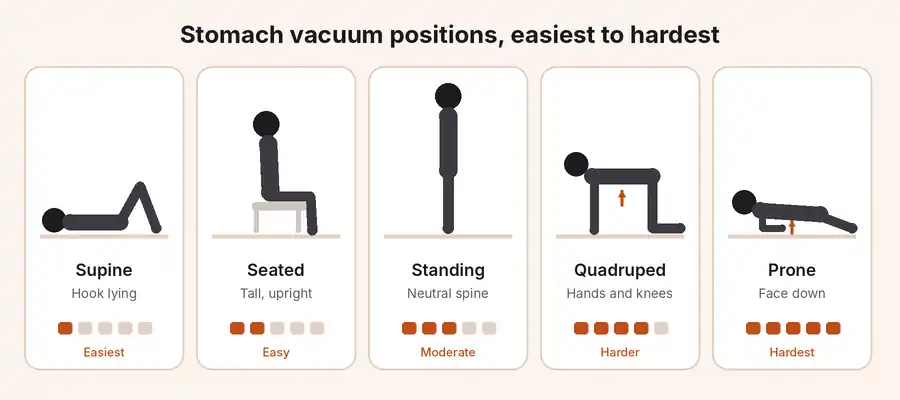
Progress to seated, then standing, once you can hold 20 seconds with steady breathing. The quadruped position on hands and knees is harder because your belly hangs towards the floor, making you work against gravity.
The prone version, lying face down with your belly lifted off the mat, is the most demanding. Move up only when the easier position feels smooth, controlled and comfortable for three sessions in a row.
| Position | Difficulty | Starting hold |
|---|---|---|
| Supine (hook lying) | Easiest | 10 seconds |
| Seated | Easy | 10-15 seconds |
| Standing | Moderate | 15 seconds |
| Quadruped | Harder | 15-20 seconds |
| Prone | Hardest | 10 seconds |
A 12-Week Stomach Vacuum Progression Plan
In weeks 1-2, practise supine vacuums with 10-15 second holds, 3-5 reps, once or twice a day. Focus on the mind-muscle connection, feeling the lower belly gently tighten while your shoulders and jaw stay soft.
In weeks 3-6, add seated and standing work. Build holds to 30-45 seconds and complete 5-10 reps, twice daily. Cut rest between efforts from 30 seconds to about 20 seconds as your control steadily improves.
From week 7 onwards, use quadruped and prone positions with holds of 60 seconds. Weave short vacuums into daily life too, such as while queueing or sitting at your desk, to build automatic core stability.
Common Technique Mistakes and How to Fix Them
The most common error is simply sucking in your stomach. That squeezes air rather than muscle. Instead, exhale first, then pull inwards from below the navel so the effort comes from the deep wall itself.
Breath-holding is the second problem. Clamping your throat can trigger lightheadedness and raise blood pressure. Keep taking sips of air through the nose while the belly stays drawn in, and release if you feel faint.
Watch your ribs and back. Rib flaring means your ribs pop forward, while rounding or arching your spine shifts work away from the TVA. Use a side-on mirror to keep your trunk long and steady.
Who Should Avoid or Modify Stomach Vacuums
Skip vacuums during pregnancy unless a midwife or pelvic health physiotherapist approves a modified version. Deep hollowing with breath control places unusual pressure on a growing bump, so gentler NHS-approved core work is usually safer.
People with high blood pressure, heart disease or a history of fainting should speak to a GP first. Strong exhalation followed by a breath hold can mimic the Valsalva manoeuvre, which briefly spikes blood pressure.
An abdominal hernia, inguinal hernia or recent abdominal surgery calls for caution. Raised intra-abdominal pressure can push tissue through a weak spot. Ask your surgeon or GP before starting, and stop with any new bulge.
Stomach Vacuums After Pregnancy and With Diastasis Recti
Diastasis recti is a widening gap between the two halves of the rectus abdominis along the linea alba. The NHS notes a two-finger gap is common in pregnancy and usually closes naturally by 8 weeks.
Gentle TVA work is often part of postnatal recovery. The NHS describes lying on your side and drawing the lower stomach in like a corset, together with a pelvic floor squeeze, holding for 10 counts.
If a gap or doming along the midline remains beyond 8 weeks, contact your GP. Mention it at your 6-8 week postnatal check, and ask for referral to a physiotherapist before progressing to standing vacuums.
Combining Vacuums With Fat Loss for a Smaller FUPA
To shrink the fat behind a FUPA, combine vacuums with a modest calorie deficit. NICE and the NHS suggest eating about 600 kcal less each day, which supports steady weight loss of roughly 0.5-1kg weekly.
Movement matters too. NHS physical activity guidelines advise at least 150 minutes of moderate intensity activity or 75 minutes of vigorous intensity activity weekly, plus strength training for all major muscle groups on two days.

Track progress with a tape measure. NICE advises keeping your waist below half your height, known as a waist-to-height ratio under 0.5. A falling ratio shows that visceral fat and lower belly fat are reducing.
Pairing Vacuums With Other Lower Belly Exercises
Vacuums work best alongside moves that train the whole trunk. A dead bug, a glute bridge and a side plank all challenge the core while keeping pressure on the abdominal wall fairly low and controlled.
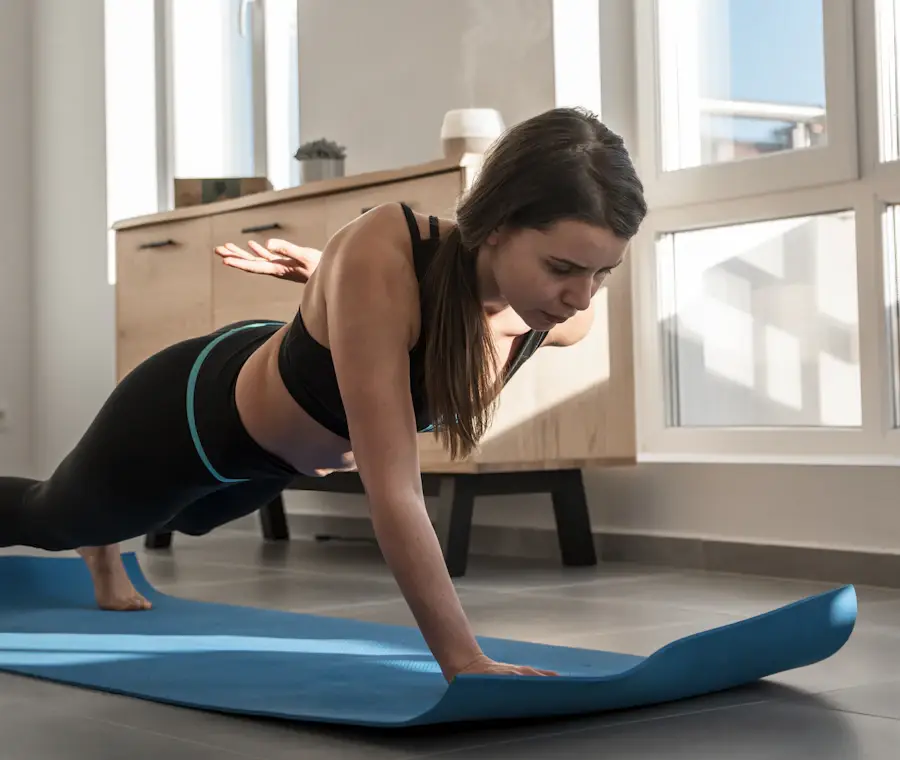
Once your base is solid, add harder options such as mountain climbers, the Russian twist or ab wheel roll-outs. Start each set by drawing the belly in, then keep that light tension throughout every rep.
Leg-heavy moves help as well. Squats and lunges use large muscles that burn more energy than any ab drill. They also strengthen the glutes, which support a level pelvis and a flatter lower belly profile.
How Long Before You See Results?
Most people feel better core control within 2-4 weeks of regular practice. You may notice your belly stays drawn in more easily during walking, lifting shopping or standing for long periods at work or home.
Visible changes to waist shape usually take 6-12 weeks of steady, consistent practice. Any shrinking of the FUPA itself depends on fat loss, which follows your calorie intake and activity rather than vacuum volume alone.
Take a waist measurement and a side-on photo every four weeks. Measure at the same time of day, ideally in the morning, so changes reflect real progress rather than bloating after meals or fizzy drinks.
Stomach Vacuum and FUPA: FAQs
Can Stomach Vacuums Get Rid of a FUPA?
No, stomach vacuums cannot get rid of a FUPA alone. They strengthen the deep core muscles behind the lower belly, but they do not burn the fat stored over the pubic bone in meaningful amounts.
A FUPA shrinks when overall body fat falls through a steady calorie deficit, regular activity and good sleep. Vacuums then help the lower belly look firmer and flatter as that fat layer gradually becomes thinner.
Some FUPAs include loose skin after pregnancy or major weight loss. Exercise cannot tighten stretched skin, so speak to a GP if the overhang causes rashes, soreness or hygiene problems that affect your daily comfort.
How Long Should I Hold a Stomach Vacuum?
Beginners should hold a stomach vacuum for 10-15 seconds. If that feels too hard, start with 5-10 seconds lying on your back, then add a few extra seconds each week as your control improves steadily.
Intermediate users can build towards 30-45 second holds, and experienced trainees may reach 60 seconds or more. Quality matters more than time, so release the moment your belly starts pushing outwards or your breathing tightens.
Rest for 20-30 seconds between holds. Keep taking small breaths throughout each effort rather than holding your breath completely, as this protects your blood pressure and stops you feeling faint or dizzy during longer sets.
How Many Stomach Vacuums Should I Do Per Day?
Most beginners do well with 3-5 vacuums, once or twice a day. That takes under five minutes and gives the deep core enough practice to improve without leaving your lower back or belly feeling sore.
As you progress, build to 5-10 vacuums twice daily, spread across different positions. Three or four dedicated sessions a week is also a sensible pattern if daily practice does not fit your busy routine easily.
More is not always better. If your back aches, your breath feels strained or your form slips, cut the number of reps. Consistent, accurate practice beats large numbers performed with poor technique every single time.
Is It Safe to Do Stomach Vacuums Every Day?
Yes, stomach vacuums are safe to do daily for most healthy adults. The exercise is low impact and gentle, so the deep core recovers quickly between short sessions when your technique stays smooth and controlled.
Daily practice is not right for everyone. Pregnant people, those with hernias, uncontrolled high blood pressure or recent abdominal surgery should get medical advice first, as the drill briefly raises pressure inside the abdominal cavity.
Listen to your body during each session. Stop straight away if you feel sharp pain, dizziness, nausea or breathlessness, and see a GP if any new swelling appears in your groin or around your navel.
Can I Do Stomach Vacuums With Diastasis Recti?
Gentle vacuums can help some people with diastasis recti, but only with professional guidance. A pelvic health physiotherapist can check your gap and confirm whether drawing-in work supports healing or adds strain to the midline.
Start lying down or on your side, using soft TVA activation with steady breathing. Watch your stomach closely for doming or a ridge along the midline, which signals too much pressure for your current strength.
Avoid sit-ups, crunches and full planks early on, as the NHS recommends after giving birth. Contact your GP if the gap remains after 8 weeks or you notice lower back pain alongside the muscle separation.
When Is the Best Time to Do a Stomach Vacuum?
The best time to do a stomach vacuum is first thing in the morning before breakfast. An empty stomach makes it easier to draw the belly in fully and to feel the deep muscles working.
Avoid vacuums straight after a large meal, as a full stomach limits how far you can hollow and may cause discomfort. Leave around two hours after eating before a focused vacuum session for best comfort.
You can also link vacuums to daily habits, such as brushing your teeth or waiting for the kettle. Tying them to set routines makes consistent practice far easier than relying on willpower or reminders alone.