
Emsculpt for a FUPA: Muscle Toning, UK Cost and Realistic Results

Page Contents
- What Is Emsculpt?
- Emsculpt: HIFEM muscle stimulation
- Emsculpt NEO: HIFEM plus radiofrequency
- What Emsculpt Is Cleared to Treat
- Does Emsculpt for FUPA Work?
- What it cannot change
- What it might change
- What the Evidence Shows
- The early studies
- An independent, critical review
- What this means for a FUPA
- How Many Sessions You Need
- UK Cost of Emsculpt
- Side Effects and Who Should Avoid It
- Common side effects
- Who should avoid Emsculpt
- Emsculpt vs CoolSculpting, Liposuction and Monsplasty
- CoolSculpting and other fat-reduction devices
- Liposuction
- Monsplasty
- Who Might Be a Good Candidate?
- Questions to Ask a UK Clinic
- Frequently Asked Questions
- Does Emsculpt work on a FUPA?
- What is the difference between Emsculpt and Emsculpt NEO?
- How much does Emsculpt cost in the UK?
- How many Emsculpt sessions will I need?
- Is Emsculpt safe?
- Can Emsculpt tighten loose skin on a FUPA?
- Is Emsculpt available on the NHS?
- The Bottom Line
Emsculpt is one of the most heavily advertised body treatments in UK clinics, and it often appears in searches about the lower belly. So does Emsculpt for FUPA fat actually work? The short answer is: not directly. Emsculpt is a muscle-toning device. A FUPA is mostly fat and skin sitting on the pubic bone. This guide explains what Emsculpt and Emsculpt NEO do, what the research really shows, typical UK prices, sessions, side effects and the alternatives that target a FUPA more directly.
This guide is general information, not medical advice. Speak to your GP before any cosmetic treatment if you have a health condition, an implant or a new lump or swelling in the pubic area.
For a full overview of every option, from fat freezing to monsplasty, see our FUPA surgery and removal guide.
What Is Emsculpt?
Emsculpt is a brand of body-contouring device made by BTL. Clinics usually sell it as a way to “build muscle and burn fat” without surgery. There are two main versions, and they work in slightly different ways.
Emsculpt: HIFEM muscle stimulation
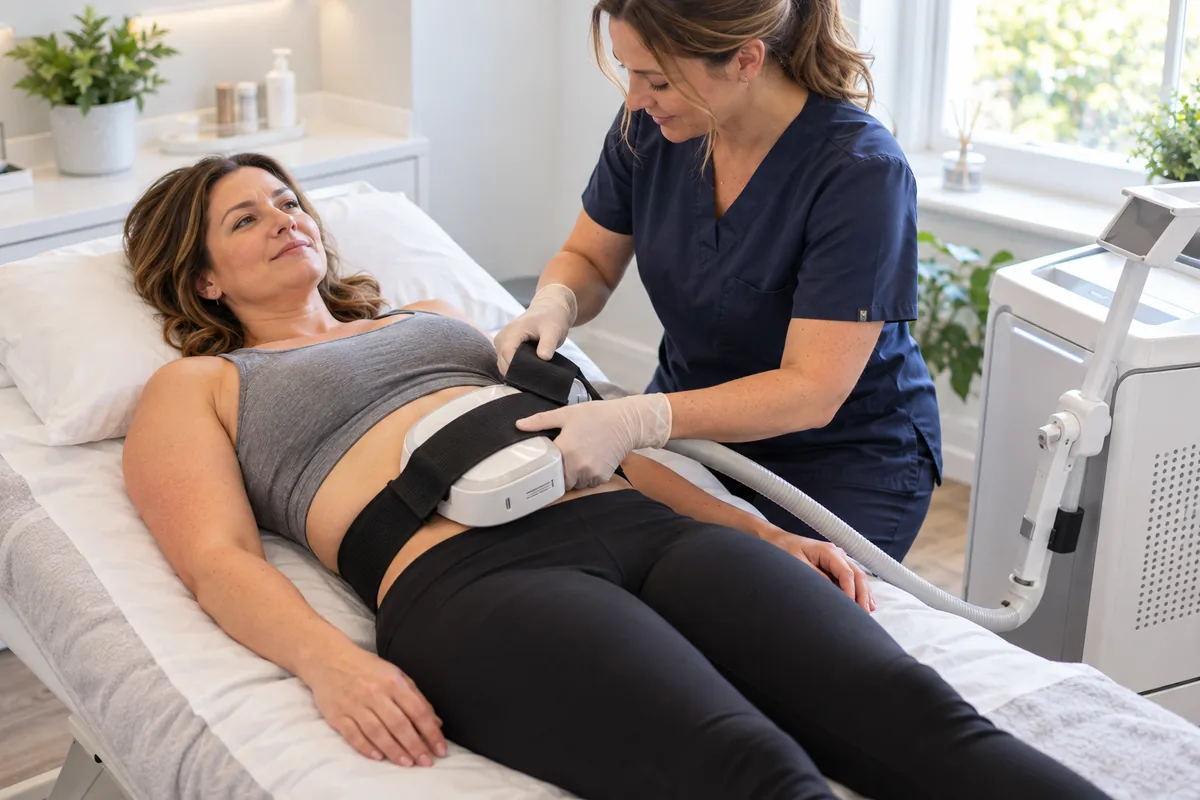
The original Emsculpt uses high-intensity focused electromagnetic energy, known as HIFEM. A flat applicator is strapped over the treatment area. It creates a magnetic field that makes the muscles underneath contract hard and fast, far more often than you could manage in a gym session. Each treatment usually lasts about 30 minutes, and you lie still while the muscles work.
The idea is simple. Repeated, intense contractions may thicken and strengthen the muscle, in a similar way to resistance training. On the abdomen, the target is the rectus abdominis, the “six-pack” muscle that runs from the ribs down to the pubic bone.
Emsculpt NEO: HIFEM plus radiofrequency
Emsculpt NEO adds radiofrequency (RF) energy to the same applicator. The RF heats the fat layer under the skin, with the aim of damaging some fat cells. Meanwhile, the HIFEM part still contracts the muscle. In other words, NEO is sold as a two-in-one treatment for fat and muscle, while the original Emsculpt focuses on muscle.
Both devices are non-invasive. There are no needles, no anaesthetic and no cuts. However, “non-invasive” does not mean “no limits”. Neither version removes loose skin.
What Emsculpt Is Cleared to Treat
Much of the marketing mentions FDA clearance. This refers to the US Food and Drug Administration, and the wording matters. FDA clearance through the 510(k) route means a device is judged similar enough to devices already on the market. It is not the same as proof that a treatment gives large or lasting results.
The FDA’s database shows these uses for BTL’s devices:
- HIFEM devices (Emsculpt): cleared in 2018 for “improvement of abdominal tone, strengthening of the abdominal muscles, development of firmer abdomen”, plus strengthening, toning and firming of the buttocks and thighs. Later clearances added the calves and arms.
- HIFEM plus RF device (Emsculpt NEO): the device, listed as BTL-899, was cleared in December 2019 for non-invasive lipolysis (breakdown of fat) of the abdomen and reduction in abdominal circumference. You can read the indications in the FDA 510(k) clearance document. Later clearances covered the thighs and a wider range of skin types.
Notice what is missing. None of these listed uses names the mons pubis or the pubic area. The FUPA sits just below the abdominal treatment zone, so any effect on it is indirect.
Does Emsculpt for FUPA Work?
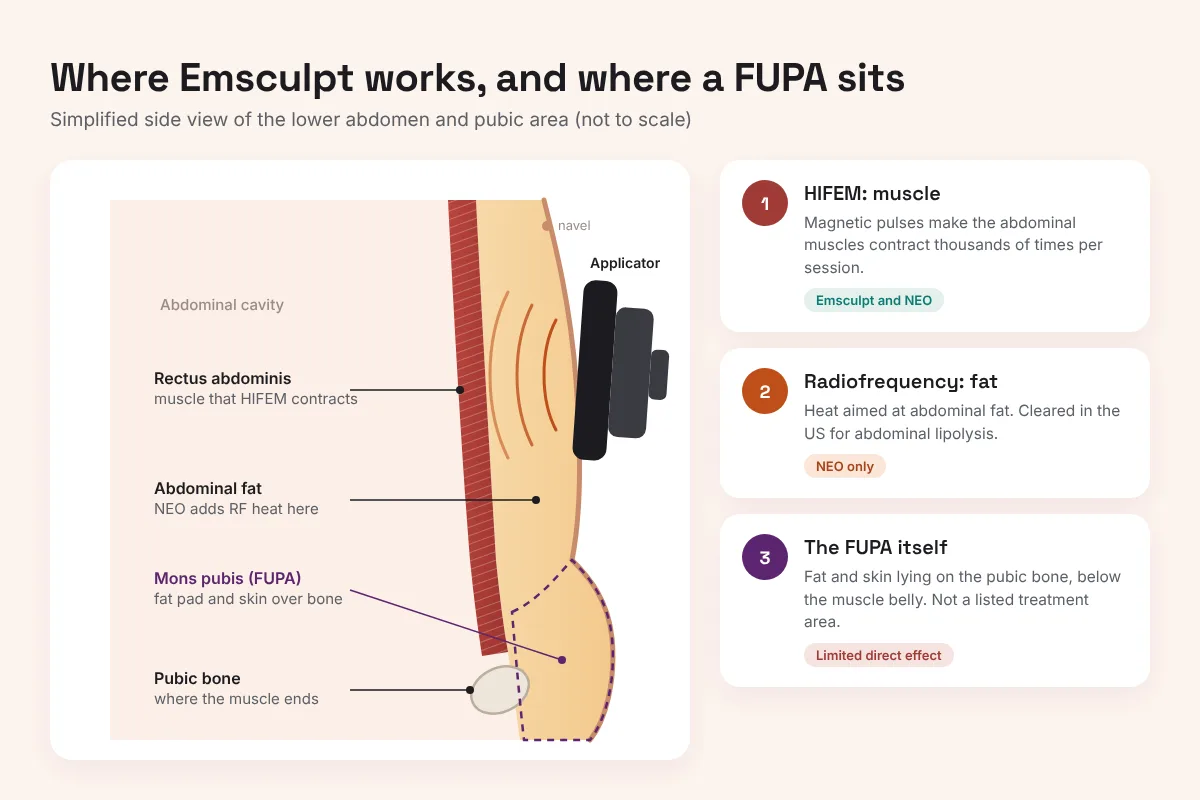
To answer this, it helps to look at what a FUPA is made of. The FUPA is the mons pubis: a pad of fat and skin lying over the pubic bone. The rectus abdominis muscle ends at the pubic bone, so there is very little muscle underneath the FUPA itself to build.
What it cannot change
- It cannot build muscle under the mons pubis, because the pubic area is mostly fat over bone.
- It does not remove loose or overhanging skin.
- The original Emsculpt is not designed to reduce fat, although studies report small changes.
- It is not a weight-loss treatment, and clinics say so on their own pages.
What it might change
A firmer lower abdominal wall can make the belly above a FUPA look a little flatter. As a result, the lower belly and mons pubis may look slightly less prominent from the side. Emsculpt NEO may also reduce a small amount of fat on the lower abdomen if the applicator is placed low enough. Yet these are modest, indirect effects. If your FUPA is mainly loose skin or a deep fat pad, Emsculpt is unlikely to make a visible difference.
Not sure which you have? Our guide to loose skin vs fat in the lower belly explains simple checks you can do at home.
What the Evidence Shows
Research on Emsculpt exists, but it needs careful reading. Most studies are small, short and linked to the manufacturer. Few compare the treatment with a sham (fake) treatment.
The early studies
A 2019 study of 22 people used MRI scans before and two months after four Emsculpt sessions on the abdomen. It reported an 18.6% reduction in fat thickness and a 15.4% increase in rectus abdominis thickness. In practice, the average fat layer went from 23.6 mm to 19.3 mm. The gap between the two sides of the six-pack muscle also narrowed by about 10%. One author was a medical advisor to BTL, and the authors said a larger controlled study was needed.
A follow-up study recalled 21 of an original 44 patients about a year after treatment. It reported a 14.6% fall in fat thickness and a 19% rise in muscle thickness compared with baseline. There was no control group, and more than half of the original group was not included. Both authors were medical advisors to BTL.
An independent, critical review
A 2024 review of Emsculpt NEO studies in the Annals of Plastic Surgery looked at seven studies with 265 patients in total. Every study had authors who advised or worked as investigators for BTL. Across the studies, fat thickness fell by about 8 mm on average and muscle thickness rose by about 5.5 mm. Only one study used a sham control.
The reviewer concluded that the changes were likely within the margin of error of the scans and of questionable clinical value. He also noted that liposuction remains the standard for fat removal. To be balanced, this review comes from a single plastic surgeon with his own clinical viewpoint. Even so, it raises fair points about bias and study design.
What this means for a FUPA
- The measured changes are real on scans but small, often a few millimetres.
- Almost all the research covers the abdomen, buttocks, thighs or arms, not the mons pubis.
- Funding links and small samples mean the results may look better than they would in independent trials.
- Nobody can promise a visible change in a FUPA from Emsculpt alone.
How Many Sessions You Need
Protocols vary between clinics and devices. The table below shows typical published schedules. Your clinic should explain its own plan before you pay.
| Detail | Emsculpt | Emsculpt NEO |
|---|---|---|
| Energy used | HIFEM only | HIFEM plus radiofrequency |
| Session length | About 30 minutes | About 30 minutes |
| Typical course | 4 sessions (as used in early studies) | Often 4 to 6 sessions |
| Spacing | 2 to 5 days apart in early studies | Usually 5 to 10 days apart |
| Maintenance | Some clinics suggest top-up sessions | Some clinics suggest top-up sessions |
Any muscle gain also depends on keeping the muscle working afterwards. Regular core and lower-body training helps maintain strength at no cost. Our guide to exercises for a FUPA covers moves that suit most fitness levels.
UK Cost of Emsculpt
There is no fixed UK price, and clinics rarely list every package online. As a guide, published UK clinic price lists checked in October 2026 showed:
- Emsculpt NEO from about £220 per session at one clinic.
- Emsculpt NEO from £1,500 for a course of four sessions on one body area at a London clinic.
- Original Emsculpt from about £200 per session, or from about £600 for a course of four, at one clinic listed on a price comparison site.
Treat these as typical published starting prices, not quotes. Costs rise with the number of areas, larger applicators and maintenance sessions. Prices also change, so always ask for a full written quote.
Watch out for very cheap “EMS” or “sculpt” offers. Some salons sell treatments from generic muscle-stimulation machines at a fraction of the price. These may not be the same device that was studied. Ask which machine the clinic uses before you book.
For comparison with surgical prices, see our guide to FUPA surgery costs in the UK.
Side Effects and Who Should Avoid It
Emsculpt is generally well tolerated in the published studies. Even so, it is a medical device, and it does not suit everyone.
Common side effects
- Muscle soreness or aching for a day or two, similar to after a hard workout.
- Warmth, redness or tenderness of the skin, mainly with Emsculpt NEO because of the heat.
- Discomfort during the session. Tell the practitioner if the contractions or heat feel too strong.
- Occasionally, a blister has been reported after Emsculpt NEO.
Who should avoid Emsculpt
UK clinic pages commonly list these reasons not to have treatment:
- Pregnancy.
- A pacemaker, implanted defibrillator or other implanted electronic device.
- Metal implants in or near the treatment area.
- An active hernia in or near the treatment area.
- Open wounds, infection or skin problems over the area.
Tell the clinic about any surgery, implants, coils or medical conditions, even if they seem unrelated. If you have recently had a baby or a caesarean, ask your GP first. A bulge that appears when you strain could be a hernia, and a ridge down the middle of the tummy may be diastasis recti rather than a FUPA. Both need proper assessment before any muscle treatment.
Emsculpt vs CoolSculpting, Liposuction and Monsplasty
The right option depends on what your FUPA is made of. Muscle, fat and loose skin each need a different approach.
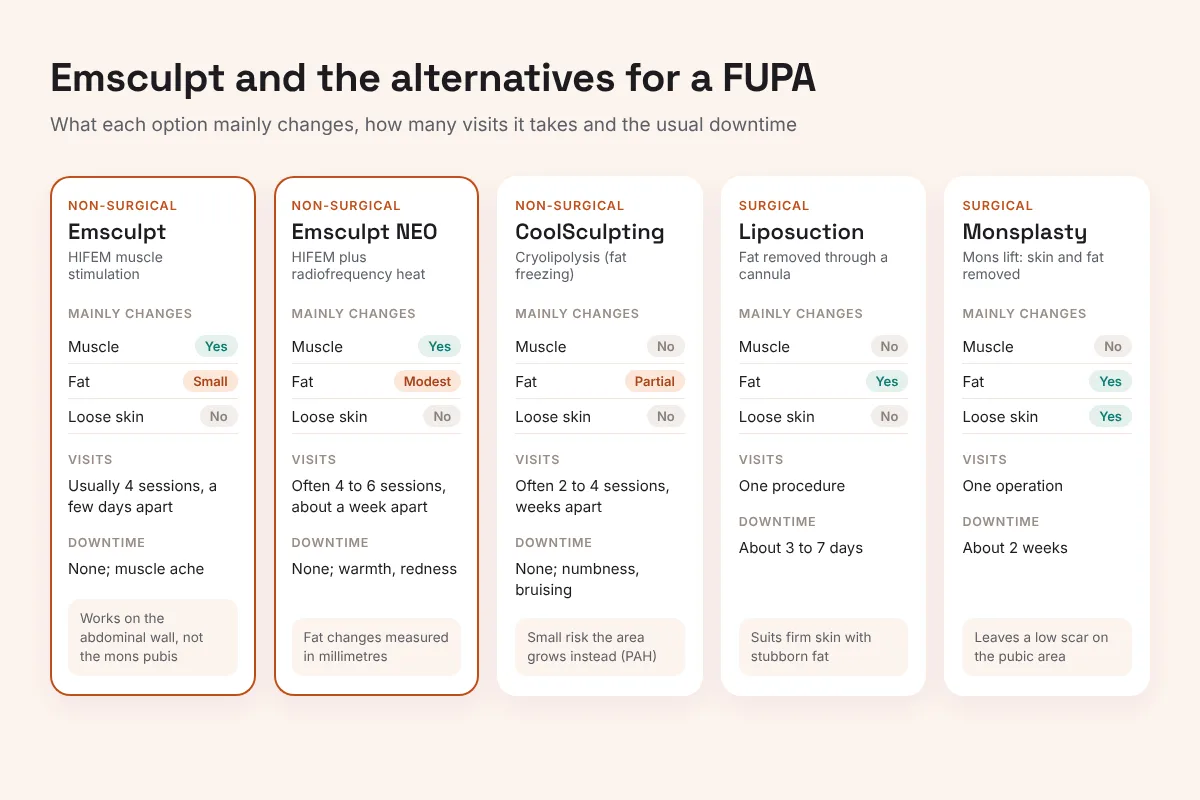
| Option | Main target | Treats loose skin? | Downtime | Best suited to |
|---|---|---|---|---|
| Emsculpt | Abdominal muscle | No | None | Toning the belly above a small FUPA |
| Emsculpt NEO | Muscle plus some abdominal fat | No | None | Small changes on the lower abdomen |
| CoolSculpting | Fat | No | None | A small, pinchable fat pad with firm skin |
| Liposuction | Fat | No | About 3 to 7 days | Stubborn fat with good skin tone |
| Monsplasty | Fat and skin | Yes | About 2 weeks | A sagging or loose mons pubis |
CoolSculpting and other fat-reduction devices
Fat freezing (cryolipolysis) targets fat cells directly, so it is closer to what a FUPA needs than muscle stimulation. It still gives partial results and carries a small risk of the area growing instead, called paradoxical adipose hyperplasia. Our guide to non-surgical FUPA removal compares fat freezing, radiofrequency and injections in detail.
Liposuction
Liposuction removes fat through a thin tube under anaesthetic. It gives a larger, more predictable fat reduction than any device. However, it does not tighten skin, so it suits people with good skin tone. Read more in our guide to liposuction for a FUPA.
Monsplasty
A monsplasty, or mons lift, removes excess skin and fat from the pubic area and lifts what remains. It is the only option in this list that deals with loose, sagging skin. It is surgery, with a scar and recovery time. Our monsplasty guide covers who it suits, risks and recovery.
Who Might Be a Good Candidate?
Emsculpt suits a fairly narrow group of people. You are more likely to be happy with the result if:
- You are close to your goal weight and your weight is stable.
- Your FUPA is small and soft, without overhanging skin.
- Your main goal is a firmer feel across the lower tummy, not a flat pubic area.
- You accept that the change may be subtle and may need maintenance.
You are less likely to see a benefit if your FUPA is mainly loose skin, if it overhangs, or if your weight is still changing. In those cases, money may be better spent on a surgical consultation, or on a strength and nutrition plan first.
Questions to Ask a UK Clinic
In England, many non-surgical cosmetic treatments can legally be offered without registration with the Care Quality Commission (CQC). The government has proposed a licensing scheme for non-surgical cosmetic procedures, but it was not yet in force at the time of writing. That makes your own checks more important.

Before you book, ask:
- Is the clinic registered with the CQC? Many doctor-led clinics are, and registration means the service is inspected. You can search the CQC website by clinic name.
- Is this a genuine BTL Emsculpt or Emsculpt NEO device? Ask for the exact model name, as “EMS” alone can mean any muscle stimulator.
- Who will carry out the treatment, and what training do they have? Ask whether a doctor or nurse oversees the service.
- Am I suitable? A good clinic takes a full medical history and checks for implants, pregnancy and hernias.
- What result can I realistically expect on my FUPA? Be wary of anyone who promises a flat pubic area.
- How many sessions, and what is the total price? Include maintenance sessions in the quote.
- What happens if I have a side effect? Ask who you contact and whether follow-up is included.
- Are the before and after photos your own patients? Check that lighting, posture and angle match.
Walk away from pressure selling, same-day discounts or claims that a muscle device will remove loose skin.
Frequently Asked Questions
Does Emsculpt work on a FUPA?
Not directly. Emsculpt strengthens the abdominal muscles, but a FUPA is mostly fat and skin lying on the pubic bone. A firmer lower tummy may make the area look slightly flatter, but published studies have not looked at the mons pubis itself.
What is the difference between Emsculpt and Emsculpt NEO?
Emsculpt uses electromagnetic energy (HIFEM) to make muscles contract. Emsculpt NEO adds radiofrequency heat to target fat at the same time. In the US, NEO was cleared for breaking down fat on the abdomen, while the original device was cleared for muscle toning.
How much does Emsculpt cost in the UK?
Published UK clinic prices checked in October 2026 started at around £200 to £220 per session. One London clinic listed Emsculpt NEO from £1,500 for four sessions on one area. Always ask for a full written quote that includes maintenance.
How many Emsculpt sessions will I need?
Most courses involve 4 to 6 sessions of about 30 minutes, spaced a few days to about a week apart. In the main early study, results were measured two months after the last session. Some clinics recommend top-up sessions to maintain the effect.
Is Emsculpt safe?
Published studies report mainly mild side effects, such as muscle soreness, warmth and redness. It is not suitable during pregnancy, or for people with pacemakers, implanted electronic devices or metal implants near the treatment area. Choose a clinic that checks your medical history first.
Can Emsculpt tighten loose skin on a FUPA?
No. Emsculpt works on muscle and, in the NEO version, some fat. It does not remove or meaningfully tighten loose skin. Significant loose skin over the pubic area usually needs surgery, such as a monsplasty.
Is Emsculpt available on the NHS?
No. Emsculpt is a private cosmetic treatment, and cosmetic procedures are not usually funded by the NHS. Speak to your GP if a FUPA causes pain, skin problems or other health concerns.
The Bottom Line
Emsculpt for FUPA concerns is a poor match on paper. The device tones the abdominal muscles, and the NEO version adds a modest fat effect on the abdomen. A FUPA, however, is fat and skin lying on the pubic bone, with little muscle underneath. The research shows small, scan-measured changes, mostly from studies linked to the manufacturer. If your FUPA is small and your skin is firm, Emsculpt may give a slightly firmer lower tummy. If it is mainly fat, fat-reduction treatments or liposuction target it more directly. If loose skin is the issue, a monsplasty is the option that deals with it. Check the clinic, the device and the full cost before you commit.