
Can Walking Get Rid of a FUPA? What 10,000 Steps Really Do to Lower Belly Fat
Page Contents
- What a FUPA Actually Is
- Why a FUPA Is So Slow to Shrink
- Why Crunches Cannot Target Lower Belly Fat
- What 10,000 Steps Really Do to Your Body
- How Many Steps a Day Help Lower Belly Fat
- Building Your Weekly Walking Target
- How Hard Should a Fat-Burning Walk Feel?
- Other Cardio That Complements Walking
- Walking Posture and Your Pelvic Floor
- Visceral Fat vs the FUPA: What Walking Shrinks First
- Strength Moves That Pair With Walking
- What to Eat to Support Your Walks
- Stress, Sleep and Everyday Movement
- A Realistic Timeline for Walking Results
- When Walking Is Not Enough
- Frequently Asked Questions
- Is Walking Better Than Running for a FUPA?
- How Long Should I Walk Each Day to Lose a FUPA?
- Does Walking After Meals Help Lower Belly Fat?
- Can I Lose a FUPA in Two Weeks by Walking?
- Do Waist Trainers Speed Up Results From Walking?
- Can Men Lose a FUPA by Walking?
Yes, walking can shrink a FUPA, but not by burning fat from one spot. It lowers total body fat, and the fatty upper pubic area gets smaller as part of that change across your body.
The catch is dose and patience. A short stroll twice weekly will barely register, while regular brisk walking combined with a sensible calorie deficit can reduce waist circumference within a few months for most people.
Walking also suits people who find gyms intimidating or joints sore. It is free, low impact and easy to repeat daily, which matters because consistency and adherence decide results far more than any single workout.
What a FUPA Actually Is
FUPA is slang for fatty upper pubic area, sometimes written as fat upper pubic area. It describes a soft pad sitting on the pubic mound, known anatomically as the mons pubis, above the pubic bone.
Clinically, the pad is mostly subcutaneous adipose tissue, the pinchable fat layer. When a larger skin and fat overhang hangs from the lower abdomen, doctors call it a panniculus rather than using the slang term.
Surgeons describe severity using panniculus grades from one to five. Most people asking about walking have a mild grade one or two FUPA, often linked to gradual weight gain, which responds well to lifestyle change.
Why a FUPA Is So Slow to Shrink
A FUPA is mostly subcutaneous fat sitting over the pubic bone, sometimes with a layer of loose skin. Its size depends on genetics and body fat distribution, which explains why two similar people look different.
Fat cells in the lower abdomen often carry more alpha-receptors, which slow fat release, and fewer beta-receptors, which speed it up. That biology makes the pubic area one of the last places to lean out.
Hormones add another layer. Falling oestrogen and rising follicle-stimulating hormone around menopause, plus pregnancy and ageing, can all shift storage towards the belly, so stubborn fat down there rarely means you are doing something wrong.
Why Crunches Cannot Target Lower Belly Fat
Spot reduction, the idea that you can spot-reduce fat by working the muscle beneath it, has failed in controlled studies. Targeted fat loss from the pubic area does not happen through crunches or leg raises.
A FUPA is a fat-loss problem, not a strength problem. Your body releases fat from stores across the frame when energy is short, so overall fat loss from added energy expenditure is what shrinks it.
That does not make ab exercises useless. Pilates, planks, a dead bug, a reverse crunch and other lower-ab exercises strengthen the deep core, tightening muscle underneath while walking steadily handles the fat sitting above it.
What 10,000 Steps Really Do to Your Body
The 10,000 steps target did not come from a clinical trial. It grew from a 1960s Japanese pedometer marketing campaign, yet later research found the number lands close to a useful activity level for adults.
Depending on body weight and pace, 10,000 steps usually burns roughly 300 to 500 calories. Across trials, step-based walking programmes produced modest average weight loss, yet one programme cut waist circumference by about 3 centimetres.
That gap between the scale and the tape measure matters. Walking may change body composition and belly measurements more than total weight, especially when it preserves lean body mass while fat stores shrink over months.
How Many Steps a Day Help Lower Belly Fat
Research suggests the jump matters more than a magic number. In one year-long walking study, adding about 1,800 daily steps on top of 7,000 steps reduced both subcutaneous and visceral fat by roughly a fifth.
UK guidance recommends at least 150 minutes of moderate activity each week, and brisk walking counts. For many people that means 30 minutes a day on five days, which adds roughly 3,000 to 4,000 steps.
Start from your current step count rather than an ideal. If you average 4,000, aim for 5,500 for two weeks, then build again. Small, steady increments protect joints and make the habit easier to keep.
Building Your Weekly Walking Target
Think in weekly totals, not single days. The WHO guidelines set a weekly activity target of 150 to 300 minutes of moderate activity, and reaching the upper end brings noticeably greater benefits for body fat.
Split those moderate minutes into walking sessions of 20 to 60 minutes, depending on your schedule. A longer, slower weekend walk can balance shorter weekday outings, as long as the weekly total keeps rising steadily.
Each step increment should feel manageable. Some walking intervention studies pushed participants towards 12,000 steps daily, but found intensity still mattered, so combine a higher count with some brisk stretches rather than chasing numbers alone.
| Weeks | Daily steps | Brisk minutes per week | Focus |
|---|---|---|---|
| 1 to 2 | Your average plus 1,500 | 90 | Build the habit |
| 3 to 4 | Your average plus 3,000 | 120 | Add a walk after meals |
| 5 to 8 | 7,000 to 8,000 | 150 | Meet UK guidance |
| 9 to 12 | 8,500 to 10,000 | 200 to 300 | Add fast and easy intervals |
How Hard Should a Fat-Burning Walk Feel?
Your walking speed matters less than your effort. Use the talk test: at a brisk walking pace you can hold a conversation but cannot sing, which puts your heart rate in the moderate-intensity cardio zone.
That moderate heart rate sits near your ventilatory threshold, where breathing deepens but stays controlled. In one published study, slow walking helped women lose more visceral fat than fast walking over the exact same distance.
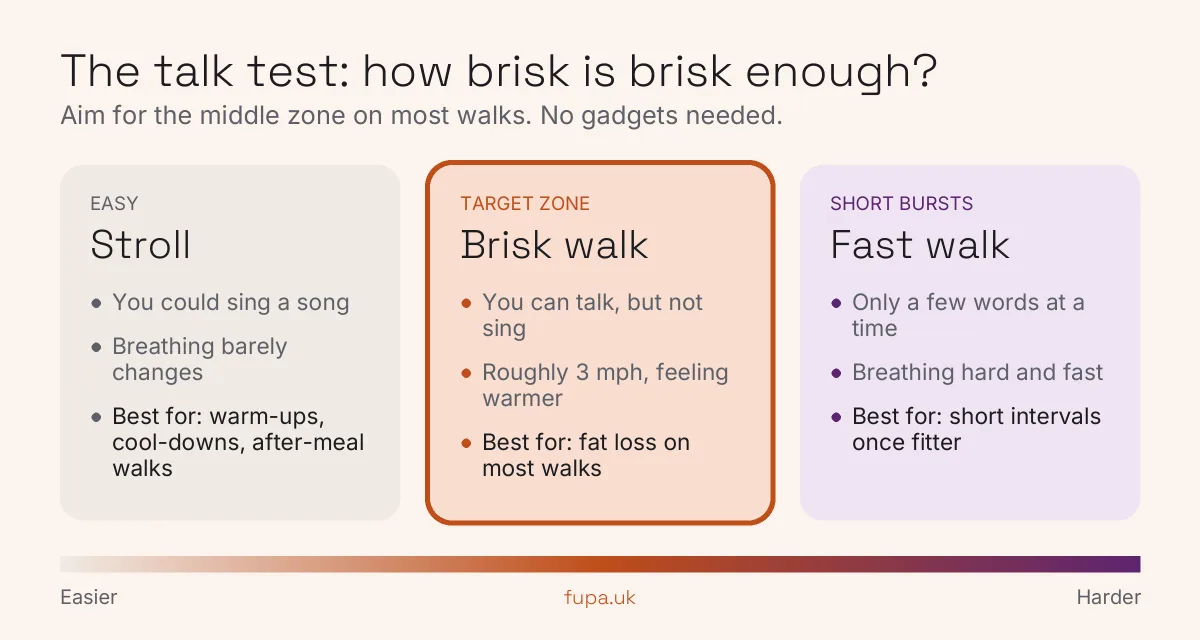
Begin each walk with a five-minute warm-up and finish with a cool-down at an easy pace. Once fitter, add fast and easy intervals, such as one brisk minute followed by two relaxed minutes, repeated throughout.
Other Cardio That Complements Walking
Walking is one form of aerobic exercise, and others work the same way. Swimming, cycling, jogging, stair climbing and rucking, which means walking with a weighted pack, raise your calorie burn without targeting one area.
Steady-state cardio at a low-intensity cardio or moderate pace relies more on fat as fuel during the session itself, while high-intensity interval training burns more calories per minute and leans more heavily on stored carbohydrate.
On HIIT vs steady-state, a review of randomised trials found HIIT no better than continuous aerobic training for abdominal fat loss. Total fat burning across the week matters far more than which style you choose.
Walking Posture and Your Pelvic Floor
Posture changes how a FUPA looks. An anterior pelvic tilt, where the pelvic tilt angles forward, pushes the lower belly out, and tight hip flexors from long periods of sitting make that forward tilt worse.
While walking briskly, aim for a neutral pelvis, tall spine and relaxed, level shoulders. Gentle bracing of the abdominal wall, drawing the rectus abdominis and obliques lightly inwards, supports your trunk without holding your breath.
A daily hip flexor stretch helps too. If you are postpartum, notice doming along the midline or have pelvic floor symptoms, see a specialist pelvic health physiotherapist, since diastasis recti can closely mimic a FUPA.
Visceral Fat vs the FUPA: What Walking Shrinks First
So, is FUPA belly fat? Partly. Visceral fat sits deep around the organs, while a FUPA is mostly surface fat. Walking tends to reduce visceral adipose tissue early, benefiting health before the pubic pouch changes.
That shift lowers cardiometabolic risk, improves insulin resistance and can also reduce triglycerides and leptin while improving the adiponectin to leptin ratio. Together, these changes gradually lower your risk of developing metabolic syndrome over time.
Track progress with a waist measurement every two weeks, alongside waist-to-hip ratio and body fat percentage if possible. NICE advises keeping your waist below half your height, a simple check that reflects central obesity well.
Strength Moves That Pair With Walking
There is no single best exercise for FUPA, but effective FUPA workouts combine walking with strength training. Compound exercises such as squats, a goblet squat, a Romanian deadlift and a dumbbell row build muscle mass. Our guide on what squats really do for a FUPA covers leg day in detail.
Add a push-up, shoulder press, glute bridge, side plank, bird dog and Pallof press to tighten lower belly support. Use progressive overload, adding reps or weight gradually, to keep steadily raising your resting metabolic rate.
This concurrent training approach, mixing walks and lifting across the week, preserves muscle while you lose fat. Two short strength sessions weekly, on non-consecutive days, fit comfortably around a daily walking habit without draining energy.
What to Eat to Support Your Walks
Diet, not exercise, decides most of the outcome. A moderate deficit, often around a 500-calorie deficit daily, creates a steady calorie deficit that walking can widen without leaving you constantly tired, hungry or losing muscle.
Build meals from whole foods: lean protein, vegetables, complex carbs and healthy fats. Aim for protein at around 1.2 to 1.6 g per kilogram, plus generous fibre and steady hydration, to improve satiety between meals.
Limit processed foods, added sugar and alcohol, which add calories quickly without filling you up. Simple portion awareness, such as half a plate of vegetables, makes the deficit much easier to hold for several months.
Stress, Sleep and Everyday Movement
Chronic stress keeps cortisol elevated, which encourages fat storage around the abdomen and drives cravings. Walking outdoors is one of the gentlest ways to lower everyday stress without adding strain to an already tired body.
Sleep matters just as much as steps. Most adults need at least seven hours nightly, because short sleep disrupts appetite regulation, raising hunger hormones and making late-night snacking far more likely across the following day.
Add plenty of daily movement outside your formal walks. Taking the stairs, standing breaks, fidgeting and a walk after meals raise non-exercise activity, and these small habits offer real sustainability long after initial motivation fades.
A Realistic Timeline for Walking Results
Your starting point shapes the pace. Some notice looser waistbands within 4 to 6 weeks, most within 4 to 8 weeks, while visible results in the FUPA often take 8 to 12 weeks or longer.
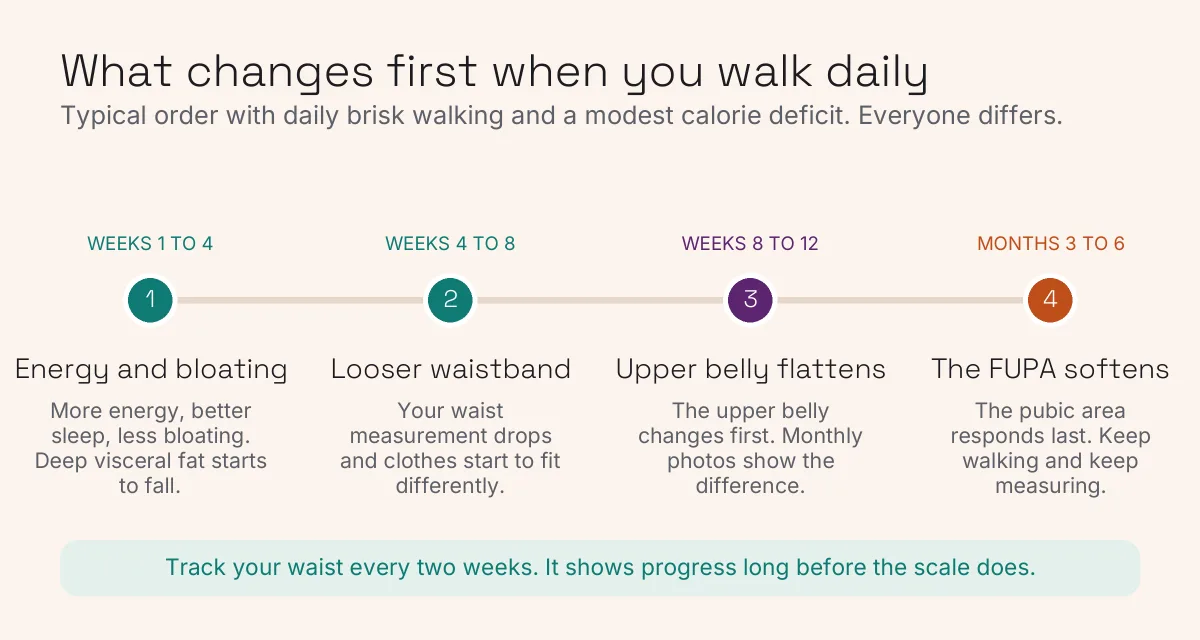
Meaningful change in stubborn pubic fat usually takes 3 to 6 months. Good progress tracking uses monthly photos, how clothes fit and your waist measurement, since daily water shifts can temporarily hide real fat loss.
Expect plateaus. When progress stalls for three weeks, add another 1,000 steps a day or tighten portions slightly. Realistic expectations and patience keep you walking long enough for stubborn lower belly fat to finally respond.
When Walking Is Not Enough
Walking cannot tighten loose skin. After major weight loss or pregnancy, the skin elasticity may not recover fully, leaving an overhang that looks like a FUPA even when very little fat remains underneath the skin.
Non-invasive treatments such as CoolSculpting, a brand of cryolipolysis, or radiofrequency, and minimally invasive laser lipolysis, can reduce small fat pockets. Liposuction removes localised fat, while a monsplasty, or pubic lift, reshapes the pubic mound.
A tummy tuck, or abdominoplasty, removes excess skin, and a panniculectomy removes a hanging apron. Choose a board-certified surgeon on the GMC specialist register, and ideally reach a stable weight through walking and diet first.
Frequently Asked Questions
Is Walking Better Than Running for a FUPA?
Not always, but it is easier to sustain. Running burns more calories per minute, yet brisk walking carries less injury risk, so total weekly calories burned often match. The best choice is the one you keep doing.
How Long Should I Walk Each Day to Lose a FUPA?
Aim for 30 minutes a day of brisk walking, then build towards 45 to 60 minutes. Three ten-minute walks spread through the day count just as well as one long session.
Does Walking After Meals Help Lower Belly Fat?
Yes, modestly. A 10 to 15 minute walk after meals helps muscles use glucose, blunting blood sugar spikes and supporting appetite control. It works best alongside your main daily walk.
Can I Lose a FUPA in Two Weeks by Walking?
No. Two weeks is too short to shift stubborn pubic fat, and no plan burns fat from the lower belly only. Use that time to build the habit and set a waist baseline.
Do Waist Trainers Speed Up Results From Walking?
No. Waist trainers compress the midsection temporarily but cannot flatten a FUPA, burn fat or strengthen muscles. Wearing one while walking can also restrict breathing and shorten sessions.
Can Men Lose a FUPA by Walking?
Yes. A male FUPA responds to the same deficit, walking and lifting. Men often lose weight elsewhere first, so the lower belly pouch flattens last, and sarcopenia after 40 makes strength training essential.