
Bodysuits for a FUPA: Smooth Lines Without the Squeeze
Page Contents
- Why Bodysuits for a FUPA Work So Well
- Shaping vs Non-Shaping Bodysuits
- Non-shaping (fashion) bodysuits
- Shaping bodysuits
- Compression levels: light, medium or firm
- Fabrics: Cotton Modal, Microfibre and Power Mesh
- Lined and ribbed fabrics
- Stretch content
- Gussets and Fastenings
- Thong back vs brief back
- High-leg vs low-leg cut
- UK Sizing: Torso Length Comes First
- Necklines and Sleeves
- Layering With High-Waisted Jeans, Skirts and Trousers
- High-waisted jeans
- Skirts
- Tailored trousers
- Top layers
- Comfort for Sensitive Skin and Chafing
- The Toilet Question
- How to Stop a Bodysuit Rolling, Digging or Riding Up
- Caring for Your Bodysuits
- What to Avoid
- Frequently Asked Questions
- Are bodysuits good for a FUPA?
- Should I choose a shaping or non-shaping bodysuit?
- Is a thong or brief bodysuit better for a FUPA?
- Why does my bodysuit dig into my lower belly?
- What is the best fabric for a bodysuit if I have sensitive skin?
- How do I measure for a bodysuit in the UK?
- How do you go to the toilet in a bodysuit?
- What should I wear with a bodysuit if I have a FUPA?
- The Bottom Line
A bodysuit looks like the perfect answer to a FUPA. It tucks in neatly, never comes untucked and gives one smooth line from the chest to the hips. Yet the wrong one digs into the lower belly, rides up between the legs and presses on the mons pubis all day. The best bodysuits for a FUPA come down to a handful of details: torso length, leg cut, gusset, fabric and how much shaping you actually want.
This guide is part of our wider advice on how to style and smooth a FUPA.
Why Bodysuits for a FUPA Work So Well
A FUPA is the pad of fat over the pubic bone, sitting on the mons pubis just below the lower belly. Most tops make it more noticeable in one of two ways. Either the hem untucks and bunches at the waistband, or a gap opens between the top and the trousers when you move.
A bodysuit solves both problems. It fastens between the legs, so it stays anchored at the shoulders and at the crotch. As a result:
- There is no waistband gap. The fabric runs unbroken under your jeans or skirt, so no skin or vest shows when you bend or reach.
- The tuck stays smooth. There is no loose hem folded over the lower belly, so the front of the outfit lies flat.
- Nothing rides up. The top stays in place through a full day of sitting, standing and lifting.
The same anchoring causes trouble when the fit is wrong. A torso that is too short pulls the gusset upwards. Leg openings can cut into the crease where the FUPA meets the inner thigh. Thin fabric clings to the outline of the lower belly, and firm compression can push soft tissue into a new ridge. The rest of this guide shows how to avoid each of those problems.
Shaping vs Non-Shaping Bodysuits
Bodysuits fall into two broad groups. Knowing which one you need saves a lot of returns.
Non-shaping (fashion) bodysuits
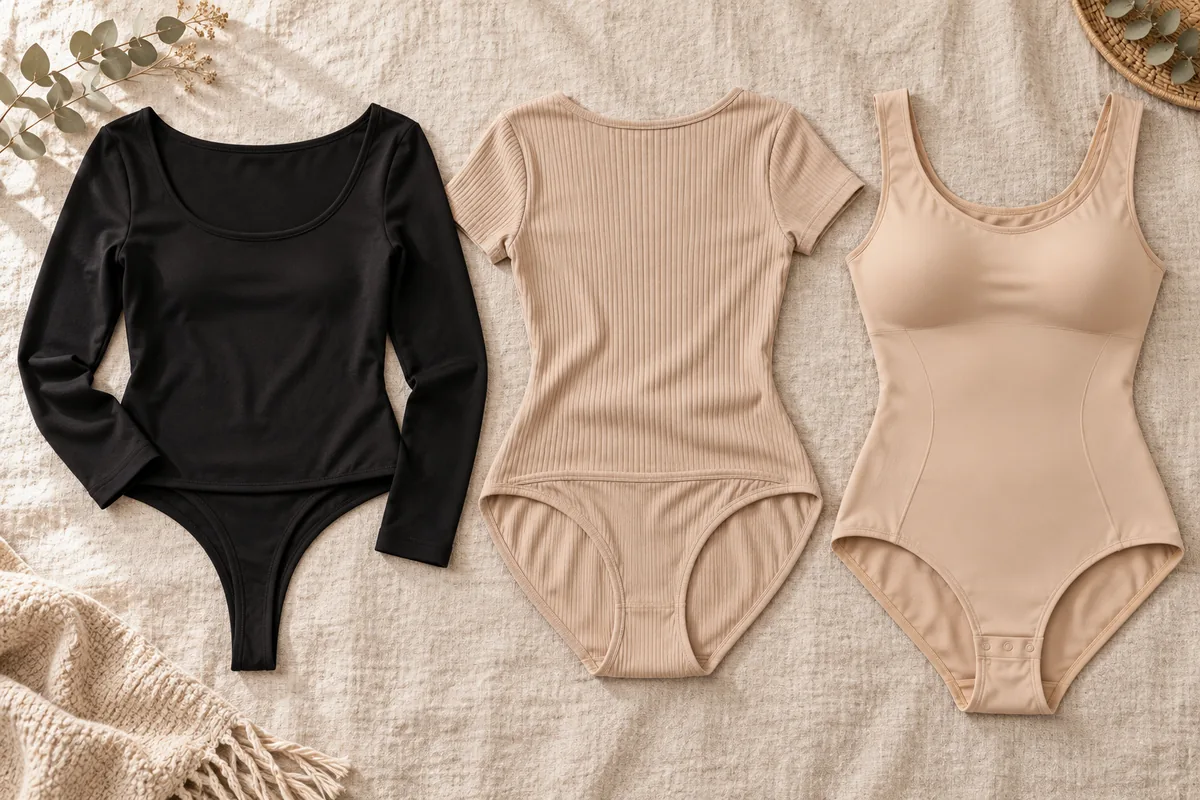
A non-shaping bodysuit is a top with a built-in brief. It is designed to be seen, usually in jersey, rib or a lined stretch fabric. It smooths the tuck but gives little or no control over the lower belly. For everyday outfits, this is often all you need.
Shaping bodysuits
A shaping bodysuit is a type of shapewear. It usually has firmer panels over the tummy and lower belly and is meant to sit under clothes. Some are smooth enough to wear as a top, but most are sold in skin tones to stay hidden. Our guide to shapewear for a FUPA compares bodysuits with high-waist briefs, shorts and slips.
Compression levels: light, medium or firm
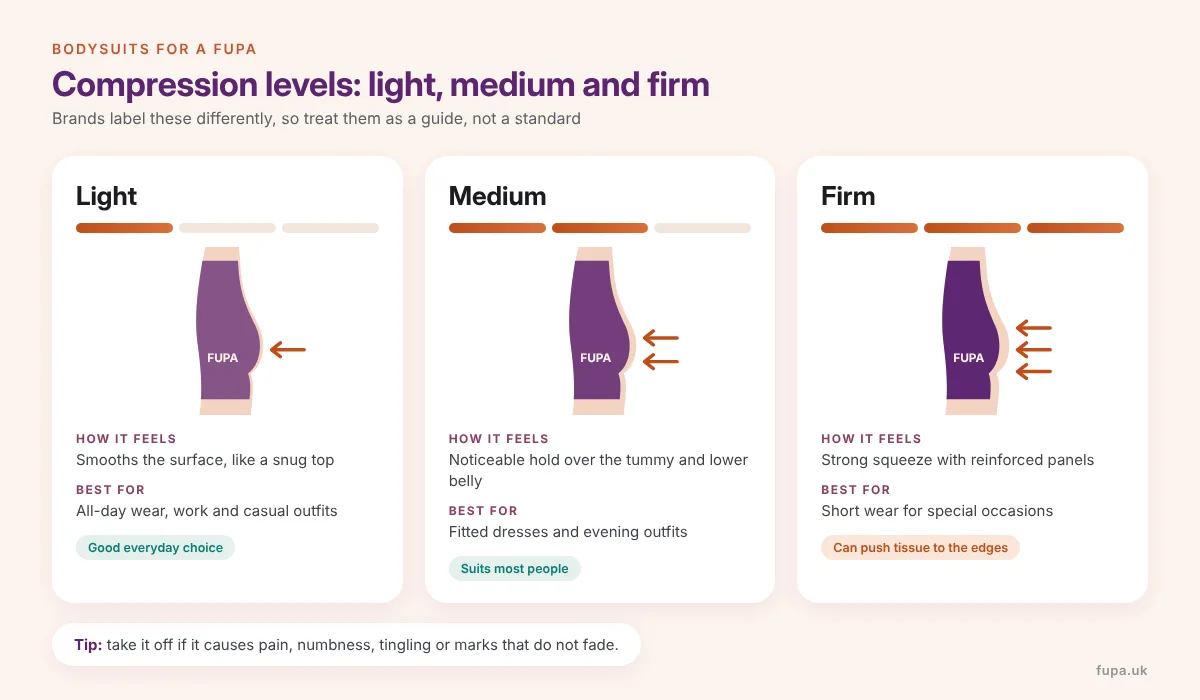
Compression describes how much a bodysuit squeezes. There is no single standard, so one brand’s firm can feel like another brand’s medium.
| Level | How it feels | Best for |
|---|---|---|
| Light | Smooths the surface, like a snug top | All-day wear, work and casual outfits |
| Medium | Noticeable hold over the tummy and lower belly | Fitted dresses and evening outfits |
| Firm | Strong squeeze with reinforced panels | Short wear for special occasions |
For a FUPA, light to medium compression is usually enough. Very firm styles push soft tissue towards the edges, so a bulge can appear at the leg line instead. Firm shaping also traps more heat, which matters for comfort later in the day.
Fabrics: Cotton Modal, Microfibre and Power Mesh
Fabric decides how a bodysuit looks over the lower belly and how it feels after eight hours. Three fabrics come up again and again.
| Fabric | What it is | Strengths | Watch out |
|---|---|---|---|
| Cotton modal | Cotton blended with modal, a soft fibre made from wood cellulose, plus a little elastane | Soft, breathable and gentle on sensitive skin | Light hold only, and thin versions can cling |
| Microfibre | Very fine nylon or polyester yarn with elastane | Smooth and slippery, so clothes glide over it without catching | Less breathable than cotton in hot weather |
| Power mesh | A firm, stretchy nylon and elastane mesh | Strong hold with some airflow through the open knit | Can feel scratchy at the edges and is too firm for some people all day |
Many good bodysuits mix these fabrics. For example, a microfibre body may have a power mesh panel over the tummy and a cotton gusset. That combination gives a smooth outer finish, targeted hold and a breathable layer where it counts.
Lined and ribbed fabrics
In a fashion bodysuit, a double-layer or lined front is the single most useful feature. Two layers hide the outline of the lower belly and anything worn underneath. A thick rib also helps, because the vertical lines draw the eye up and down and the texture disguises small bumps. Fine ribs, on the other hand, can stretch open over the FUPA.
Stretch content
Care labels list the share of elastane, also sold as spandex or Lycra. More elastane means a closer fit and stronger recovery. Fashion bodysuits tend to have a modest amount, while shaping bodysuits usually have much more. A cotton or modal blend with some elastane is a good balance for daily wear.
Gussets and Fastenings
The gusset is the panel of fabric between the legs, and the fastening sits within it. You will use it several times a day, so it deserves as much attention as the front.
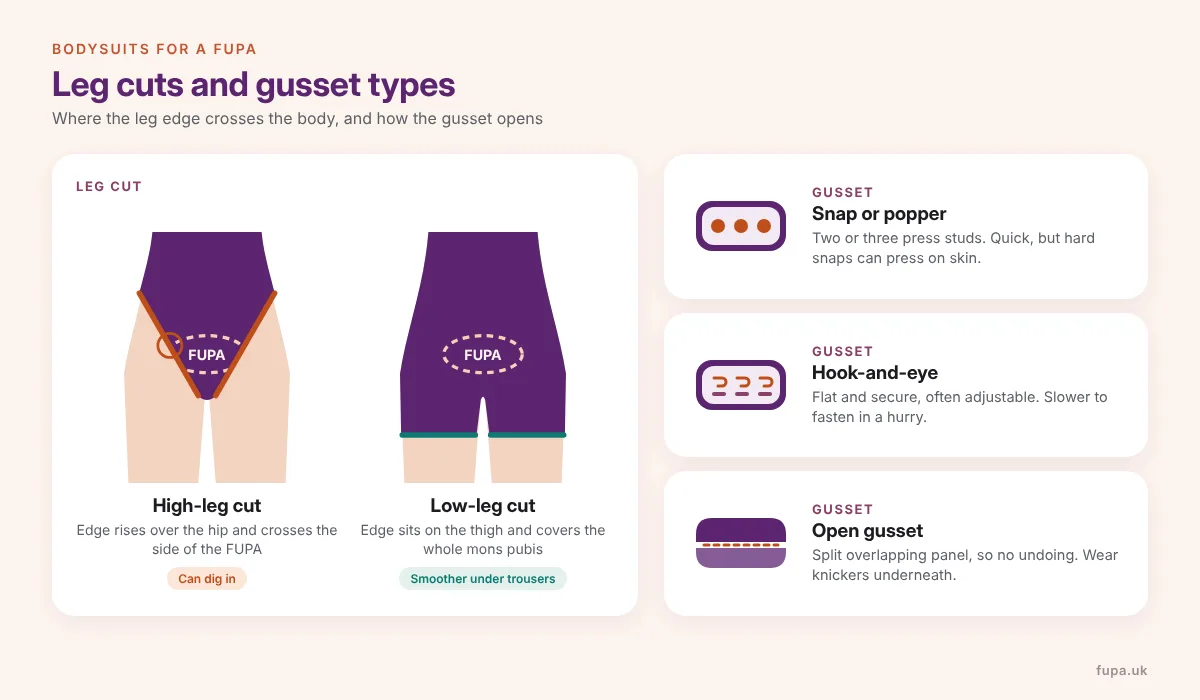
| Fastening | How it works | Pros | Watch out |
|---|---|---|---|
| Poppers (snaps) | Two or three press studs | Quick to open and close | Hard metal poppers can press on skin, and weak ones pop open |
| Hook and eye | Small hooks along a tape, often with two rows | Flat and secure, and the extra row adds a little length | Fiddly to fasten, especially in a hurry |
| Open gusset | An overlapping split panel you can use without undoing anything | Easiest toilet option in shaping bodysuits | You still need knickers underneath |
| No fastening | One continuous panel | Smooth, with no hardware at all | Means taking the whole thing off each time |
Check that the fastening sits low, between the legs, and not on the mons pubis. A hook and eye gusset with two rows is useful if you are between torso lengths. Look for a cotton-lined gusset as well. NHS advice to help prevent thrush includes choosing cotton underwear and avoiding tight underwear, and a bodysuit gusset sits in exactly the same place.
Thong back vs brief back
A thong-back bodysuit avoids visible lines under fitted jeans and trousers. However, the narrow back can pull the front down and feel tight across the mons pubis. A brief or full-back bodysuit spreads that pull over a wider area of fabric. For most people with a FUPA, a brief back is the more comfortable everyday choice, while a thong back suits close-fitting trousers.
High-leg vs low-leg cut
A high-leg cut rises over the hip bone. It lengthens the leg, but the edge crosses the side of the FUPA, where it can dig. A low-leg or boy-leg cut sits lower on the thigh and covers the whole mons pubis. Low-leg styles are usually smoother under trousers, while high-leg styles suit looser skirts.
UK Sizing: Torso Length Comes First
Most bodysuits are sold in UK dress sizes, such as 12, 14 or 16. That number tells you about width, though, not length. A bodysuit can fit perfectly around the bust and waist and still be far too short in the body.
Torso length is the key measurement. If it is too short, the bodysuit pulls down from the shoulders and up from the crotch. That is when it digs into the FUPA and rides up. Some brands list a torso or girth measurement, taken from the top of one shoulder, down through the crotch and back up to the same shoulder. When a brand gives it, trust it over the dress size.
- Measure your torso girth with a soft tape, keeping it snug but not tight.
- Compare it with that brand’s own size guide, not a general chart.
- If you have a long body, look at tall ranges first. Petite ranges suit a short torso.
- If you sit between sizes, choose the larger one for comfort over the lower belly.
- Read reviews for comments on whether the style runs short in the body.
Once it is on, sit down and lift your arms above your head. The gusset should not move up or press on the mons pubis. If you plan to wear a particular bra underneath, try the bodysuit on with it.
Necklines and Sleeves
The bottom half of a bodysuit does the practical work, but the neckline shapes the whole outfit. A good neckline draws the eye upwards and away from the lower belly.
- Square neck: opens up the collarbones and adds clean, horizontal structure at the top of the body.
- Scoop neck: soft and flattering on most frames, and easy to wear with a necklace.
- V-neck or wrap front: creates a vertical line that lengthens the torso.
- Crew neck: neat under blazers and cardigans for work.
- High neck or turtleneck: warm in winter, but it creates one long block of colour. Break it up with an open layer or a belt.
Sleeves are about season and layering. A long-sleeve bodysuit is the easiest winter base layer and stays put under knitwear. Short-sleeve and sleeveless styles suit warmer months and sit neatly under jackets.
Layering With High-Waisted Jeans, Skirts and Trousers
A bodysuit is a base layer, so the bottom half finishes the look. Choose bottoms with a waistband that sits at or above the navel. That way, the waistband rests above the FUPA and the bodysuit lies flat beneath it.
High-waisted jeans
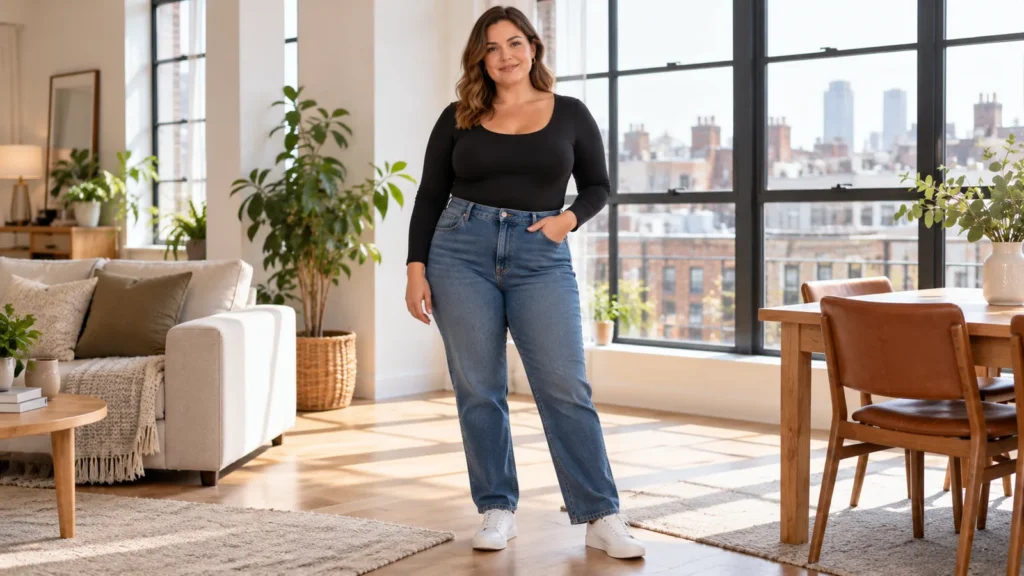
A bodysuit with high-waisted straight jeans is the classic pairing. The jeans waistband sits above the lower belly, and there is no bulky tuck to push against it. Choose a mid or dark wash with a flat front. Our guide to the best jeans for a FUPA covers rise, stretch and leg shape in detail.
Skirts
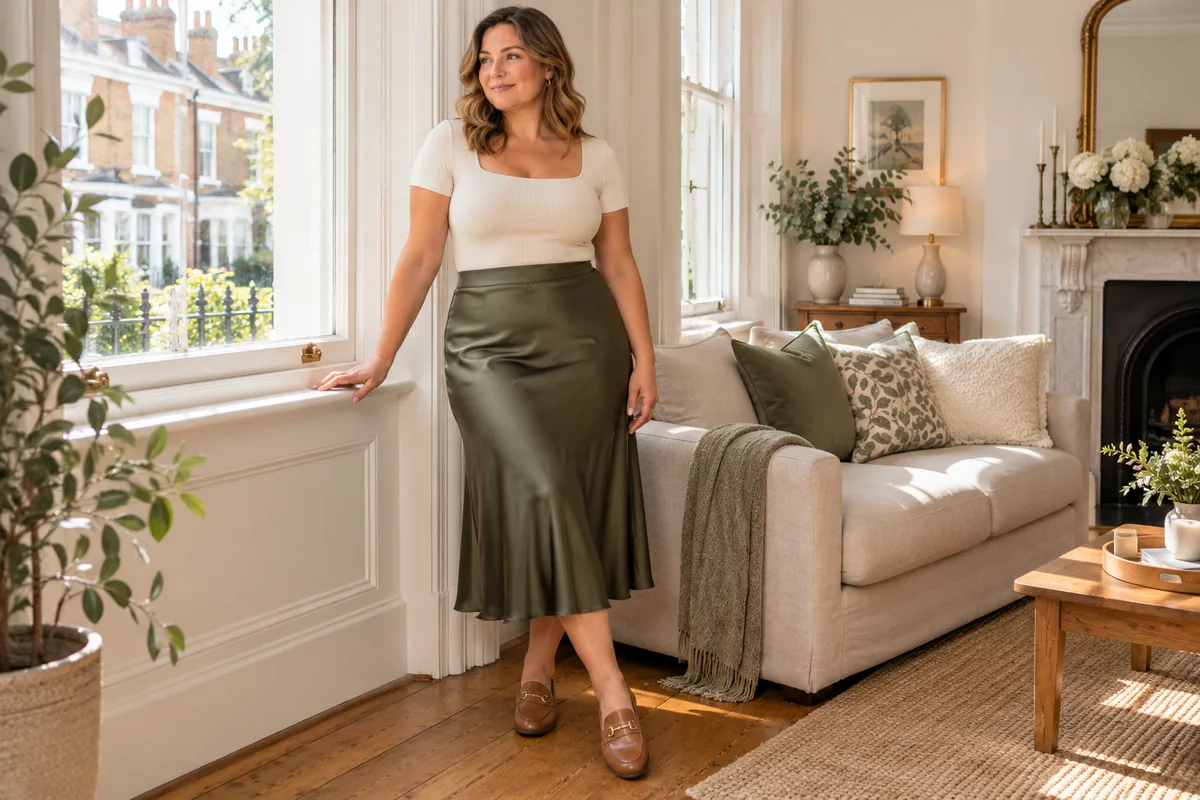
Bodysuits are ideal with high-waisted skirts, as there is nothing to bunch at the waist. A ribbed square-neck bodysuit with an A-line or satin midi skirt makes an easy smart-casual outfit. See our list of skirts for a FUPA for the shapes that fall away from the lower belly.
Tailored trousers
Wide-leg and straight tailored trousers look sharp with a long-sleeve bodysuit. A flat front and a wide waistband keep the line clean. For office options, our guide to work trousers for a FUPA covers rises and cuts that suit a long day at a desk.
Top layers
An open shirt, long cardigan or blazer adds a vertical line and softens the silhouette. Leave it unbuttoned so the edges frame the body. For more combinations, browse our full guide to outfits for a FUPA.
Comfort for Sensitive Skin and Chafing
A bodysuit sits close to sensitive skin, often for a full working day. The crease under the lower belly and the groin are both warm, so friction and trapped sweat can lead to soreness.
- Choose breathable fabric next to the skin. Cotton modal or a cotton gusset is kinder than a full synthetic body in warm weather.
- Check the seams. Flat, bonded or laser-cut edges rub less than raised seams and thin elastic.
- Keep compression moderate. Firm shaping traps heat and presses seams into the skin.
- Cover the poppers. A fabric flap over metal fastenings stops them pressing into the inner thigh.
- Change when you get hot. Swap out of a shaping bodysuit before exercise or a long journey.
NHS advice on heat rash is to wear loose cotton clothing, so save firm, synthetic styles for cooler days. If you already notice soreness, chafing or a rash in that area, our guide to FUPA pain and irritation explains the common causes and when to see a GP.
Take a bodysuit off if it causes pain, numbness, tingling or marks that do not fade soon after removing it.
The Toilet Question
Toilet trips are the most common complaint about bodysuits. A few design choices make them much easier.
- Poppers are quickest. Two or three poppers open in seconds. Check they close firmly, as weak ones can pop open during the day.
- Hook and eye takes longer. It feels secure and flat, but it can be fiddly when you are in a rush.
- Open gussets need no undoing. Many shaping bodysuits use an overlapping split panel. Wear knickers underneath for hygiene.
- Avoid fastening-free bodysuits for long days. Without a gusset opening, you have to undress completely each time.
Practise opening and closing the gusset at home before a long day out. If your fingers struggle with small hooks, choose poppers instead.
How to Stop a Bodysuit Rolling, Digging or Riding Up
Most bodysuit problems trace back to length or to the edges. Here are the fixes for the most common ones.
- Rolling at the leg line: choose a wider, bonded or laser-cut leg edge rather than thin elastic. Silicone grip on the inside also helps.
- Digging into the FUPA: try a low-leg cut so the edge sits on the thigh, not across the side of the lower belly.
- Riding up: this nearly always means the torso is too short. Size up, use the longer row of hooks or try a tall fit.
- Straps cutting in: adjustable straps let you tune the length a little.
- Bulge above the leg edge: drop a compression level, as the squeeze is too strong for the edge.
The same fit rules apply to shaping briefs and shorts. Our guide to shapewear that rolls down covers fit checks for every style.
Caring for Your Bodysuits
Good care keeps the stretch and shape for longer. Always check the care label first, then follow these general rules:
- Fasten the poppers or hooks before washing, so they do not snag other clothes.
- Wash on a cool, gentle cycle inside a mesh laundry bag, or hand wash shaping styles.
- Follow the label on fabric conditioner, as many stretch garments advise against it.
- Dry flat or on a line, away from direct heat. High heat wears out elastane faster.
- Rotate two or three bodysuits, so the elastic recovers between wears.
What to Avoid
- Single-layer, shiny or very thin fabrics that cling to the lower belly.
- Bodysuits that are short in the torso, however good they look on the hanger.
- Very high-leg cuts under fitted trousers, as the edge shows through.
- Bulky metal poppers or a fastening that lands on the mons pubis.
- Firm compression for all-day wear, especially in hot weather.
- Low-rise bottoms, which leave the bodysuit fabric exposed over the FUPA.
Frequently Asked Questions
Are bodysuits good for a FUPA?
Yes, a well-fitted bodysuit is one of the smoothest tops for a FUPA. It has no loose hem to bunch over the lower belly and no gap at the waistband. The key is a torso length that suits your body, a lined fabric and a leg cut that does not dig in.
Should I choose a shaping or non-shaping bodysuit?
A non-shaping bodysuit is enough for most everyday outfits, as it smooths the tuck without squeezing. A shaping bodysuit with light to medium compression suits fitted dresses and occasions. Very firm styles are best kept for short wear.
Is a thong or brief bodysuit better for a FUPA?
A brief or full-back bodysuit is usually more comfortable with a FUPA, because it spreads the pull over a wider panel of fabric. A thong bodysuit avoids visible lines under fitted trousers, but it can feel tighter across the mons pubis.
Why does my bodysuit dig into my lower belly?
A bodysuit that digs in is usually too short in the torso or cut with a high leg. The fabric pulls between the shoulders and the crotch and presses on the FUPA. Try a larger size, a tall fit or a low-leg cut.
What is the best fabric for a bodysuit if I have sensitive skin?
Cotton modal is the gentlest everyday choice, as it is soft and breathable. If you prefer microfibre or power mesh for a smoother finish, look for a cotton-lined gusset and flat, bonded edges.
How do I measure for a bodysuit in the UK?
Start with your usual UK dress size, then check torso length. If the brand lists a girth measurement, measure from the top of one shoulder, down through the crotch and back up to the same shoulder. Compare it with that brand’s own size guide.
How do you go to the toilet in a bodysuit?
Most bodysuits open at the gusset with poppers or a hook and eye fastening. Undo it, then fasten it again afterwards. Many shaping bodysuits have an open gusset instead, so you do not need to undo anything.
What should I wear with a bodysuit if I have a FUPA?
High-waisted straight jeans, A-line or midi skirts and wide-leg tailored trousers all work well. Their waistbands sit above the lower belly, so the bodysuit stays flat underneath. An open cardigan or blazer adds a long, flattering line.
The Bottom Line
The best bodysuits for a FUPA start with the right torso length, then add a brief back or low-leg cut, a lined or ribbed fabric and a low, easy gusset. Choose cotton modal for soft daily wear, microfibre for a smooth finish and power mesh only where you want real hold. Pair your bodysuit with high-waisted jeans, skirts or trousers, and always sit and stretch in it before you commit.