
Choosing a FUPA Surgeon in the UK: Qualifications, Questions and Red Flags

Page Contents
- Which Procedures Does a FUPA Surgeon Perform?
- Monsplasty, liposuction and tummy tuck
- Why the specialty matters
- Qualifications to Check Before You Book
- GMC registration and the Specialist Register
- FRCS(Plast): the plastic surgery exit exam
- BAAPS and BAPRAS membership
- CQC registration and the hospital’s rating
- Experience and Before-and-After Photos
- Ask how often they do this operation
- How to read before-and-after photos
- What Should Happen at the Consultation
- You should see the surgeon who will operate
- The cooling-off period
- Questions to Ask Your Surgeon
- Costs and What a Quote Should Include
- What a written quote should cover
- Paying for surgery
- Cosmetic Surgery Abroad: The Risks
- Aftercare and follow-up
- Flying after surgery
- Red Flags That Mean Walk Away
- Pressure selling and deadline discounts
- No consultation with your surgeon
- Finance pushes and influencer deals
- NHS or Private?
- When a medical problem may qualify
- How to Complain if Something Goes Wrong
- Start with the clinic
- Taking it further
- Frequently Asked Questions
- How do I check a FUPA surgeon’s qualifications in the UK?
- Should I meet my surgeon before the day of surgery?
- How long is the cooling-off period for cosmetic surgery?
- Will the NHS pay for FUPA surgery?
- Is it safe to have FUPA surgery abroad?
- The Bottom Line
Choosing who operates on you matters as much as choosing the operation. This guide shows you how to find a FUPA surgeon UK patients can trust: the qualifications to check, what a proper consultation looks like, the questions to ask, what a quote should include and the red flags that mean you should walk away.
This guide is general information, not medical advice. The rules differ slightly across England, Scotland, Wales and Northern Ireland. Speak to your GP if you are unsure whether surgery is right for you.
For every option, cost and recovery time in one place, see our FUPA surgery guide.
Which Procedures Does a FUPA Surgeon Perform?
A FUPA is extra fat, loose skin or both over the mons pubis. Three operations treat it, depending on which is the main problem.
Monsplasty, liposuction and tummy tuck
- Monsplasty (mons lift): removes a strip of skin and fat and lifts the pubic area, leaving a low scar along the bikini line. See our monsplasty guide.
- Liposuction: removes fat through small cuts but does not tighten loose skin. See our guide to FUPA liposuction.
- Tummy tuck with a mons lift: removes loose skin and fat from the lower tummy and lifts the mons in the same operation. See our guide to a tummy tuck for a FUPA.
Why the specialty matters
All three are body contouring operations, which sit within plastic surgery training. The safest starting point is a consultant plastic surgeon who does them often.
Qualifications to Check Before You Book
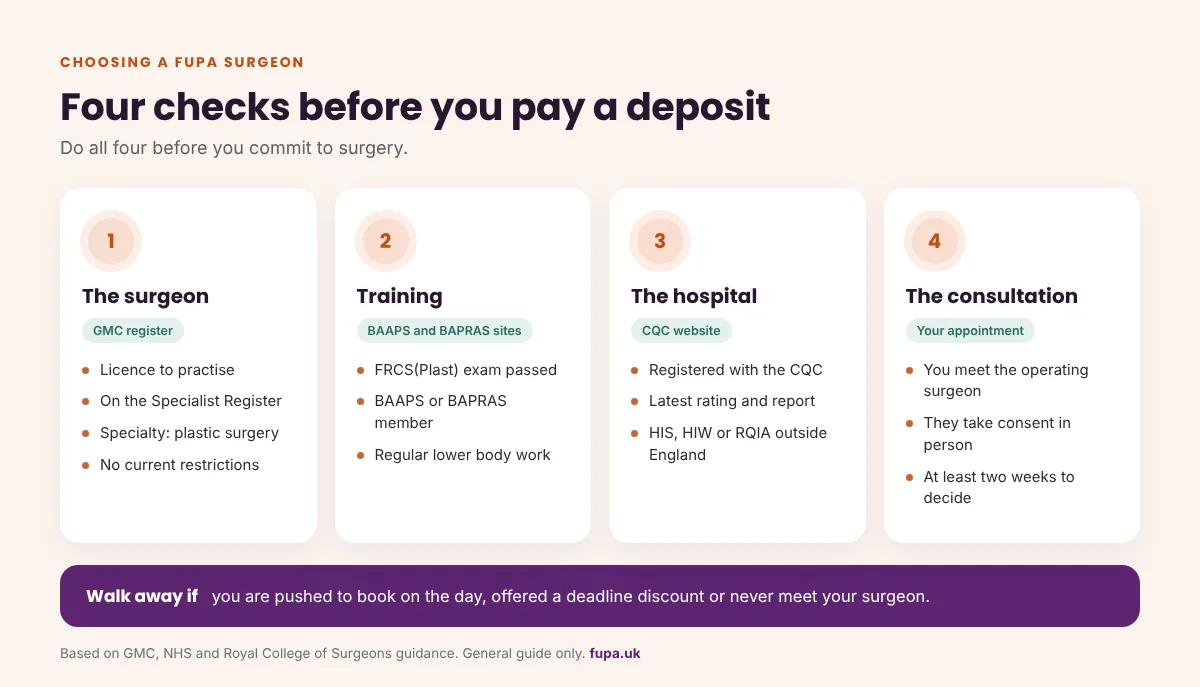
Only registered doctors can perform cosmetic surgery in England. The four checks below tell you far more.
GMC registration and the Specialist Register
Search the surgeon’s name or GMC reference number on the General Medical Council’s online register. Look for a licence to practise, plastic surgery as the listed specialty, the date they joined the Specialist Register and no current restrictions. BAPRAS notes that fully qualified UK plastic surgeons appear on the Specialist Register for plastic surgery.
FRCS(Plast): the plastic surgery exit exam
FRCS(Plast) after a surgeon’s name means they passed the intercollegiate specialty exam in plastic surgery. BAPRAS describes it as the test of whether a trainee is ready to work as an NHS consultant. Surgeons trained abroad may hold a different qualification, so the Specialist Register entry remains the key check.
BAAPS and BAPRAS membership
The British Association of Aesthetic Plastic Surgeons (BAAPS) says its members are fully trained plastic surgeons on the GMC Specialist Register. The British Association of Plastic, Reconstructive and Aesthetic Surgeons (BAPRAS) is the other main professional body. Confirm membership on each association’s own website rather than trusting a logo on a clinic page.
CQC registration and the hospital’s rating
In England, every independent hospital or clinic that provides cosmetic surgery must be registered with the Care Quality Commission (CQC). Search for the hospital on the CQC website and read its latest rating, from outstanding to inadequate, and its inspection report. In Scotland, Wales and Northern Ireland, check Healthcare Improvement Scotland, Healthcare Inspectorate Wales or the RQIA instead.
Experience and Before-and-After Photos
Ask how often they do this operation
The NHS suggests asking how many of these procedures a surgeon has done, how many had complications and what their own patient satisfaction rates are. The Private Healthcare Information Network (PHIN) publishes consultant profiles that can show how many private patients a surgeon has treated and, where available, their fees.
How to read before-and-after photos
Ask for photos of the surgeon’s own patients who had the same operation and started with a body like yours. Good pairs match the lighting, angle and posture, and show the result months later, once swelling has settled. Our guide to FUPA surgery before and after explains what a realistic result looks like.
What Should Happen at the Consultation
You should see the surgeon who will operate
The GMC’s guidance for doctors who offer cosmetic interventions says the doctor who will carry out the procedure must discuss it with you and seek your consent personally. They must not delegate this. The consultation should cover your medical history, an examination, which operation suits your FUPA, the risks, the scar and the recovery.
The cooling-off period
The GMC says doctors must give you the time and information you need to reach a voluntary, informed decision, and must tell you that you can change your mind at any point. It does not set a fixed number of days. Royal College of Surgeons standards for cosmetic surgery, welcomed by the CQC, go further: consent is taken in two stages, with a cooling-off period of at least two weeks between them.

Questions to Ask Your Surgeon
Take this checklist to your consultation and note the answers.
| Question to ask | What a good answer sounds like |
|---|---|
| Are you on the GMC Specialist Register, and in which specialty? | Yes, in plastic surgery, with a GMC number you can check. |
| How many of these operations do you do each year? | A clear number for this exact operation. |
| Which operation suits my FUPA, and why? | A reason linked to your skin, fat and goals, including when no surgery is better. |
| What are your own complication and revision rates? | Figures from their own practice, or an honest reason why not. |
| Which hospital will you use, and what is its CQC rating? | A named, registered hospital you can look up. |
| Who do I call at night if something goes wrong? | A named team and a number you can ring at any hour. |
| What does the quote include? | A written breakdown covering follow-up, garments and revisions. |
Costs and What a Quote Should Include
The NHS puts the cost of a tummy tuck in the UK at about £5,000 to £10,000, plus consultations and follow-up care. Monsplasty and liposuction prices vary with the clinic and the amount treated. See our guide to FUPA surgery costs in the UK.
What a written quote should cover
The GMC says doctors must explain their charges clearly, including what a quote covers for revisions and routine follow-up. Before you pay a deposit, check the quote names:
- The surgeon’s, anaesthetist’s and hospital fees.
- Any overnight stay and tests before surgery.
- Compression garments and dressings.
- Follow-up appointments, and for how long they run.
- What you pay if you need more surgery to correct a problem.
- Cancellation terms and what happens to your deposit.
Paying for surgery
The NHS advises against paying for a procedure until you have had a consultation. If you plan to use finance, arrange it after your cooling-off period and check the total cost of the credit.
Cosmetic Surgery Abroad: The Risks
Aftercare and follow-up
The NHS warns that overseas clinics may not provide follow-up treatment, or may not provide it to UK standards. BAPRAS adds that some have no one in the UK to turn to if problems arise. The NHS will treat a life-threatening emergency, but BAPRAS says less serious problems may not be treated free of charge.
Flying after surgery
Air travel and major surgery both raise the risk of a blood clot. The NHS advises against flying for 5 to 7 days after liposuction and 7 to 10 days after a tummy tuck. Our guide to FUPA surgery risks lists the warning signs to watch for.
Red Flags That Mean Walk Away
Pressure selling and deadline discounts
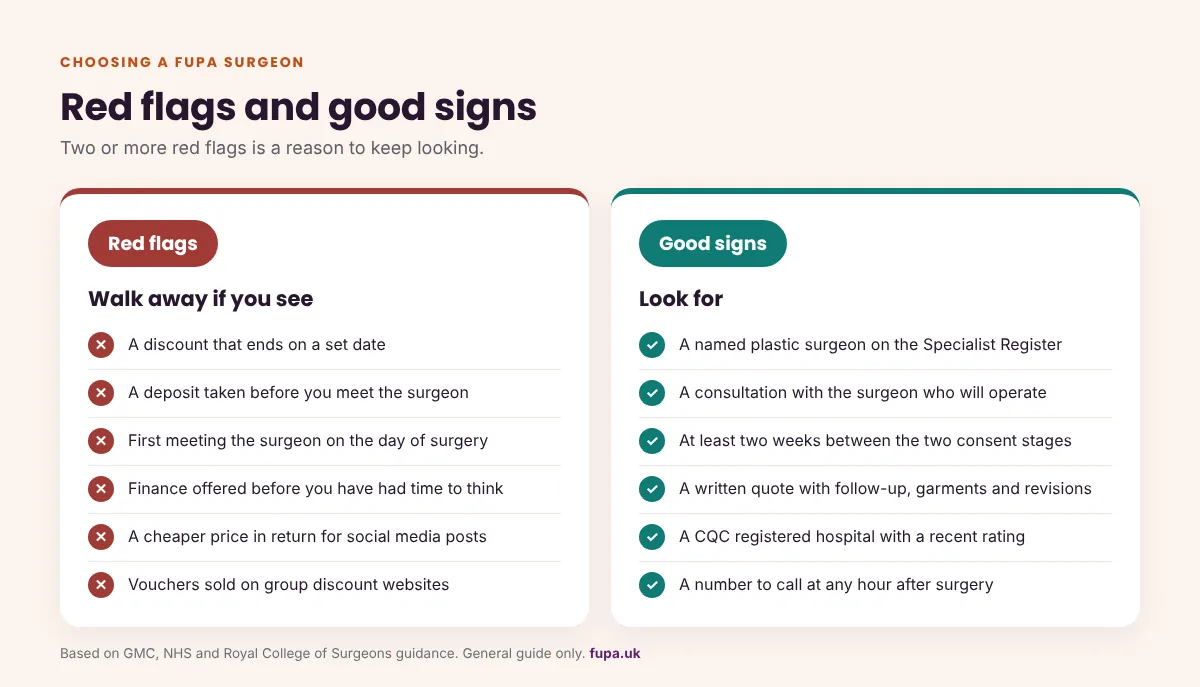
Royal College of Surgeons standards say financial inducements such as time-limited offers and discounts should not be used. The GMC tells doctors not to use promotional tactics that could push you into an ill-considered decision, and not to offer their services as a prize.
No consultation with your surgeon
Walk away if you are asked to pay before meeting the surgeon, or if you would first meet them on the day of surgery. The NHS also advises avoiding treatment vouchers sold on group discount websites.
Finance pushes and influencer deals
Be cautious if staff steer you towards finance before you have had time to think, or offer a cheaper price for social media posts. The NHS points out that influencers are usually paid to advertise the service.
NHS or Private?
The NHS says cosmetic surgery is not routinely provided, so most people pay privately. Surgery to change how the mons pubis looks is very unlikely to be funded.
When a medical problem may qualify
Local NHS commissioners set their own rules for removing an overhanging apron of skin, called an apronectomy or panniculectomy. A 2024 Cheshire and Merseyside policy, for example, only considers it when the fold causes chronic skin breakdown for at least three months despite treatment, in non-smokers who meet strict weight criteria. Ask your GP about local rules. Our guide to a FUPA vs an apron belly explains the difference.
How to Complain if Something Goes Wrong
Start with the clinic
Raise your concern with the hospital or surgeon first, in writing, and keep copies of messages, photos and receipts. CQC registered providers must have a complaints process.
Taking it further
- ISCAS: if the provider subscribes to the Independent Sector Complaints Adjudication Service, it can review your complaint independently.
- CQC: tell the regulator about poor care. It uses this to plan inspections but does not resolve individual complaints.
- GMC: report a serious concern about a doctor’s fitness to practise.
- PHIN: its website explains how to complain about private care.
Frequently Asked Questions
How do I check a FUPA surgeon’s qualifications in the UK?
Search the GMC online register to confirm the surgeon holds a licence to practise and sits on the Specialist Register for plastic surgery. Look for FRCS(Plast) and check BAAPS or BAPRAS membership on their own websites. Then confirm the hospital is registered with the CQC, or the regulator in Scotland, Wales or Northern Ireland.
Should I meet my surgeon before the day of surgery?
Yes. GMC guidance says the doctor who will carry out a cosmetic procedure must discuss it with you and take your consent personally, without delegating it. BAPRAS advises at least one consultation with the operating surgeon before you commit. Be wary of any clinic where you would first meet your surgeon on the day.
How long is the cooling-off period for cosmetic surgery?
The GMC does not set a fixed number of days, but it says you must have the time and information you need to decide. Royal College of Surgeons standards set a two-stage consent process with a cooling-off period of at least two weeks between the stages. You can change your mind at any point.
Will the NHS pay for FUPA surgery?
Very rarely. The NHS says cosmetic surgery is not routinely provided, so most people pay privately. Some local NHS policies fund removal of an overhanging apron of skin when it causes chronic skin breakdown and strict weight criteria are met. Surgery to change how the mons pubis looks is very unlikely to qualify.
Is it safe to have FUPA surgery abroad?
It carries extra risks. The NHS warns that overseas clinics may not provide follow-up care to UK standards, and flying soon after surgery raises the risk of blood clots. It advises waiting 5 to 7 days after liposuction and 7 to 10 days after a tummy tuck before flying home.
The Bottom Line
Choosing a FUPA surgeon comes down to checks you can make yourself: the GMC Specialist Register, FRCS(Plast), BAAPS or BAPRAS membership and the hospital’s CQC rating. Meet the surgeon who will operate, get a written quote and take at least two weeks to decide. If anyone rushes you, walk away. The NHS guide to choosing who will do your cosmetic procedure is a useful final check.