
Can Contraception Cause a FUPA? The Pill, Implant and Injection Explained
Page Contents
- Key Takeaways
- Can Contraception Cause a FUPA? The Short Answer
- What the evidence actually supports
- Why the lower belly notices first
- The Combined Pill and a FUPA
- What it contains
- What the evidence says
- The Progestogen-Only Pill
- Desogestrel and traditional mini pills
- What the evidence says
- The Contraceptive Implant (Nexplanon)
- How it works
- Mixed evidence, strong anecdote
- The Contraceptive Injection (Depo-Provera and Sayana Press)
- The method with the strongest evidence
- How much and where
- The Hormonal Coil (IUS) and the Copper Coil
- Mirena, Kyleena, Levosert and Benilexa
- The copper coil as a comparison
- Contraception and FUPA Risk: Method by Method
- Bloating, Water and Timing: Why It Can Look Worse Than It Is
- Fluid versus fat
- Measure before you decide
- What to Do If You Think Your Contraception Is Adding to Your FUPA
- Talk before you stop
- Rule out the other causes
- Give any change time to show
- Frequently Asked Questions
- Does the pill make your FUPA bigger?
- Which contraception is most likely to cause weight gain?
- Does the implant cause lower belly fat?
- Will my FUPA go away if I stop the injection?
- Is it safe to stop contraception to see if my FUPA shrinks?
- The Bottom Line
- Blame the right thing, then act on it
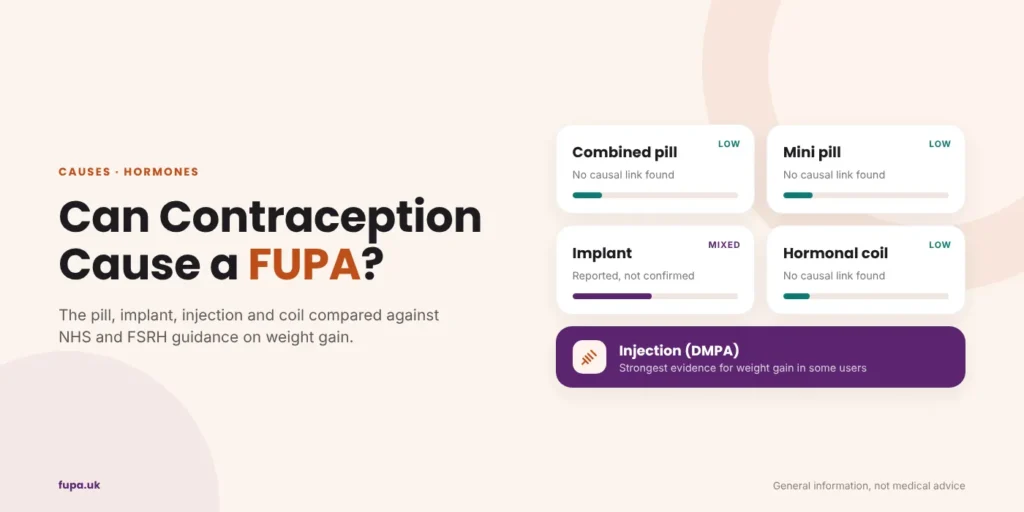
Many women notice their lower belly change in the months after starting a new contraceptive and ask the same question: can contraception cause a FUPA? The honest answer is that it depends on the method. Most hormonal contraception has not been shown to cause weight gain in good quality studies. One method, the contraceptive injection, does have real evidence behind the complaint. For all of them, the fat pad above the pubic bone, the mons pubis, is simply one of the places a woman’s body tends to store any extra fat she gains.
This guide works through the combined pill, the progestogen-only pill, the implant, the injection and the hormonal coil in turn. For each, it sets out what NHS and Faculty of Sexual and Reproductive Healthcare (FSRH) guidance says, how any effect might reach the lower belly, and what you can do about it without stopping contraception on your own.
This guide is general information, not medical advice. Do not stop or switch a contraceptive without speaking to your GP, practice nurse or a sexual health clinic first, because you may be left unprotected.
Key Takeaways
- No contraceptive puts fat on the mons pubis specifically. Any weight gained goes where your body already stores it, and for many women that includes the lower belly.
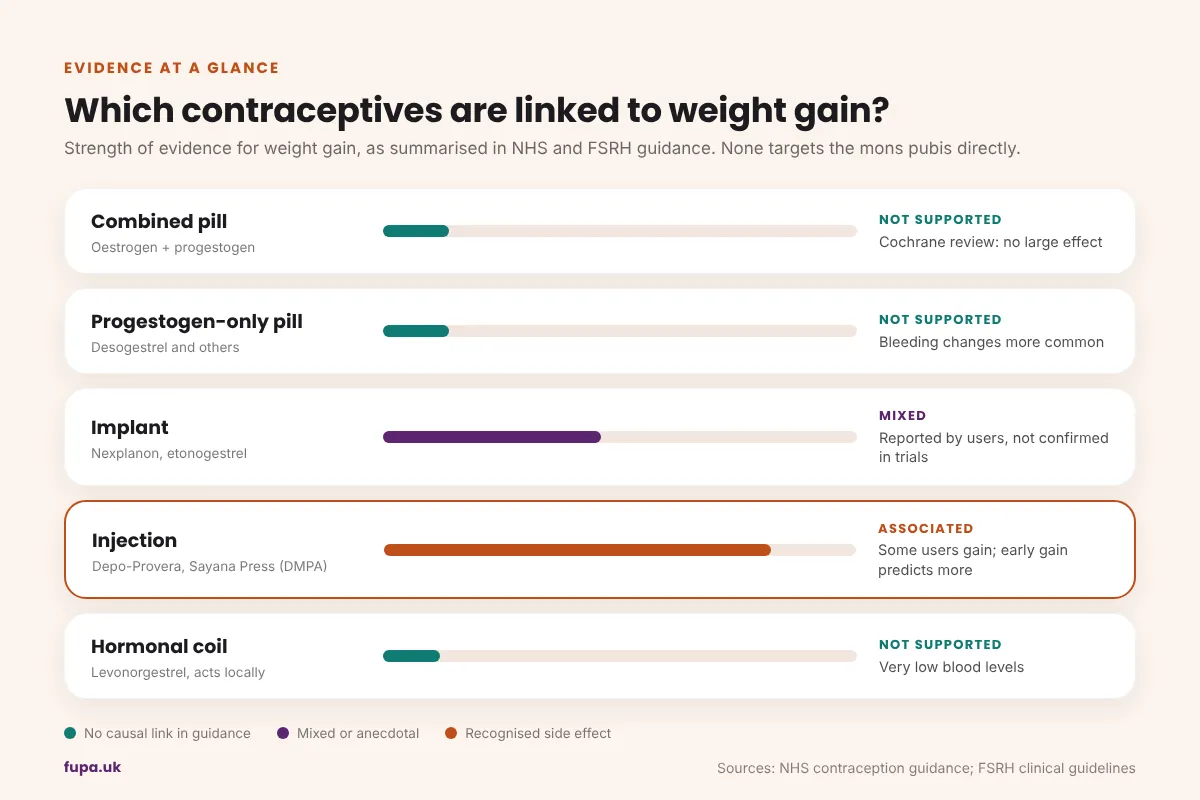
- The combined pill, the progestogen-only pill and the hormonal coil have not been shown to cause weight gain in the studies reviewed by the NHS and FSRH.
- The implant has mixed evidence: some women report gaining weight, but comparison studies do not show a clear difference from non-users.
- The injection (Depo-Provera, Sayana Press) is the exception. FSRH guidance accepts that it is linked with weight gain in some users, most clearly in women under 18 with a BMI of 30 or more.
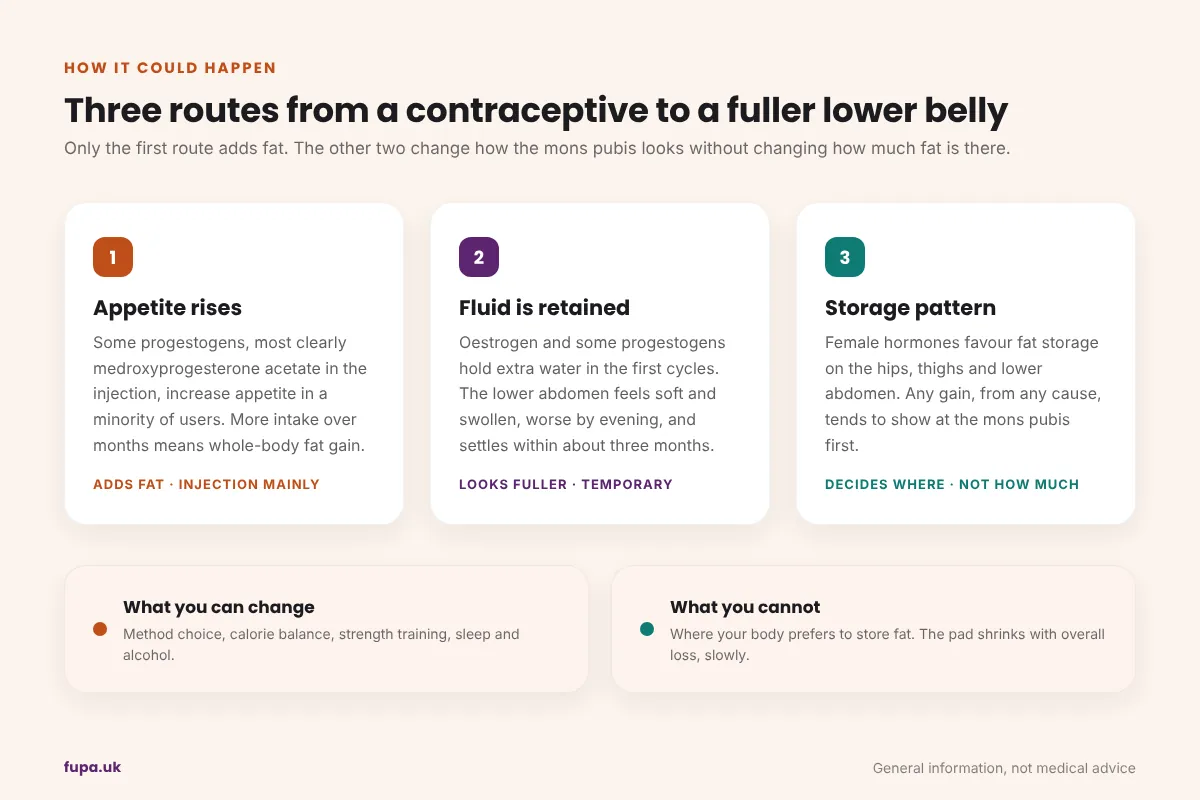
- Bloating and fluid retention in the first three months can look like a bigger FUPA without any fat being added.
Can Contraception Cause a FUPA? The Short Answer
What the evidence actually supports
A FUPA is fat stored over the mons pubis, a pad of tissue every woman has in some degree. What causes a FUPA is mostly total body fat, genetic storage pattern, hormones and stretched skin. Contraception enters that picture through two routes: it can change appetite or fluid balance, and it can shift your hormone profile while you use it. Neither route targets one patch of fat.
Why the lower belly notices first
Oestrogen encourages the body to store fat in a gynoid pattern, meaning the hips, thighs and lower abdomen rather than the upper belly. The mons pubis sits inside that zone, and the anatomy of the mons pubis means it has room to expand. If you gain two or three kilograms for any reason while using a hormonal method, the lower belly is a likely place for it to show.
The Combined Pill and a FUPA
What it contains
The combined pill contains a synthetic oestrogen, usually ethinylestradiol, and a progestogen. It is the method most often blamed for weight gain, partly because older, higher dose pills from the 1960s and 1970s did cause fluid retention.
What the evidence says
A Cochrane systematic review of combined hormonal contraception found no large effect on weight, and the trials that compared different pills found no meaningful differences between them. NHS guidance states that there is no evidence the combined pill causes weight gain. FSRH clinical guidance on combined hormonal contraception reaches the same conclusion: it does not support a causal link.
What the pill can do, especially in the first three months, is cause mild fluid retention and breast tenderness. Fluid sitting in the lower abdomen can make a FUPA look fuller for a few weeks. This usually settles. If it does not, a pill with a different progestogen may suit you better.
The Progestogen-Only Pill
Desogestrel and traditional mini pills
The progestogen-only pill, or mini pill, contains no oestrogen. The most common UK versions contain desogestrel. Because it is often prescribed to women who cannot take oestrogen, including those with a higher BMI, weight gain on the mini pill is sometimes noticed and attributed to the tablet.
What the evidence says
FSRH guidance on progestogen-only pills does not list weight gain as an established side effect, and the NHS says there is no evidence it causes weight gain. Irregular bleeding is the complaint that drives most women to switch. If your lower belly has grown on the mini pill, the hormones and genetics behind a FUPA are a more likely explanation than the tablet itself.
The Contraceptive Implant (Nexplanon)
How it works
Nexplanon is a small flexible rod placed under the skin of the upper arm. It releases etonogestrel, a progestogen, at a steady low dose for up to three years.
Mixed evidence, strong anecdote
Weight gain is one of the most common reasons women give for having the implant removed early, and the NHS lists it among possible side effects. However, FSRH guidance on the implant notes that the evidence does not show a causal link. Comparison studies that follow implant users alongside copper coil users tend to find similar weight changes in both groups.
The gap between what women experience and what trials show deserves respect. It may partly reflect that women gain weight through their twenties and thirties regardless of method, and the implant stays in for three years at a time. It may also be that a minority respond to etonogestrel with increased appetite while most do not. If the implant is the only thing that has changed and your waist measurements are climbing, raise it with your prescriber.
The Contraceptive Injection (Depo-Provera and Sayana Press)
The method with the strongest evidence
The injection contains depot medroxyprogesterone acetate, usually shortened to DMPA. Depo-Provera is given into the muscle and Sayana Press under the skin, both every 13 weeks. This is the one method where guidance accepts weight gain as a genuine side effect.
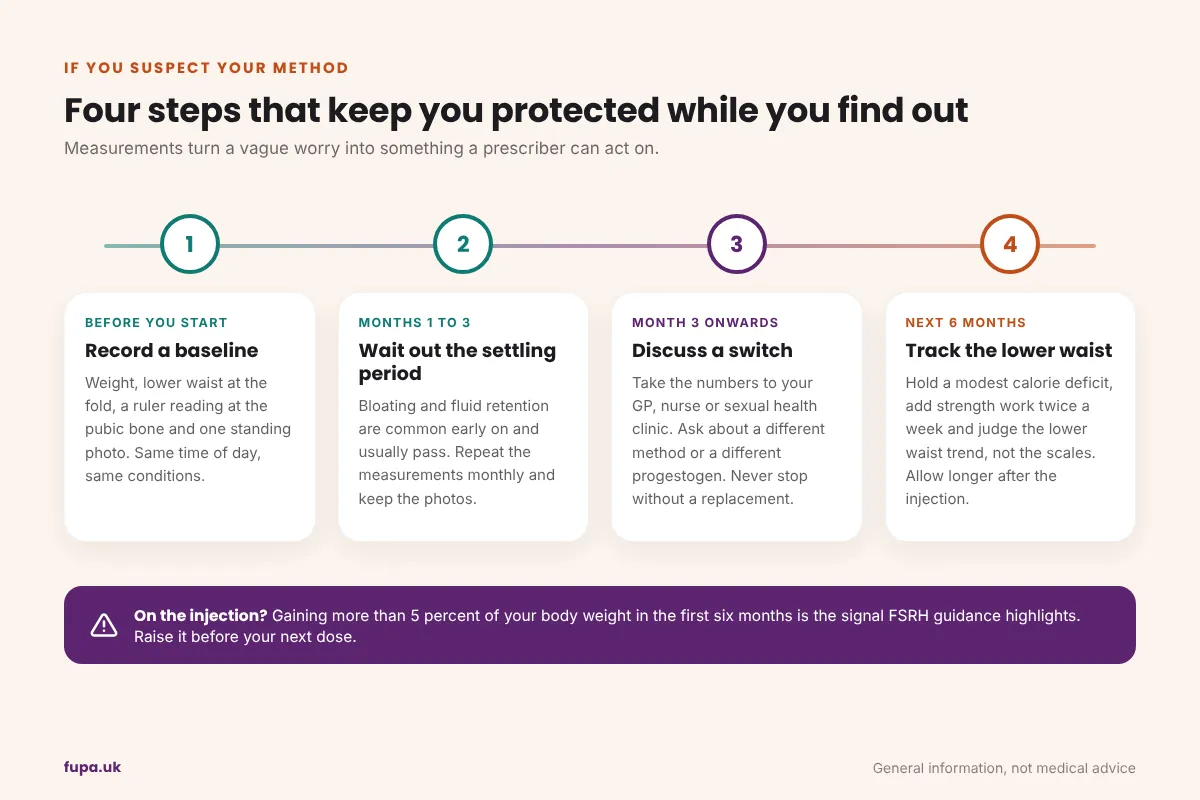
FSRH guidance on progestogen-only injectables states that the available evidence indicates DMPA use is associated with some weight gain. The effect is not uniform. It appears most marked in women under 18 who already have a BMI of 30 or more. One pattern reported in the research is that women who gain more than five percent of their body weight in the first six months of use are more likely to keep gaining while they continue the injection. The NHS lists weight gain among the side effects of the injection.
How much and where
Studies vary, but average gains of a few kilograms over the first one to two years are reported in some groups, with a wide spread, and many women gain nothing at all. Medroxyprogesterone acetate is thought to increase appetite in some users, and it has a weak glucocorticoid-like action that may encourage fat storage around the middle. If you gained noticeably in the first six months on the injection, that early change is the most useful signal you have, and it is worth discussing with your prescriber before your next dose.
The injection also takes time to leave the body. Fertility can take up to a year to return after the last dose, so any weight change linked to DMPA does not reverse the week you stop. The calorie deficit guide explains why the lower belly is usually the last area to respond.
The Hormonal Coil (IUS) and the Copper Coil
Mirena, Kyleena, Levosert and Benilexa
The hormonal coil, or intrauterine system, releases levonorgestrel directly into the womb. Blood levels of the hormone are far lower than with a pill or injection because the hormone acts locally. FSRH guidance on intrauterine contraception does not identify weight gain as an effect of the IUS, and the NHS says there is no evidence it causes weight gain.
The copper coil as a comparison
The copper coil (IUD) contains no hormones, which is why researchers use it as a comparison group. It is the clearest option if you want no hormonal influence on appetite or fluid, though heavier periods are a common trade-off.
Contraception and FUPA Risk: Method by Method
| Method | Hormones | Weight gain evidence | Likely lower belly effect |
|---|---|---|---|
| Combined pill | Oestrogen plus progestogen | Not supported (Cochrane, NHS, FSRH) | Short-term fluid retention in the first three months |
| Progestogen-only pill | Progestogen only | Not supported (NHS, FSRH) | Little expected; bleeding changes more common |
| Implant (Nexplanon) | Etonogestrel | Mixed: reported by users, not confirmed in comparison studies | Possible in a minority, usually whole-body |
| Injection (Depo-Provera, Sayana Press) | Medroxyprogesterone acetate | Associated with weight gain in some users (FSRH, NHS) | Most likely of the five; early gain predicts more |
| Hormonal coil (IUS) | Levonorgestrel, local | Not supported (NHS, FSRH) | Little expected |
| Copper coil (IUD) | None | Not applicable | None from the method |
Bloating, Water and Timing: Why It Can Look Worse Than It Is
Fluid versus fat
Hormonal changes in the first cycle or two on a new method often cause bloating and water retention. A lower belly swollen with fluid feels soft, changes through the day and is often worse in the evening. Fat does not behave like that. The guide to FUPA vs bloating explains how to tell the two apart, and most fluid-related change settles within three months.
Measure before you decide
Weigh yourself and take a lower waist measurement and a photo before starting a new method, then repeat monthly. Without a baseline it is hard to know whether anything has changed. The method in how to measure a FUPA takes five minutes and gives you something concrete to show your prescriber.
What to Do If You Think Your Contraception Is Adding to Your FUPA
Talk before you stop
Stopping a method without a replacement leaves you at risk of pregnancy, and a pregnancy changes the lower belly far more than any contraceptive. Book an appointment with your GP, practice nurse or a sexual health clinic and take your measurements with you. Ask whether a different method, or a different progestogen, might suit you better. Switching is routine, and the NHS contraception guide sets out every option.
Rule out the other causes
Weight gain in women is more often driven by sleep, stress, alcohol, lower activity and life stage than by contraception. Conditions such as PCOS also push fat towards the lower abdomen, and the guide to FUPA and PCOS covers that overlap. Many women start hormonal contraception in their late teens or twenties, which is also when natural weight gain tends to begin, so the method takes the blame for a trend that was coming anyway.
Give any change time to show
If you switch methods, allow three to six months before judging the effect, and longer for the injection, because DMPA leaves the body slowly. Combine the switch with a modest calorie deficit and regular strength training, and track the lower waist rather than the scales. The does a FUPA go away guide explains what to expect.
Frequently Asked Questions
Does the pill make your FUPA bigger?
Current evidence says no. A Cochrane review and both NHS and FSRH guidance find no causal link between the combined pill and weight gain. The pill can cause mild fluid retention in the first three months, which may make the lower belly look fuller for a while, but this is not added fat and usually settles.
Which contraception is most likely to cause weight gain?
The contraceptive injection, Depo-Provera or Sayana Press, has the strongest evidence. FSRH guidance accepts that DMPA is associated with some weight gain, most clearly in women under 18 with a BMI of 30 or more. The effect varies widely, and many women using the injection gain no weight at all.
Does the implant cause lower belly fat?
The evidence is mixed. Some women report weight gain on Nexplanon and the NHS lists it as a possible side effect, but comparison studies against non-hormonal methods do not show a clear difference. If your measurements rise after the implant and nothing else has changed, raise it with your prescriber rather than assuming it is in your head.
Will my FUPA go away if I stop the injection?
Not automatically. Any fat gained stays until it is lost through a sustained calorie deficit, and DMPA can take up to a year to leave the body fully. Switching to a different method removes a possible contributor, but the lower belly usually responds slowly and is often the last area to change.
Is it safe to stop contraception to see if my FUPA shrinks?
Stopping without a replacement leaves you at risk of pregnancy, which changes the lower belly far more than any contraceptive. Speak to your GP, practice nurse or a sexual health clinic first. Switching between methods is routine, and you can be protected throughout while you test whether a change helps.
The Bottom Line
Blame the right thing, then act on it
Can contraception cause a FUPA? For the combined pill, the mini pill and the hormonal coil, the evidence says it is unlikely. For the implant, the picture is mixed and worth watching. For the injection, weight gain is a recognised side effect for some women, and early gain in the first six months is the clearest warning sign. Fat that does arrive goes where your body prefers to store it, which for many women is the lower belly. Measure before you start, talk before you stop, and treat the fat pad the way it responds to anyway: a steady deficit, strength training and patience. The FUPA in women guide brings the hormonal causes together.