
A waistband that feels fine at 7pm can feel like a rope by midnight. When you lie down, curl up or roll over, the lower belly shifts, and a thin band of elastic ends up pressing straight into it. Choosing pyjamas for a FUPA comes down to a few clear details: where the waistband sits, how wide and soft it is, and what the fabric does when you get warm.
This guide covers waistband types, fabrics, cuts and loungewear sets that stay comfortable over the lower belly, plus UK sizing tips and what to avoid. It is part of our wider advice on dressing comfortably with a FUPA.
Why Pyjama Waistbands Dig In at Night
A FUPA is the soft pad of fat over the pubic bone, on the mons pubis just below the lower belly. Standing up, it forms a gentle curve. Lying down or sitting curled on the sofa, that curve changes shape, and a crease often forms across the lower belly.
Most pyjama bottoms are cut with a simple elasticated waist, because it is cheap and easy to pull on. That design causes most of the problems:
- The elastic is narrow, so all the pressure lands on one thin line.
- The waistband often sits at mid rise, which is right on the lower belly crease.
- When you bend your knees or lie on your side, the crease deepens and the band folds into it.
- After an evening meal, the tummy can feel fuller, so a band that fitted earlier now feels tight.
- Some bands roll over when you turn in bed, which turns a soft edge into a hard ridge.
If you already battle with knickers that fold down, our guide to underwear waistbands that roll down explains the same problem in daywear. The fixes for pyjamas follow the same logic: go wider, softer and either higher or lower than the crease.
The Best Waistbands in Pyjamas for a FUPA
The waistband matters more than the print, the brand or the price. A wide, soft band that spreads pressure is the single biggest upgrade you can make.
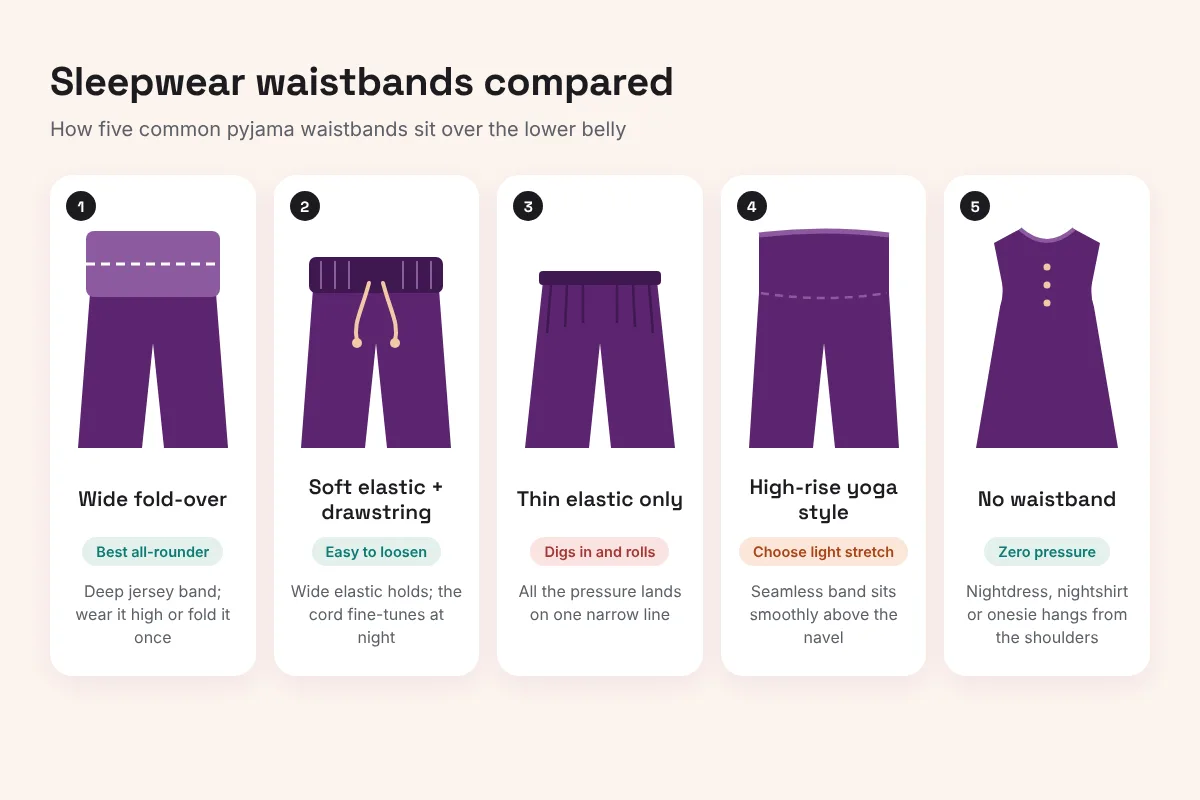
Wide fold-over waistbands
A fold-over waistband is a deep band of stretch jersey that you can wear high or fold down. It is the most forgiving option for most people with a FUPA. Worn high, it covers the lower belly in one smooth layer. Folded once, it sits lower, under the curve. Just avoid folding it so it lands exactly on the crease.
Drawstring versus elastic
A drawstring lets you set the tension yourself, so you can loosen it after dinner or before bed. On its own, though, a cord bunches fabric into gathers. The best design combines a soft, wide elastic with a drawstring threaded through it. The elastic holds the trousers up, and the cord fine-tunes the fit. Thin, tight elastic on its own is the type most likely to dig in and leave red marks.
Yoga-style high-rise bands
Yoga-style bottoms have a smooth, high-rise waistband with no seam or elastic channel. The band is made from the same stretch knit as the leg. It sits at or above the navel, so it covers the FUPA instead of cutting across it. Choose a soft, light stretch rather than a firm, compressive one. Sleep is not the time for shapewear-level hold. Our guide to leggings for a FUPA explains how to judge rise and band height in the same type of knit.
High-rise versus low-sitting bottoms
Rise describes where the waistband sits on your body. For sleepwear there are two comfortable positions:
- High rise, at or just above the navel, sits above the lower belly crease. It works well for back sleepers and anyone who likes a covered, held feeling.
- Low and loose, sitting under the FUPA, can feel freer for side sleepers, as long as the band is soft and does not push upwards.
Mid rise is the awkward middle. It often lands right on the crease, which is where digging starts.
Nightdresses, nightshirts and onesies: no waistband at all
The simplest way to stop a waistband digging in is not to wear one. A cotton nightdress or a long nightshirt hangs from the shoulders, so nothing grips the lower belly. This makes them a popular choice for anyone with a sensitive or sore FUPA, after surgery or during late pregnancy.
Onesies and all-in-one sleepsuits also have no waistband. Check that the body is long enough, though. A onesie that is too short in the torso pulls up into the groin and presses on the mons pubis. If you are tall or long-bodied, look for a “tall” range or size up.
| Waistband type | How it sits | Comfort over a FUPA | Best for |
|---|---|---|---|
| Wide fold-over | Deep jersey band, worn high or folded | Very comfortable; spreads pressure | Most sleepers and lounging |
| Soft elastic with drawstring | Wide elastic plus an adjustable cord | Comfortable; easy to loosen at night | Woven cotton and brushed cotton sets |
| Thin elastic only | Narrow gathered band | Most likely to dig in and roll | Best avoided if you feel pressure |
| Yoga-style high rise | Seamless stretch band above the navel | Smooth and covered; choose light stretch | Back sleepers and loungewear |
| No waistband | Nightdress, nightshirt or onesie | No pressure on the lower belly | Sensitive skin, recovery, pregnancy |
Fabrics That Stay Comfortable All Night
Fabric decides two things in bed: how soft the waistband feels against the skin, and how hot you get. A FUPA creates a skin fold, and warm, damp skin in a fold can become sore. As a result, breathable fabric is worth more than a fancy finish.
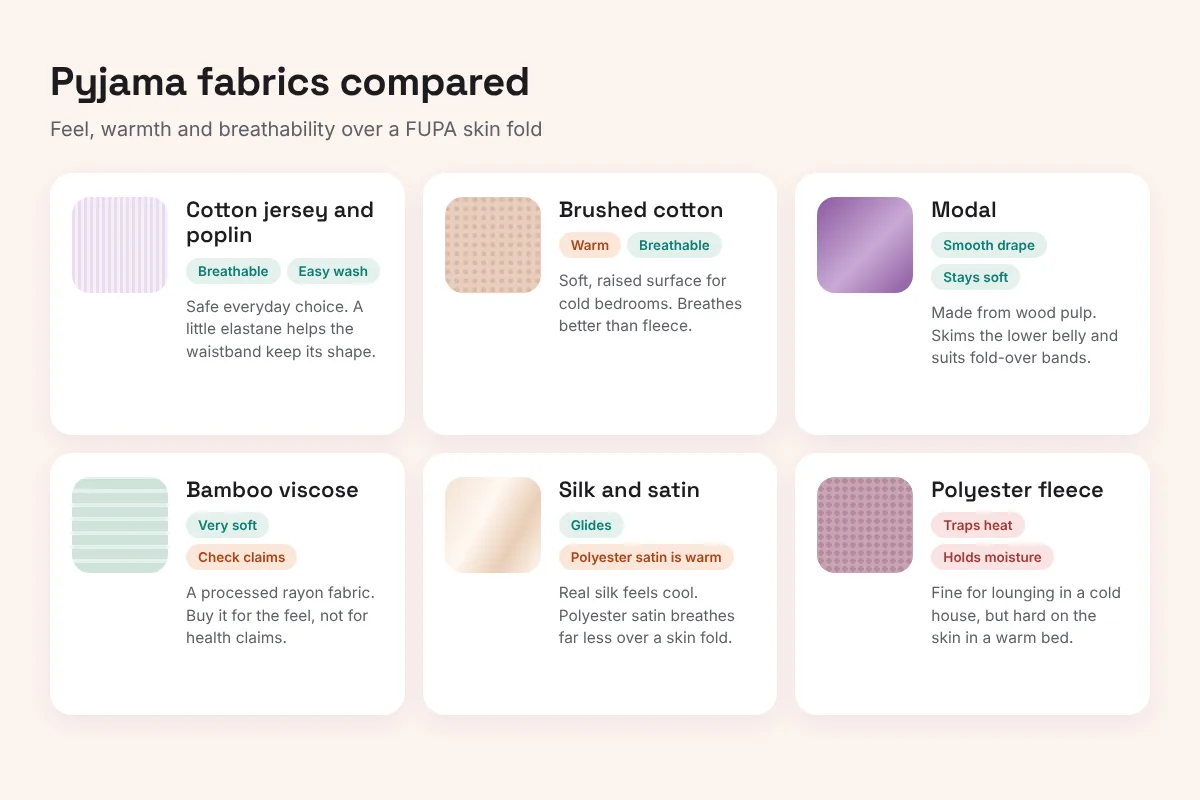
Cotton jersey and cotton poplin
Cotton is the safe, everyday choice. Cotton jersey is a soft knit with natural stretch, so it moves when you turn over. Cotton poplin is a crisp woven fabric that feels cool and stays away from the skin. Both are breathable and easy to wash at higher temperatures. Pure cotton does stretch out over a night, so a jersey waistband with a little elastane holds its shape better.
Brushed cotton
Brushed cotton, sometimes sold as flannelette, has its fibres raised on one side to create a soft, slightly fuzzy surface. It feels warm and cosy, which suits cold British bedrooms in winter. Because it is still cotton, it breathes better than synthetic fleece. Look for brushed cotton sets with a drawstring and a wide elastic, as woven fabric has no stretch of its own.
Modal
Modal is a semi-synthetic fibre made from wood pulp, usually beech. It feels smooth and silky, drapes well and keeps its softness after washing. Modal jersey with a little elastane is a favourite for fold-over and yoga-style waistbands, because it stretches without gripping. It skims over the lower belly rather than clinging to it.
Bamboo viscose: check the claims
Pyjamas labelled “bamboo” feel lovely and soft, and many people find them comfortable. However, the soft fabric is almost always viscose or rayon, made by dissolving bamboo pulp with chemicals. The US Federal Trade Commission notes that there is no evidence that rayon made from processed bamboo is naturally antibacterial, and that none of the original plant is left after processing. In short, buy bamboo viscose for the feel, not for health claims. Treat words like “antibacterial” or “odour-free” on the label with caution.
Silk and satin
Silk feels cool and smooth, and it glides over the skin rather than catching on a fold. It is also expensive, needs careful washing and shows sweat marks. Satin is a weave, not a fibre, and most budget satin pyjamas are polyester. Polyester satin looks similar but breathes far less, so it can feel clammy over a skin fold. If you love the look, choose a loose cut and keep a cotton option for warm nights.
Fleece and heavy synthetics
Polyester fleece is warm and cheap, but it traps heat and moisture. That combination is hard on the skin under a FUPA. Keep fleece for loungewear in a cold house, rather than for sleeping in a warm bed under a duvet.
Cuts That Leave Room Over the Lower Belly
The cut of the leg changes how the whole garment hangs from the waist. A good cut means the waistband does not have to work as hard.
Wide-leg pyjama trousers
Wide-leg trousers fall straight from the hip, so the fabric hangs away from the FUPA. They also give room at the thighs and knees, which matters when you curl up. Pair a wide leg with a fold-over or drawstring waist and the trousers will not drag down as you move.
Joggers with soft cuffs
Cuffed joggers stay in place at the ankle, so they do not ride up the leg overnight. Choose cuffs that are soft and loose rather than tight ribbing that marks the skin. Check the rise in particular, as many joggers sit at mid rise. A high-rise or fold-over jogger is more comfortable over a FUPA than a standard sports cut.
Nightshirts and longline tops
A nightshirt is a long, loose button-through shirt that usually ends at mid-thigh or knee. It covers the lower belly without any pressure. Longline pyjama tops that fall past the hips do a similar job when worn with bottoms. They cover the waistband, so there is no hard line across the FUPA.
Shorts sets for summer
Pyjama shorts follow the same rules as trousers. Look for a wide waistband, a loose leg and a slightly longer length. Very short, close-fitting shorts can pull up into the groin and rub against the inner thigh.
Loungewear Sets for Home and Popping Out
Loungewear sits between sleepwear and daywear. You might wear it all evening, on a work-from-home day or for a quick trip to the shop. The same waistband rules apply, but structure matters a little more when other people see you.
- Co-ord sets in heavyweight jersey or ribbed knit hold their shape and do not cling. A matching top and bottom also creates one long, unbroken line.
- Wide-leg knit trousers with a flat, wide waistband look smart enough for the school run.
- Longline cardigans and tunic tops fall past the hips, covering the waistband and the lower belly.
- Joggers with a fold-over waist work well under an oversized jumper or hoodie.
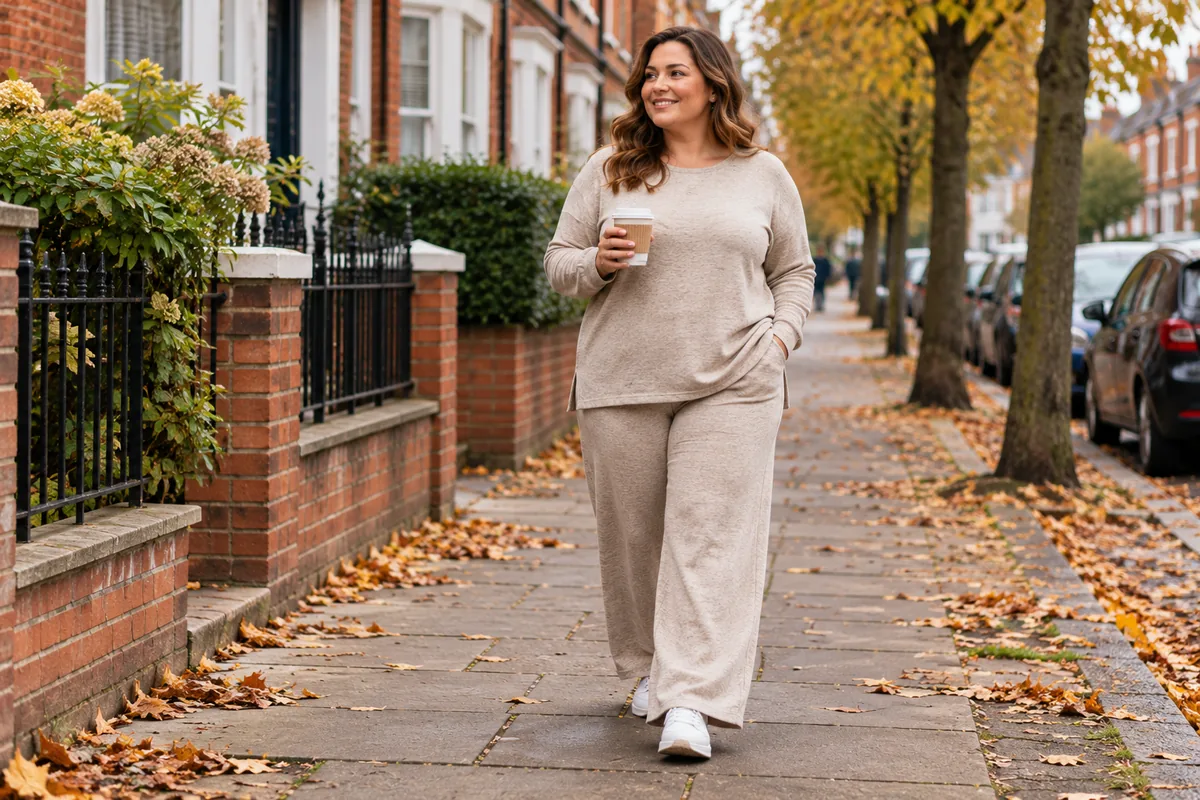
Avoid thin, clingy loungewear for outdoors, as it shows the outline of the FUPA and of your knickers. For more complete daytime looks, see our guide to outfits for a FUPA.
Chafing, Sweating and Night Sweats
Bedtime brings its own skin problems. The skin under a FUPA and between the thighs stays in contact for hours, and warmth under the duvet adds moisture.
Keeping the skin fold comfortable
- Wear breathable cotton or modal next to the skin rather than polyester.
- Make sure the skin under the FUPA is fully dry after a bath or shower before you dress.
- Choose shorts or trousers with a loose leg, so fabric does not rub the inner thighs.
- Change out of damp sleepwear rather than sleeping in it.
Our guides to sweating under the belly fold and lower belly chafing explain these issues in more depth. See a pharmacist or GP if a rash in the skin fold is sore, smells or does not settle after a few days.
Night sweats
Sweating at night is normal if your room or bedding makes you too hot. However, the NHS lists causes of night sweats that include menopause, anxiety, some medicines, low blood sugar and alcohol. It advises seeing a GP if night sweats regularly wake you or worry you, come with a very high temperature, cough or diarrhoea, or happen alongside weight loss with no clear reason.
If hot flushes are the cause, light cotton or modal layers are easier to adjust than one heavy set. Our guide to the FUPA and menopause explains how hormonal changes affect the lower belly too.
UK Sizing Tips for Pyjamas and Loungewear
Many UK shops size pyjamas by dress size, such as 12, 14 or 16. Others use S, M, L and XL, which often span two dress sizes. Either way, the waistband stretch varies a lot between brands, so measure yourself instead of guessing.
- Measure your waist in centimetres where you want the waistband to sit: at the navel for high rise, or below the FUPA for low rise.
- Measure your hips around the fullest part of your bottom.
- Compare both numbers with that brand’s size chart, not your usual jeans size.
- If you fall between sizes, choose the larger one for sleepwear. A slightly loose fit is more comfortable lying down.
- Check the inside leg too, as sizing up can make trousers too long. Some brands sell short and tall lengths.
- Read the care label. Cotton can shrink a little in a hot wash or tumble dryer.
Before you remove the tags, sit cross-legged on the bed and lie on your side for a minute. The waistband should not dig in, roll over or leave a deep mark. A good fit should feel almost unnoticeable.
What to Avoid
A few details make pyjamas uncomfortable over a FUPA, however nice they look:
- Thin elastic waistbands with no drawstring to loosen.
- Mid-rise bottoms that sit right on the lower belly crease.
- Firm, compressive waistbands designed for exercise or shaping.
- Thick seams, tags or bows sitting on the front of the waistband.
- Polyester fleece and polyester satin for sleeping in warm rooms.
- Onesies or bodysuits that are too short in the body and pull into the groin.
- Very short, tight shorts that ride up and rub the inner thighs.
It is also worth thinking about what you wear underneath. Many people sleep without knickers, which removes a second waistband entirely. If you prefer to wear them, a soft cotton high-waist brief that sits above the crease is usually the most comfortable pairing.
Frequently Asked Questions
What are the best pyjamas for a FUPA?
The best pyjamas for a FUPA have a wide, soft waistband, such as a fold-over jersey band or wide elastic with a drawstring. Breathable cotton or modal and a wide-leg or relaxed cut help too. A nightdress or nightshirt avoids waistband pressure altogether.
Why do my pyjama bottoms dig into my lower belly at night?
Lying down and curling up change the shape of the lower belly and create a crease. A narrow or mid-rise elastic waistband often lands right in that crease. Choose a wider band that sits either above the navel or low and loose under the FUPA.
Is a drawstring or elastic waistband better?
A combination of soft, wide elastic and a drawstring is usually best. The elastic holds the trousers up, while the drawstring lets you loosen the fit after an evening meal or before bed. Thin elastic on its own is the most likely to dig in.
Is bamboo fabric better for sleeping?
Bamboo viscose feels soft and many people find it comfortable. However, it is a processed fabric, and the US Federal Trade Commission says there is no evidence that rayon made from bamboo is naturally antibacterial. Choose it for the feel, not for health claims.
What should I wear to bed if I have a sore FUPA?
A loose cotton nightdress or nightshirt puts no pressure on the lower belly. Keep the skin fold clean and fully dry before dressing. See a pharmacist or GP if soreness, a rash or pain does not settle after a few days.
Should I size up in pyjamas?
If you are between sizes, the larger size is usually more comfortable for sleep. Measure your waist where the band will sit and your hips, then check the brand’s size chart. Watch the leg length, as sizing up can make trousers too long.
The Bottom Line
Comfortable pyjamas for a FUPA start with the waistband. Choose a wide fold-over band, soft elastic with a drawstring, a gentle high-rise yoga band, or skip the waistband with a nightdress or nightshirt. Breathable cotton, modal and brushed cotton keep the skin fold comfortable, while wide-leg and relaxed cuts give room to curl up. Measure yourself, size up if in doubt and always test the fit lying down. For more on rest and the lower belly, read our guide to the FUPA and sleep.