Hip Thrusts and Glute Training for a FUPA: Why Your Glutes Matter
Page Contents
- Key Takeaways
- Why Your Glutes Matter for a FUPA
- Meet the three glute muscles
- The link to the front of the pelvis
- What glute training cannot do
- What Is a Hip Thrust?
- The basic movement
- Why it suits the glutes so well
- Why beginners often like it
- How to Do a Hip Thrust Step by Step
- Set up
- Lift
- Lower
- Common mistakes to avoid
- Hip Thrust Variations for Every Level
- Glute bridge on the floor
- Bodyweight hip thrust
- Single leg hip thrust
- Banded hip thrust
- Barbell or dumbbell hip thrust
- Other Glute Exercises That Help
- Romanian deadlift
- Squats and split squats
- Side lying leg raises and clamshells
- Step ups
- How Glute Training Fits Into FUPA Fat Loss
- Muscle helps, but diet leads
- Keep muscle while you lose fat
- Move more across the week
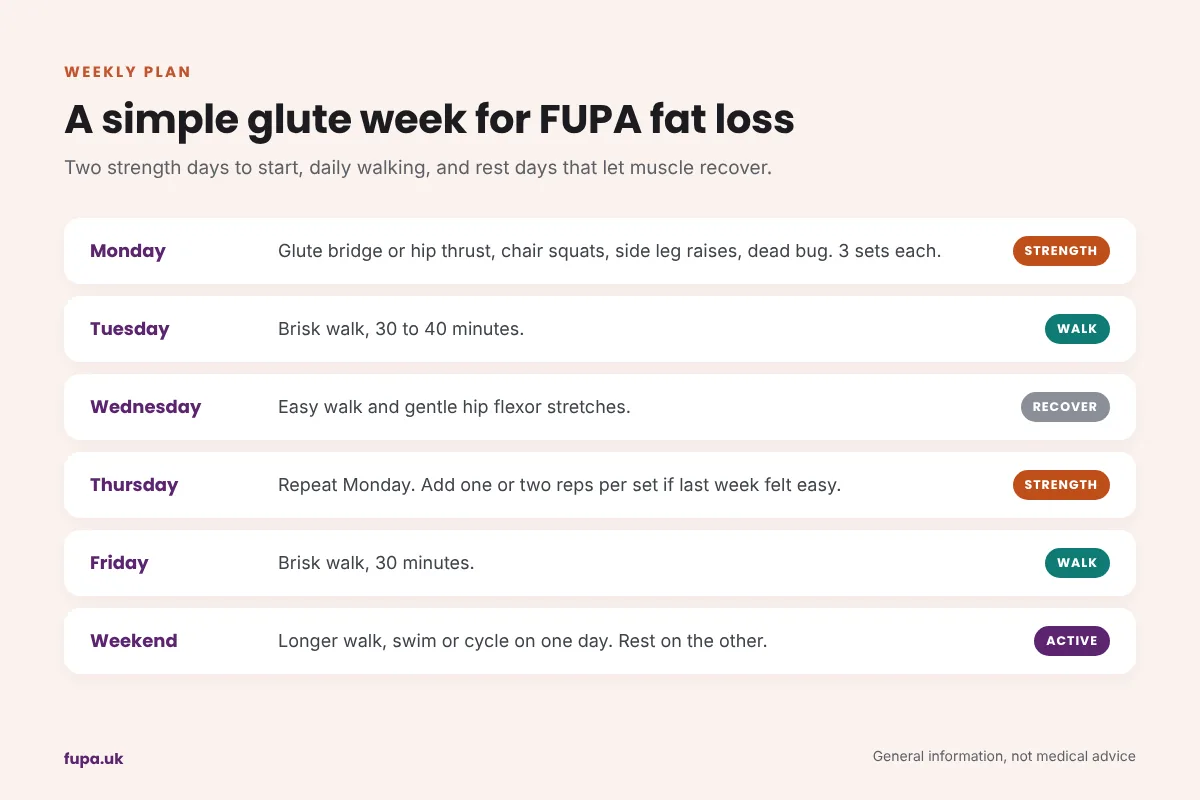
- A Simple Weekly Glute Plan
- Beginner plan: two days a week
- Next step: three days a week
- How to progress
- What Changes to Expect and When
- The first month
- Two to three months
- Why the scale can stall
- When fat loss is not the whole story
- Safety Tips and When to Get Advice
- Back and hip comfort
- After pregnancy
- Joint or health conditions
- Frequently Asked Questions
- Do hip thrusts get rid of a FUPA?
- Can stronger glutes make a FUPA look smaller?
- How many hip thrusts should I do a day?
- Are glute bridges as good as hip thrusts?
- Can I do hip thrusts after a C-section?
- Why do I feel hip thrusts in my lower back?
- The Bottom Line
- Train the back to support the front
Most FUPA advice talks about the front of the body: crunches, belly fat and waistbands. Yet the muscles behind you may matter just as much. Hip thrusts and glute training for a FUPA will not melt fat from the mons pubis, the soft pad just above the pubic bone. What they can do is build strength, support your pelvis, burn energy and change the overall shape of your lower half, so the front looks more in balance.
This guide explains what your glutes do, how a hip thrust works, how to do one safely at home or in the gym, and how to fit it into a plan that actually shrinks a FUPA over time. It sits within our main guide on how to get rid of a FUPA.
This guide is general information, not medical advice. If you have back, hip or pelvic pain, are pregnant, or have recently given birth, speak to your GP or a physiotherapist before you start a new exercise plan.
Key Takeaways
- Glute work cannot spot reduce a FUPA. Fat loss happens across the whole body, and the lower belly often changes last.
- Strong glutes help hold the pelvis in a more neutral position. For some people this makes the lower belly stick out less when standing.
- The hip thrust loads the gluteus maximus hard with little strain on the lower back, which makes it a good fit for many beginners.
- Two or three lower body sessions a week, alongside daily walking and a modest calorie deficit, is a realistic plan.
- Progress shows first in strength and shape. Track a tape measure and photos, not only the scales.
Why Your Glutes Matter for a FUPA
Meet the three glute muscles
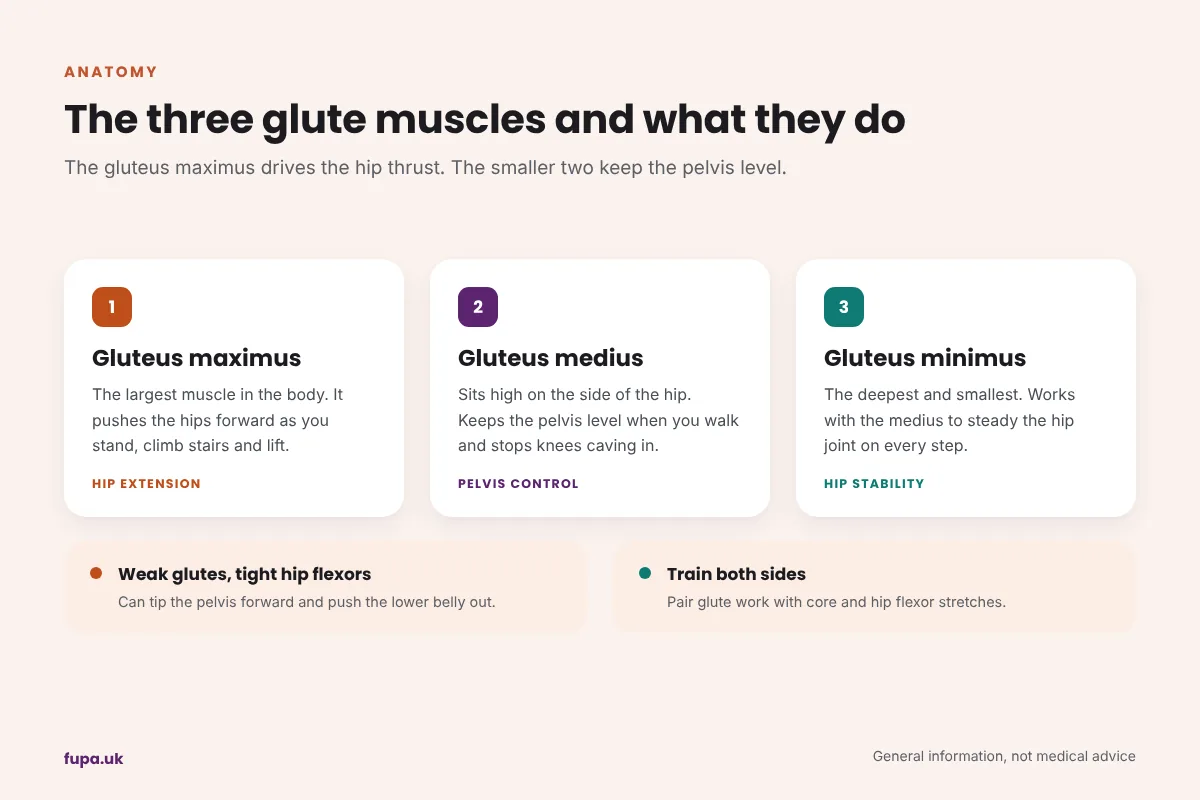
Your buttocks hold three muscles. The gluteus maximus is the largest muscle in the body. It drives hip extension, the movement of pushing your hips forward as you stand up, climb stairs or sprint. The gluteus medius and gluteus minimus sit higher on the side of the hip. They keep the pelvis level when you walk and stop the knee from caving in.
The link to the front of the pelvis
The glutes and the deep abdominal muscles work as a team around the pelvis. When the glutes are weak and the hip flexors at the front are tight, the pelvis can tip forward. This is called an anterior pelvic tilt. It pushes the lower belly forward and can make a FUPA look larger than it is. Our guide to posture and a FUPA explains this in more detail.
What glute training cannot do
No exercise burns fat from the muscle beneath it. Research on spot reduction has found again and again that training one area does not remove more fat from that area. The fat on the mons pubis is subcutaneous fat. It shrinks when your body is in an energy deficit and draws on stores everywhere. So think of glute work as a shape and strength tool, and your diet as the main fat loss tool.
What Is a Hip Thrust?
The basic movement
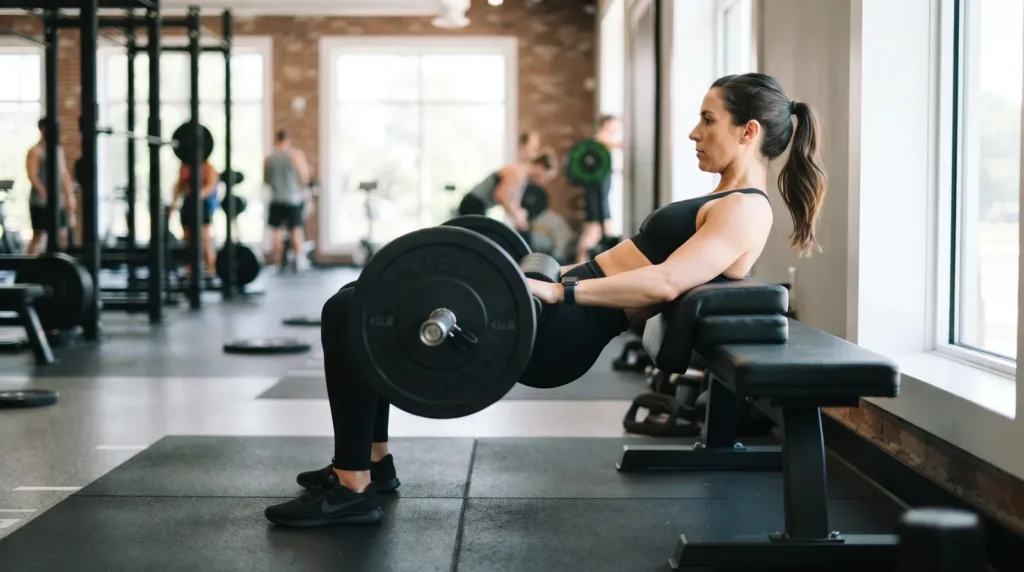
A hip thrust is a bridge with your upper back resting on a bench or sofa. Your feet stay flat on the floor and your knees bend to roughly a right angle at the top. You drive through your heels and lift your hips until your body forms a straight line from shoulders to knees. Then you lower with control.
Why it suits the glutes so well
The hip thrust puts the most tension on the glutes at the top of the lift, when the hips are fully extended. Squats and lunges, by contrast, load the glutes most when you are deep in the bottom position. Small studies using muscle activity sensors have found high glute activity during hip thrusts. A 2023 trial that compared hip thrusts with back squats over nine weeks found that both built glute size by similar amounts. So the hip thrust is a strong option, not a magic one.
Why beginners often like it
The movement is short and stable. Your back is supported, there is little balance needed, and you can start with no weight at all. Many people who find squats uncomfortable on their knees can hip thrust without trouble.
How to Do a Hip Thrust Step by Step
Set up
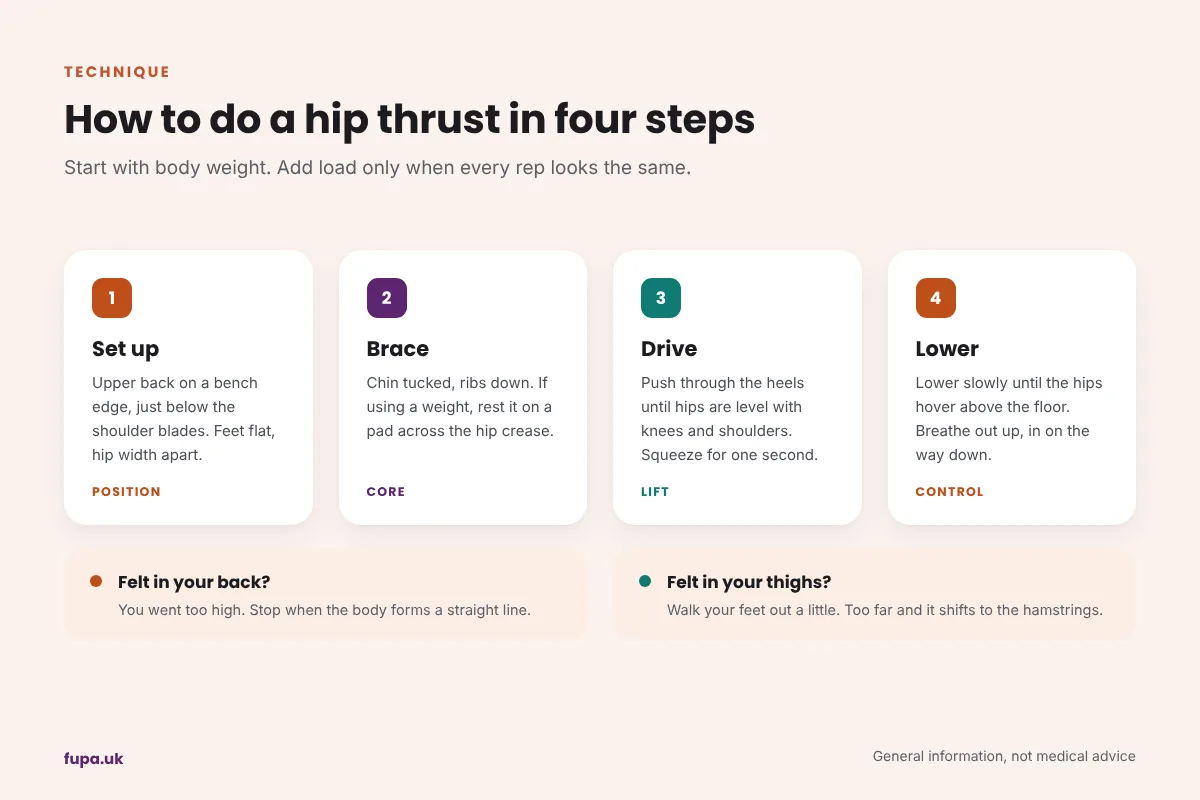
Sit on the floor with your back against the long edge of a bench, a sturdy sofa or a low bed. The edge should sit just below your shoulder blades. Place your feet flat, about hip width apart, with your toes turned out slightly. If you use a weight, rest it across your hip crease on a pad or a folded towel.
Lift
Tuck your chin a little and keep your ribs down. Push through your heels and lift your hips. At the top, your shins should be close to vertical and your hips level with your knees and shoulders. Squeeze your buttocks for one second.
Lower
Lower your hips slowly until they hover just above the floor. Keep the movement smooth. Then lift again. Breathe out as you lift and in as you lower.
Common mistakes to avoid
- Arching the lower back at the top. If you feel it in your back, you have gone too high. Stop when your hips are level and keep your ribs down.
- Feet too close. You will feel it mostly in the front of the thighs. Walk your feet out a little.
- Feet too far. You will feel it in the hamstrings. Bring your feet slightly closer.
- Rushing. A slow lower and a pause at the top make light loads work harder.
Hip Thrust Variations for Every Level
Glute bridge on the floor
Lie on your back with knees bent and feet flat. Lift your hips until your body forms a line from shoulders to knees. This is the easiest starting point and needs no equipment. It is also a common early exercise in postnatal recovery plans, once your GP or physiotherapist is happy.
Bodyweight hip thrust
Move your upper back onto a bench or sofa. The longer range makes the movement harder than a floor bridge. Aim for three sets of 12 to 20 slow reps before you add weight.
Single leg hip thrust
Lift one foot off the floor and drive through the other. This doubles the load on one side with no extra kit. It also trains the gluteus medius, because the pelvis has to stay level.
Banded hip thrust
Loop a resistance band just above your knees. Push your knees gently out against the band as you lift. This adds work for the side glutes and keeps your knees in line.
Barbell or dumbbell hip thrust
In a gym, a barbell with a thick pad across the hips is the classic version. At home, a dumbbell, a kettlebell or a backpack filled with books works too. Add weight in small steps, and only when you can complete all your reps with good form.

Other Glute Exercises That Help
Romanian deadlift
Hold a weight in front of your thighs. Push your hips back with a soft bend in the knees until you feel a stretch in your hamstrings, then stand tall. This trains the glutes in a stretched position, which is a good partner to the hip thrust.
Squats and split squats
Squats work the glutes, thighs and core together. Split squats and reverse lunges add a balance challenge. Our guide on whether squats shrink a FUPA covers what they can and cannot do.
Side lying leg raises and clamshells
These target the gluteus medius. They are useful warm up moves and help if your knees roll inwards when you squat or climb stairs.
Step ups
Stepping onto a sturdy step or low bench trains one leg at a time and raises your heart rate. Drive through the whole foot on the step and stand up tall at the top.
How Glute Training Fits Into FUPA Fat Loss
Muscle helps, but diet leads
Building muscle raises the energy your body uses a little, and strength training burns calories during each session. These effects are modest. The main driver of fat loss is still a steady calorie deficit. Our calorie deficit guide shows how to set a sensible target without crash dieting.
Keep muscle while you lose fat
When you eat less, your body can lose muscle as well as fat. Strength training two or more days a week sends a signal to keep that muscle. Eating enough protein supports this too. The result is that more of the weight you lose comes from fat.
Move more across the week
The NHS physical activity guidelines advise adults to do strengthening activities that work all the major muscle groups on at least two days a week. They also suggest 150 minutes of moderate activity, such as brisk walking, spread across the week. Glute work covers part of the first target. Walking covers much of the second.
A Simple Weekly Glute Plan
Beginner plan: two days a week
Choose two days with at least one rest day between them, such as Monday and Thursday. Do each exercise for three sets, resting about 60 to 90 seconds between sets.
- Glute bridge or bodyweight hip thrust: 12 to 15 reps
- Bodyweight squat to a chair: 10 to 12 reps
- Side lying leg raise: 12 to 15 reps each side
- Dead bug or a plank on your knees: 20 to 30 seconds
Next step: three days a week
After four to six weeks, add a third session or move to harder versions. Use weighted hip thrusts, Romanian deadlifts with dumbbells, reverse lunges and banded side steps. Keep two days of rest between hard sessions for the same muscles if you feel sore.
How to progress
Add one or two reps each week. When you reach the top of the rep range for all sets, add a little weight and drop back to the lower end. Keep a short note of what you lifted. Small, steady increases beat big jumps.
What Changes to Expect and When
The first month
Early gains are mostly about your nervous system learning the movement. You will likely feel stronger within a few weeks. Your posture may also feel easier to hold.
Two to three months
With regular training and enough protein, the glutes start to look fuller and firmer. If you are also in a calorie deficit, your waist and hips will usually shrink. The lower belly tends to follow later.
Why the scale can stall
New muscle and the water stored with it can hide fat loss on the scales. This is why a tape measure and photos work better. Our guide on how to measure a FUPA shows where to place the tape and how often to check.
When fat loss is not the whole story
After pregnancy or large weight loss, part of the fullness may be loose skin. Exercise will not tighten stretched skin, although stronger muscles underneath can improve the outline a little. If your lower belly also bulges along the midline, ask your GP to check for a gap between the abdominal muscles.
Safety Tips and When to Get Advice
Back and hip comfort
A hip thrust should be felt in the buttocks, not the lower back or the front of the hip. If it pinches, reduce the range, check your foot position and slow down. Stop if you feel sharp pain.
After pregnancy
Gentle bridges are often part of early postnatal plans. Heavier hip thrusts usually come later, once your pelvic floor and deep core are working well. If you leak urine, feel heaviness in the pelvis or notice doming along your tummy, speak to your GP. You can ask for a referral to a women’s health physiotherapist.
Joint or health conditions
If you have arthritis, a past hip or back injury, or a heart or blood pressure condition, check with your GP before you start lifting heavier weights. A physiotherapist can adapt the exercises for you.
Frequently Asked Questions
Do hip thrusts get rid of a FUPA?
Not on their own. Hip thrusts build the glutes and burn some energy, but they cannot remove fat from the lower belly directly. A FUPA shrinks when you lose body fat overall through a calorie deficit, regular activity and time. Hip thrusts are a useful part of that plan.
Can stronger glutes make a FUPA look smaller?
They can change how it looks. Strong glutes help hold the pelvis in a more neutral position, which may reduce a forward tilt that pushes the lower belly out. Fuller glutes also balance the profile from the side. The fat pad itself only shrinks with overall fat loss.
How many hip thrusts should I do a day?
You do not need to do them every day. Two or three sessions a week of three sets of 10 to 20 reps is enough for most people. The muscles grow during rest, so leave a day or two between hard sessions.
Are glute bridges as good as hip thrusts?
Glute bridges are a great starting point and need no equipment. Hip thrusts use a longer range of movement and are easier to load with weight, so they become more useful as you get stronger. Many plans start with bridges and move to hip thrusts after a few weeks.
Can I do hip thrusts after a C-section?
Gentle bridges are often included in postnatal recovery once you are cleared for exercise, usually after your six to eight week check. Heavier hip thrusts should wait until your scar has healed and your core and pelvic floor feel strong. Ask your GP or a physiotherapist before you add weight.
Why do I feel hip thrusts in my lower back?
This usually means you are arching your back at the top. Stop the lift when your hips are level with your knees and shoulders, keep your chin tucked and your ribs down, and squeeze your glutes. Moving your feet slightly can also shift the work back to the buttocks.
The Bottom Line
Train the back to support the front
Hip thrusts and glute training will not target a FUPA, but they earn their place in any plan to change it. They build strength, help support a more neutral pelvis and improve the shape of your lower half. Pair two or three glute sessions a week with daily walking, enough protein and a steady calorie deficit. Then judge progress by the tape measure over months, not days. For a full view of how training and diet fit together, see our guide to the best exercises for a FUPA.