
Pregnancy changes the way clothes sit on the lower belly almost week by week. If you already had a FUPA before you were pregnant, you may notice that ordinary maternity advice does not quite fit your shape. Choosing maternity clothes for a FUPA comes down to a few clear details: where the waistband sits, how the fabric stretches over the bump and the fold below it, and how soft everything feels against warm skin.
This guide covers how a bump and a FUPA interact by trimester, over-bump and under-bump waistbands, belly bands, jeans, leggings and dresses, support belts, fabrics, UK sizing and the move back into everyday clothes after the birth. It is part of our wider advice on dressing comfortably with a FUPA.
How a FUPA and a Bump Change Shape Together
A FUPA is the soft pad of fat over the pubic bone, on the mons pubis just below the lower belly. A pregnancy bump grows from above it, as the womb rises out of the pelvis. The two sit stacked on top of each other, so what you wear has to work for both at once.
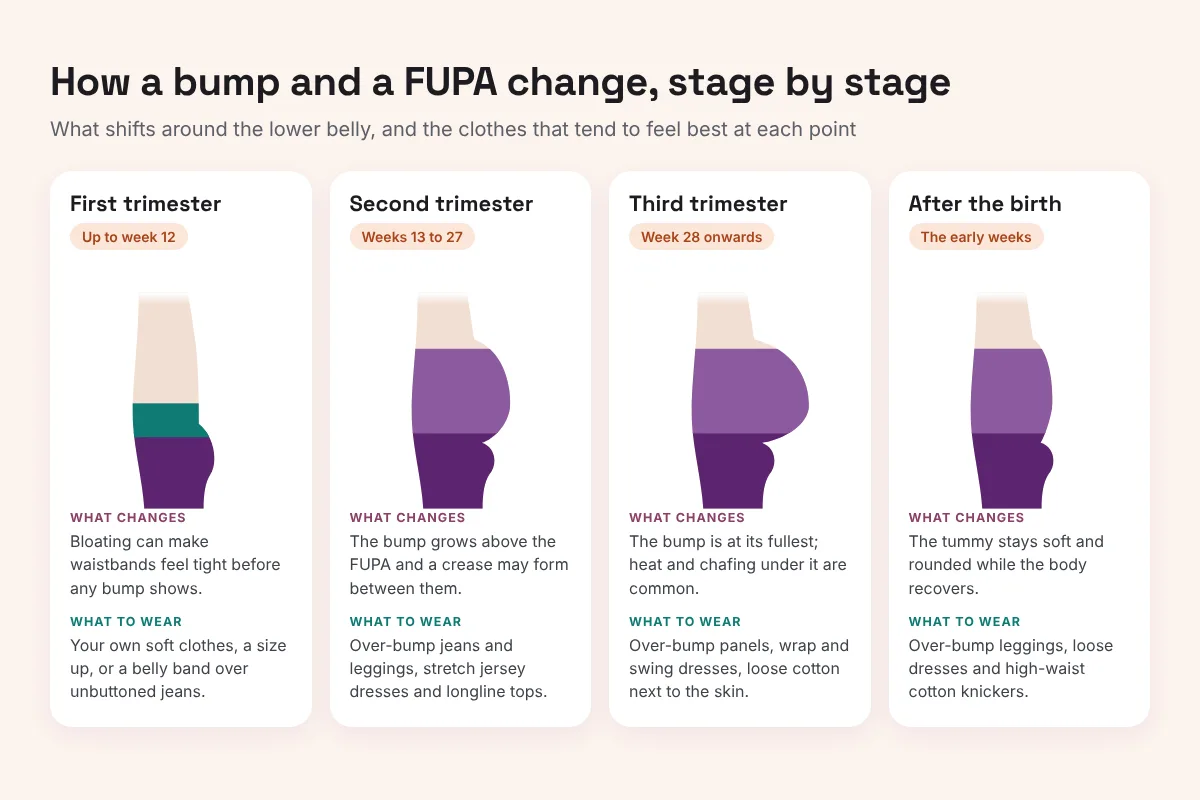
First trimester (up to week 12)
In the early weeks there is usually little or no visible bump. Even so, many people find that waistbands start to feel tight sooner than expected. Bloating plays a part, and a FUPA can make a fitted waistband dig in earlier. Your own softest clothes, a size up in leggings or a belly band over unbuttoned jeans will often carry you through this stage.
Second trimester (weeks 13 to 27)
The bump becomes more noticeable during these weeks. As it grows, it often rounds out above the FUPA, and a soft crease can form between them. Some people call this a “B belly”, because the side view looks a little like a capital B. It is a common shape, and it can be more noticeable when the lower belly was fuller before pregnancy. However, it does change which waistbands feel good, because a band that lands in the crease tends to dig.
Third trimester (week 28 onwards)
In the last weeks the bump is at its fullest and heaviest. The FUPA can feel tucked beneath it, and the skin fold between them stays warm and damp for longer. Heat, rubbing and pressure from waistbands are the main complaints at this stage. Over-bump panels, loose dresses and breathable fabric usually feel best.
Over-Bump vs Under-Bump: Maternity Clothes for a FUPA
Maternity trousers, jeans and leggings come with three main waistband designs. For most people with a FUPA, the waistband type matters more than the cut of the leg or the brand.
Over-bump panels
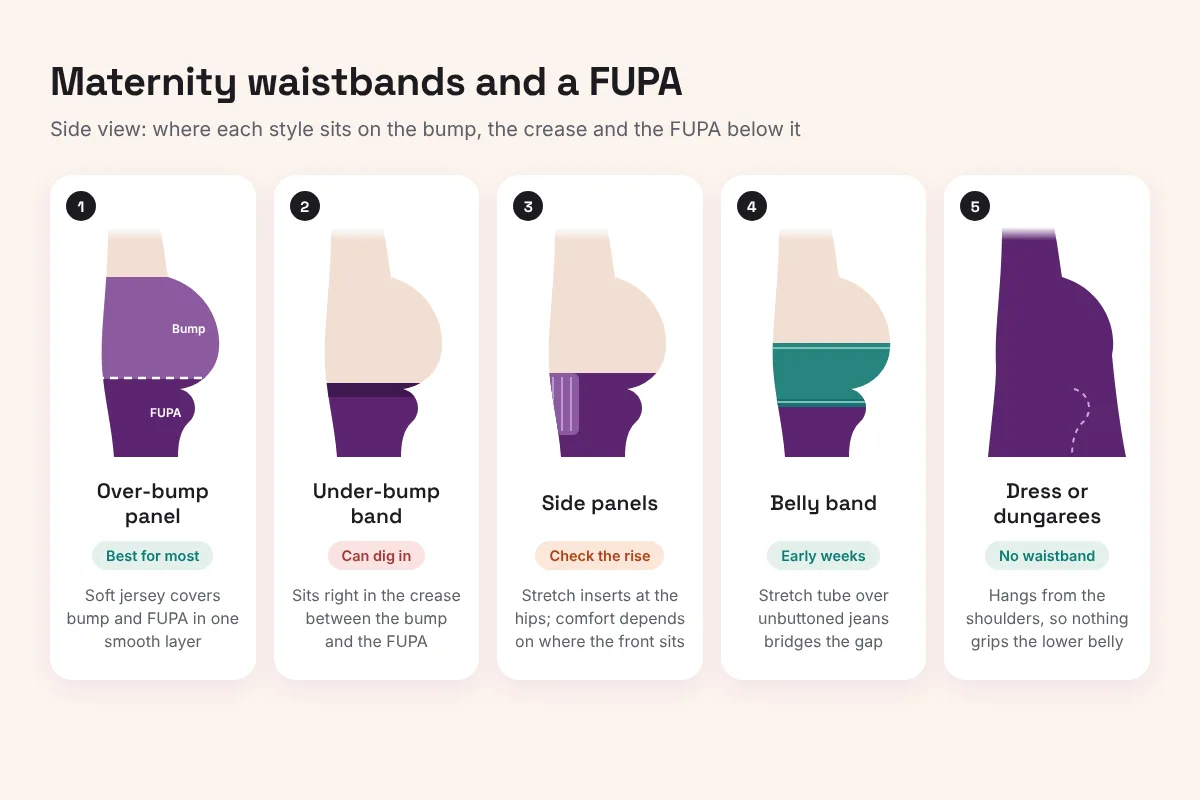
An over-bump waistband is a deep panel of soft stretch jersey that pulls up over the whole bump. It covers the FUPA, the crease and the bump in one continuous layer, so there is no edge pressing into the fold. Many maternity shopping guides describe over-bump styles as the most supportive and the least likely to slip down. For a FUPA, they are the most reliable choice through the second and third trimesters.
Choose a panel that feels soft and gently stretchy rather than firm. You want it to hold the trousers up, not to squeeze the bump.
Under-bump bands
An under-bump waistband is a soft elasticated band that sits low, beneath the bump. Many people like them in the second trimester and in warm weather, as they cover less skin. With a FUPA, though, the band often lands right in the crease between the bump and the lower belly. It can dig in, roll over or slide down as you move. If you love the look, choose a wide, soft band and try it sitting down before you buy.
Side panels and adjustable waists
Some maternity jeans use stretch panels at the hips with a lower front, while others add adjustable button elastic inside the waistband. These suit early pregnancy and people who dislike fabric over the bump. Check where the front of the waistband sits, because a mid-height front can press on the FUPA in the same way as an under-bump band.
| Waistband type | Where it sits | Comfort with a FUPA | Best for |
|---|---|---|---|
| Over-bump panel | Pulls up over the whole bump | Very comfortable; no edge in the crease | Second and third trimesters |
| Under-bump band | Low, beneath the bump | Can dig into the crease or roll | Warm weather, smaller bumps |
| Side panels | Stretch inserts at the hips | Depends on the height of the front | Early pregnancy |
| Belly band | A tube over unbuttoned trousers | Comfortable for a few weeks | The first trimester |
| No waistband | Dresses and dungarees | No pressure on the lower belly | Any stage, hot days, late pregnancy |
Bump Bands and Belly Bands
The terms “bump band” and “belly band” are used loosely, and they can mean two quite different things. It helps to know which one you are buying.
- Fashion belly bands are wide tubes of stretch jersey. You wear them over unbuttoned jeans or trousers to hold them up and cover the gap. They also smooth the line between a top and the waistband.
- Support belts are firmer garments with straps or fastenings. They are designed to lift or steady the bump or the pelvis, and they are covered further down this guide.
A fashion belly band can be a handy bridge in the first trimester, when your usual jeans no longer fasten comfortably. For a FUPA, wear it high enough to cover the open fly and the crease in one layer. A band that stops halfway down the FUPA can create a ridge.
Maternity Jeans, Leggings and Dresses
Once you know which waistband suits you, the same rules about rise and pressure apply to every garment.
Maternity jeans
Jeans are often the first thing that stops fitting, because denim has far less give than jersey. Over-bump maternity jeans with a deep jersey panel are the most comfortable choice for a FUPA. Look for soft stretch denim and a straight, wide or relaxed leg, which avoids tight pressure at the thighs. Our guide to the best jeans for a FUPA explains rise and denim stretch in more detail.
Maternity jeans should feel supportive but never tight around the bump. If you feel pressure across the lower belly, try a different waistband or size.
Maternity leggings
Leggings are comfortable at home, for walking and for the school run. Over-bump maternity leggings with a soft, seamless panel are ideal, as nothing cuts across the FUPA. Choose an opaque, mid-weight fabric that does not turn sheer when you bend. For more on rise and fabric weight, see our guide to leggings for a FUPA.
Maternity dresses
Dresses remove the waistband problem altogether. They hang from the shoulders, so nothing presses on the bump, the crease or the FUPA. The most useful styles are:
- Wrap dresses in stretch jersey, which adjust as the bump grows and often work for breastfeeding later.
- Swing and smock dresses, which fall loosely from the chest and leave plenty of room.
- Jersey midi dresses with ruching at the sides, which skim the bump without clinging to the lower belly.
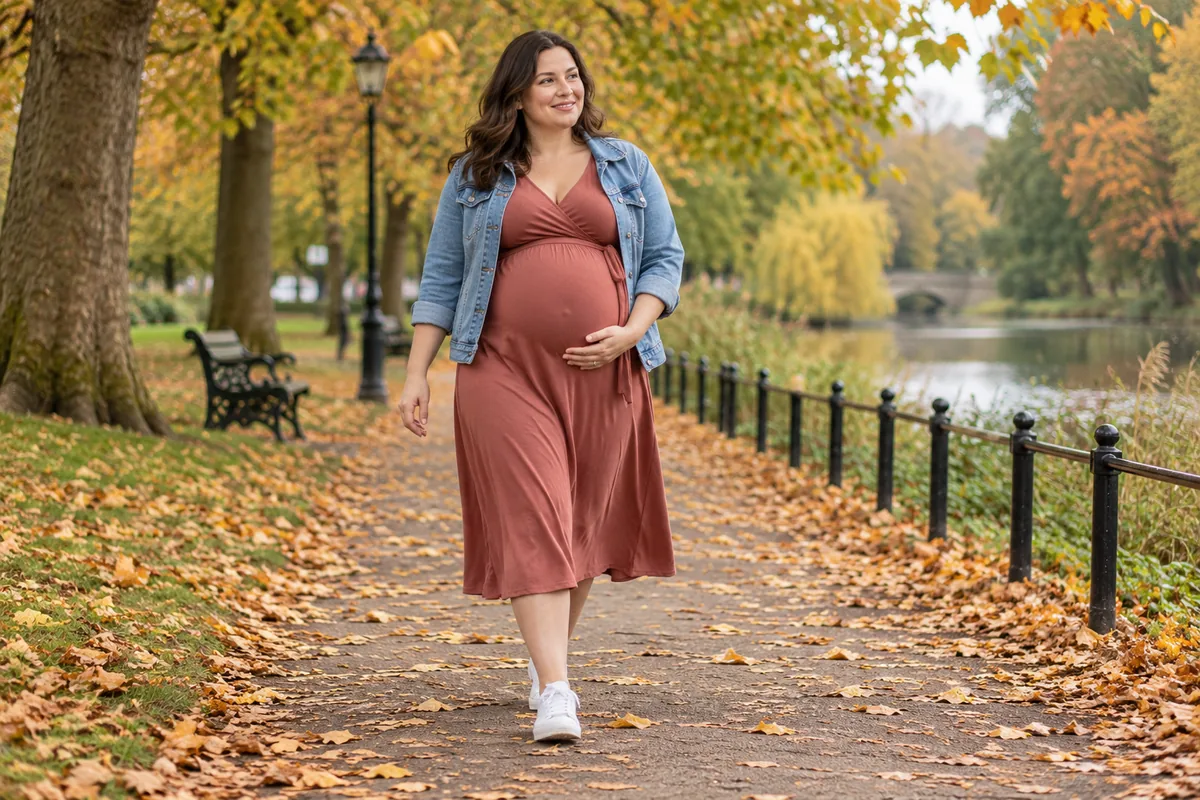
Our guide to dresses for a FUPA covers the same shapes outside of pregnancy, which helps when you choose pieces to keep afterwards.
Tops, dungarees and layers
Longline maternity tops with side ruching cover the waistband and the crease, so there is no hard line across the lower belly. Maternity dungarees and jumpsuits have no waistband at all, which suits late pregnancy. Long cardigans and open shirts add a layer that falls past the hips without clinging.
Maternity Support Belts and Pelvic Girdle Pain
Maternity support belts are often sold to ease back pain, bump weight or pelvic pain. They are not the same as a fashion belly band, and they are not shapewear.
Pelvic girdle pain (PGP), sometimes called symphysis pubis dysfunction (SPD), is a common cause of pain over the pubic bone, across the lower back or into the thighs during pregnancy. The NHS guide to pelvic pain in pregnancy says it is not harmful to your baby, but it can be painful and limit movement. It advises contacting your midwife or GP if the pain makes it hard to move around, turn over in bed or use stairs. You may be referred to a physiotherapist who specialises in pregnancy-related pelvic problems. The NHS notes that your physiotherapist may recommend a pelvic support belt or crutches, so a belt is best chosen with professional advice.
Physiotherapy guidance from the Pelvic, Obstetric and Gynaecological Physiotherapy group (POGP) adds some practical points about belts:
- The evidence for support belts is mixed, and a belt should not be used as the only treatment.
- A belt is usually worn for short periods, mainly when you are up and moving around.
- If a belt increases your pain, stop wearing it.
- If it irritates your skin, it can be worn over a layer of clothing.
With a FUPA, the position of a pelvic belt matters. A belt that sits across the soft lower belly can press into the crease and chafe. Ask your physiotherapist to show you where it should sit on your body. Avoid firm shapewear or tummy control garments during pregnancy unless a midwife or physiotherapist has recommended a specific garment.
Fabrics That Feel Good Over a Bump and a FUPA
Pregnancy can make you feel warmer, and the skin under the bump and around the FUPA stays in contact for long periods. As a result, fabric choice matters as much as fit.
- Cotton jersey is soft, breathable and stretches as you grow. It is the best everyday choice next to the skin.
- Modal and viscose jersey drape well and skim the bump without clinging to the lower belly.
- Stretch denim with a little elastane gives enough movement for jeans, but it should always be paired with a jersey panel.
- Linen and cotton blends are cool and loose for summer dresses and trousers.
- Polyester and nylon are fine in leggings and outer layers, but they hold heat and moisture against a skin fold.
Look for flat seams and soft labels, especially on the front of the waistband. A thick seam that sits on the FUPA can rub all day.
UK Sizing for Maternity Clothes
Most UK maternity ranges are sized by dress size, such as 10, 12, 14 or 16. Many brands advise buying the same size as your usual pre-pregnancy clothes, because the stretch panels allow room for the bump. Every bump and every brand is different, though, so a few checks help.
- Start with your pre-pregnancy dress size, then check that brand’s own size chart.
- Measure your hips around the fullest part, as maternity trousers are cut to fit the hips and thighs.
- Check the leg length. Many ranges come in petite, regular and tall lengths.
- Try trousers sitting down. The panel should stay in place, and nothing should press across the FUPA or the crease.
- Keep receipts and tags on until you have worn something around the house for an hour.
Clothes that slip down are often the wrong waistband style rather than the wrong size.
Comfort, Chafing and Itching
Later in pregnancy, the bump can rest on the FUPA, and the skin in between can become warm, damp and sore. The inner thighs may also rub more than usual.
- Wear breathable cotton next to the skin, including soft high-waist cotton knickers.
- Dry the skin under the bump and around the FUPA well after a bath or shower.
- Choose dresses with cycling shorts or loose leggings underneath to stop thigh rubbing.
- Change out of damp clothes after walking or on hot days.
Our guide to sweating under the belly fold covers skin fold care in more depth. See a pharmacist, midwife or GP if a rash in a skin fold is sore, smells or does not settle.
Itching is common in pregnancy as the skin stretches, and loose clothing made from natural fibres such as cotton can help. However, the NHS advice on itching in pregnancy warns about a liver condition called intrahepatic cholestasis of pregnancy (ICP). Contact your maternity unit urgently if the itching is intense, worse at night or affects the palms of your hands or the soles of your feet.
Moving Into Postpartum Clothes
After the birth, the tummy usually stays soft and rounded for a while. The womb takes time to shrink back, and the skin and muscles recover gradually. Maternity clothes often remain the most comfortable option for the first weeks and sometimes longer.

- Over-bump leggings and jeans stay useful, as the soft panel covers the lower belly without pressure.
- Wrap and button-front dresses make breastfeeding easier and avoid a waistband altogether.
- High-waist cotton knickers sit above the lower belly instead of across it.
- A fashion belly band can hold up pre-pregnancy trousers that do not fasten yet.
After a caesarean, the NHS advises wearing loose, comfortable clothes and cotton underwear while you recover. The scar usually sits low, near the FUPA, so a waistband that rests on it can be uncomfortable. High-waist knickers and over-bump trousers keep pressure off the wound. Our guide to the FUPA after a C-section explains how the lower belly can change after surgery.
Many people notice that the FUPA looks different after pregnancy. Our guide to the FUPA after pregnancy explains what tends to settle over time and what may not. Ask your midwife, health visitor or GP before using a postnatal support garment, particularly after a caesarean.
What to Avoid
A few details make maternity clothes uncomfortable over a FUPA, however good they look on the hanger:
- Under-bump bands that sit in the crease between the bump and the FUPA.
- Thin, tight elastic waistbands with no soft panel.
- Firm shapewear or tummy control garments, unless a professional has advised one.
- Support belts worn all day, or worn even though they make pain worse.
- Thick seams, bows or labels on the front of the waistband.
- Rigid denim with no stretch and no jersey panel.
- Synthetic fabrics next to the skin on hot days.
- Very short or tight dresses that ride up and rub the inner thighs.
Frequently Asked Questions
What are the best maternity clothes for a FUPA?
Over-bump jeans and leggings with a soft jersey panel suit most people with a FUPA, because they cover the bump, the crease and the lower belly in one layer. Stretch jersey wrap dresses and dungarees are also comfortable, as they have no waistband at all.
Are over-bump or under-bump maternity jeans better with a FUPA?
Over-bump jeans are usually more comfortable with a FUPA. Under-bump bands often sit in the crease between the bump and the lower belly, where they can dig in, roll or slide down. If you prefer under-bump styles, choose a wide, soft band.
What is a B belly?
A B belly is an informal name for a bump with a soft crease across it, so the side view looks a little like a capital B. It can be more noticeable when the lower belly was fuller before pregnancy. It is a common shape rather than a medical condition, but ask your midwife if you have any questions about your bump.
Can I wear a maternity support belt with a FUPA?
You can, but it is best to get advice first. The NHS says a physiotherapist may recommend a pelvic support belt for pelvic girdle pain. Ask them where the belt should sit, wear it for short periods when moving around and stop if it makes the pain worse.
What size maternity clothes should I buy?
Many UK brands advise buying your usual pre-pregnancy dress size, as the stretch panels allow room for the bump. Check each brand’s size chart, measure your hips and look for petite or tall leg lengths if you need them.
Is it safe to wear shapewear while pregnant?
Firm shapewear and tummy control garments are not designed for pregnancy and can press on the bump. Choose soft maternity panels instead, and only use a support garment if a midwife or physiotherapist has recommended a specific one.
What should I wear after a C-section with a FUPA?
The NHS advises loose, comfortable clothes and cotton underwear after a caesarean. High-waist cotton knickers and over-bump leggings keep pressure off the scar, which usually sits low near the FUPA. Loose dresses are also comfortable in the first weeks.
The Bottom Line
The most comfortable maternity clothes for a FUPA avoid the crease between the bump and the lower belly. Over-bump panels, wrap dresses, dungarees and soft jersey layers do this best, while under-bump bands and firm shapewear tend to dig in. Choose breathable cotton next to the skin, start with your usual dress size and always try trousers sitting down. For pelvic pain, talk to your midwife or GP before buying a support belt. After the birth, keep your over-bump favourites for as long as they feel good, and read our guide to a FUPA versus diastasis recti if your tummy still bulges in the middle months later.