
What Is a FUPA? Meaning, Definition and Where It Sits
Page Contents
- What does FUPA stand for?
- Where the FUPA actually sits
- Is FUPA a medical term?
- What a FUPA is not
- What causes fat to sit there
- Can you get rid of it?
- Common questions
- What does FUPA stand for?
- Is a FUPA the same as belly fat?
- Is having a FUPA normal?
- Do men get a FUPA?
- Can you lose a FUPA without surgery?
- Sources
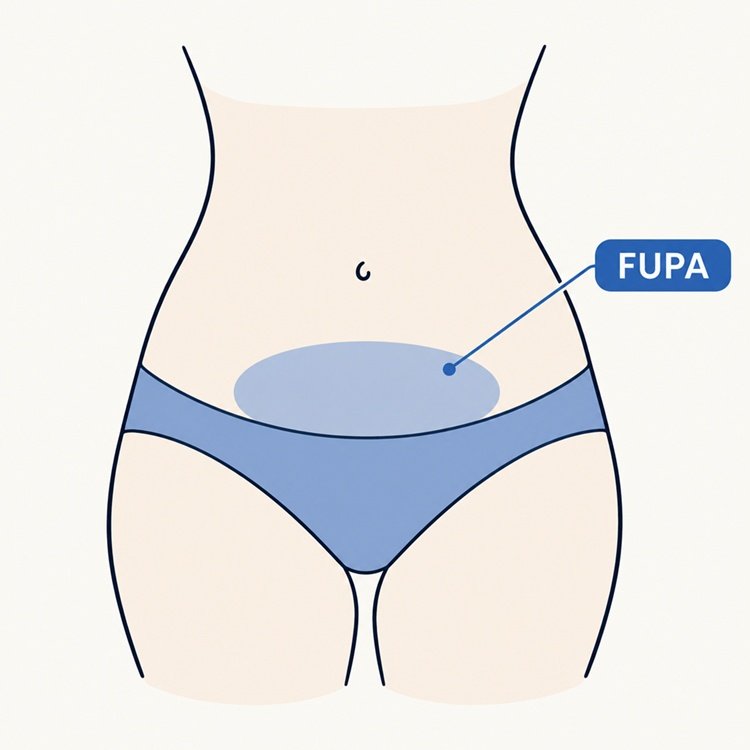
A FUPA is fat that sits on the mons pubis, the soft mound at the very bottom of the abdomen, directly above the pubic bone and below the belly button. It is not a medical diagnosis and it is not a sign that anything is wrong. It is a description of where fat is sitting on a particular body.
The word itself is an acronym, and an unflattering one, which is part of why it spread so quickly online and why so many people arrive here unsure whether it applies to them at all. This guide sets out what the term means, where the area actually is anatomically, what it is commonly confused with, and what can and cannot change it. For the wider picture, see everything about the FUPA.
What does FUPA stand for?
FUPA stands for fat upper pubic area. It began as internet slang rather than clinical language, and it is used casually, sometimes cruelly, to describe a visible fullness above the pubic bone. Our guide to the term’s meaning and slang history covers where it came from in more depth.
You will also see the same area described as a pubic mound, a lower pouch, or, in older slang, a gunt. None of these are medical terms either. When clinicians describe the same region they refer to the mons pubis, and when they describe a fold of skin and fat that hangs over it they use the word panniculus (or pannus).
Where the FUPA actually sits
The mons pubis is, anatomically, “a pad of fatty tissue lying in front of the pubic symphysis”: the joint where the two halves of the pubic bone meet at the front of the pelvis. It is a normal, expected structure. Everybody has one, and one of its functions in women is to provide cushioning over that bony junction. For the precise boundaries and how to find it on yourself, see where the FUPA is located.
Two things follow from that, and they matter more than most FUPA content admits:
- The area is supposed to have fat in it. A completely flat mons pubis is not the anatomical baseline. The question is only ever about degree and about what has changed for you personally. See our guide to FUPA sizes and shapes for the normal range of variation.
- It is a different fat pad from the belly. Abdominal fat sits above and around the navel and includes fat inside the abdominal wall. Mons fat sits below, outside the abdominal wall, and behaves differently, which is why people often lose weight overall and find this area stubbornly unchanged.
Is FUPA a medical term?
No. You will not find FUPA in a clinical record, an NHS leaflet or a surgical textbook. It is slang that has been widely adopted, including by some clinics who use it because it is what patients type into a search box.
This matters for a practical reason. If you ever discuss the area with a GP or a surgeon, the words that will get you a useful answer are mons pubis, and, if there is an overhanging fold, panniculus. The clinical procedure that addresses the mons specifically is called a monsplasty or pubic lift.
What a FUPA is not
A great deal of confusion comes from four different things being given the same name. They sit in different places, have different causes, and respond to different approaches.
- An apron belly (panniculus). A fold of skin and fat that hangs down over the pubic area, often after significant weight loss or pregnancy. The defining feature is the overhang and the skin, not the fat volume. We cover the difference from an apron belly in detail.
- A lower pooch. A rounded fullness of the lower abdomen, above the pubic bone rather than on it. Frequently confused with a FUPA, and the distinction is worth getting right. See pooch and muffin top compared.
- A muffin top. Fullness at the sides of the waist, above the waistband. A different location entirely.
- A gunt. A cruder slang term for a broader area spanning the navel to the pubic region, effectively combining lower belly fat with the FUPA area. See FUPA versus gunt compared.
- Diastasis recti. A separation of the abdominal muscles, common after pregnancy, which can make the whole lower abdomen protrude. This is a muscular issue rather than a fat one, and it is worth ruling out with a physiotherapist before assuming the problem is fat.
What causes fat to sit there
Fat distribution is largely decided by genetics and hormones rather than by effort. Oestrogen encourages fat storage around the hips, thighs and lower abdomen, which is why the mons is typically more pronounced in women than in men. Pregnancy, significant weight change, ageing skin and previous abdominal surgery all change how the region sits (a caesarean scar in particular can tether the skin and make the area above it look fuller).
Because the causes are structural rather than behavioural, the area often persists in people who are otherwise lean. We go through this properly in our guide to the causes, and if the change has been recent, why it keeps getting bigger covers what tends to be behind that.
Can you get rid of it?
Partly, and honestly the answer depends on which of the three components you are dealing with: fat volume, skin laxity, or muscle separation. Fat responds to an overall calorie deficit, but not selectively: spot reduction of a single area is not something the evidence supports. Loose skin does not respond to exercise at all. Muscle separation responds to targeted rehabilitation rather than to general training.
That gives three realistic routes, covered in full in our reduction guide:
- Overall fat loss, which reduces the area proportionally along with everything else, at a rate you do not get to choose.
- Clothing and shapewear, which changes appearance immediately and costs nothing. See our styling guide.
- Surgery, meaning monsplasty, liposuction to the area, or abdominoplasty where there is a significant skin component.
On the surgical route, two things are worth knowing before you start reading clinic pages. The NHS is clear that an abdominoplasty “is regarded as cosmetic surgery, so it is not usually available on the NHS”, and that it “is not a quick fix for losing weight”. Privately in the UK it typically runs to between £5,000 and £10,000 before consultation and follow-up costs. Monsplasty is a smaller operation than a full tummy tuck, but it is still surgery, with the usual risks of infection, seroma, numbness, scarring and asymmetry.
Clinically, surgery on this area is most clearly indicated where there is a functional problem (hanging tissue causing hygiene difficulties, recurrent skin infections, or interference with urination or sexual activity) rather than appearance alone.
Common questions
What does FUPA stand for?
Fat upper pubic area. It is internet slang, not a medical term, and it describes fat sitting on the mons pubis above the pubic bone.
Is a FUPA the same as belly fat?
No. Belly fat sits around and above the navel and includes fat inside the abdominal wall. A FUPA is fat on the mons pubis, below the abdomen and outside the abdominal wall. They are separate fat pads and they do not shrink at the same rate.
Is having a FUPA normal?
Yes. The mons pubis is a normal anatomical structure that is meant to contain fat, and it is more pronounced in women. How prominent it is varies enormously between people and across a single person’s life.
Do men get a FUPA?
Yes, although it is generally less pronounced because male fat distribution favours the abdomen over the lower pelvis. In men it is more often associated with overall weight gain than with hormonal fat distribution.
Can you lose a FUPA without surgery?
You can reduce the fat component through overall weight loss, and you can change how it looks through clothing and shapewear. Loose skin and muscle separation do not respond to either, which is where the non-surgical route reaches its limit.
Sources
- NHS, Tummy tuck (abdominoplasty): NHS availability, purpose and typical UK cost.
- Encyclopaedia Britannica, Mons pubis: anatomical definition and function.
- Cleveland Clinic, Monsplasty (pubic lift): causes of a prominent or ptotic mons, candidacy, procedure and risks.