
What Does a FUPA Look Like? Appearance, Size and Shape
Page Contents
- The short answer
- Where to look, and one common mix-up
- It looks different depending on how you are standing
- Size and shape vary enormously
- What it looks like at different body weights
- How it looks in clothing
- How it changes through life
- Skin texture, not just volume
- Quick visual differences from things it is confused with
- When the appearance is worth a GP appointment
- One note on photographs
- Frequently asked questions
- Does everyone have a FUPA?
- Can you be slim and still have a visible FUPA?
- Why does mine look bigger in some clothes than others?
- Does a FUPA look different lying down?
- Is it normal for a FUPA to be uneven?
There is no single answer to this, and that is the honest place to start. A FUPA is ordinary anatomy rather than a condition with a fixed appearance, so it looks different from one person to the next in the same way that shoulders or calves do. What is consistent is where it sits and the general character of it: a soft, rounded fullness in the area above the pubic bone and below the belly button.
This guide describes what that actually looks like: in profile, in clothing, at different body weights, and at different points in life. If you came here hoping to compare against photographs, our guide to why FUPA pictures mislead explains what to check instead. Our guide to FUPA before and after covers how the area changes over realistic timeframes. If you are still working out what the term means at all, the definition guide covers that first.
The short answer
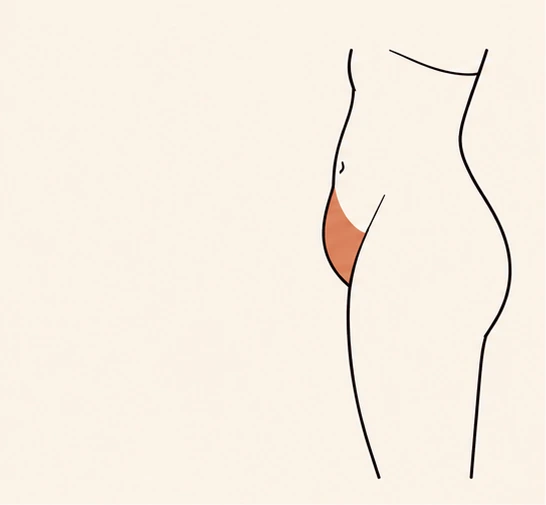
A FUPA presents as a gently domed pad of tissue sitting over the mons pubis, the soft mound above the pubic bone. Seen from the front it reads as a slight fullness low on the abdomen. Seen from the side it is more obvious, because it curves forward from the line of the lower belly.
It is soft rather than firm, it moves when you do, and it has no sharp edges. Where it becomes noticeable is at its upper border, where it meets the flatter part of the lower abdomen. That shallow transition is what people are usually seeing when they say they can spot one.
Where to look, and one common mix-up
The area runs from roughly the level of the pubic hairline up towards the navel, or umbilicus, and sits between the two inguinal creases where the abdomen meets the tops of the thighs. In anatomical terms this is the suprapubic region, mapped precisely in our guide to where the FUPA sits, and the fat pad itself is adipose tissue sitting over the mons pubis.
Worth clearing up while we are here: this area is very often called a “fat vagina” online, and that is anatomically wrong. The vagina is internal. What people are describing is the mons pubis, the external pad of tissue over the pubic bone. It is a small distinction, but it matters if you ever want to describe the area accurately to a GP.
It looks different depending on how you are standing
This surprises people, and it explains a lot of the confusion.
- Standing, from the front. Usually the most forgiving view. The fullness is there but it sits within the overall line of the lower abdomen.
- Standing, in profile. The most revealing view, because the forward curve is visible against a flat background. Most people first notice theirs in a side-on mirror or a photograph taken from the side.
- Seated. The abdomen compresses and the waistband presses in, which pushes the tissue forward and makes it look fuller than it does standing.
- Lying on your back. Subcutaneous fat spreads out under its own weight, so the mound flattens considerably and can almost disappear.
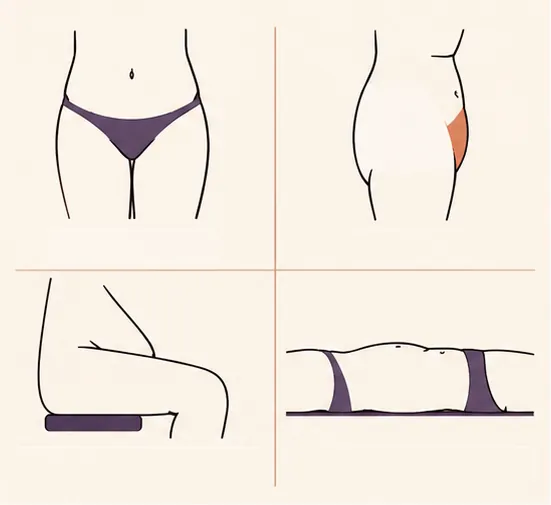
None of these views is the “real” one. They are all the same tissue behaving normally under gravity.
Size and shape vary enormously
There is no clinical grading scale for this, and inventing one would be unhelpful. Our guide to FUPA sizes and shapes sets out the usual range in more detail. In practice, though, most descriptions fall somewhere along a range.
At one end is a gentle fullness that only shows in profile or under fitted clothing, with no clear border. In the middle is a distinctly rounded mound with a visible upper edge where it meets the lower abdomen. At the fuller end, the pad has enough volume to create a soft crease along its top edge and to sit over the underwear line.
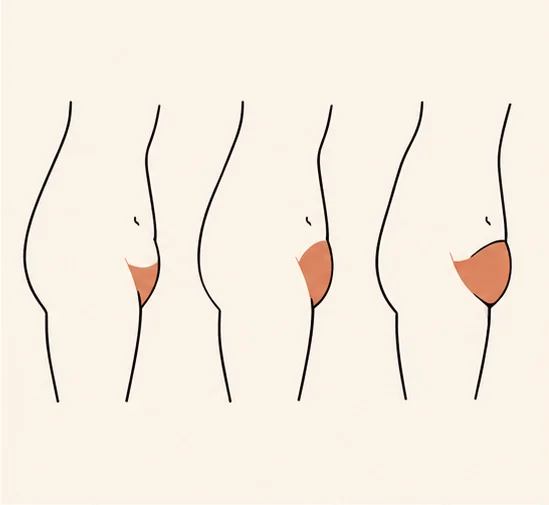
Shape varies too. Some are broad and shallow, spreading towards the hips. Others are narrower and more centrally concentrated. Some sit high and blend upwards into the lower belly; others sit low and are more clearly defined against the pubic bone.
Asymmetry is normal. One side being slightly fuller than the other is extremely common and is not a sign of anything wrong.
What it looks like at different body weights
Two things often catch people out here.
The first is that a visible FUPA does not require a high body weight. Fat distribution is largely genetic and hormonal, and a gynoid pattern, meaning fat stored preferentially around the hips, thighs and lower abdomen, can produce a noticeable pad on someone who is lean everywhere else. This is one of the most common reasons people arrive at this topic confused, and it has specific and well-understood causes.
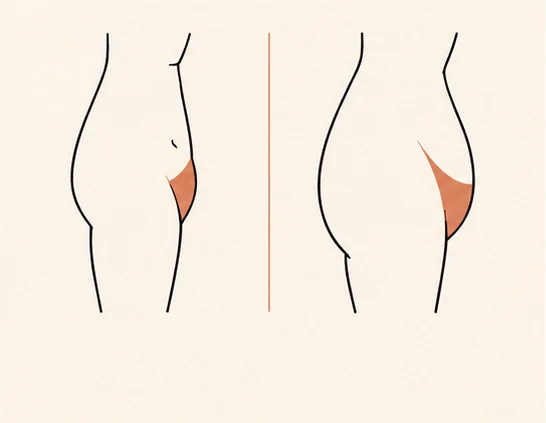
The second is the opposite: at higher body weights the pad often becomes less distinct rather than more, because it blends into the surrounding lower abdomen and loses its defined upper border. Someone can carry more fat there and see it less clearly than someone lean who has a sharply outlined mound. If yours seems disproportionate to the rest of your body, that has its own explanation.
How it looks in clothing
For most people this is where they actually notice it, rather than undressed in a mirror.
Waistband height is the single biggest factor. A low-rise waistband sits across the middle of the pad and divides it, creating a fold above the fabric. A high-rise waistband sits above it and smooths the whole area into one line. Mid-rise is the awkward middle ground, because it tends to land exactly on the upper border.
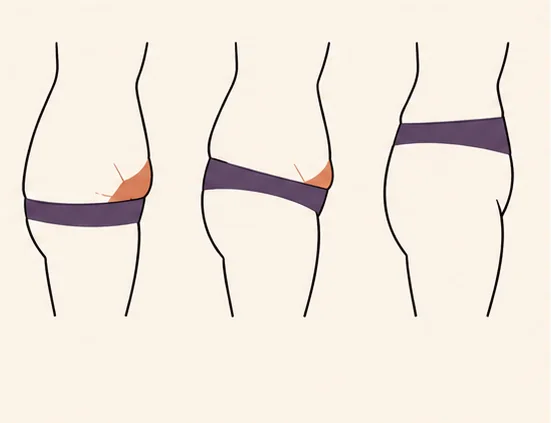
Fabric matters nearly as much. Leggings and swimwear follow the contour precisely, so anything that is there will be visible. Structured denim and thicker jersey hold their own shape and reveal much less. Our guide to what to wear works through this properly, and there are shapewear options if smoothing is what you are after.
How it changes through life
The appearance is not static, and most of the changes are predictable.
Puberty. The fat pad over the mons pubis develops as part of normal hormonal change. It is a secondary sex characteristic, not something that appears because of diet.
Pregnancy and after. The skin and tissue across the whole lower abdomen stretch. In the postpartum period the area is often fuller and softer than it was before, and it may stay that way permanently. Stretch marks are common here and fade from red or purple to silver over time.
After a caesarean. The scar sits low, and the tissue above it can settle over the scar line to create a small shelf. This is one of the most frequently asked-about appearances and it is a normal result of how the incision heals.
Menopause. Falling oestrogen shifts fat storage patterns, and the lower abdomen is one of the areas that commonly gains.
After significant weight loss. The fat volume drops but the skin does not always retract with it. The result often looks softer and more creased than before rather than flatter, which can be disheartening if nobody warned you it was likely.
Skin texture, not just volume
A description of shape alone misses half of what people are actually looking at. The surface matters as much as the contour.
Skin elasticity determines how the area holds its shape, and it declines with age as collagen production slows. That is why the same volume of fat can look smooth and taut on one person and softer and looser on another. It is also why the appearance can change over the years without any change in weight at all.
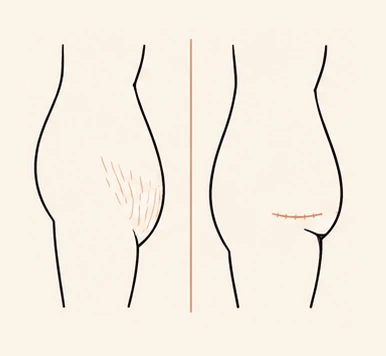
Striae, better known as stretch marks, are extremely common across this area following pregnancy, puberty or a rapid change in weight. They start out red or purple because the blood vessels beneath are visible through thinned skin, and settle to a pale silvery line over months to years.
Dimpling or a slightly textured surface is also normal here. Subcutaneous fat sits in compartments separated by connective tissue, and where those bands tether the skin, the surface between them can look uneven. It is a structural feature of how the tissue is arranged rather than a sign that anything is wrong.
Quick visual differences from things it is confused with
A few fast tells, since these come up constantly:
- Apron belly. Hangs downward and creates a crease that stays put when you stand. A FUPA sits in place and does not fold over itself.
- Lower belly pooch. Involves the whole area below the navel rather than the pubic pad specifically, and often changes noticeably through the day.
- Muffin top. Sits at the sides, at or above the hip bones. Different location entirely.
- Diastasis recti and the B-belly. Produces a horizontal crease across the middle of the abdomen and a bulge that domes outward when you sit up. That is muscle separation rather than fat.
Our full comparison of the types sets these out properly, with the tissue differences behind each one.
When the appearance is worth a GP appointment
Almost always this is a cosmetic question rather than a medical one. A few appearances are worth having looked at:
- Soreness, a rash, an odour or broken skin where a fold meets itself
- Swelling that is one-sided, or that has come on quickly without a weight change
- A lump or bulge that appears when you cough, strain or lift, which can indicate a hernia
- Pain, tenderness or heat in the area
- Skin that feels unusually firm, dimpled or heavy rather than soft, particularly if the legs are affected too
One note on photographs
If you are comparing yourself to images, it is worth knowing how much the picture itself is doing. A camera held close and low exaggerates whatever is nearest the lens. Overhead lighting deepens every contour. Posture changes the silhouette more than most people expect, and the images that circulate most widely have usually been posed, lit, and often edited.
The version of yourself you see standing under a bathroom light at the end of the day is not a fair comparison against any of that. If you want to see the wider picture on this topic, the main guide covers everything from causes through to options.
Frequently asked questions
Does everyone have a FUPA?
Everyone has a mons pubis, and everyone has some tissue over it. Whether it is prominent enough to be visible varies with genetics, hormones, body composition and life stage.
Can you be slim and still have a visible FUPA?
Yes, and it is common. Fat distribution is largely genetic, so someone lean overall can still store noticeably in the lower abdomen and mons pubis.
Why does mine look bigger in some clothes than others?
Waistband height is usually the reason. A waistband that lands on the upper border of the pad divides it and creates a fold, while a higher waistband sits above it and smooths the line.
Does a FUPA look different lying down?
Yes. Subcutaneous fat spreads out when you lie on your back, so the mound flattens and can look considerably smaller than it does standing.
Is it normal for a FUPA to be uneven?
Yes. Mild asymmetry is very common across the body and is not in itself a sign of a problem. Swelling that is clearly one-sided and new is worth mentioning to a GP.