
FUPA Surgery: Options, Costs and Recovery in the UK
Page Contents
- What “FUPA surgery” actually refers to
- Fat or skin? The question that decides everything
- Mons liposuction
- Monsplasty
- Abdominoplasty, and why the mons is included
- Non-surgical alternatives, and what the evidence shows
- Can you get FUPA surgery on the NHS?
- What it costs in the UK
- Recovery, week by week
- Risks you should be told about
- Choosing a surgeon and a clinic in the UK
- Questions worth asking at the consultation
- Before you book anything
- Frequently asked questions
- Is there a surgery that only removes a FUPA?
- How much does FUPA surgery cost in the UK?
- Will the NHS pay for it?
- How long does recovery take?
- Will it come back after surgery?
- Is fat freezing a safe alternative?
Surgery is the one option that removes tissue rather than shrinking it, which is why people start looking into it after diet and training have taken them as far as they are going to go. It is also the option with the highest cost, the longest recovery and the only permanent scar, so it deserves a careful look rather than a hopeful one.
This guide sets out what is actually available in the UK, what each procedure does, what it costs, how long recovery really takes, and where the NHS does and does not fund treatment. If you are earlier in the process, the main FUPA guide covers the whole picture, and the causes guide is worth reading first, because the cause often points to the right treatment.
This page is general information, not medical advice. Only a consultation with a GMC-registered surgeon who has examined you can tell you what is suitable in your case.
What “FUPA surgery” actually refers to
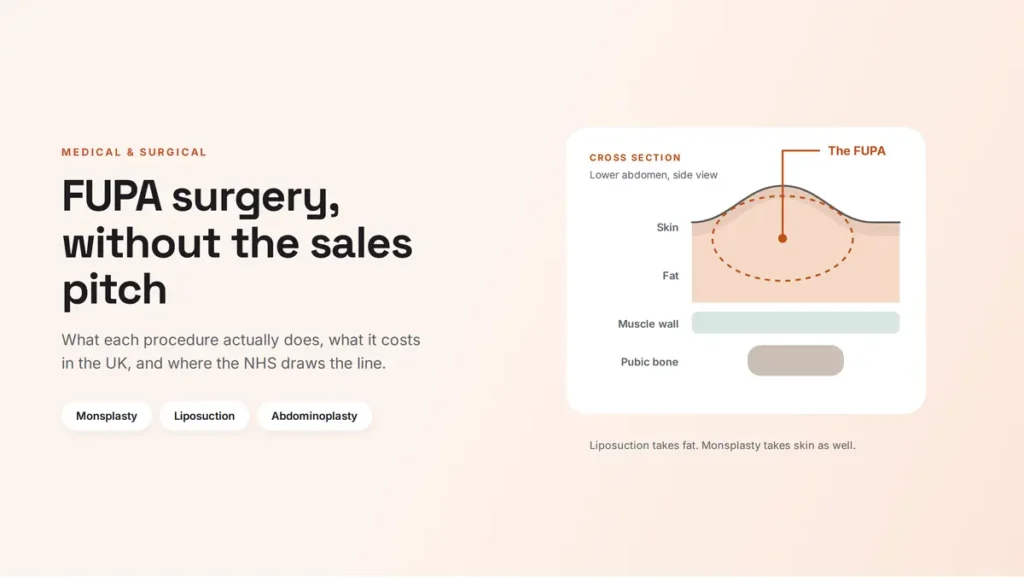
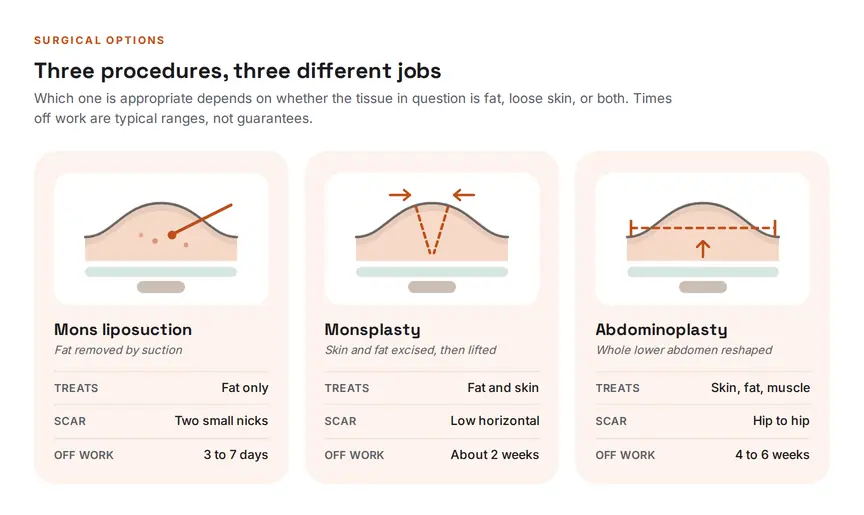
There is no single operation called FUPA surgery. The phrase is an umbrella for three different procedures that surgeons choose between depending on whether the problem is fat, loose skin, or both. Clinics rarely use the term at all, incidentally: in a consultation you will hear mons pubis, which is the anatomical name for the area.
- Mons liposuction. Fat is removed from the pad above the pubic bone through small incisions. Nothing is cut away and nothing is tightened.
- Monsplasty, also called a mons lift or pubic lift. A strip of skin and fat is excised and the underlying tissue is stitched to lift the area. This leaves a horizontal scar low across the mons.
- Abdominoplasty, or tummy tuck. A larger operation addressing the whole lower abdomen, often with the mons lifted at the same time so the result does not look uneven.
Choosing between them is not a matter of preference. It is decided by what the tissue is doing, and that is why the consultation matters more than the brochure.
Fat or skin? The question that decides everything
Surgeons assess two things: how much fat sits in the pad, and how well the skin recoils when it is released. Fat responds to liposuction. Loose skin does not, and removing fat from beneath slack skin can make the area look worse rather than better, because there is now less volume holding the skin out.
Broadly, the pattern runs like this. If the pad is firm and full and the skin snaps back when you lift and release it, liposuction alone can work well. If the skin hangs, creases, or has been stretched by pregnancy or significant weight loss, skin has to come out, which means a monsplasty or an abdominoplasty. Anyone who has lost a lot of weight is usually in the second group even when they do not expect to be.
This is also where an accurate description of your own anatomy helps. Plenty of people arrive at a consultation describing a FUPA when what they have is a lower abdominal apron, and the two are treated differently. The comparison of the two is worth five minutes before you book anything, and this walk through the different shapes covers the variations surgeons see most often.
Mons liposuction
The most straightforward of the three. An anaesthetic solution is injected, the fat is loosened and then suctioned out through incisions of a few millimetres. The NHS describes liposuction as taking one to three hours depending on the areas treated, and notes that most people stay in hospital overnight when it is done under general anaesthetic.
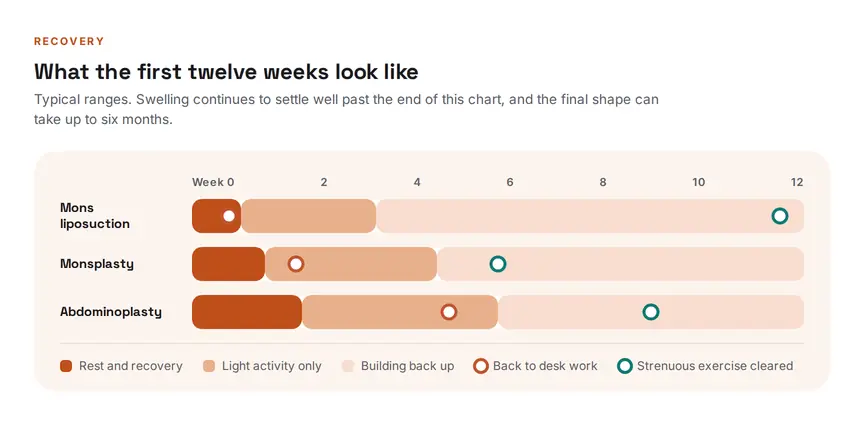
Compression garments are worn for several weeks afterwards. The NHS advises gentle exercise from around three to four weeks and no strenuous activity for ten to twelve weeks, with the final shape taking up to six months to appear as swelling settles.
Liposuction removes fat cells permanently, but it does not stop the cells that remain from enlarging. Weight gain after the procedure will still show in the area, which is why surgeons want your weight stable before they operate. Our dedicated liposuction guide covers technique choice and candidacy in more depth.
Monsplasty
A monsplasty removes skin as well as fat. The surgeon makes a horizontal incision low across the mons pubis, excises the excess tissue, tightens the underlying layer with internal sutures and closes. Drains are sometimes placed for the first day or two. It is usually a day case, under general anaesthetic or local anaesthetic with sedation.
Recovery is more demanding than liposuction in the first fortnight and shorter overall. Discomfort tends to peak in the first five to seven days, desk work is often possible at around two weeks, and strenuous exercise waits four to six weeks. Full healing takes at least eight weeks. The trade is the scar, which sits low enough to be covered by underwear but is permanent.
Results hold as long as weight stays stable. Significant weight gain, or a subsequent pregnancy, can undo them. Our dedicated monsplasty guide goes into candidacy, technique choice and recovery in more depth.
Abdominoplasty, and why the mons is included
A full abdominoplasty involves an incision from hip to hip, removal of excess skin and fat, repair of separated abdominal muscles and repositioning of the navel. The NHS puts the operation at two to five hours and advises four to six weeks off work and exercise.
The reason it appears in a FUPA guide at all is that a tummy tuck which tightens the abdomen without addressing the mons can leave the pubic area looking more prominent than it did before, simply by contrast. Good surgeons plan the two together. Adding a mons lift to a tummy tuck typically costs a few hundred pounds more rather than the full standalone price, because the theatre time and anaesthetic are shared. Our dedicated tummy tuck guide covers muscle repair, panniculectomy and when this is the right choice over monsplasty alone.
Non-surgical alternatives, and what the evidence shows
Cryolipolysis, marketed as fat freezing, is the most common non-surgical offer for this area. It cools fat cells to the point where they die and are cleared over the following weeks. It requires no incision and no downtime, and it reduces fat volume modestly rather than dramatically. It does nothing at all for loose skin.
It is not risk free. A 2025 systematic review and meta-analysis in Aesthetic Surgery Journal Open Forum, covering 13,078 patients across 28 studies, put the pooled incidence of paradoxical adipose hyperplasia at 0.22 per cent, roughly one case in every 455 patients. Paradoxical adipose hyperplasia is a firm enlargement of the treated area rather than a reduction, and correcting it generally requires liposuction. The authors noted the rate was around six and a half times higher than the most recent manufacturer figure, which suggests it is under-recognised rather than rare in the way clinics often imply.
Non-surgical treatment in the UK is far less tightly regulated than surgery. If you go this route, the practitioner and the premises matter as much as the machine. Our dedicated non-surgical guide covers the different technologies, what the evidence shows for each, and how to choose a provider.
Can you get FUPA surgery on the NHS?
For cosmetic reasons, no. The NHS states plainly that abdominoplasty “is regarded as cosmetic surgery, so it is not usually available on the NHS”, and cosmetic liposuction is not routinely funded either, although liposuction is provided for conditions such as lipoedema and lymphoedema.
Funding for an abdominoplasty or apronectomy is possible where there is documented clinical need. Local NHS commissioning policies vary, but the criteria used across England follow a common shape. A typical policy requires all of the following:
- Age 18 or over.
- A starting BMI above 40, or above 35 with significant co-morbidities.
- A current BMI below 30, with weight stable for more than twelve months.
And at least one functional problem, such as an abdominal apron hanging at or below the level of the pubic symphysis with severe difficulty in daily activities, recurrent intertrigo, panniculitis or ulceration beneath the fold, or a requirement for the surgery as part of hernia repair.
Note what that means in practice. The threshold is built around a hanging pannus and skin breaking down underneath it, not around the appearance of the pubic area. A FUPA on its own will not meet it. Your GP is still the right first stop if you have recurrent soreness, rashes or infection in the fold, since those are treatable in their own right. This guide to why the area gets larger covers some medical causes that are worth ruling out first.
What it costs in the UK
Private prices vary by surgeon, city and technique. The figures below are indicative ranges rather than quotes, and most exclude consultation fees, garments and follow-up. Our full cost breakdown covers financing options and the fees that quotes often leave out.
| Procedure | Typical UK cost | What it addresses |
|---|---|---|
| Mons liposuction | £3,000 to £8,500 (NHS range for liposuction generally) | Fat only |
| Monsplasty, standalone | From around £4,000 | Fat and loose skin |
| Mons lift added to a tummy tuck | £500 to £1,000 extra | Fat and loose skin |
| Abdominoplasty | £5,000 to £10,000 | Whole lower abdomen |
Three things move the price: the technique, whether it is standalone or combined, and the anaesthetic. A procedure under local anaesthetic costs less than one requiring an anaesthetist and full theatre time. Be wary of quotes materially below these ranges, and be equally wary of any clinic that will not put revision policy and aftercare in writing.
Recovery, week by week
| Stage | Liposuction | Monsplasty | Abdominoplasty |
|---|---|---|---|
| Worst discomfort | Days 1 to 4 | Days 1 to 7 | Days 1 to 10 |
| Desk work | 3 to 7 days | About 2 weeks | 4 to 6 weeks |
| Gentle exercise | 3 to 4 weeks | 4 to 6 weeks | 6 weeks plus |
| Strenuous exercise | 10 to 12 weeks | 6 to 8 weeks | 8 to 12 weeks |
| Final result visible | Up to 6 months | 8 weeks to 6 months | 6 months plus |
Swelling is the part people underestimate. It is normal for the area to look larger and firmer than it did before surgery for weeks, and judging the result at three weeks is a reliable way to make yourself miserable. Compression garments, walking early and short, and keeping to the follow-up schedule all matter more than they sound.
Risks you should be told about
Every surgeon should walk you through these before you consent, and a consultation that skips them is a warning in itself.
- Common after any of the three: bruising, prolonged swelling, numbness in the treated skin, and scarring where an incision is made. Numbness can last months and is occasionally permanent.
- Wound problems: seroma, which is fluid collecting under the skin, haematoma, infection, and wounds that separate or heal slowly. The mons sits in a warm, moist fold, which does not help.
- Contour problems: lumpiness or asymmetry after liposuction, and recurrent sagging after skin excision if weight changes.
- Serious but uncommon: blood clots, significant bleeding, and, specific to liposuction, fluid overload and damage to deeper structures.
- Smoking raises the risk of wound breakdown substantially. Surgeons generally require at least four weeks without smoking before and after.
Choosing a surgeon and a clinic in the UK
The regulatory checks are quick and there is no reason to skip them.
- Check the GMC register. Your surgeon should be on the specialist register for plastic surgery. The register is public and searchable.
- Check the CQC. In England, every clinic carrying out surgery must be registered with the Care Quality Commission, and inspection reports are published.
- Insist on seeing the operating surgeon. GMC guidance is explicit that the doctor performing the procedure must seek consent themselves, not delegate it to a salesperson or patient adviser.
- Take the reflection time. The GMC requires that patients are given time to reflect before deciding. Any pressure to book on the day, or a discount that expires, is a reason to leave.
- Ask about revision. Who pays if a second procedure is needed, and under what circumstances.
Surgery abroad is cheaper and is chosen by a lot of UK patients. The practical difficulty is not the operation, it is what happens six weeks later if a wound breaks down and your surgeon is in another country. NHS services will treat complications, but they are not obliged to complete or revise private work.
Questions worth asking at the consultation
- Based on what you have examined, is my issue fat, skin, or both?
- Which procedure are you recommending, and what would happen if I chose the less invasive one instead?
- Where exactly will the scar sit, and will it be hidden by underwear?
- How many of these do you perform each year?
- What is included in the quoted price, and what is not?
- What is your complication rate, and what does your aftercare cover?
Our before and after guide covers what genuinely changes with each procedure and how to judge a surgeon’s own photos properly.
Before you book anything
Surgeons want weight stable for a year before operating, and a good many people find that the year spent getting there changes the picture enough that the operation is no longer what they want. That is not a fobbing off. Fat in this area does respond to a sustained deficit, it is just slower and less linear than people expect, and the non-surgical route is worth exhausting first for reasons of cost as much as anything.
If the immediate problem is how clothes sit rather than the tissue itself, the styling guide deals with that directly and costs nothing. And if you are still not certain the area you are looking at is what you think it is, this comparison of the different types of lower belly fat will settle it.
Frequently asked questions
Is there a surgery that only removes a FUPA?
Yes. A monsplasty, also called a mons lift, treats the pubic mound alone, and mons liposuction treats the fat in that area alone. Neither requires a full tummy tuck. Whether one of them is right for you depends on how much loose skin is present.
How much does FUPA surgery cost in the UK?
A standalone monsplasty starts at around £4,000. Liposuction generally falls between £3,000 and £8,500 depending on the areas treated, and an abdominoplasty costs roughly £5,000 to £10,000. Adding a mons lift to a tummy tuck usually adds £500 to £1,000 rather than the standalone price.
Will the NHS pay for it?
Not for cosmetic reasons. Funding for an abdominoplasty or apronectomy is possible where a hanging abdominal apron causes documented functional problems or recurrent skin infection, and where BMI and weight stability criteria are met. A FUPA on its own does not meet the threshold.
How long does recovery take?
Liposuction to the area allows desk work within a week and gentle exercise at three to four weeks. A monsplasty typically means about two weeks off work and four to six weeks before exercise. An abdominoplasty requires four to six weeks off work and exercise. Swelling takes months to fully settle in all three cases.
Will it come back after surgery?
The fat cells removed do not return, but the ones that remain can still enlarge. Significant weight gain, and pregnancy after a skin excision, can both change the result. Surgeons ask for stable weight beforehand for exactly this reason.
Is fat freezing a safe alternative?
It avoids surgery and downtime, and it produces a modest reduction in fat rather than a dramatic one. It does not treat loose skin. Pooled data across more than 13,000 patients puts the risk of paradoxical adipose hyperplasia, where the treated area enlarges instead, at about 0.22 per cent, and that rate appears to be higher than manufacturer reporting suggests.