
Best Jeans for a FUPA: Rise, Fit and What to Avoid
Page Contents
- Rise: measure it, do not trust the label
- The waistband is what actually fails
- Waist gap, and why sizing up backfires
- Denim weight, stretch and recovery
- Cuts that tend to work with a FUPA
- Front details: pockets, fly length and whiskering
- How to try jeans on properly
- Sizing, curve fits and alterations
- Brands with consistent waistband construction
- Postpartum denim
- What tends to work against you
- Frequently asked questions
- What rise is best for a FUPA?
- Are skinny jeans a bad choice?
- Why do my jeans dig in even though they fit everywhere else?
- Does denim weight matter?
- Should I wear shapewear under jeans?
- Do maternity or postpartum jeans help?
Denim is the garment people with a FUPA complain about most, and usually for the same reason: the waistband lands in exactly the wrong place. A pair of jeans that fits the hips and legs perfectly can still cut a hard line across the mons pubis, dig in when you sit down, and produce the divided look that no amount of shopping seems to solve.
Almost all of it comes down to four measurable things: rise, waistband construction, denim weight and stretch recovery. If you are not sure whether a FUPA is what you are dealing with, that guide covers the anatomy first. None of them are about size. This guide covers each in turn, plus how to try jeans on in a way that predicts how they will behave at 4pm rather than in the first thirty seconds.
For the wider wardrobe picture, see our main styling guide, and for what goes underneath, our underwear guide.
Rise: measure it, do not trust the label
Rise is the distance from the crotch seam to the top of the waistband at the front. Brands label rises inconsistently, so the number is far more useful than the word.
| Rise | Typical front measurement | Effect over a FUPA |
|---|---|---|
| Ultra high | Around 12 inches and above | Sits at the natural waist, clears the mons entirely |
| High | Roughly 10 to 12 inches | Usually clears the fullest point, the dependable range |
| Mid | Roughly 8 to 9.5 inches | Often lands on the mons, depends on your torso |
| Low | Under 8 inches | Sits below the fullest point and pushes tissue over the band |
Find your own number once and reuse it. Measure from the crotch seam of a pair that already works, straight up to the top edge of the waistband. That figure, not the size on the label, is what you are shopping for. Most online denim listings publish the front rise in the measurements table.
The waistband is what actually fails
Two pairs of jeans in the same size with the same rise can behave completely differently depending on how the band is built.
A rigid, faced waistband, cut on grain with an inner facing, holds a fixed circumference. It does not stretch out over the day, and it sits level rather than rolling. A contoured or curved waistband, cut with a slight arc rather than a straight strip, follows the difference between waist and hip measurement and is the single most useful feature if you carry weight low on the abdomen.
A fully elasticated band is comfortable for an hour and compresses unevenly after that, often folding over on itself and forming a hard ridge. Pull-on jeggings with a wide soft band sit somewhere in between: comfortable, but with no structure to hold the shape.
Waist gap, and why sizing up backfires
The gap that opens at the centre back when jeans fit the hip but not the waist has a name in the trade: the V-gap. The instinctive fix is to buy a bigger size, which makes the gap larger, or a smaller one, which makes the front band cut deeper into the mons.
Neither works, because the problem is the ratio between waist and hip, not the overall size. The real solutions are a contoured waistband, a curve or shaped fit line, or twenty minutes with a tailor, who can take in a centre back seam for a few pounds and will transform a pair of jeans that already fits everywhere else.
Denim weight, stretch and recovery
Denim weight is measured in ounces per square yard. Light denim at 8 to 10oz drapes softly but gives little support. Mid weight at 10 to 12oz is the useful range for most people: enough body to hold a smooth line, not so heavy that it feels like armour. Heavy denim above 13oz holds a shape beautifully and takes weeks to break in.
Stretch content matters just as much. Around one to two per cent elastane gives comfort stretch: the fabric moves with you and springs back. Above roughly five per cent, the denim behaves more like a legging, which means it follows contours rather than smoothing them, and it tends to bag out at the knee and seat by the afternoon.
Recovery, the ability to return to shape after stretching, is what separates good stretch denim from bad. Jeans that fit in the morning and are loose by lunchtime have poor recovery, and a loose waistband slides down onto the mons pubis, which reintroduces the exact problem you chose a high rise to avoid.
Cuts that tend to work with a FUPA
- High rise straight leg. The most reliable combination. Balanced through the leg, no added volume, nothing clinging past the hip.
- Wide leg and barrel leg. Volume below the hip balances fullness at the lower abdomen, and the fabric never touches the mons below the waistband.
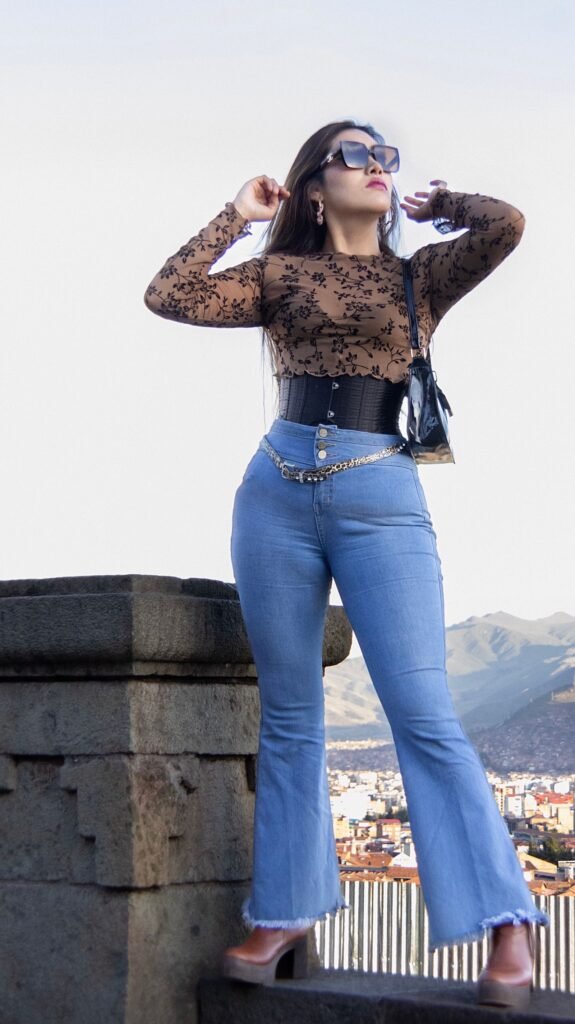
- Bootcut and kick flare. A slight flare at the hem visually narrows the middle of the body by comparison.
- Slim straight or tapered. Fitted without being clinging, provided the denim has structure rather than heavy stretch.
- Mom jeans, with care. The genuinely high rise versions work well. The vintage inspired low rise ones do not, despite the name.
Front details: pockets, fly length and whiskering
Small construction details sit directly over the area and change how it reads.
A longer fly, which comes with a higher rise anyway, distributes the front seam over more length rather than concentrating it. Deep front pocket bags that lie flat are better than shallow ones, which bulge outward when you sit. Whiskering, the pale fan of fade lines radiating from the crotch, draws the eye straight to the centre front, and heavy distressing or contrast stitching across the front does the same. Plain, dark, uniform washes are the quiet option.
How to try jeans on properly
Standing still in front of a mirror tells you almost nothing. Three tests take under a minute each:
- Sit down for two minutes. Waistbands that are comfortable standing often dig in hard when seated, because sitting increases the circumference at the waist by several centimetres.
- Squat or bend. If the back waistband drops and the front band rides up onto the mons, the rise is too low for you.
- Run a hand around the waistband. Feel for the gap at the back and for any point where the band is standing away or pressing in unevenly.
If you can, walk for five minutes in the changing room. Denim reveals its recovery problems through movement, not through standing.
Sizing, curve fits and alterations
Size by the larger of your waist and hip measurements and alter down, never the reverse. Buying small to compress a FUPA produces a deeper waistband line, not a flatter one. A curve or shaped fit line, offered by several denim brands, is cut with a larger waist to hip difference as standard and removes the need for alteration for many people.
Alterations are undervalued. Taking in a centre back waistband, shortening a hem, or having the waistband eased are all inexpensive and permanent, and they turn a nearly right pair into a right one.
Brands with consistent waistband construction
Fit varies so much between labels that brand recommendations are only ever a starting point. That said, brands offering a genuine range of rises and a dedicated curve or plus size denim line, among them Levi’s, Good American, Universal Standard and Marks and Spencer, tend to draft separate patterns for larger sizes rather than scaling one pattern up, which usually produces better waistband behaviour across the size range. Trying two or three labels is more productive than assuming a size translates.
Postpartum denim
In the months after birth the abdomen is still changing, and firm rigid waistbands over a healing caesarean scar are uncomfortable for many people. Softer high rise panels, as used in postpartum specific lines, are worth having for that period. Once swelling has settled, a well chosen high rise regular jean usually works as well as anything specialised. Our postpartum guide covers what changes and over what timescale.
What tends to work against you
- Low and mid rise jeans, which sit on or below the fullest point.
- High stretch skinny jeans, which outline rather than smooth.
- Fully elasticated waistbands that roll over and form a ridge.
- Buying a size down in the hope that tighter reads as smoother.
- Whiskering, distressing and contrast stitching placed across the FUPA.
- Jeans with poor recovery that loosen and slip down during the day.
The same reasoning transfers to the rest of the wardrobe: waist height and fabric structure decide the outcome, in outfits and in swimwear alike.
Frequently asked questions
What rise is best for a FUPA?
A high rise, generally 10 to 12 inches at the front, so the waistband sits above the fullest part of the mons pubis rather than cutting across it. Measure a pair that already works and shop to that number.
Are skinny jeans a bad choice?
Not automatically. High rise skinny jeans in structured denim with low stretch can work well. It is the combination of low rise and heavy elastane that outlines the lower abdomen.
Why do my jeans dig in even though they fit everywhere else?
Usually waistband construction rather than size. A straight cut rigid band cannot accommodate a large waist to hip difference. A contoured waistband, a curve fit, or taking in the centre back seam all solve it.
Does denim weight matter?
Yes. Mid weight denim of roughly 10 to 12oz holds a smooth line. Very light or very stretchy denim follows contours instead, and loses shape through the day.
Should I wear shapewear under jeans?
It can help under structured high rise denim, though a well constructed waistband usually does most of the work on its own. Our shapewear guide covers which styles sit well under denim.
Do maternity or postpartum jeans help?
In the early months, yes. A soft high panel avoids pressure on a healing caesarean scar. Once swelling settles, a standard high rise jean usually performs just as well.