
Outfits for a FUPA: What to Wear and What to Avoid
Page Contents
- The principle behind every recommendation
- Waistline placement: the biggest single lever
- Silhouettes that work, and why
- Hemlines, the half tuck and the rule of thirds
- Fabric: structure beats stretch
- Colour, print and the vertical line
- Layering
- Dressing for specific occasions
- The base layer underneath
- What tends to work against you
- Frequently asked questions
- What waistline is most flattering with a FUPA?
- Are bodycon dresses always a bad idea?
- Do wrap dresses actually help?
- Should tops be tucked in or left out?
- Does layering actually make a visible difference?
- What about activewear and leggings?
Individual garments matter less than most people expect. What actually changes how a FUPA reads in a mirror is a handful of structural decisions: where the waistline lands relative to the mons pubis, whether the fabric skims or clings, and where the eye is drawn first. Get those three right and almost any garment works. Get them wrong and the most expensive dress in the wardrobe still sits badly.
This guide covers whole outfits: tops, dresses, layering, proportion and fabric. Denim has its own rules, covered in our jeans guide, and the full styling picture including shapewear sits in our main styling guide.
The principle behind every recommendation
The suprapubic fat pad, described in full in our definition guide, is soft. Fabric laid across it does one of three things: it skims over the top, it clings to the surface, or it cuts a horizontal line through the middle. Skimming is flattering, clinging is neutral to unflattering depending on the fabric, and cutting across is what produces the divided look people most want to avoid.
Every rule below is an application of that. You are not trying to hide anything. You are trying to keep the line of the body unbroken from the bust to the hem.
Waistline placement: the biggest single lever
| Waistline | Where it sits | Effect over a FUPA |
|---|---|---|
| Empire | Just under the bust | Skips the lower abdomen entirely, fabric falls away |
| Natural waist | Narrowest point, above the navel | Defines above the FUPA, flatters when paired with a fuller hem |
| High rise | At or just below the navel | Usually clears the fullest point, reliable for trousers and skirts |
| Dropped or low rise | On or below the mons | Cuts across the fullest point, least flattering |
Empire and natural waist are the two that consistently work. Both place the narrowest visual point well above the lower abdomen, which lets the fabric below hang from that point rather than wrapping around the fullest part of the body.
Silhouettes that work, and why
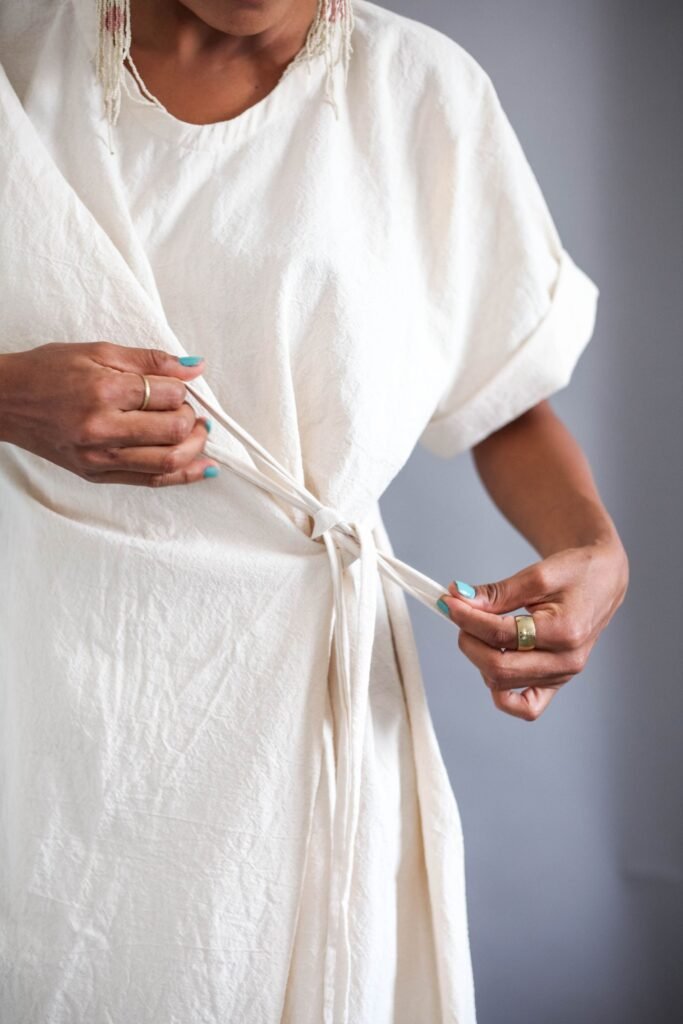
Wrap dresses and wrap tops. The diagonal front line draws the eye up and across rather than down and in, and the adjustable tie lets you place the definition exactly where you want it, which is usually an inch or two higher than a fixed waistband would sit.
A-line and fit and flare. Fitted through the bust, released from the waist or empire line, skimming outward past the hips. The skirt never makes contact with the mons pubis, so there is nothing to cling to.
Peplum. A flared panel below the waist seam adds volume above the FUPA and creates a soft break that sits higher than the fullest point. It works best when the peplum ends below the mons rather than exactly on it.
Shift and swing dresses. No waist definition at all, hanging from the shoulders. Less shape overall, but nothing cuts across anything.
Tunics and longline tops. Anything ending at mid hip or lower covers the lower abdomen completely and avoids the horizontal break a cropped hem creates.
Straight sheath dresses and bodycon in thin jersey are the two to approach carefully. Neither is automatically wrong, but both make direct contact along the whole length of the torso, so the fabric has to have enough weight to hold its own shape.
Hemlines, the half tuck and the rule of thirds
A top hem creates a horizontal line, and the eye reads it as a division point. A hem that lands directly on the fullest part of the FUPA emphasises it; a hem two inches lower, at mid hip, does not.
The half tuck, sometimes called a French tuck, is the useful compromise: tuck the front centre of the top into the waistband and leave the sides and back loose. It shows that there is a waist without laying fabric flat across the lower abdomen. It works best with a high rise waistband and a top with some drape.
The rule of thirds is worth knowing as a rough guide. Outfits tend to look balanced when the division between top and bottom falls at roughly one third or two thirds of the total height rather than at the halfway point. A cropped jacket over a long skirt, or a longline top over slim trousers, both land near a third. A top that ends exactly at the hip bone with trousers below lands near the half, which is the least flattering division for most body shapes.
Fabric: structure beats stretch
Ponte, scuba, crepe, denser cotton blends and good viscose all have enough body to hold a shape over the mons rather than following it. Thin jersey, slinky satin, clingy modal and lightweight knit all do the opposite: they take the shape of what is beneath them, which is exactly what you are trying to avoid.
Weight matters more than fibre content. A heavy viscose crepe skims better than a thin cotton jersey, even though cotton sounds like the more structured of the two. If you can bunch a fabric in your fist and it springs back with some resistance, it will skim. If it collapses into a limp ball, it will cling.
Linings help. An unlined thin skirt clings; the same skirt with a slip lining stands away from the body.
Colour, print and the vertical line
Keeping the top and bottom close in tone reads as one continuous column rather than two blocks divided at the waist, which is why monochrome dressing gets recommended so often. It is not about black specifically. Navy with navy, cream with camel, or any two shades within a couple of steps of each other all do the same job.
Small, busy prints break up the surface and disguise contours far better than large scale prints, which draw the eye to whatever the pattern sits on. Horizontal stripes placed directly across the lower abdomen are the one genuinely reliable thing to avoid. Vertical seams, button plackets and long open layers all work in your favour.
Layering
An open cardigan, a longline blazer or a duster coat worn undone creates two vertical lines down the front of the body and a narrow visible strip between them. That strip is what the eye follows, and it reads as taller and narrower than the actual torso.
Structure at the shoulder helps too. A blazer with a defined shoulder line balances proportions so the lower half reads as smaller by comparison. The layer needs to be long enough to pass the fullest point: a cropped jacket ending at the natural waist leaves the FUPA framed rather than covered.
Dressing for specific occasions
Work. A high rise wide leg trouser with a tucked or half tucked blouse and an open longline blazer covers every principle at once. Ponte and wool crepe both hold their shape through a full day.
Wedding guest or evening. Wrap dresses, empire line maxi dresses and fit and flare in crepe all work. A fully lined dress will always sit better than an unlined one in the same style.
Smart casual. A longline top over high rise straight leg jeans, with the front half tucked, is the everyday version of the same structure. In the first year after birth, when shape is still settling, soft structured fabrics tend to be more comfortable than firm ones: our postpartum guide covers that timeline.
Activewear. The rules do not change. A high rise legging with a compressive waistband and a top that ends below the hip works; a low rise legging with a cropped top is the least forgiving combination in the wardrobe. Look for a wide waistband rather than a narrow one, since narrow bands roll down during movement and form exactly the ridge you were avoiding.
The base layer underneath
None of this survives a badly chosen brief. A low rise waistband under a beautifully cut dress still prints a line through it. High rise seamless underwear is the foundation for everything above, and our underwear guide covers rise, seams and fabric in detail. If you want more than smoothing, shapewear is a separate decision with its own trade-offs. The same structural logic carries into swimwear, where fabric weight and waist height do almost all the work.
What tends to work against you
- Cropped tops that end exactly at the waistband, creating a horizontal break at the fullest point.
- Low rise trousers or skirts, which sit on the mons rather than above it.
- Thin jersey bodycon and unlined satin, which follow every contour.
- Large scale prints or horizontal stripes placed across the lower abdomen.
- Cropped jackets that end above the FUPA and frame it.
- Belts worn low on the hips rather than at the natural waist.
Frequently asked questions
What waistline is most flattering with a FUPA?
An empire waistline just under the bust, or a defined natural waist above the navel. Both sit well clear of the mons pubis, so the fabric below hangs away from the fullest point rather than wrapping around it.
Are bodycon dresses always a bad idea?
No. Thin jersey bodycon does follow every contour, but a bodycon in scuba, ponte or a lined crepe has enough structure to hold its own shape, which is a very different result.
Do wrap dresses actually help?
Yes. The diagonal front line pulls the eye up and across, and because the tie is adjustable you can place the definition an inch or two above where a fixed waistband would fall.
Should tops be tucked in or left out?
A half tuck at the front centre usually works best. It shows a waist without laying fabric flat across the lower abdomen, which a full tuck does.
Does layering actually make a visible difference?
Yes. An open cardigan, blazer or duster creates a vertical strip down the centre of the body that the eye follows, which reads as longer and narrower. The layer needs to end below the fullest point to work.
What about activewear and leggings?
The same principles apply. A high rise legging with a wide compressive waistband and a top ending below the hip is the flattering combination. Narrow waistbands roll down during movement and create a ridge.