
Lower Belly Fat in Men: Why It Happens and How to Shift It
Page Contents
- Key Takeaways
- Why Men Store Fat on the Lower Belly
- The male fat pattern
- Visceral fat and subcutaneous fat
- Where a FUPA fits in
- Common Causes of Lower Belly Fat in Men
- Eating more than you burn
- Alcohol
- Losing muscle with age
- Hormones, stress and sleep
- Sitting for long periods
- Is Lower Belly Fat in Men Dangerous?
- Why the waist matters
- The waist to height check
- A worked example
- How Men Can Lose Lower Belly Fat
- Set a steady calorie deficit
- Build meals around protein and fibre
- Cut back on drinks
- Lift weights
- Add cardio and daily movement
- Sleep and stress
- Exercises for Lower Belly Fat in Men
- Why sit-ups alone will not work
- A short strength session
- Simple cardio options
- When to See a GP
- Signs worth checking
- Checking testosterone
- Help with weight loss
- Frequently Asked Questions
- Why is my lower belly fat the last to go?
- How long does it take a man to lose belly fat?
- Does beer cause a beer belly?
- Can low testosterone cause belly fat in men?
- Is fat above the pubic area in men normal?
- The Bottom Line
- One plan for the whole belly
Lower belly fat in men is one of the most common body worries, and it is also one of the most useful warning signs. Men tend to store extra fat around the middle rather than on the hips and thighs, and some of that fat sits deep inside the tummy around the organs. This guide explains why lower belly fat in men builds up, how to tell whether yours is a health risk, and the steps that shift it, with UK targets you can check yourself.
For the full science of why you cannot target one spot and what does work for the whole lower belly, start with our main guide on how to burn lower belly fat.
This guide is general information, not medical advice. If your waist has grown quickly, you have pain or a lump, or you have other symptoms such as tiredness or a low sex drive, speak to your GP.
Key Takeaways
- Men are more likely than women to store fat around the tummy, including visceral fat around the organs.
- The NHS advises keeping your waist to less than half your height. Above that, your health risk rises.
- You cannot burn fat from one spot. A steady calorie deficit, strength training and more daily movement reduce belly fat over time.
- Alcohol, poor sleep, stress and low muscle mass all make lower belly fat in men more likely.
- Fat that sits right on the pubic bone is a FUPA, which is usually the last area to shrink.
Why Men Store Fat on the Lower Belly
The male fat pattern
Men and women store fat in different places. Men usually gain weight around the middle first, which gives the classic apple shape. Women more often store fat on the hips, bottom and thighs before the tummy. This is partly down to sex hormones, which affect where fat cells grow and how readily they release fat. So when a man puts on weight, the belly is often where it shows first.
Visceral fat and subcutaneous fat
Belly fat comes in two main types. Subcutaneous fat sits just under the skin. It is the soft fat you can pinch. Visceral fat sits deeper, inside the tummy wall and around the liver, gut and other organs. You cannot pinch it, but it pushes the belly forward and can make it feel firm. Men tend to carry a higher share of visceral fat than women of the same weight, which is why a hard, round belly is so common in middle aged men.
Where a FUPA fits in
Some men notice that, even as the rest of the belly shrinks, a pad of fat stays just above the penis. This is the pubic fat pad, often called a FUPA. Our guide to the FUPA in men explains why this area holds on to fat and how it can make the penis look smaller. If that is your main concern, read our page on prepubic fat as well. Our guide to stubborn lower belly fat explains why this area is usually the last to go.
Common Causes of Lower Belly Fat in Men
Eating more than you burn
The basic cause of any fat gain is taking in more energy than you use. The NHS says an average man needs around 2,500kcal a day, although this changes with age, size and activity. Large portions, takeaways, sugary drinks and snacking in the evening all add up without feeling like much.
Alcohol
Beer is a big source of extra calories for many men. The NHS lists a pint of 5% beer at up to 222kcal, so four pints on a night out can add close to 900kcal. Alcohol also tends to come with salty snacks and late food. Both men and women are advised not to drink more than 14 units a week on a regular basis, spread over three days or more. Our guide to the FUPA vs a beer belly looks at how the two differ.
Losing muscle with age
From middle age onwards, men slowly lose muscle unless they train to keep it. Less muscle means the body burns slightly fewer calories at rest, and it is easier to gain fat on the same diet. This is one reason a man can eat the same as in his twenties and still find his waist creeping up.
Hormones, stress and sleep
Low testosterone is linked with more body fat, and extra belly fat can in turn lower testosterone, so the two can feed each other. Our page on the FUPA and testosterone covers this in more detail. Long term stress and short sleep can also raise appetite and make healthy choices harder to stick to.
Sitting for long periods
Desk jobs, long drives and evenings on the sofa mean fewer calories burned across the day. Small amounts of movement, such as walking, standing and taking the stairs, make a real difference to your total energy use over a week.
Is Lower Belly Fat in Men Dangerous?
Why the waist matters
Fat around the middle, especially visceral fat, is more closely linked to health problems than fat on the hips or legs. The NHS lists type 2 diabetes, heart disease, stroke, high blood pressure, some cancers and fatty liver disease among the conditions linked to obesity. A large waist is one of the clearest signs that you may be at higher risk, even if your weight looks normal on the scales.
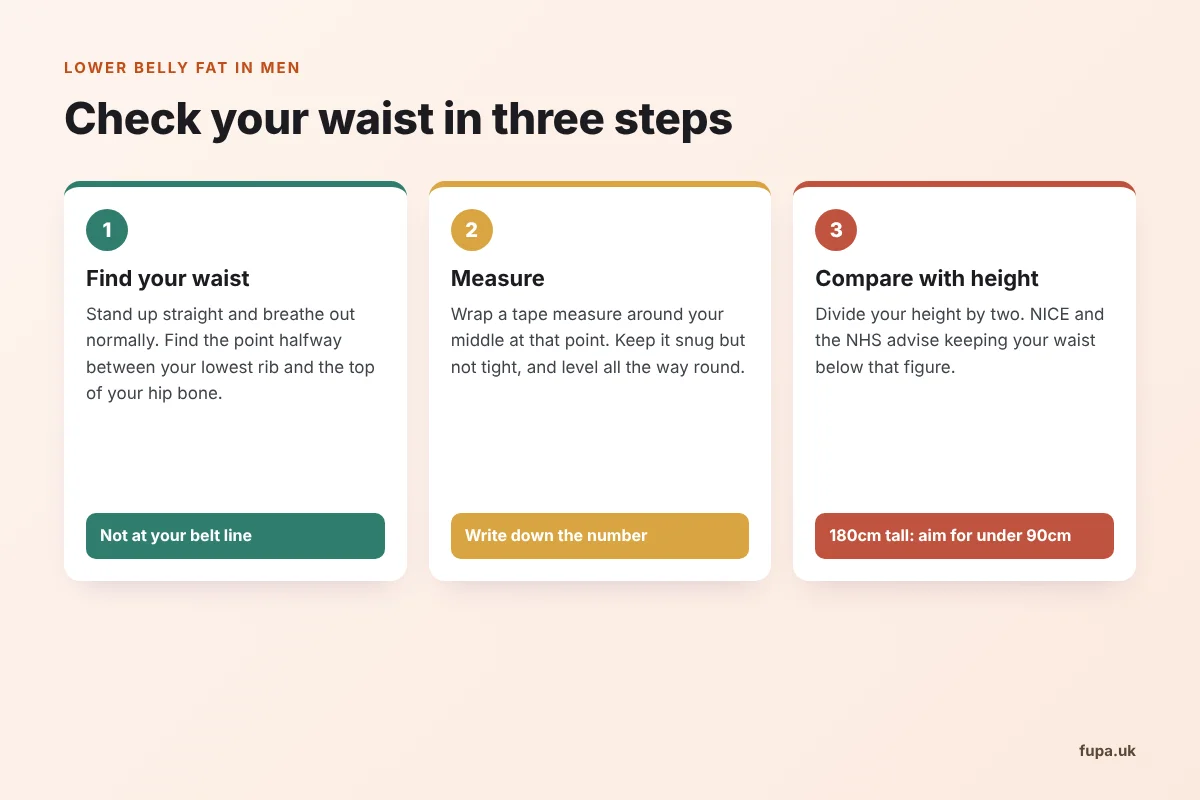
The waist to height check
The NHS advises that you should try to keep your waist size to less than half your height. This rule works for men and women of all heights. If your waist is more than half your height and you want help losing weight, the NHS suggests speaking to your GP.
A worked example
| Height | Half your height | Waist | Result |
|---|---|---|---|
| 170cm | 85cm | 82cm | Below half your height |
| 178cm | 89cm | 96cm | Above half your height |
| 185cm | 92.5cm | 90cm | Below half your height |
Measure every two to four weeks at the same time of day. A falling waist is often a better sign of progress than the scales, especially if you are building muscle.
How Men Can Lose Lower Belly Fat
Set a steady calorie deficit
To lose fat, you need to eat a little less energy than you burn, every day, for weeks and months. The NHS suggests aiming to lose 0.5kg to 1kg a week. Faster loss is harder to keep up and often means losing muscle too. Our guide to a calorie deficit shows how to work out a sensible target.
Build meals around protein and fibre
Protein helps you keep muscle while you lose fat, and it keeps you full. Fill a quarter of your plate with lean meat, fish, eggs, beans or tofu, half with vegetables or salad, and the rest with wholegrain carbohydrates. Our page on protein for fat loss gives simple daily amounts.
Cut back on drinks
Swapping beer for lower alcohol or alcohol free drinks, having several drink free days a week and avoiding sugary soft drinks are some of the easiest ways for men to cut calories without feeling hungry.
Lift weights
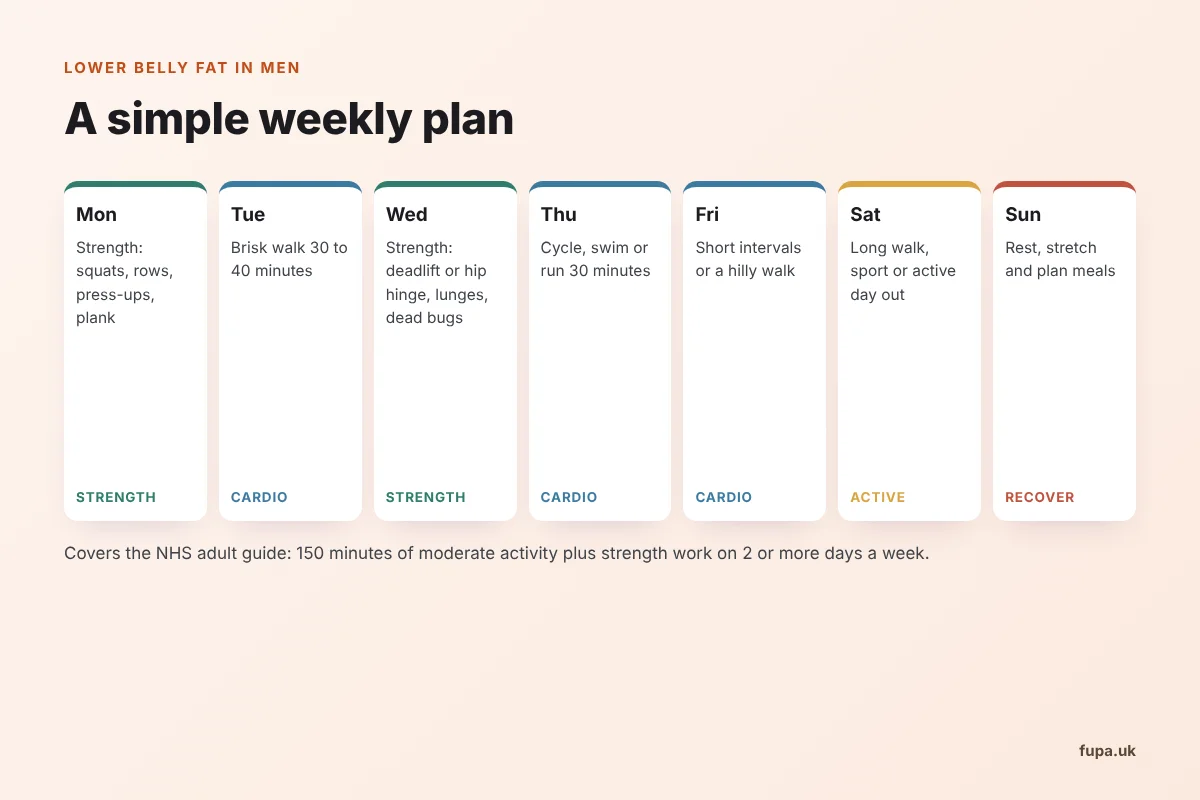
Strength training helps you hold on to muscle as you lose weight, so more of what you lose is fat. Big moves such as squats, deadlifts or hip hinges, rows, presses and press-ups train many muscles at once. The NHS advises strength work on at least two days a week.
Add cardio and daily movement
The NHS recommends at least 150 minutes of moderate activity or 75 minutes of vigorous activity a week. Brisk walking, cycling, swimming and running all count. On top of that, try to sit less and walk more across the day.
Sleep and stress
Short sleep is linked to bigger appetite and more snacking, and stress can make it harder to stay on track. A regular bedtime, less screen time late at night and cutting back on caffeine after lunch can all help. Our guide to sleep and the FUPA covers this in more detail.
Exercises for Lower Belly Fat in Men
Why sit-ups alone will not work
Crunches and sit-ups strengthen the tummy muscles, but they burn few calories and do not take fat from the area above them. Research on spot reduction has found that training one body part does not burn the fat over it more than elsewhere. Core work is still worth doing for strength and posture, but it should sit alongside a full plan.
A short strength session
- Goblet squat: 3 sets of 8 to 12
- Romanian deadlift or hip hinge: 3 sets of 8 to 12
- Dumbbell row: 3 sets of 10 each side
- Press-ups: 3 sets, as many as you can with good form
- Plank or dead bug: 3 rounds of 30 to 45 seconds
Add a little weight or a few more reps each week. For moves aimed at the pubic area, see our guide on how men can lose a FUPA.
Simple cardio options
Walking is free and easy on the joints, and you can build it into your commute. Cycling and swimming suit heavier men or anyone with sore knees. Short intervals, such as one minute fast and two minutes easy, save time once you have a base of fitness.
When to See a GP
Signs worth checking
See your GP if your waist is more than half your height and you want support, if your belly has grown quickly without a clear reason, or if it feels hard, swollen or painful. Also book an appointment if you notice a lump in the groin or above the pubic bone, especially one that gets bigger when you cough or strain.
Checking testosterone
If you have belly fat along with a low sex drive, erection problems, low mood or tiredness, ask your GP whether a blood test for testosterone is worth doing. Do not buy testosterone or other hormones online without medical advice.
Help with weight loss
Your GP can check your blood pressure, blood sugar and cholesterol, and may refer you to a local or digital weight management programme. For some people, weight loss medicines may be an option on prescription.
Frequently Asked Questions
Why is my lower belly fat the last to go?
Fat stores in the lower belly and pubic area tend to have less blood flow and respond more slowly to fat burning signals. Keep going with your plan and it will usually reduce once your overall body fat falls.
How long does it take a man to lose belly fat?
At the NHS rate of 0.5kg to 1kg a week, most men see a clear change in waist size within two to three months. Bigger amounts of fat take longer, and the lowest part of the belly is often the slowest to change.
Does beer cause a beer belly?
Beer adds a lot of calories, and those extra calories are often stored around the middle in men. It is the total calories, not beer alone, that causes the gain, but cutting back on alcohol is one of the easiest ways to shrink the belly.
Can low testosterone cause belly fat in men?
Low testosterone is linked with more body fat, and extra belly fat can also lower testosterone. If you have symptoms such as low sex drive or tiredness, ask your GP about a blood test.
Is fat above the pubic area in men normal?
Yes. Everyone has a pad of fat over the pubic bone, and it often grows with weight gain. It is usually harmless, but see a GP if you notice a new lump, swelling or pain in the area.
The Bottom Line
One plan for the whole belly
Lower belly fat in men is common, and men are more likely to carry the deeper visceral fat that raises health risks. Check your waist against half your height, then focus on a steady calorie deficit, strength training twice a week, regular cardio, less alcohol and better sleep. The lowest part of the belly is usually the last to shrink, so judge your progress over months, not weeks. For the full plan, read our guide on burning lower belly fat.