
Lower Ab Exercises: How to Strengthen Your Lower Abs Properly
Page Contents
- Key Takeaways
- What Are Your Lower Abs?
- One long muscle, not two
- The deep core layer
- Why lower ab work feels harder
- Can You Target Your Lower Abs?
- What the research shows
- Strength is not the same as fat loss
- What stronger lower abs do give you
- 8 Lower Ab Exercises, From Easiest to Hardest
- 1. Pelvic tilts
- 2. Dead bug
- 3. Heel taps
- 4. Reverse crunch
- 5. Lying leg raise
- 6. Hollow body hold
- 7. Plank with knee drive
- 8. Hanging knee raise
- Lower Ab Exercises Compared
- Which ones to choose
- A Simple Lower Abs Workout
- Beginner session
- Intermediate session
- How often to train
- How to progress
- Form Mistakes That Shift the Work Away From Your Abs
- Letting your lower back arch
- Using momentum
- Holding your breath
- Pulling on your neck
- Who Should Take Extra Care
- After pregnancy
- Back pain
- A new bulge or lump
- Frequently Asked Questions
- What are the best lower ab exercises?
- Can you train your lower abs separately?
- Will lower ab exercises get rid of my lower belly?
- How often should I do lower ab exercises?
- Why do I feel lower ab exercises in my hips or back?
- The Bottom Line
- Control first, then load
Lower ab exercises strengthen the bottom part of your stomach muscles and the deep core layer underneath. They will not burn the fat that sits over your lower belly, but they do build control, support your lower back and make your stomach look firmer as body fat comes down. The trick is choosing moves that make your abs, not your hip flexors, do the work.
This guide explains how the lower abs work, what the research says about targeting them, eight exercises from easiest to hardest with form cues, and a simple routine you can follow. It sits alongside our belly fat workout plan, which covers the cardio and strength side of fat loss.
This guide is general information, not medical advice. If you are pregnant, have recently given birth, have a hernia, or have back pain, speak to your GP or a physiotherapist before starting new core exercises.
Key Takeaways
- The “lower abs” are the lower fibres of one long muscle, the rectus abdominis, working with the deep transverse abdominis.
- A small 2023 ultrasound study found that leg raises made the lowest section of the muscle work harder than crunches did.
- Lower ab exercises build strength and control; they do not burn fat from the lower belly.
- The key cue for every move is a gentle backward tilt of the pelvis so your lower back stays in contact with the floor.
- Two or three short core sessions a week, progressed slowly, is enough for most people.
What Are Your Lower Abs?
One long muscle, not two
Your “six pack” muscle, the rectus abdominis, runs from your lower ribs to your pubic bone. Bands of tendon cross it to create the segmented look, but it is one muscle. When people talk about the lower abs, they mean the section below the belly button, closest to the pelvis.
The deep core layer
Underneath sits the transverse abdominis, a wide muscle that wraps around your middle like a belt. It tightens to support your spine and pull the stomach wall in. Many of the best lower ab exercises are really about training this deep layer to switch on while your legs move.
Why lower ab work feels harder
Most lower ab moves involve lifting or lowering your legs. Your legs are heavy, and the hip flexor muscles at the front of the hips are strong, so they try to take over. If your lower back arches off the floor, the hip flexors are doing most of the work and your abs are losing the battle. Learning to control that is the real goal.
Can You Target Your Lower Abs?
What the research shows
For years, trainers argued that the rectus abdominis always works as one unit. Newer research suggests the picture is more mixed. A 2023 study in the International Journal of Exercise Science used ultrasound on 15 young adults and found that a leg raise produced the greatest change in the lowest section of the muscle, while a crunch worked the top section most. The study was small, so treat it as a useful hint rather than proof, but it supports using leg based moves for the lower abs.
Strength is not the same as fat loss
Training a muscle does not burn the fat on top of it. Fat comes off the whole body when you use more energy than you eat, and the lower belly and the fat pad over the pubic bone are often last to change. Our guide to the best exercises for lower belly fat ranks the moves that burn the most energy, and our main guide on how to burn lower belly fat explains the full method.
What stronger lower abs do give you
A stronger lower core helps you hold your pelvis in a neutral position, supports your back when lifting, and keeps the stomach wall firmer. As fat drops, that firmer wall shows more clearly. It can also help how your stomach looks if posture is part of the picture, which our guide to FUPA and posture covers.
8 Lower Ab Exercises, From Easiest to Hardest
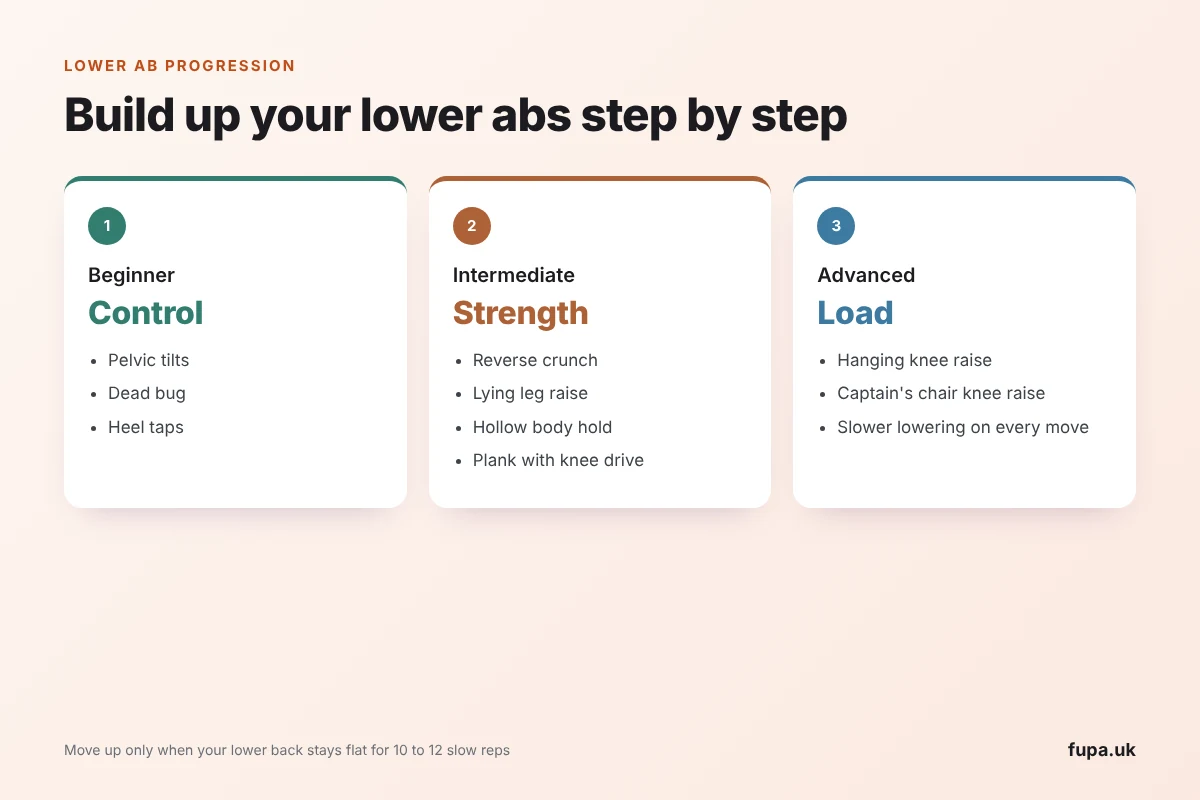
Start at the top of the list and only move on when you can do 10 to 12 slow, controlled reps with your lower back staying flat. Breathe out as you do the hardest part of each rep.
1. Pelvic tilts
Lie on your back with knees bent and feet flat. Gently flatten your lower back into the floor by tilting your pelvis backwards, as if tucking your tailbone under. Hold for two to three seconds, then relax. This is the foundation movement for every other exercise on the list.
2. Dead bug
Lie on your back with arms pointing at the ceiling and knees bent at 90 degrees above your hips. Hold the pelvic tilt, then slowly lower one heel towards the floor while reaching the opposite arm overhead. Return and swap sides. If your back lifts, make the movement smaller.
3. Heel taps
Start in the same tabletop position as the dead bug, with arms by your sides. Keeping your knees bent, lower one heel to tap the floor, then bring it back up. Alternate legs slowly. Straighter legs make it harder, so keep them bent at first.
4. Reverse crunch
Lie with knees bent and lifted, hands by your sides. Breathe out and curl your hips off the floor, bringing your knees towards your chest by rolling your pelvis, not by swinging your legs. Lower slowly. The movement is small: if you need to throw your legs, you are using momentum.
5. Lying leg raise
Lie flat with legs straight and hands under your bottom for support. Hold the pelvic tilt, then lift both legs until they point at the ceiling and lower them slowly. Stop lowering at the point where your back starts to arch. Bending your knees slightly makes this easier.
6. Hollow body hold
Lie on your back, press your lower back down, then lift your shoulders, arms and legs a little off the floor so your body forms a shallow banana shape. Hold for 10 to 30 seconds. Bend your knees or bring your arms forward to make it easier.
7. Plank with knee drive
Start in a high plank with hands under shoulders. Slowly draw one knee towards your chest, pause, then return it. Keep your hips level and avoid letting them sag. Doing this slowly turns a cardio move into a strength move for the deep core.
8. Hanging knee raise
Hang from a bar, or use the arm rests of a captain’s chair station in a gym. Curl your knees up towards your chest by tilting your pelvis, then lower under control. A study run for the American Council on Exercise in 2001 ranked the captain’s chair among the top two moves for activating the rectus abdominis.
Lower Ab Exercises Compared
The table sums up where each move fits. Reps are a starting point; slow, clean reps matter more than high numbers.
| Exercise | Level | Main focus | Starting dose | Common mistake |
|---|---|---|---|---|
| Pelvic tilts | Beginner | Pelvic control | 2 sets of 10 | Pushing with the legs |
| Dead bug | Beginner | Deep core, coordination | 2 sets of 8 each side | Back lifting off the floor |
| Heel taps | Beginner | Lower abs, deep core | 2 sets of 10 each side | Rushing the reps |
| Reverse crunch | Intermediate | Lower rectus abdominis | 2 sets of 10 | Swinging the legs |
| Lying leg raise | Intermediate | Lower abs, hip flexors | 2 sets of 8 | Lowering too far |
| Hollow body hold | Intermediate | Whole front core | 3 holds of 15 seconds | Neck straining |
| Plank with knee drive | Intermediate | Deep core, shoulders | 2 sets of 8 each side | Hips sagging |
| Hanging knee raise | Advanced | Lower abs, grip | 2 sets of 6 to 8 | Swinging |
Which ones to choose
Pick one move from the beginner group, one from the middle group and one hold. That gives you control, strength and endurance in a session of about ten minutes.
A Simple Lower Abs Workout
Beginner session
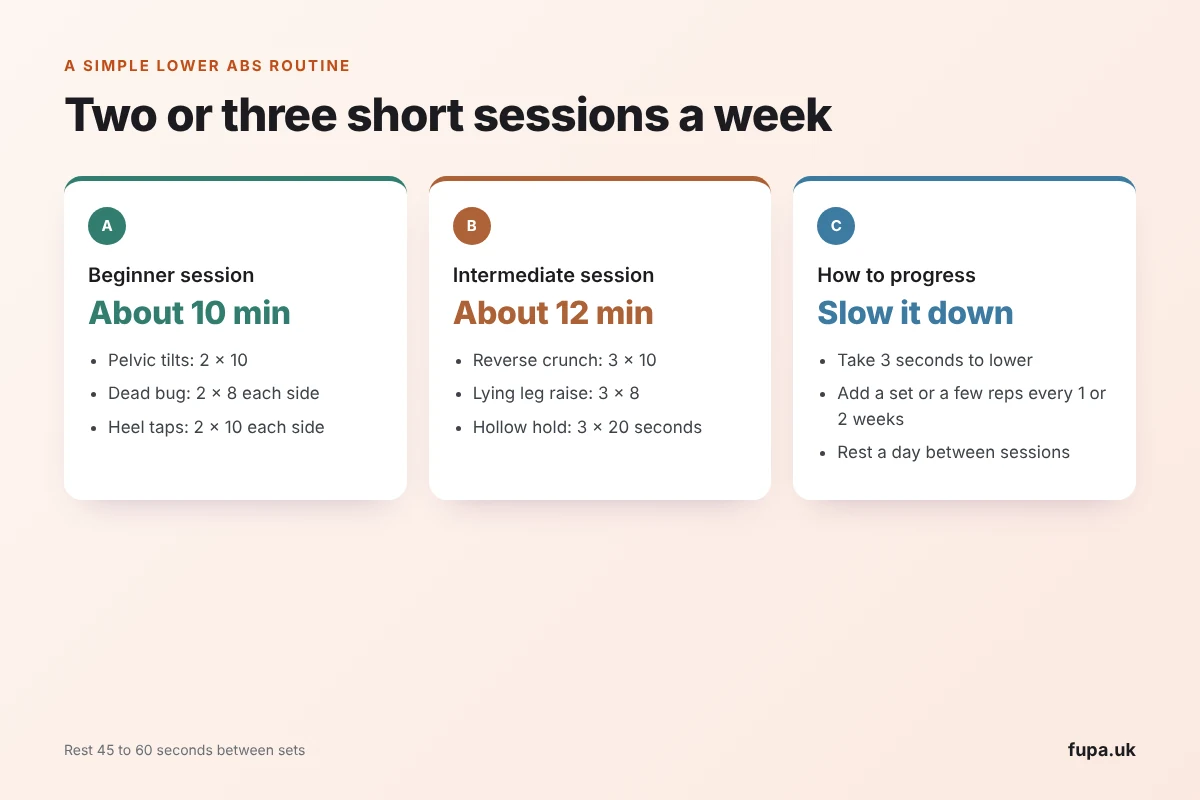
- Pelvic tilts: 2 sets of 10
- Dead bug: 2 sets of 8 each side
- Heel taps: 2 sets of 10 each side
- Rest 45 to 60 seconds between sets
Intermediate session
- Reverse crunch: 3 sets of 10
- Lying leg raise: 3 sets of 8
- Hollow body hold: 3 holds of 20 seconds
- Rest 45 to 60 seconds between sets
How often to train
The NHS physical activity guidelines advise strengthening activities that work all the major muscle groups on at least 2 days a week. Adding a short lower ab block to the end of two or three of those sessions is plenty. Your core also works hard during squats, deadlifts and carries.
How to progress
- Slow each rep down, taking three seconds to lower.
- Add one set, or two to three reps per set, each week or two.
- Move to the next exercise on the ladder when the current one feels easy with perfect form.
- Keep at least one rest day between core sessions.
Form Mistakes That Shift the Work Away From Your Abs
Letting your lower back arch
This is the most common problem. Once the back arches, the hip flexors take over and strain can build in the lower spine. Shorten the range, bend your knees or go back a step on the ladder.
Using momentum
Swinging the legs makes reps easier but turns off the abs. Count slowly and pause at the top of each rep.
Holding your breath
Breathe out on the effort and in as you return. Holding your breath raises pressure in the abdomen, which is unhelpful if you have pelvic floor weakness or a separation of the stomach muscles.
Pulling on your neck
If your hands are behind your head, keep them light. Your chin should stay a fist’s width from your chest.
Who Should Take Extra Care
After pregnancy
Many people have a gap between the two sides of the abdominal muscles after pregnancy. Gentle deep core work and pelvic floor exercises usually come first, and crunch style moves may need to wait. Our guide on FUPA vs diastasis recti explains how to check, and your GP can refer you to a pelvic health physiotherapist.
Back pain
Dead bugs and pelvic tilts are often well tolerated, but stop any move that causes sharp or spreading pain and ask your GP or a physiotherapist for advice.
A new bulge or lump
If you notice a bulge that appears when you strain or cough, or pain in the groin, see your GP before carrying on with core training, as these can be signs of a hernia.
Frequently Asked Questions
What are the best lower ab exercises?
Reverse crunches, leg raises, dead bugs and hanging knee raises are among the best because they make you control your pelvis while your legs move. Start with dead bugs and pelvic tilts if you are new to core work.
Can you train your lower abs separately?
Partly. Your rectus abdominis is one muscle, but a small 2023 ultrasound study found that leg raises worked its lowest section harder than crunches did. Leg based moves are a sensible choice for the lower abs.
Will lower ab exercises get rid of my lower belly?
No. They strengthen the muscle under the fat but do not burn the fat itself. Fat loss comes from a calorie deficit, regular activity and time.
How often should I do lower ab exercises?
Two or three short sessions a week is enough for most people, with a rest day in between. Quality and slow control matter more than doing them every day.
Why do I feel lower ab exercises in my hips or back?
That usually means your hip flexors are taking over and your lower back is arching. Make the move smaller, bend your knees and focus on keeping your back flat against the floor.
The Bottom Line
Control first, then load
Good lower ab exercises are slow and controlled, start with a pelvic tilt, and progress from dead bugs and heel taps to reverse crunches, leg raises and hanging knee raises. They build a stronger, flatter stomach wall, but they will not remove lower belly fat on their own. Pair them with the cardio and strength sessions in our belly fat workout plan and a modest calorie deficit for the best result.