
Intermittent Fasting for Lower Belly Fat: Does It Help?
Page Contents
- Key Takeaways
- What Is Intermittent Fasting?
- 16:8 time restricted eating
- The 5:2 diet
- Alternate day fasting
- Does Intermittent Fasting Burn Belly Fat? What the Research Shows
- The 12 month trial with matched calories
- The 16:8 trial without calorie targets
- What this means for your belly
- Why Fasting Does Not Target the Lower Belly
- The body chooses where fat comes from
- Deep belly fat responds to any calorie deficit
- The insulin question
- Intermittent Fasting vs a Simple Calorie Deficit
- When fasting may help
- When a daily deficit is better
- How to Try 16:8 Fasting Sensibly
- Start gently
- What to eat in your window
- A sample 16:8 day
- Keep training and moving
- Who Should Not Try Intermittent Fasting
- People who should avoid it
- People who should speak to a GP first
- Side effects to watch for
- Frequently Asked Questions
- Does intermittent fasting burn belly fat?
- Is 16:8 fasting good for lower belly fat?
- Is 5:2 better than 16:8 for belly fat?
- How long does it take to see results from intermittent fasting?
- Can I drink coffee while fasting?
- The Bottom Line
- A tool, not a shortcut
Intermittent fasting for belly fat is one of the most popular ideas in weight loss, and plenty of people say a 16:8 or 5:2 routine finally helped them slim down. The research tells a more measured story. Fasting can work, but mainly because it helps some people eat less, not because skipping meals burns belly fat in a special way.
This guide explains the main types of intermittent fasting, what the best trials found, how fasting compares with a simple calorie deficit, and how to try it safely if it suits you. For the full fat loss method, see our main guide on how to burn lower belly fat, part of our wider guide on how to get rid of a FUPA.
This guide is general information, not medical advice. Do not try fasting if you are pregnant, breastfeeding, under 18, underweight or have a history of an eating disorder, and speak to your GP first if you have diabetes or take regular medication.
Key Takeaways
- Intermittent fasting means limiting when you eat, such as within an eight hour window or on two low calorie days a week.
- A 12 month trial found that adding an eight hour eating window to a calorie controlled diet did not lead to a meaningful extra loss of weight or body fat.
- Fasting does not burn fat from the lower belly first; the body decides where fat comes from.
- Fasting can be a useful way to cut calories if it fits your routine and appetite.
- It is not safe for everyone, and some people find it leads to overeating later in the day.
What Is Intermittent Fasting?

Intermittent fasting is an eating pattern rather than a diet. It sets rules about when you eat, and sometimes how much on certain days, instead of which foods you eat.
16:8 time restricted eating
You eat all your meals within an eight hour window, such as 10am to 6pm or 12pm to 8pm, and have only water, black coffee or plain tea for the other 16 hours. Some people use a gentler 14:10 pattern. This is the most popular form because it often just means skipping breakfast or late night snacks.
The 5:2 diet
You eat normally on five days a week and cut right down, usually to around a quarter of your normal intake, on two days that are not back to back. The low calorie days often mean two small meals built around protein and vegetables.
Alternate day fasting
You switch between normal eating days and very low calorie days. It is the strictest form and many people find it hard to keep up over months.
Does Intermittent Fasting Burn Belly Fat? What the Research Shows
The 12 month trial with matched calories
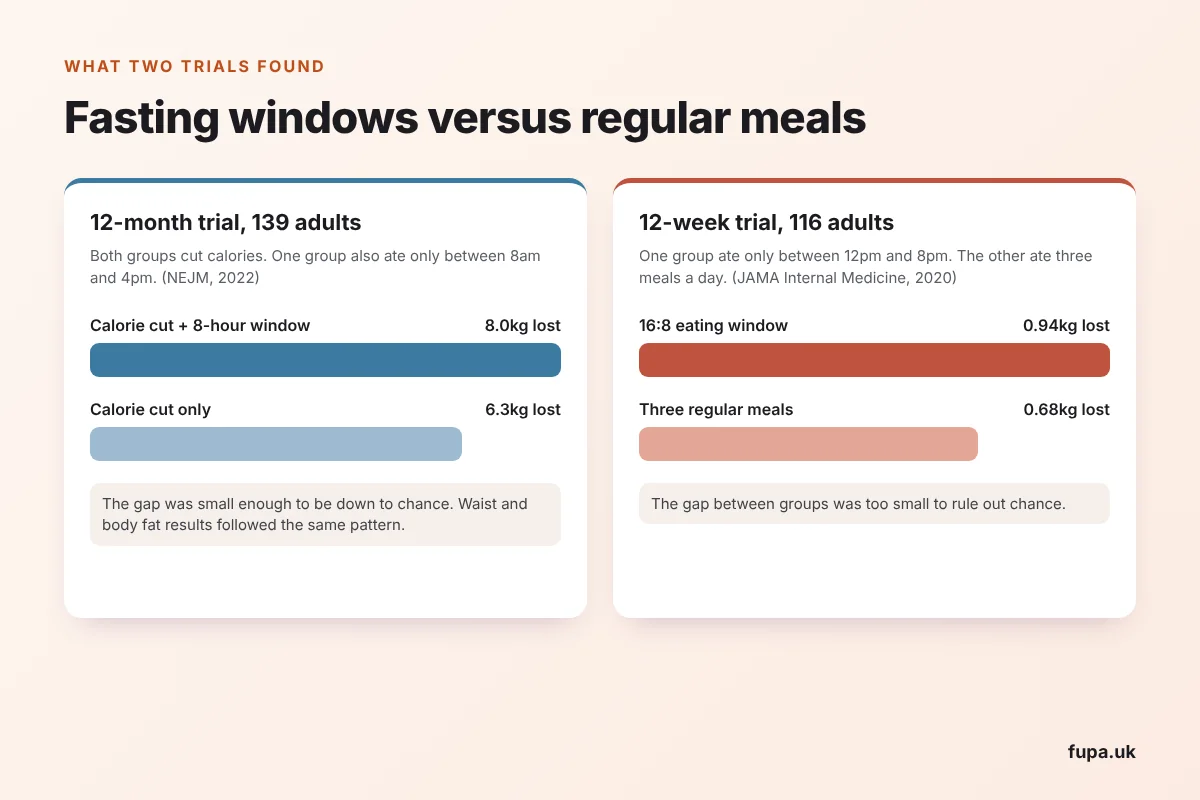
A trial published in the New England Journal of Medicine in 2022 followed 139 adults with obesity for a year. Everyone ate a calorie controlled diet of 1,500 to 1,800 calories a day for men and 1,200 to 1,500 for women. Half also ate only between 8am and 4pm. After 12 months, the time restricted group had lost an average of 8.0kg and the calorie only group 6.3kg, a gap the researchers found could be explained by chance. Changes in waist size and body fat followed the same pattern.
The 16:8 trial without calorie targets
The TREAT trial, published in JAMA Internal Medicine in 2020, followed 116 adults with overweight or obesity for 12 weeks. One group ate only between 12pm and 8pm, while the other ate three regular meals a day. The 16:8 group lost an average of 0.94kg and the regular meals group 0.68kg, and the gap between the groups was too small to rule out chance. The researchers concluded that time restricted eating was not more effective for weight loss than eating throughout the day.
What this means for your belly
When people eat the same number of calories, the timing of meals makes little difference to fat loss. Fasting works when it helps you eat less overall, which it does for some people and not others. There is no strong evidence that fasting shrinks belly fat faster than any other way of creating a calorie deficit.
Why Fasting Does Not Target the Lower Belly
The body chooses where fat comes from
No eating pattern can tell your body to burn fat from one area first. Fat in the lower belly and over the pubic bone tends to be among the last to go, especially in women. Our guide to stubborn lower belly fat explains why.
Deep belly fat responds to any calorie deficit
Visceral fat, the deeper fat around your organs, often shrinks early in weight loss. This happens whether the deficit comes from fasting, smaller portions or more activity. It is good news for your health, even before the lower belly looks different.
The insulin question
Fasting is often promoted as a way to lower insulin and switch on fat burning. Longer gaps between meals do mean lower insulin levels for longer, but in trials this has not translated into extra fat loss when calories are matched. If you have insulin resistance or prediabetes, losing weight by any method usually improves blood sugar control. Our guide to FUPA and insulin resistance covers this in more depth.
Intermittent Fasting vs a Simple Calorie Deficit
Both approaches work the same way at heart. The best one is the one you can keep up.
| Feature | 16:8 fasting | 5:2 diet | Daily calorie deficit |
|---|---|---|---|
| Main rule | Eat within an eight hour window | Two low calorie days a week | Eat a little less every day |
| Calorie counting | Not always needed | Mainly on low days | Usually needed at first |
| Fat loss when calories match | Similar | Similar | Similar |
| Suits people who | Are not hungry in the morning | Like strict days and relaxed days | Prefer regular meals |
| Common problems | Overeating in the window, low energy for morning workouts | Hunger, headaches and irritability on low days | Counting fatigue, slow progress |
When fasting may help
If you snack a lot in the evening, a set cut off time can remove hundreds of calories without much effort. If you are rarely hungry in the morning, skipping breakfast may cost you nothing. In both cases, fasting is a simple rule that makes a deficit easier.
When a daily deficit is better
If long gaps make you ravenous and you then overeat, fasting will work against you. The NHS advises not skipping meals for exactly this reason. Our guide to a calorie deficit for a FUPA shows how to set a daily target instead.
How to Try 16:8 Fasting Sensibly
Start gently
- Begin with a 12 hour overnight gap, such as 8pm to 8am, for a week.
- Move to 14:10 by pushing breakfast later or finishing dinner earlier.
- Try 16:8 only if the shorter windows feel easy.
- Drink water, plain tea or black coffee during the fasting hours.
- Review after four weeks: if you are hungrier, more tired or overeating, stop.
What to eat in your window
Fasting does not cancel out the quality of what you eat. Build meals around protein, vegetables, wholegrains and some healthy fats, and keep sugary drinks, alcohol and ultra processed snacks to a minimum. Our FUPA diet guide sets out what the evidence supports, and our guide to protein for FUPA fat loss explains why protein matters more when meals are fewer. Fibre helps too, and our guide to fibre and belly fat shows how to reach the 30g daily target.
A sample 16:8 day
- 12pm: wholemeal wrap with chicken or beans, salad and a yoghurt.
- 3pm: fruit and a handful of nuts.
- 7pm: salmon or tofu with roasted vegetables and new potatoes.
- 8pm onwards: water or caffeine free tea until midday.
Keep training and moving
Fasting works best alongside regular activity. If you lift weights, try to eat a protein rich meal within your window after training to support muscle repair. Strength training on two days a week helps you keep muscle while you lose fat.
Who Should Not Try Intermittent Fasting
People who should avoid it
- Women who are pregnant, trying to conceive or breastfeeding.
- Anyone under 18.
- People who are underweight.
- Anyone with a current or past eating disorder.
People who should speak to a GP first
- People with type 1 or type 2 diabetes, especially those taking insulin or other medicines that lower blood sugar, because of the risk of hypos.
- People taking medicines that need to be taken with food.
- Anyone with a long term health condition, such as heart or kidney disease, or who is having treatment for cancer.
Side effects to watch for
Common early side effects include hunger, headaches, low energy, poor concentration and irritability. These often settle within a couple of weeks. If they do not, or if fasting leaves you thinking about food all the time, it is a sign that another approach would suit you better.
Frequently Asked Questions
Does intermittent fasting burn belly fat?
It can help you lose belly fat if it helps you eat fewer calories overall. Trials that matched calories found no clear extra fat loss from fasting compared with ordinary meal times.
Is 16:8 fasting good for lower belly fat?
16:8 does not target the lower belly. It is one way of creating a calorie deficit, and the lower belly usually shrinks last whichever method you use.
Is 5:2 better than 16:8 for belly fat?
There is no clear winner. Both work through cutting calories, so the better choice is the one that fits your routine and appetite and that you can keep doing.
How long does it take to see results from intermittent fasting?
Most people see a small drop on the scales in the first week or two, much of it water. Visible changes to the lower belly usually take a few months of steady fat loss.
Can I drink coffee while fasting?
Black coffee, plain tea and water are usually fine during the fasting hours. Adding milk, sugar or syrups adds calories, which breaks the fast.
The Bottom Line
A tool, not a shortcut
Intermittent fasting is not a special way to burn belly fat. It is one of several ways to eat less, and the best studies show similar results to a plain daily calorie deficit. If a 16:8 or 5:2 pattern makes it easier for you to eat a little less, it is a reasonable option. If it leaves you hungry, tired or overeating, choose regular meals instead. For the complete plan, read our guide on how to burn lower belly fat.