
Coats and Jackets for a FUPA: Lengths and Cuts That Balance Your Shape
Page Contents
- Key Takeaways
- Why Coat Length Matters
- A hem is a line
- Proportion and height
- Movement and fit
- Coat Lengths From Best to Trickiest
- Knee length coats
- Mid thigh coats
- Midi and long coats
- Hip length jackets
- Cropped jackets
- Cuts That Balance Your Shape
- Wrap coats
- Belted trench coats
- Single breasted tailored coats
- Swing and A line coats
- Cocoon coats
- Jackets for Everyday Wear
- Blazers
- Denim jackets
- Leather and faux leather jackets
- Utility and shacket styles
- Puffer Coats and Raincoats
- Choosing a puffer
- Parkas
- Raincoats
- Details That Make a Difference
- Pockets
- Buttons and fastening
- Fabric
- Colour
- How to Wear Your Coat
- Open or closed
- What to wear underneath
- Scarves
- Buying Tips
- Try it with your usual layers
- Sit down in it
- Check the shoulders first
- Buy for the life you live
- Frequently Asked Questions
- What coat length is best for a FUPA?
- Are belted coats good for a FUPA?
- Can I wear a puffer coat with a FUPA?
- Should I wear my coat open or closed?
- Are double breasted coats bad for a FUPA?
- What jacket suits a FUPA for work?
- The Bottom Line
- Let the hem fall past the lower belly
In the UK, a coat is often the first thing people see you in for half the year. So it makes sense to choose one that feels good and works with your shape. If you have a FUPA, the length and cut of a coat can make a big difference. Some styles end right at the lower belly and frame it. Others fall cleanly past it and create a long, balanced line. This guide to coats and jackets for a FUPA explains which lengths and cuts flatter, and why.
A FUPA is a soft pad of fat over the mons pubis, just above the pubic bone. It is common at every size. Styling is about comfort and confidence, not hiding who you are. For the full set of styling ideas, start with our guide on how to hide a FUPA.
Key Takeaways
- Avoid hems that stop at the widest part of the lower belly or the top of the hips. These draw a line across the FUPA.
- Mid thigh, knee length and midi coats fall past the lower belly and create a long vertical line.
- Wrap coats and belted trench coats define the waist and let fabric skim the lower body.
- Single breasted styles usually flatter more than double breasted ones, as they add less bulk at the front.
- Wearing a longer coat open creates two strong vertical lines, which slims the outline.
Why Coat Length Matters
A hem is a line
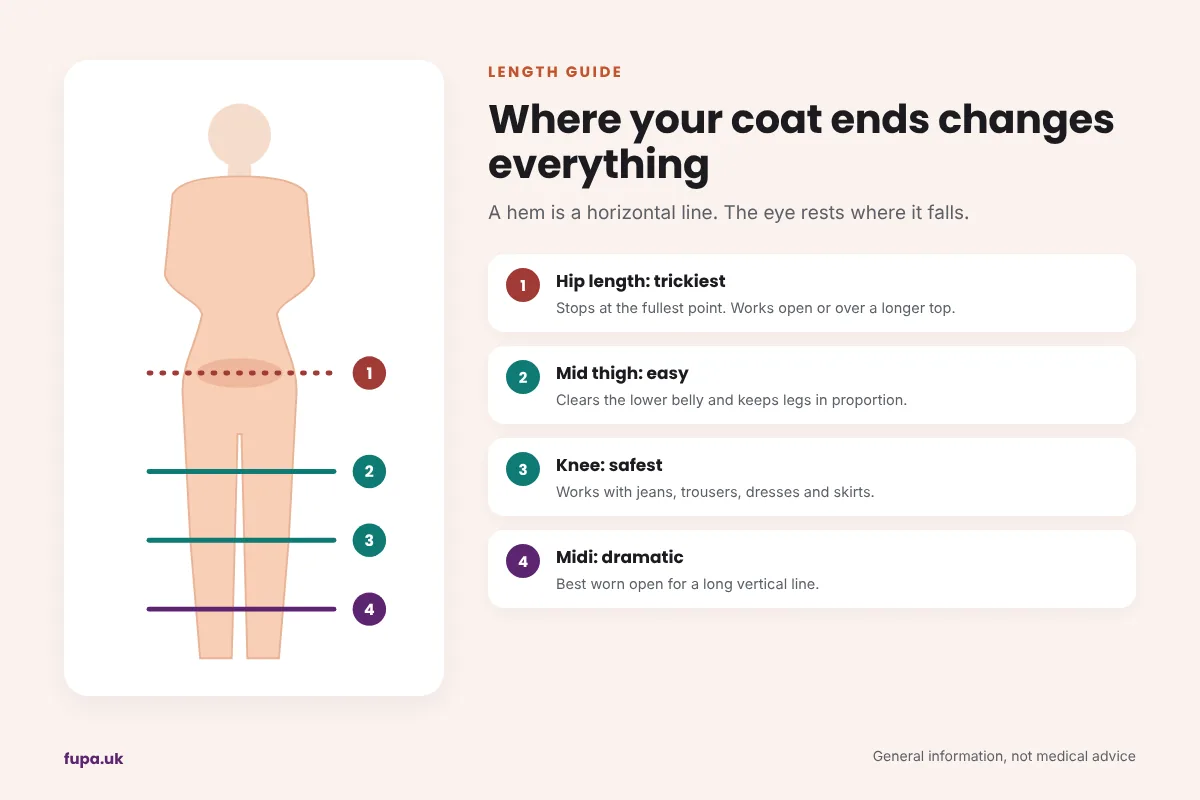
Wherever a coat ends, it draws a horizontal line across your body. The eye tends to rest there. If that line falls at the fullest part of the lower belly or hips, it frames the area. If it falls on the thigh or knee, the eye moves past the FUPA without stopping.
Proportion and height
Your height and leg length also play a part. On a shorter frame, a very long coat can swamp you. On a taller frame, a short jacket can cut you in half. The aim is a hem that sits in proportion with your body and clear of the lower belly.
Movement and fit
A coat that is tight across the hips will pull when you walk or sit. That pulling creates creases that point to the lower belly. Choose a size that closes easily over your usual layers.
Coat Lengths From Best to Trickiest
Knee length coats
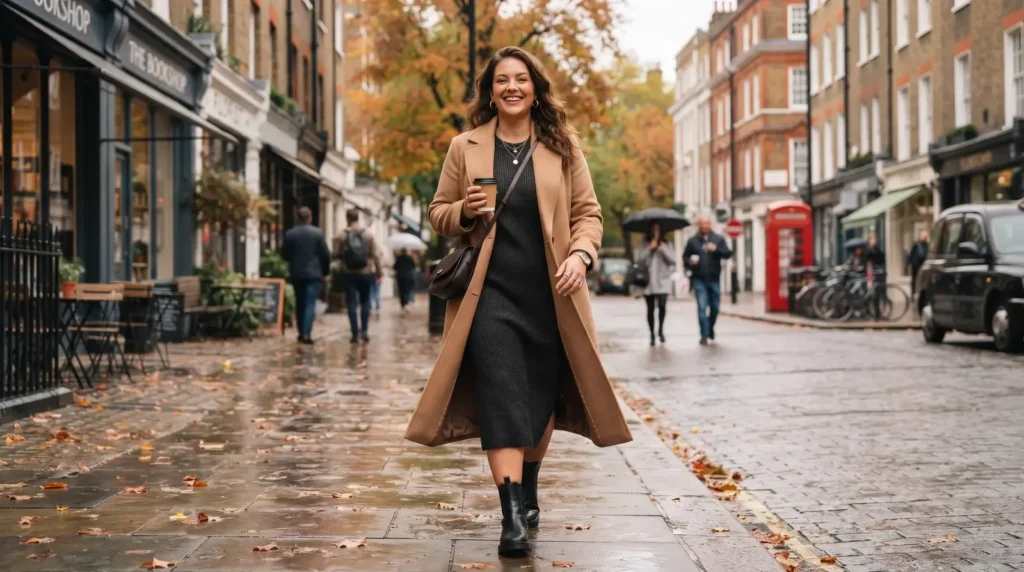
A coat that ends just above or at the knee is the most reliable choice. It covers the lower belly and the hips fully, and it works with jeans, trousers, skirts and dresses. If you buy one smart coat, this length is a safe bet.
Mid thigh coats
A mid thigh length is a good everyday option, especially for parkas and car coats. It falls past the FUPA and leaves enough leg showing to keep things balanced on a shorter frame.
Midi and long coats
A coat that reaches mid calf creates a dramatic, elegant line. It works well open over a simple outfit. On a petite frame, choose a slimmer cut and pair it with a slight heel or a longer trouser to keep the line unbroken.
Hip length jackets
Short jackets that end at the top of the hip are the trickiest. They often stop right at the FUPA. They can still work if they sit at the high hip above the lower belly, or if you wear them open over a longer top or dress.
Cropped jackets
Jackets that stop at the waist can be surprisingly flattering. They highlight the narrowest part of the torso and leave the lower half to a dress, skirt or high rise trousers. Pair them with a high waisted bottom so the waistband sits above the FUPA.
Cuts That Balance Your Shape
Wrap coats
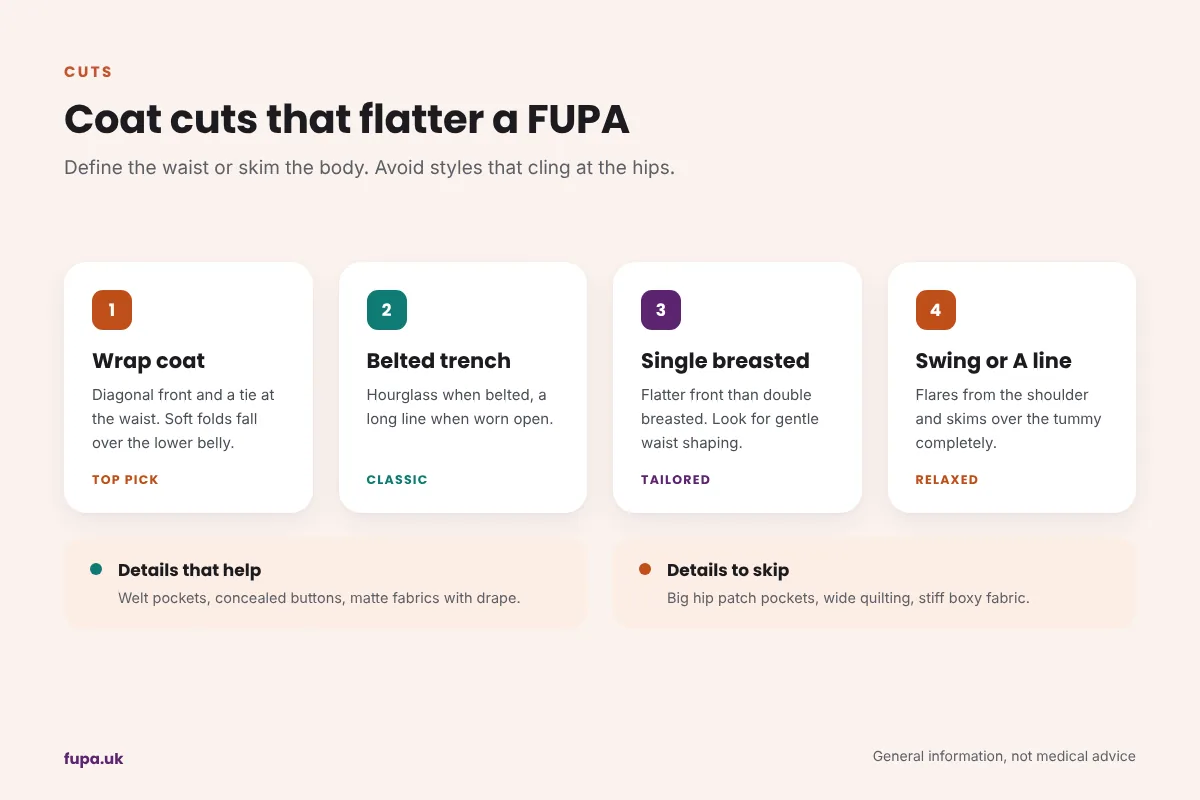
A wrap coat crosses over at the front and ties at the waist. The diagonal line draws the eye up and across, and the tie defines the waist. The fabric below the belt falls in soft folds over the lower belly. This is one of the most flattering cuts for a FUPA.
Belted trench coats
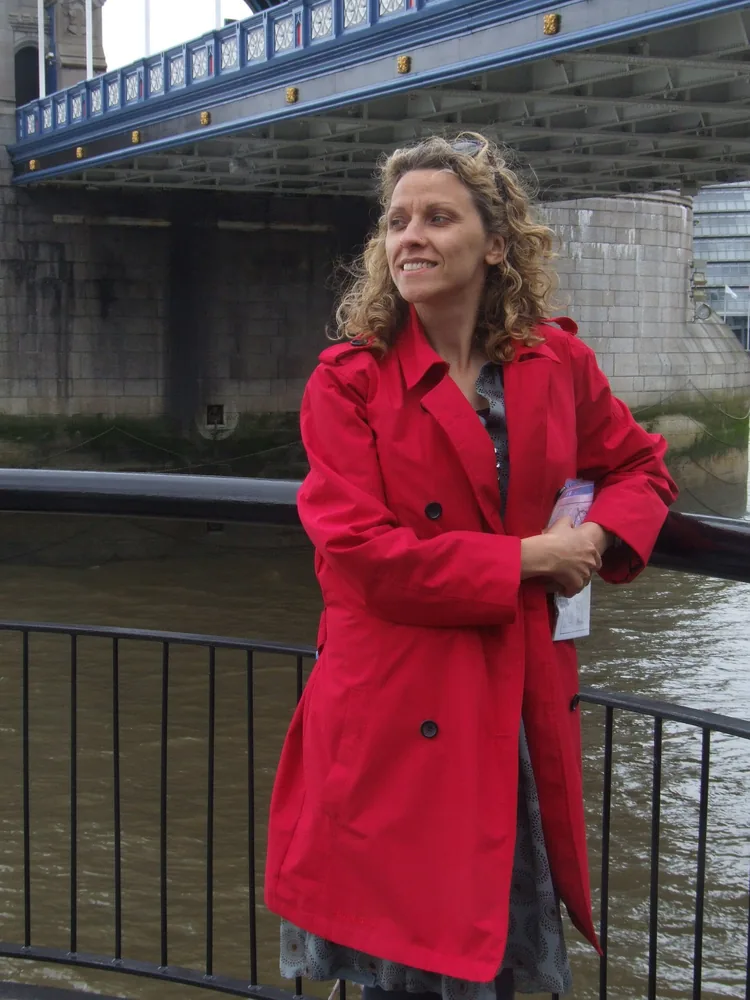
The classic trench has a tie belt at the waist and a skirt that flares slightly. Belted, it gives an hourglass shape. Open, with the belt tied loosely behind, it gives a long, relaxed line. Choose a trench that reaches the knee for the best balance.
Single breasted tailored coats
A single breasted coat with one row of buttons sits flatter at the front than a double breasted one. A slight shaping at the waist helps. Look for a coat with a gentle A line from the waist down, so it does not cling to the hips.
Swing and A line coats
Swing coats are narrow at the shoulders and flare out towards the hem. They skim over the tummy and lower belly completely. They work best on people with narrower shoulders.
Cocoon coats
Cocoon coats are rounded and roomy through the middle and taper at the hem. They do not define the waist, but they do not cling either. Wear them open with a fitted layer underneath to avoid a boxy look.
Jackets for Everyday Wear
Blazers
A blazer that ends at the hip bone or just below the bottom is the most flattering. Single button styles create a deep V that lengthens the torso. Wear it open over a simple top, or belted for shape. Our guide to work trousers for a FUPA covers what to pair it with.
Denim jackets
Classic denim jackets are short and stiff. They work best open, over a dress or longer top. A slightly longer or oversized denim jacket that reaches the mid hip is easier to wear.
Leather and faux leather jackets
Biker jackets usually stop at the waist or high hip. Because they are short, they highlight the waist and leave the lower half free. Pair them with high rise jeans or a wrap dress.
Utility and shacket styles
Shirt jackets and utility jackets that reach the mid thigh are relaxed and easy. A drawstring at the waist can add some shape without squeezing.
Puffer Coats and Raincoats
Choosing a puffer
Puffers add volume, and wide horizontal quilting can make the body look wider. Look for narrower channels, a longer length and a two way zip. A puffer with a belt or a fitted waist gives more shape. A matte finish is often more flattering than a high shine.
Parkas
Parkas with a drawstring at the waist are practical for the British winter. Pull the drawstring gently to add shape at the natural waist, not around the hips. A length that reaches the mid thigh or knee works best.
Raincoats
Lightweight raincoats in a trench or mac shape are easy to style. Choose a version with a hood and a tie belt. A longer length keeps you drier and covers the lower belly.
Details That Make a Difference
Pockets
Big patch pockets at hip level add bulk exactly where you may not want it. Slanted or welt pockets lie flatter. Keep your pockets empty, as phones and keys can push the fabric out.
Buttons and fastening
A coat that closes with a concealed placket or a single row of buttons gives a smoother front. If buttons pull across the lower belly, size up or wear the coat open.
Fabric
Wool and wool blend coats hold their shape and drape well. Very stiff fabrics stand away from the body and can look boxy. Very thin fabrics can cling. A medium weight with some drape is the sweet spot.
Colour
A single colour from top to toe creates a long line. A darker coat over a lighter outfit, worn open, draws two vertical stripes down the body. Camel, navy, charcoal and black are easy to wear with everything.
How to Wear Your Coat
Open or closed
Wearing a coat open creates a strong vertical frame and is often the most flattering way. Closed, it needs to fit well across the hips and lower belly without pulling.
What to wear underneath
A smooth base layer helps the coat sit well. Our guides to shapewear for a FUPA and outfits for a FUPA cover tops, bottoms and underlayers that sit cleanly under outerwear.
Scarves
A long scarf hanging down the front adds another vertical line. A chunky scarf wrapped high draws the eye to the face.
Buying Tips
Try it with your usual layers
Try coats on over a jumper, not just a T shirt. A coat that fits in summer may pull across the lower belly in winter.
Sit down in it
Sit in the changing room or on a chair at home. If the coat rides up or strains across the hips, try a different cut or a size up.
Check the shoulders first
Shoulders are hard to alter, while a hem can be shortened. Pick the size that fits your shoulders and chest, then check the length. A tailor can take up a hem quite cheaply.
Buy for the life you live
If you walk or commute a lot, prioritise warmth, a hood and a length you can move in. If you drive, a mid thigh coat is easier to sit in than a full length one.
Frequently Asked Questions
What coat length is best for a FUPA?
Knee length and mid thigh coats are the most flattering for most people. They fall past the lower belly and hips and create a long vertical line. Avoid hems that stop right at the widest part of the lower belly.
Are belted coats good for a FUPA?
Yes. A belt at the natural waist creates shape, and the fabric below falls over the lower belly. Wrap coats and trench coats are good examples. Keep the belt at your waist, not lower.
Can I wear a puffer coat with a FUPA?
You can. Choose a longer style with narrow quilting, a matte finish and some shaping at the waist. A two way zip lets you open the bottom so the coat sits comfortably over the hips.
Should I wear my coat open or closed?
Open is often the most flattering, as the two front edges create long vertical lines. If you prefer it closed, make sure it fastens without pulling across the lower belly.
Are double breasted coats bad for a FUPA?
Not bad, but they add an extra layer of fabric and buttons at the front, which can add bulk. If you like them, choose a softer fabric, a longer length and a slightly higher button stance.
What jacket suits a FUPA for work?
A single breasted blazer that ends at the hip bone or just below the bottom works well. A single button creates a flattering V. Wear it open or with a belt for shape.
The Bottom Line
Let the hem fall past the lower belly
The best coats and jackets for a FUPA end below the lower belly or well above it, never right across it. Knee length and mid thigh coats, wrap and trench styles, and single breasted tailoring all create a balanced outline. Wear longer coats open for a vertical line, keep pockets flat, and choose fabrics that drape. Most of all, pick a coat that keeps you warm and feels good to wear. For more ideas, see our guide to dresses for a FUPA.