
How to Lose Lower Belly Fat as a Woman
Page Contents
- Key Takeaways
- Why Women Store Fat on the Lower Belly
- Oestrogen and the pear shape
- Subcutaneous and visceral fat
- Genes and the FUPA
- Lower Belly Fat Women Notice at Different Life Stages
- The monthly cycle and bloating
- After pregnancy
- PCOS
- Perimenopause and menopause
- How to Lose Lower Belly Fat as a Woman: The Plan
- Step 1: Set a modest calorie deficit
- Step 2: Build meals around protein and fibre
- Step 3: Move every day
- Step 4: Lift weights twice a week
- Step 5: Sleep, stress and alcohol
- A Sample Week for Women
- Training schedule
- Adjusting the plan to your life stage
- Lower Stomach Fat Female Myths
- “Ab exercises will burn it”
- “Detox teas and belly wraps work”
- “You have to cut out carbs”
- Tracking Your Progress
- Use a tape measure
- What a realistic timeline looks like
- When to See a GP
- Signs it may not be fat
- Getting help with weight
- Frequently Asked Questions
- Why do women get lower belly fat?
- What is the fastest way for a woman to lose lower belly fat?
- Can hormones stop you losing lower belly fat?
- Is lower belly fat after pregnancy different?
- Why does my lower stomach look bigger before my period?
- The Bottom Line
- Lose fat overall and work with your life stage
If you are wondering how to lose lower belly fat as a female, the honest answer is that the method is the same as for anyone else, but the reasons fat settles there and the things that get in the way are often different. Oestrogen, the monthly cycle, pregnancy, PCOS and menopause all affect where a woman stores fat and how her lower stomach looks. This guide gives you a realistic plan built around those factors, with clear targets from UK health guidance.
For the full science of fat loss in this area, including why spot reduction does not work, start with our main guide on how to burn lower belly fat.
This guide is general information, not medical advice. If your lower belly is swollen, hard, painful or growing quickly, or you have changes to your periods, speak to your GP.
Key Takeaways
- Women naturally carry more fat on the hips, thighs and lower belly than men, mainly because of oestrogen.
- No exercise burns lower stomach fat on its own. Fat comes off the whole body when you eat a little less than you use.
- Life stage matters: the cycle, pregnancy, PCOS and menopause each change how the lower belly looks.
- Strength training and enough protein protect muscle, which matters more as women get older.
- Track your waist, not just your weight. NICE advises keeping your waist to less than half your height.
Why Women Store Fat on the Lower Belly
Oestrogen and the pear shape
Before menopause, oestrogen encourages the body to store fat under the skin on the hips, thighs, bottom and lower belly. This is often called a pear shape. It is a normal pattern and is linked with fertility and pregnancy. It also means lower belly fat in women is often softer and sits lower than the deeper belly fat men tend to carry.
Subcutaneous and visceral fat
Most of the fat on a woman’s lower belly is subcutaneous, which means it sits just under the skin and you can pinch it. Visceral fat sits deeper, around the organs, and is the type linked with type 2 diabetes and heart disease. Women usually have less visceral fat than men until menopause, when the balance starts to shift.
Genes and the FUPA
Your genes help decide where fat goes first and where it leaves last. Some women carry a noticeable pad of fat above the pubic bone, often called a FUPA, even at a healthy weight. Our guide to FUPA in women explains this fat pad and why it is so common.
Lower Belly Fat Women Notice at Different Life Stages
The monthly cycle and bloating
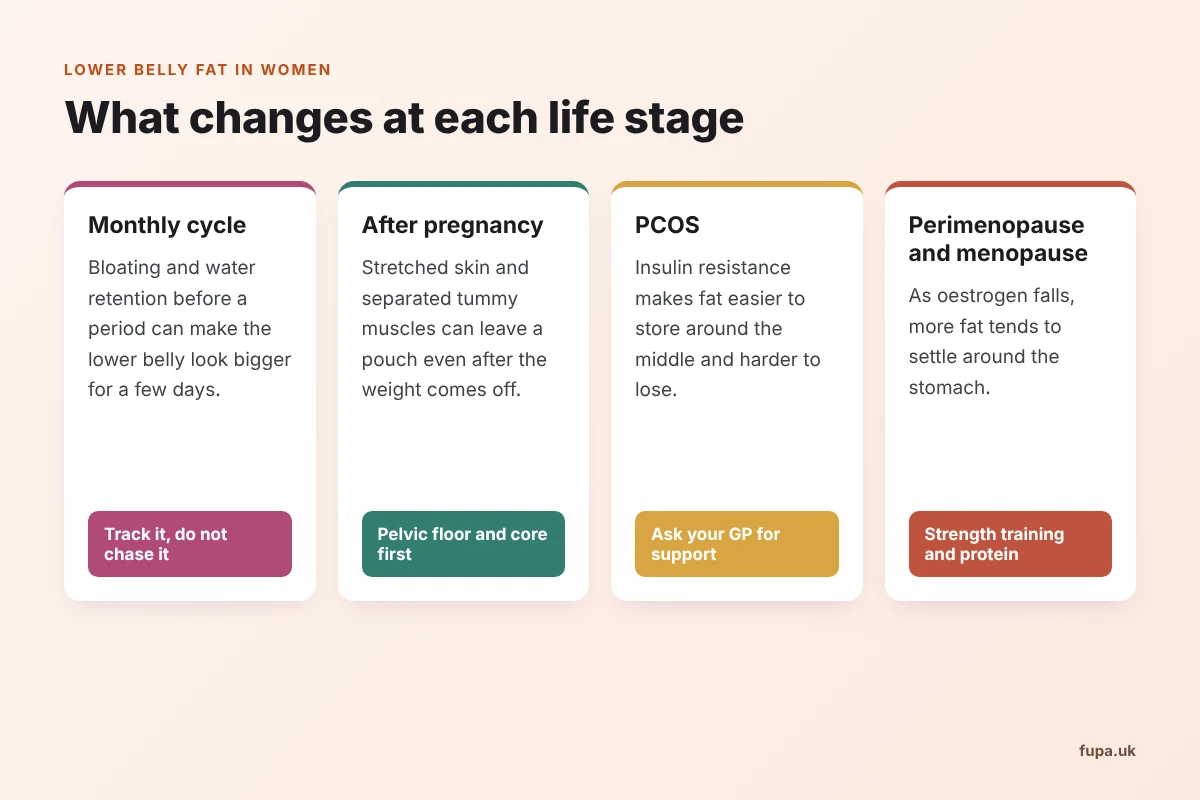
Many women find their lower stomach looks bigger in the days before a period. This is usually bloating and water retention, not new fat, and it settles once the period starts. It helps to measure your waist at the same point in your cycle each month so you compare like with like. Our page on the FUPA and the menstrual cycle covers this in more detail.
After pregnancy
Pregnancy stretches the skin and the tummy muscles. Some women are left with a gap between the two sides of the six pack muscle, known as diastasis recti, which can make the lower belly push forward even after the weight has gone. Wait for your postnatal check, usually around 6 to 8 weeks after birth, before starting harder exercise, and begin with pelvic floor and deep core work. See our guide to the FUPA after pregnancy.
PCOS
Polycystic ovary syndrome is linked with insulin resistance, which makes it easier to store fat around the middle and harder to lose it. The NHS notes that losing weight can improve PCOS symptoms. The plan in this guide still applies, but you may benefit from extra support from your GP. Read more in our guide to the FUPA and PCOS.
Perimenopause and menopause
The NHS lists weight gain as a common menopause symptom and says it often happens around the stomach and upper body. As oestrogen falls, fat storage moves towards the belly and more of it becomes visceral. Muscle also drops with age, which lowers the energy you burn each day. Our page on the FUPA and menopause looks at this stage in depth.
How to Lose Lower Belly Fat as a Woman: The Plan
Step 1: Set a modest calorie deficit
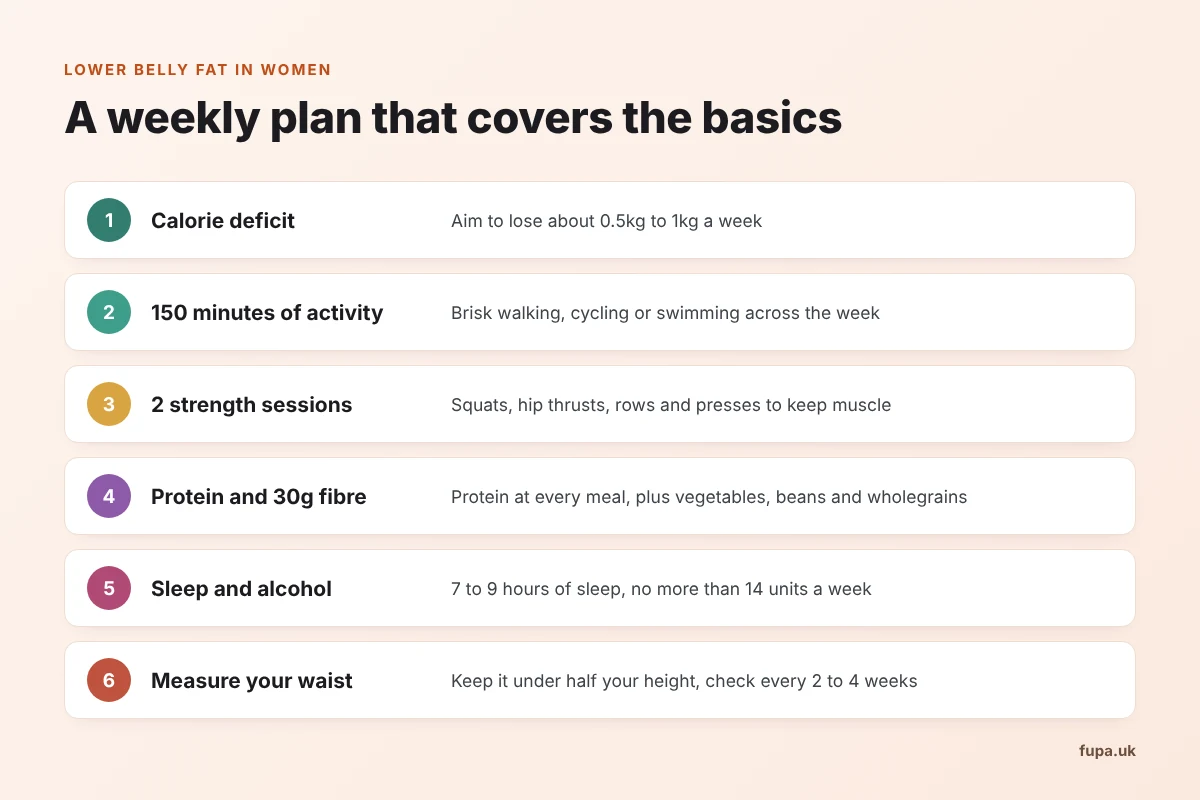
Fat loss happens when you take in slightly less energy than you use. The NHS suggests aiming for a steady loss of 0.5kg to 1kg a week. As a rough guide, the reference intake for an average woman is about 2,000 kcal a day, and a deficit of around 500 kcal a day produces that kind of loss for many people. Your own needs depend on your size, age and how active you are. Very low calorie diets are harder to stick to and can cost you muscle.
Step 2: Build meals around protein and fibre
Protein and fibre both help you feel full on fewer calories. Include a portion of protein at each meal, such as eggs, Greek yoghurt, fish, chicken, tofu, beans or lentils. UK guidance recommends 30g of fibre a day, and most adults eat far less. Vegetables, fruit, oats, wholegrain bread, beans and pulses are easy ways to raise it.
Step 3: Move every day
Aim for at least 150 minutes of moderate activity a week, as the NHS recommends. Brisk walking counts and is easy to fit around work and family. Small habits, such as walking part of the school run or taking the stairs, add up over a week.
Step 4: Lift weights twice a week
Strength training on at least 2 days a week helps you keep muscle while you lose fat. This becomes more important after 40. You do not need a gym: squats, glute bridges, hip thrusts, rows with a resistance band and wall press ups all work at home.
Step 5: Sleep, stress and alcohol
Most adults need 7 to 9 hours of sleep. Poor sleep and long term stress can raise hunger and make healthy choices harder. Alcohol adds calories quickly, so keep to the UK guideline of no more than 14 units a week, spread over 3 or more days.
A Sample Week for Women
Training schedule
| Day | Activity | Time |
|---|---|---|
| Monday | Strength: squats, hip thrusts, rows, wall press ups, dead bugs | 30 to 40 minutes |
| Tuesday | Brisk walk | 30 minutes |
| Wednesday | Cycling, swimming or an exercise class | 30 to 45 minutes |
| Thursday | Strength: lunges, glute bridges, band pulls, planks | 30 to 40 minutes |
| Friday | Brisk walk | 30 minutes |
| Saturday | Longer walk, hike or active day out | 45 to 60 minutes |
| Sunday | Rest or gentle stretching | As you like |
Adjusting the plan to your life stage
If you are postnatal, swap planks for gentle deep core and pelvic floor exercises until you have been checked. If you have PCOS, regular walking after meals may help with blood sugar control. In perimenopause, give extra priority to the two strength sessions and to protein at every meal.
Lower Stomach Fat Female Myths
“Ab exercises will burn it”
Crunches and leg raises strengthen the muscles under the fat, but they do not burn the fat on top. Core work is still useful for posture and support, especially after pregnancy, but it is not a fat loss tool on its own.
“Detox teas and belly wraps work”
Detox teas often contain laxatives, and wraps make you sweat. Both can make you lighter for a few hours by removing water, not fat. They are not a safe way to lose lower stomach fat.
“You have to cut out carbs”
You can lose fat with or without carbs. What matters is the total amount you eat over time. Wholegrain carbs bring fibre, which many women need more of.
Tracking Your Progress
Use a tape measure
Scales can stay the same while you lose fat and gain a little muscle. Measure your waist every 2 to 4 weeks, at the same point in your cycle if you have periods. NICE advises keeping your waist to less than half your height, so a woman who is 165cm tall should aim for a waist below 82.5cm.
What a realistic timeline looks like
Many women see their waist start to change within 4 to 8 weeks. The pad of fat right above the pubic bone is often one of the last places to shrink. That is normal and is not a sign the plan has failed.
When to See a GP
Signs it may not be fat
See your GP if your lower belly feels hard or firm, keeps growing, or comes with pain, heavy or irregular periods, bloating most days, needing to pee more often or changes to your bowels. These can have other causes, such as fibroids or ovarian problems, that need checking.
Getting help with weight
Your GP can check for conditions such as an underactive thyroid or PCOS and tell you about local weight management support. The free NHS Weight Loss Plan app is another good place to start.
Frequently Asked Questions
Why do women get lower belly fat?
Oestrogen encourages women to store fat on the hips, thighs and lower belly. Genes, pregnancy, PCOS and the fall in oestrogen at menopause can all add to fat in this area.
What is the fastest way for a woman to lose lower belly fat?
There is no shortcut. A steady calorie deficit, 150 minutes of activity a week, 2 strength sessions and good sleep give the most reliable results, with a loss of about 0.5kg to 1kg a week.
Can hormones stop you losing lower belly fat?
Hormones can make it slower, for example with PCOS or during menopause, but they do not stop fat loss. If you are struggling despite a good routine, ask your GP to check for an underlying condition.
Is lower belly fat after pregnancy different?
Often it is a mix of fat, stretched skin and separated tummy muscles. Fat loss helps with the fat part, while core rehab helps with muscle separation. Loose skin may not fully tighten.
Why does my lower stomach look bigger before my period?
Bloating and water retention are common in the days before a period. This is not fat gain and usually goes down once your period starts.
The Bottom Line
Lose fat overall and work with your life stage
Women store fat on the lower belly for natural reasons, and that area is often slow to change. The way to shift it is steady overall fat loss: a modest calorie deficit, plenty of protein and fibre, daily movement, strength training twice a week and enough sleep. Fit the plan to your life stage, measure your waist rather than chasing the scales, and see your GP if anything feels hard, painful or unusual. For the wider picture, go back to our guide on how to burn lower belly fat.