
Is Lower Belly Fat Dangerous? Visceral Fat and Your Waist Size
Page Contents
- Key Takeaways
- Is Belly Fat Dangerous? The Two Types Explained
- Subcutaneous fat: the fat you can pinch
- Visceral fat: the fat you cannot see
- Why the two behave so differently
- Visceral Fat Health Risks
- Conditions linked to a large waist
- Why the risk can be hidden
- Insulin resistance and belly fat
- Is Lower Belly Fat Dangerous Compared With Upper Belly Fat?
- The FUPA is usually harmless
- A hard, round belly is a different story
- You can have both
- Subcutaneous vs Visceral Fat at a Glance
- Waist to Height Ratio: The Simplest Check
- What NICE recommends
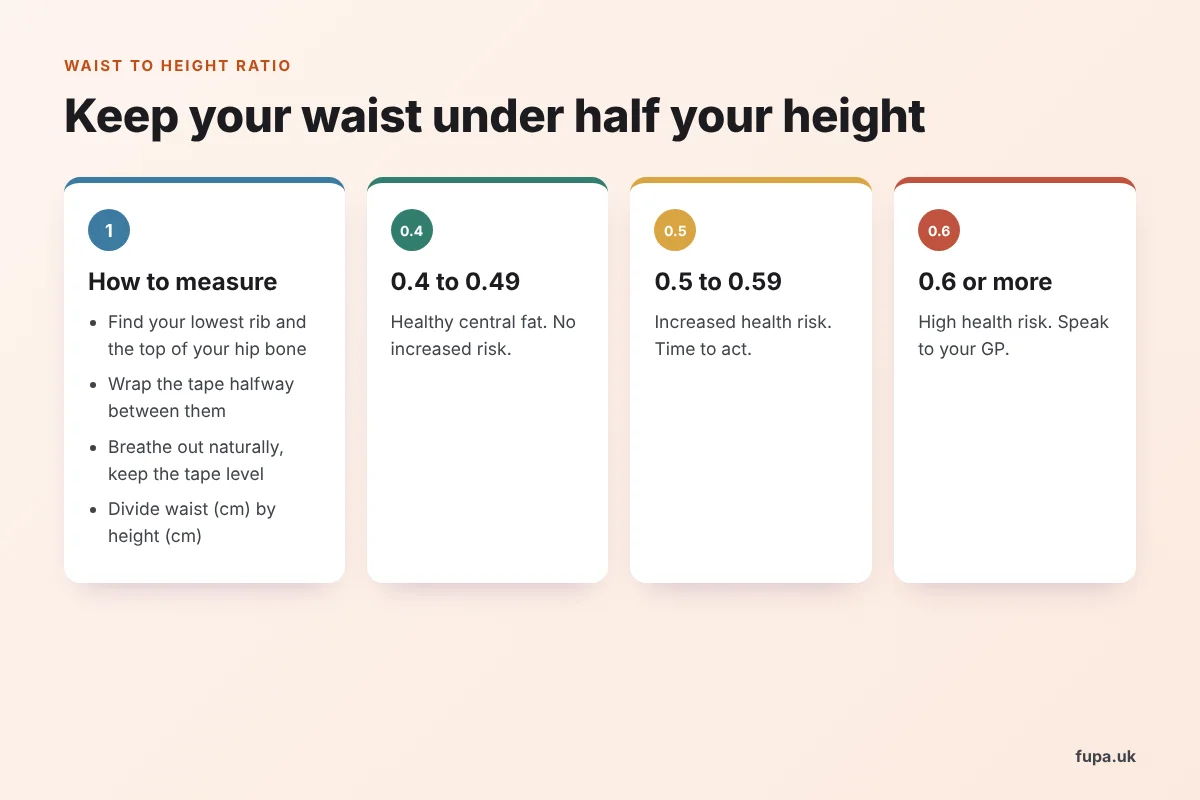
- How to work out your ratio
- What your result means
- A worked example
- How to Measure Your Waist Correctly
- Find the right spot
- Get an accurate reading
- Waist size thresholds
- How to Reduce Visceral Fat
- Create a steady calorie deficit
- Move more every day
- Cut back on alcohol and sugary drinks
- Sleep and stress
- When to See a GP
- Ask for a health check
- Signs that need prompt attention
- Frequently Asked Questions
- Is belly fat dangerous?
- Is lower belly fat dangerous?
- What is a healthy waist to height ratio?
- How can I tell if I have visceral fat?
- What is the fastest way to lose visceral fat?
- The Bottom Line
- Check your waist, not just your weight
Is belly fat dangerous? It is one of the most common questions people ask once they notice their trousers getting tighter around the middle. The short answer is that some belly fat is a real health concern and some is not. Where the fat sits, how deep it is and how big your waist has become matter far more than how your lower belly looks in the mirror.
This guide explains the difference between visceral and subcutaneous fat, why the pad over your pubic bone is usually harmless, and how to use your waist to height ratio to check your own risk at home. For the full fat loss method, see our main guide on how to burn lower belly fat.
This guide is general information, not medical advice. If you are worried about your weight, your waist size or any new swelling in your belly, speak to your GP or practice nurse.
Key Takeaways
- There are two main types of belly fat: subcutaneous fat under the skin and visceral fat deep inside the abdomen.
- Visceral fat is the type linked to type 2 diabetes, heart disease, high blood pressure and fatty liver disease.
- A FUPA, the fat pad over the pubic bone, is mostly subcutaneous fat and is not dangerous in itself.
- NICE advises keeping your waist to less than half your height. A ratio of 0.5 or more points to raised health risk.
- Visceral fat usually shrinks quickly once you start eating a little less and moving more.
Is Belly Fat Dangerous? The Two Types Explained
Subcutaneous fat: the fat you can pinch
Subcutaneous fat sits just under the skin. It is the soft layer you can grab between your fingers on your stomach, hips, thighs and pubic area. Everyone needs some of it: it stores energy, cushions the body and helps keep you warm. On its own, subcutaneous fat on the lower belly carries much less health risk than fat stored deeper inside.
Visceral fat: the fat you cannot see
Visceral fat sits behind the abdominal muscles, packed around the liver, gut, kidneys and other organs. You cannot pinch it. Instead, it pushes the belly outwards and tends to make the stomach feel firm and round rather than soft. A person can look only slightly overweight and still carry a lot of visceral fat, which is why waist size is a better guide than appearance alone.
Why the two behave so differently
Visceral fat is very active. It releases fatty acids and inflammatory substances straight into the blood vessels that lead to the liver. Over time this can upset blood sugar control, raise cholesterol and put strain on the heart and blood vessels. Subcutaneous fat is far less active, which is why two people with the same weight can have very different health risks.
Visceral Fat Health Risks

Conditions linked to a large waist
Carrying too much fat around the middle raises the risk of several long term conditions. These include type 2 diabetes, heart disease, stroke, high blood pressure and non alcoholic fatty liver disease. Public Health England reported that men with a waist over 102cm are five times more likely to develop type 2 diabetes, and women with a waist over 88cm are three times more likely.
Why the risk can be hidden
Body mass index (BMI) only looks at height and weight. It cannot tell where fat is stored. Someone with a normal BMI but a large waist may carry more visceral fat than their weight suggests. This is why UK guidance now asks adults to check their waist as well as their BMI.
Insulin resistance and belly fat
Visceral fat and insulin resistance often go together. When the body becomes less responsive to insulin, blood sugar rises and more fat tends to be stored around the middle, which can then make insulin resistance worse. Our guide to FUPA and insulin resistance covers the signs and what helps.
Is Lower Belly Fat Dangerous Compared With Upper Belly Fat?
The FUPA is usually harmless
The pad of fat over the pubic bone, known as the mons pubis or FUPA, is made mostly of subcutaneous fat. Everyone has one, and its size is shaped largely by genes, hormones and overall body fat. On its own, a FUPA is not a sign of disease. Our guide to whether a FUPA is normal explains why it is such a common body shape.
A hard, round belly is a different story
If most of your extra weight sits above the belly button, and your stomach feels firm when you press it, more of it is likely to be visceral fat. This is the pattern often called a beer belly or apple shape, and it is more common in men and in women after the menopause. Our guide to FUPA vs other belly fat compares the different shapes.
You can have both
Many people carry a mix: some visceral fat inside, plus a soft lower belly and pubic fat pad outside. Visceral fat tends to shift first when you lose weight, so your health risk can drop well before your lower belly looks very different.
Subcutaneous vs Visceral Fat at a Glance
| Feature | Subcutaneous fat | Visceral fat |
|---|---|---|
| Where it sits | Just under the skin | Deep inside, around the organs |
| Can you pinch it? | Yes | No |
| How it feels | Soft and squashy | Belly feels firm and pushed out |
| Health risk | Lower | Higher |
| Typical areas | Lower belly, FUPA, hips, thighs | Upper and middle abdomen |
| Response to fat loss | Often slow, especially low down | Usually quick |
Waist to Height Ratio: The Simplest Check
What NICE recommends
NICE, the body that writes health guidance for England, advises adults to keep their waist to less than half their height. It recommends using the waist to height ratio alongside BMI for adults with a BMI under 35, because it gives a better picture of central fat and the risk of type 2 diabetes, high blood pressure and heart disease.
How to work out your ratio
- Measure your height in centimetres.
- Measure your waist in centimetres (see the method below).
- Divide your waist by your height.
What your result means
| Waist to height ratio | What it suggests |
|---|---|
| 0.4 to 0.49 | Healthy central fat, no increased risk |
| 0.5 to 0.59 | Increased health risk |
| 0.6 or more | High health risk |
A worked example
Take someone who is 165cm tall with a waist of 86cm. 86 divided by 165 is 0.52, which puts them just into the increased risk group. To bring the ratio below 0.5, their waist would need to be under 82.5cm, so losing around 4cm from the waist would move them back into the healthy range. A change that size is very achievable over a few months.
How to Measure Your Waist Correctly
Find the right spot
The NHS method is to find the bottom of your ribs and the top of your hip bones, then wrap a tape measure around your middle at the point halfway between the two. For many people this sits roughly in line with the belly button, but not always.
Get an accurate reading
- Stand up straight with your feet together and your stomach relaxed.
- Breathe out naturally before you read the tape.
- Keep the tape level all the way round, snug but not digging in.
- Measure on bare skin or over thin clothing, at the same time of day each time.
Waist size thresholds
The NHS has long used these waist sizes as a guide. A waist over 94cm (37 inches) in men or over 80cm (31.5 inches) in women points to a higher risk. Over 102cm (40 inches) in men or over 88cm (34.5 inches) in women points to an even higher risk. The waist to height ratio is now preferred because it takes your height into account. For tracking the pubic fat pad itself, see our guide on how to measure a FUPA.
How to Reduce Visceral Fat
Create a steady calorie deficit
Visceral fat is usually one of the first types of fat to go once you eat a little less than you burn. The NHS suggests aiming to lose 0.5kg to 1kg a week. Our guide to a calorie deficit for a FUPA shows how to set realistic numbers.
Move more every day
UK guidance is to aim for at least 150 minutes of moderate activity a week, such as brisk walking or cycling, plus strength exercises on two or more days. Regular activity helps reduce visceral fat even when the scales move slowly.
Cut back on alcohol and sugary drinks
Alcohol and sugary drinks add calories without filling you up. The UK low risk guideline is no more than 14 units of alcohol a week, spread over three or more days. Our guide to FUPA and alcohol explains the link with belly fat.
Sleep and stress
Poor sleep and long term stress both make it harder to stick to a healthy routine and are linked with more fat around the middle. Our guide to FUPA and cortisol has practical tips.
When to See a GP
Ask for a health check
If your waist to height ratio is 0.5 or more, it is worth speaking to your GP or pharmacist. Adults in England aged 40 to 74 without certain existing conditions are invited for a free NHS Health Check every five years, which includes blood pressure, cholesterol and diabetes risk.
Signs that need prompt attention
See a GP soon if your belly is swelling quickly, feels hard or lumpy, is painful, or if you have symptoms such as unexplained weight loss, changes in bowel habits, constant tiredness or extreme thirst. These are not typical of ordinary fat and should be checked.
Frequently Asked Questions
Is belly fat dangerous?
Some belly fat is. Visceral fat, which sits deep around the organs, is linked to type 2 diabetes, heart disease and high blood pressure. Soft subcutaneous fat under the skin, including a FUPA, carries much less risk.
Is lower belly fat dangerous?
Soft lower belly fat and the pubic fat pad are mostly subcutaneous fat, which is not dangerous in itself. The bigger concern is a large waist, which suggests more visceral fat inside the abdomen.
What is a healthy waist to height ratio?
NICE advises keeping your waist to less than half your height, so a ratio below 0.5. A ratio of 0.5 to 0.59 suggests increased risk and 0.6 or more suggests high risk.
How can I tell if I have visceral fat?
You cannot pinch visceral fat. A firm, round belly and a waist of half your height or more are signs you may be carrying too much. Only a scan can measure it exactly.
What is the fastest way to lose visceral fat?
A steady calorie deficit, regular activity such as brisk walking, strength training, less alcohol and better sleep. Visceral fat often reduces faster than the fat under the skin.
The Bottom Line
Check your waist, not just your weight
Belly fat is not all the same. The soft pad on your lower belly or over your pubic bone is mostly harmless, while visceral fat deep inside the abdomen is the type that raises health risks. Measure your waist, divide it by your height and aim for a result below 0.5. If you are above that line, small, steady changes to your eating and activity will shrink visceral fat first. For a full plan, read our guide on how to burn lower belly fat.