Mons Pubis Fat: Why It Builds Up and What Helps
Page Contents
- Key Takeaways
- What Is Mons Pubis Fat?
- The anatomy in brief
- How much fat is normal?
- Mons pubis fat versus a FUPA
- Why Mons Pubis Fat Builds Up
- Overall weight gain
- Genes and fat distribution
- Hormones
- Pregnancy
- Ageing and skin laxity
- Large weight loss
- Is a Fatty Mons Pubis a Health Problem?
- Usually not on its own
- When it causes day to day problems
- Signs that it is not fat
- What Helps Reduce Mons Pubis Fat?
- Overall fat loss
- Exercise that supports the area
- Patience with the last area to change
- Medical and Surgical Options
- Liposuction
- Monsplasty
- Non surgical treatments
- Choosing a provider
- How the Pubic Fat Pad Changes Through Life
- Puberty and early adulthood
- After pregnancy
- Midlife and menopause
- Later life
- Living Comfortably With a Larger Mons
- Skin care
- Clothing
- Body confidence
- Frequently Asked Questions
- Can you lose fat from the mons pubis?
- Why do I have a fat pubic area when I am slim?
- Is mons pubis fat the same as a FUPA?
- Do men have a mons pubis fat pad?
- Can the NHS remove mons pubis fat?
- The Bottom Line
- Know which problem you have
Mons pubis fat is the cushion of fat that sits over the pubic bone, at the very bottom of the belly. Everyone has some, but for many adults it grows with weight gain, pregnancy or age and starts to show through clothes. This guide explains what the fat pad is, why it builds up, and the options that can help it shrink or tighten.
When people search for “mon pubis fat”, a fatty mons pubis or a pubic fat pad, they are usually describing the same area that the slang term FUPA refers to. If you are new to the topic, start with our guide to what a FUPA is.
This guide is general information, not medical advice. If you have a new lump, swelling, pain, redness or skin changes in the pubic area, speak to your GP or call NHS 111.
Key Takeaways
- The mons pubis is a natural pad of fat over the pubic bone. It protects the bone and is present in both women and men.
- Pubic mound fat grows with overall weight gain and is shaped by genes, hormones, pregnancy and age.
- It shrinks with overall fat loss, but often later than other areas.
- Loose skin over the mons, called mons ptosis, does not improve with diet and may need surgery.
- Liposuction and monsplasty can reshape the area but are usually private, cosmetic procedures in the UK.
What Is Mons Pubis Fat?
The anatomy in brief
The mons pubis is the rounded area at the front of the pelvis, just above the genitals. It is made of skin, a layer of fatty tissue, and the pubic symphysis below, which is the joint where the two pubic bones meet. The fat pad acts as a cushion. Our detailed guide to mons pubis anatomy covers its structure and development.
How much fat is normal?
There is no single normal size. A visible pubic fat pad is common, especially in women, and its size changes over a lifetime. A larger mons is usually a cosmetic or comfort issue rather than a sign of poor health.
Mons pubis fat versus a FUPA
“FUPA” is a slang term for the same area. People tend to use “mons pubis fat” when they want the anatomical description, and “FUPA” in everyday speech. They describe the same fat pad.

Why Mons Pubis Fat Builds Up
Overall weight gain
The most common reason for a larger fatty mons pubis is gaining body fat in general. The lower belly and pubic area are common storage sites, so they often grow as weight goes up.
Genes and fat distribution
Your genes shape where your body prefers to store fat. Some people store more around the hips and lower belly, which makes the fat on the pubic area more noticeable even at a healthy weight.
Hormones
The mons fills out during puberty as oestrogen rises, which is why it is usually fuller in women. Hormone changes later in life, such as during menopause in women and falling testosterone in men, can shift more fat towards the middle. Our guide to hormones and genetics explains these links.
Pregnancy
Pregnancy stretches the skin and muscles of the lower belly, and the body stores extra fat to support the baby. After birth, some people are left with a fuller lower belly and pubic area, sometimes with loose skin or a C-section overhang.
Ageing and skin laxity
Skin loses collagen and elasticity with age. The mons can start to sag, which makes the area look larger even when the amount of fat has not changed.
Large weight loss
After major weight loss, including after weight loss surgery, the fat pad may shrink but leave loose skin behind. This drooping is known as mons ptosis. For the full list of contributing factors, see our guide to what causes a FUPA.
Is a Fatty Mons Pubis a Health Problem?
Usually not on its own
The fat on the pubic area is subcutaneous fat, the soft layer just under the skin. It is not linked to the same health risks as visceral fat, which sits deep around the organs. A larger mons is usually a concern about appearance, clothing or comfort.
When it causes day to day problems
A large or sagging fat pad can cause chafing, sweating and skin irritation in the fold, make hygiene harder and affect how clothes fit. If you remove hair from the area, our guide on how to shave a FUPA explains how to avoid razor burn and ingrown hairs. Some people find it affects their confidence or sex life. In men, a large pubic fat pad can partly cover the penis and make it look smaller. Our guide to prepubic fat in men explains why this happens and how to reduce it.
Signs that it is not fat
See your GP if the area swells quickly, feels hard, is painful, red or hot, or if you notice a lump. These can be signs of an infection, a cyst, a hernia or other conditions that need checking.
What Helps Reduce Mons Pubis Fat?
Overall fat loss
You cannot burn fat from one spot, so pubic mound fat shrinks as part of losing fat across the body. A modest calorie deficit, regular activity and strength training are the foundations. The NHS guide to managing your weight sets out free tools, including a 12 week weight loss plan. Our guide on how to burn lower belly fat turns this into a weekly routine.
Exercise that supports the area
Walking, cycling and swimming help with fat loss, while strength work such as squats, glute bridges and core exercises builds muscle and posture around the pelvis. These will not burn fat from the mons directly, but they support the overall change.
Patience with the last area to change
For many people the pubic fat pad is among the last places to slim down. Measure your waist and take photos every few weeks rather than judging by the mirror each day. For a step by step plan covering diet, exercise and treatment, read our guide on how to get rid of mons pubis fat.
Medical and Surgical Options
Liposuction
Liposuction removes fat through small cuts using a thin tube. It can reduce a fatty mons pubis that stays after weight loss, but it does not tighten loose skin. The NHS page on liposuction explains that it is rarely available on the NHS and is usually paid for privately. Our FUPA liposuction guide covers what is involved.
Monsplasty
A monsplasty, also called a pubic lift, removes excess skin and fat and lifts the mons. It is aimed at people with sagging skin as well as fat. It is often combined with liposuction or a tummy tuck. Read more in our monsplasty guide.
Non surgical treatments
Fat freezing and other clinic treatments are marketed for small, stubborn areas. Results vary, they work best on people close to their goal weight, and they carry their own risks. They do not treat loose skin.
Choosing a provider
If you consider a procedure, choose a surgeon on the GMC specialist register and a clinic registered with the Care Quality Commission in England, or the equivalent body elsewhere in the UK. Be wary of offers that seem cheap or rushed.
How the Pubic Fat Pad Changes Through Life
Puberty and early adulthood
The mons fills out and becomes more rounded during puberty as sex hormones rise. In young adults its size mostly follows overall body fat and family traits.
After pregnancy
Stretched skin, extra fat stores and a separated abdominal wall can all make the lower belly and mons look fuller for months after birth. Fat often reduces with time and activity, while loose skin may stay.
Midlife and menopause
As oestrogen falls around menopause, many women find more fat settles around the middle and lower belly. Men often see a similar shift as muscle mass and testosterone decline with age. Strength training helps keep muscle through these years.
Later life
The fat pad can become thinner in older age, but skin also loosens, so the area may look softer or lower than before.
Living Comfortably With a Larger Mons
Skin care
Keep the area clean and dry, especially in hot weather or after exercise. Breathable cotton underwear and an anti chafing balm can help prevent soreness.
Clothing
Higher rise trousers and underwear with a wide, soft waistband tend to sit more comfortably over the mons than low rise styles that dig in below the fat pad.
Body confidence
A visible pubic fat pad is very common. Changing it is a personal choice, not a health requirement. If worries about your body are affecting your daily life, speak to your GP.
Frequently Asked Questions
Can you lose fat from the mons pubis?
Yes, as part of overall fat loss. You cannot target the area with exercise, but a steady calorie deficit and regular activity will reduce the fat pad over time. It is often one of the last areas to change.
Why do I have a fat pubic area when I am slim?
Genes and hormones shape where you store fat. Some slim people naturally carry more fat on the mons, and loose skin after pregnancy or weight loss can make the area look fuller.
Is mons pubis fat the same as a FUPA?
Yes. FUPA is a slang term for the fat pad over the pubic bone, which is known medically as the mons pubis. The terms describe the same area.
Do men have a mons pubis fat pad?
Yes. Men also have a fat pad over the pubic bone. It is usually smaller than in women, but it can grow with weight gain and may partly cover the penis.
Can the NHS remove mons pubis fat?
Rarely. Liposuction and monsplasty are usually seen as cosmetic procedures, so most people pay privately. The NHS may fund surgery in limited cases, such as excess skin causing medical problems after major weight loss.
The Bottom Line
Know which problem you have
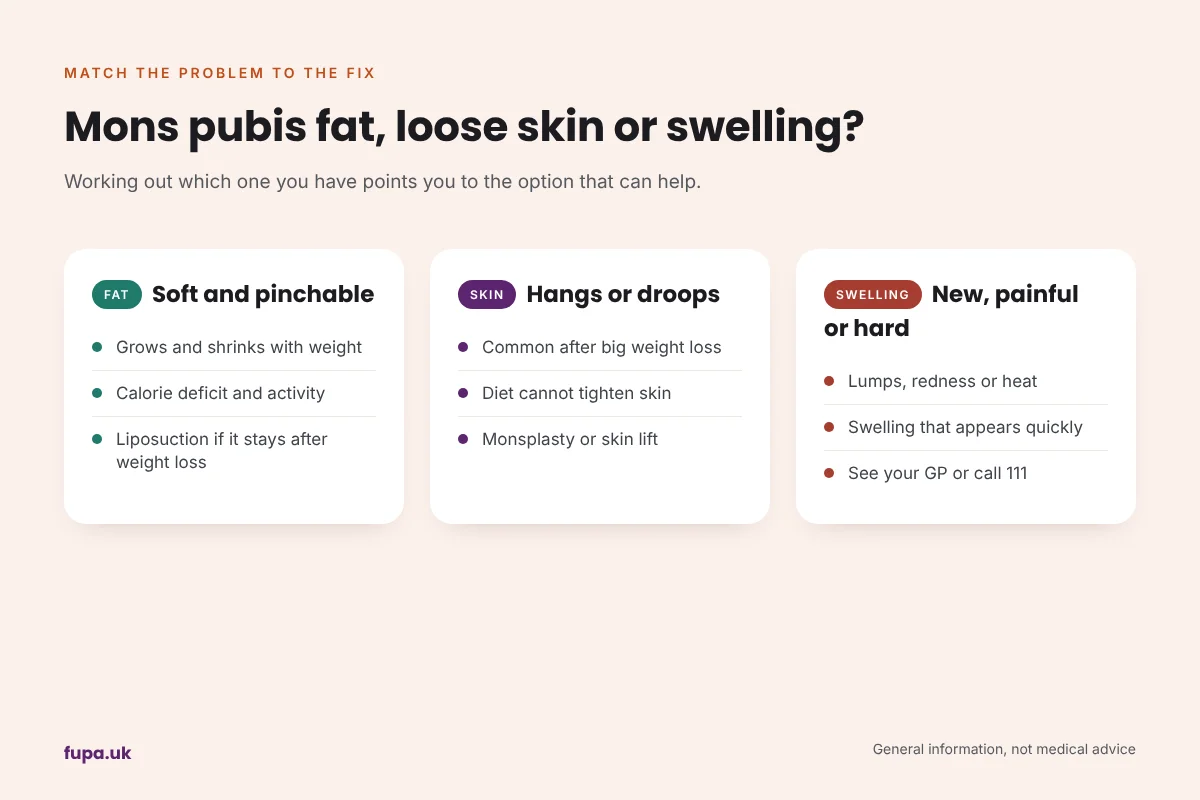
Mons pubis fat is a normal fat pad that grows with weight gain, hormones, pregnancy and age. If the area is soft and pinchable, overall fat loss is the first step, and it will shrink with time. If the skin hangs or droops, diet alone will not fix it, and a monsplasty may be an option. If the area is swollen, painful or lumpy, see your GP. For the next step, our guide on how to get rid of a FUPA brings all the options together.