
How Long Does It Take to Lose Lower Belly Fat?

Page Contents
- Key Takeaways
- How Long Does It Take to Lose Lower Belly Fat? The Short Answer
- It depends on how much fat you have to lose
- A realistic rate of loss
- Why the lower belly lags behind
- Lower Belly Fat Timeline: Week by Week
- Weeks 1 to 2: mostly water
- Weeks 3 to 8: deeper belly fat goes first
- Months 3 to 12: the lower belly catches up
- How to Work Out Your Own Timeline
- The calorie maths
- A worked example
- Why the maths is only a starting point
- What Affects How Fast You Lose Lower Belly Fat
- Factors you can change
- Factors you cannot change
- Starting point
- Can You Lose Lower Belly Fat Faster?
- Ab exercises will not speed it up
- What does help
- Be careful with crash diets
- How to Track Progress on Your Lower Belly
- Use more than the scales
- A simple monthly check
- When the lower belly stops changing
- Frequently Asked Questions
- How long does it take to lose lower belly fat?
- Why is lower belly fat the last to go?
- Can I lose lower belly fat in two weeks?
- How much weight should I lose each week?
- Will my lower belly be flat once I lose the fat?
- The Bottom Line
- Think in months, not weeks
How long does it take to lose lower belly fat? For most people, the honest answer is a few months rather than a few weeks. You can usually measure a smaller waist within the first month of steady effort, but the soft fat low on the belly and over the pubic bone tends to be the last to shrink, so it often takes three to six months or more before it looks clearly different.
This guide sets out a realistic week by week timeline, explains the maths behind fat loss so you can work out your own timescale, and covers the factors that make it faster or slower. For the full method, read our main guide on how to burn lower belly fat.
This guide is general information, not medical advice. If you have a health condition, take regular medication or are pregnant, speak to your GP before changing how you eat or exercise.
Key Takeaways
- The NHS advises losing weight steadily at around 0.5kg to 1kg a week.
- Early weight loss in the first week or two is partly water, not just fat.
- Deep visceral fat usually shrinks first; the lower belly and FUPA usually shrink last.
- Many people see a clear change in their lower belly after three to six months of consistent effort.
- You cannot target the lower belly with ab exercises; overall fat loss is what makes it smaller.
How Long Does It Take to Lose Lower Belly Fat? The Short Answer
It depends on how much fat you have to lose
Someone who wants to lose 3kg of body fat will finish far sooner than someone who wants to lose 20kg. Because the lower belly is one of the last places to slim down, it tends to look noticeably flatter only once you are well into your overall goal. That is why two people following the same plan can see results at very different times.
A realistic rate of loss
The NHS advises adults who are trying to lose weight to aim to lose 0.5kg to 1kg (1lb to 2lb) a week. Losing weight faster than this tends to mean more muscle loss, more hunger and a higher chance of putting the weight back on. A steady rate also gives your skin more time to adjust, which matters for the lower belly.
Why the lower belly lags behind
Your body decides where fat comes from, and it does not draw evenly from every area. Fat in the lower belly and hips often has a poorer blood supply and more of the receptors that slow fat release, so it tends to hang on longer. Our guide to stubborn lower belly fat explains the science behind this.
Lower Belly Fat Timeline: Week by Week
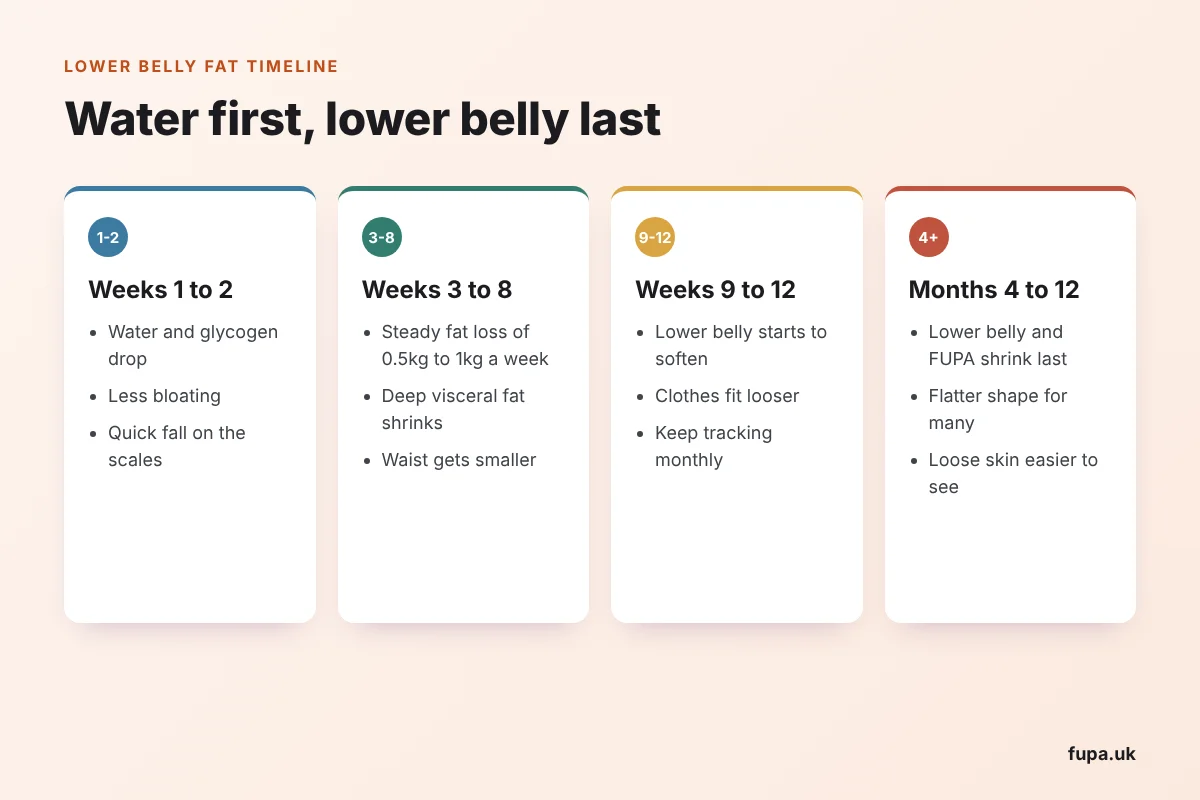
Everyone loses fat at a different pace, but the changes tend to follow a similar order. The table below shows a typical pattern for someone eating in a modest calorie deficit and staying active. Treat it as a rough guide, not a promise.
| Time on plan | What is usually happening | What you might notice |
|---|---|---|
| Weeks 1 to 2 | Stored carbohydrate (glycogen) and the water bound to it drop | A quick fall on the scales, less bloating, waist slightly smaller |
| Weeks 3 to 4 | Steady fat loss begins at around 0.5kg to 1kg a week | Clothes start to feel a little looser around the middle |
| Weeks 5 to 8 | Deep visceral fat reduces, along with some fat under the skin | Upper and middle belly look smaller; waist measurement falls |
| Weeks 9 to 12 | Continued fat loss across the body | The lower belly starts to look softer and less pronounced |
| Months 4 to 6 | The more stubborn lower belly fat begins to shift | A visibly flatter lower belly for many people |
| Months 6 to 12 | The last of the lower belly and pubic fat reduce | The FUPA is smaller; any loose skin becomes easier to see |
Weeks 1 to 2: mostly water
The first drop on the scales is often bigger than later weeks. Much of it is water that was stored alongside carbohydrate in your muscles and liver. It is a good start, but it is not all fat, so do not expect the same speed to continue.
Weeks 3 to 8: deeper belly fat goes first
Once the water shift settles, true fat loss takes over. Visceral fat, the deep fat around your organs, tends to respond quickly to a calorie deficit and regular activity. This is good news for your health, even if your lower belly still looks much the same in the mirror. Our guide asking is lower belly fat dangerous explains why that deep fat matters most.
Months 3 to 12: the lower belly catches up
The fat below the belly button and over the pubic bone usually shrinks last. Around the three month mark, many people start to see a real difference low down. If you have a lot of fat to lose, it can take a year or more before the FUPA reaches its smallest size.
How to Work Out Your Own Timeline
The calorie maths
One kilogram of body fat stores roughly 7,700 calories. To lose it, you need to burn about that many more calories than you eat over time. NICE guidance on obesity suggests a deficit of around 600 calories a day for steady weight loss. Our guide to a calorie deficit for a FUPA shows how to set your own numbers.
| Daily calorie deficit | Weekly deficit | Approximate fat loss per week |
|---|---|---|
| 300 calories | 2,100 calories | About 0.27kg |
| 500 calories | 3,500 calories | About 0.45kg |
| 600 calories | 4,200 calories | About 0.55kg |
| 750 calories | 5,250 calories | About 0.68kg |
A worked example
Take someone who needs to lose around 8kg of body fat before their lower belly looks the way they want. At 0.5kg a week, that would take about 16 weeks, or four months. At a slightly faster 0.75kg a week, it would take about 11 weeks. In real life, progress slows as you get lighter, and holidays or busy weeks slow it further, so adding a few extra weeks to your estimate is sensible.
Why the maths is only a starting point
The 7,700 calorie figure is an approximation. As you lose weight, your body needs fewer calories, so the same eating plan produces a smaller deficit over time. Water shifts, hormones and how much muscle you keep also blur the numbers from week to week. Track the trend over a month rather than reacting to single days.
What Affects How Fast You Lose Lower Belly Fat
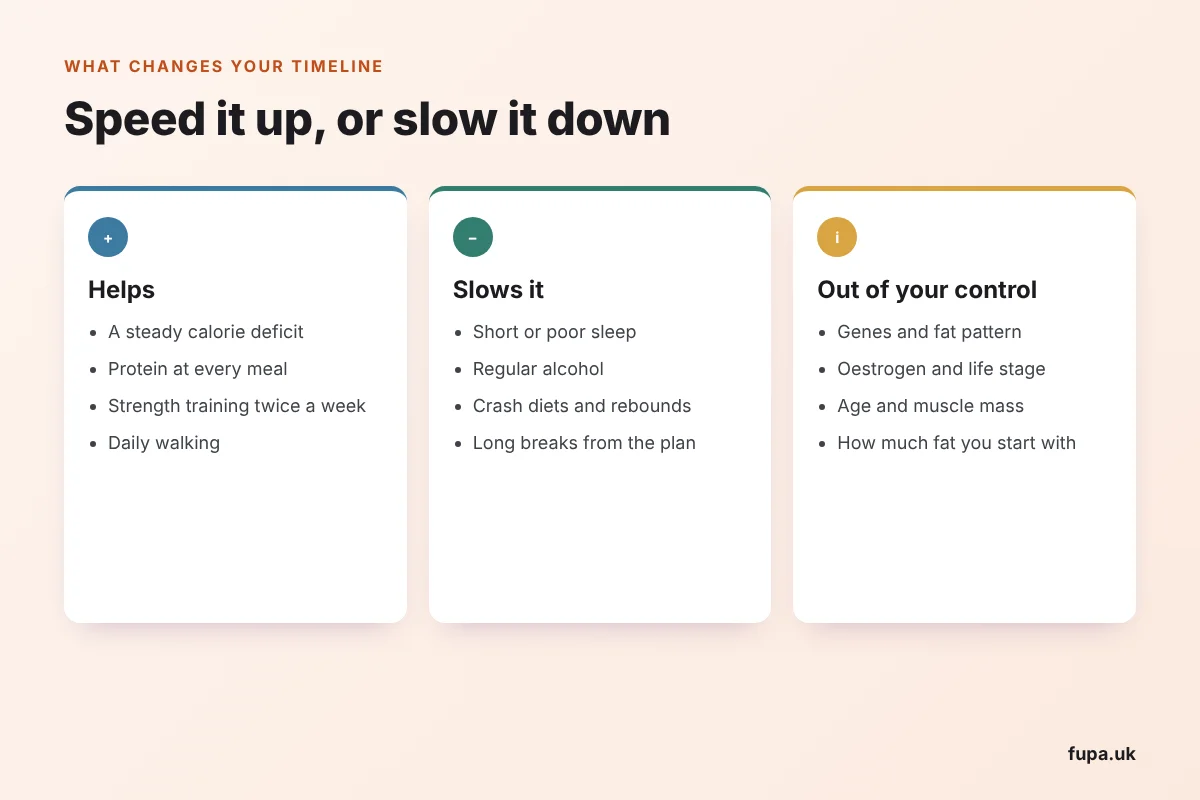
Factors you can change
- Consistency: a moderate deficit kept up for months beats a strict diet that lasts two weeks.
- Protein: eating enough protein helps you feel full and keep muscle. See our guide to protein for FUPA fat loss.
- Strength training: keeping muscle helps your body burn more energy at rest.
- Daily movement: walking and general activity add up to a large share of the calories you burn.
- Sleep and alcohol: short sleep and regular drinking both make it harder to stick to a calorie deficit.
Factors you cannot change
- Sex and hormones: oestrogen encourages fat storage on the lower belly, hips and thighs, so women often find this area slower to shift.
- Age: muscle mass tends to fall with age, which lowers how many calories you burn.
- Genetics: your genes play a large part in where you store fat and the order in which you lose it.
- Pregnancy and surgery: stretched skin or scar tissue, such as after a C-section, can change how the lower belly looks after fat loss.
Starting point
People with more body fat often lose weight faster at first, because a larger body needs more energy. Leaner people usually lose fat more slowly and may find the lower belly is the very last area to change.
Can You Lose Lower Belly Fat Faster?
Ab exercises will not speed it up
Doing hundreds of crunches does not burn the fat sitting over those muscles. A controlled trial published in the Journal of Strength and Conditioning Research in 2011 found that six weeks of abdominal exercise alone did not reduce belly fat. Core work makes your muscles stronger, but overall fat loss is what makes your lower belly smaller.
What does help
- Set a calorie deficit you can keep up, usually 300 to 600 calories a day.
- Eat protein at every meal and fill half your plate with vegetables.
- Do strength training on at least two days a week, as UK activity guidelines advise.
- Build up to at least 150 minutes of moderate activity a week, such as brisk walking.
- Sleep seven to nine hours where you can and keep alcohol within the low risk guideline of 14 units a week.
Be careful with crash diets
Very low calorie diets can lead to fast weight loss, but they are hard to stick to and should only be followed with medical supervision. If you have an event coming up, our guide on how to lose a FUPA fast covers what is realistic in a short time and what to avoid.
How to Track Progress on Your Lower Belly
Use more than the scales
Your weight can jump by a kilogram or more from one day to the next because of water, salt and hormones. A tape measure and photos give a clearer picture of what is happening to your lower belly.
A simple monthly check
- Measure your waist halfway between your lowest rib and the top of your hip bone.
- Measure around the widest part of your lower belly, just above the pubic bone.
- Take front and side photos in the same light and clothing.
- Note how your usual jeans or trousers fit at the waistband.
Our guide on how to measure a FUPA walks through each step.
When the lower belly stops changing
If you have reached a healthy weight and your lower belly has stopped shrinking, the remaining shape may be down to loose skin, genetics or the natural fat pad that everyone has. Our guide asking does a FUPA go away explains what to expect at this stage.
Frequently Asked Questions
How long does it take to lose lower belly fat?
Most people see a smaller waist within four to eight weeks of steady effort, and a clearly flatter lower belly after three to six months. If you have a lot of weight to lose, it can take a year or more.
Why is lower belly fat the last to go?
Fat in the lower belly tends to have a poorer blood supply and more receptors that slow fat release. Genes and hormones such as oestrogen also make the body hold on to fat in this area.
Can I lose lower belly fat in two weeks?
Not in any meaningful amount. Most of the weight lost in the first two weeks is water. You may feel less bloated, but lasting fat loss from the lower belly takes months.
How much weight should I lose each week?
The NHS advises aiming for 0.5kg to 1kg a week. This usually means eating around 500 to 600 fewer calories a day than your body uses.
Will my lower belly be flat once I lose the fat?
It depends on your genes, skin and history. Everyone keeps a natural pad of fat over the pubic bone, and loose skin after pregnancy or large weight loss may remain even when the fat has gone.
The Bottom Line
Think in months, not weeks
Losing lower belly fat takes patience. Expect water loss first, deeper belly fat next and the lower belly last, with clear changes for many people somewhere between three and six months. Work out your own timescale with the calorie maths, aim for 0.5kg to 1kg a week and track your progress with a tape measure as well as the scales. For the complete plan, read our guide on how to burn lower belly fat, or explore every option in our guide to how to get rid of a FUPA.