
Fitness for Belly Fat: A Weekly Workout Plan That Works
Page Contents
- Key Takeaways
- Fitness for Belly Fat: What Exercise Can and Cannot Do
- You cannot spot reduce belly fat
- What regular exercise does do
- Why the plan mixes three types of training
- How Much Exercise You Need Each Week
- The UK activity guidelines
- Moderate versus vigorous effort
- More is helpful, but only if you recover
- The Weekly Workout Plan for Belly Fat
- Strength days
- Cardio days
- Rest day
- The Workouts in Detail
- Strength session A
- Strength session B
- Interval session
- Core finisher
- How to Adapt the Plan
- If you are a complete beginner
- If you have a larger body or sore joints
- If you have had a baby
- If you are short on time
- Make Your Workouts Count: Food, Sleep and Steps
- Pair training with a modest calorie deficit
- Eat enough protein
- Move more between workouts
- Protect your sleep
- How to Track Your Progress
- Measure more than your weight
- Track your training too
- Give it time
- Frequently Asked Questions
- What is the best fitness routine for belly fat?
- Can exercise alone get rid of belly fat?
- Do sit-ups and crunches burn belly fat?
- Is cardio or weights better for belly fat?
- How many days a week should I work out to lose belly fat?
- The Bottom Line
- Consistency beats intensity
Fitness for belly fat works best when you stop chasing one magic exercise and follow a balanced weekly plan instead. Strength training, cardio and a little core work each play a different part, and together they help you burn more energy, keep muscle and lose fat from your whole body, including the lower belly and FUPA.
This guide gives you a seven day workout plan you can start this week, explains what each session does, and shows how to adapt it for your fitness level. It sits within our wider guide on how to get rid of a FUPA, and pairs well with our main guide on how to burn lower belly fat.
This guide is general information, not medical advice. If you have a health condition, joint pain, a recent injury or are pregnant or recently postnatal, speak to your GP or a physiotherapist before starting a new exercise plan.
Key Takeaways
- No workout burns fat from the belly alone; overall fat loss is what makes it smaller.
- UK guidelines advise at least 150 minutes of moderate activity or 75 minutes of vigorous activity a week.
- Strength training on two or more days a week helps you keep muscle while you lose fat.
- Core exercises build strength and support your back, but they do not burn belly fat by themselves.
- Exercise works far better for belly fat when it is paired with a modest calorie deficit, good sleep and plenty of daily movement.
Fitness for Belly Fat: What Exercise Can and Cannot Do
You cannot spot reduce belly fat
Working a muscle does not burn the fat that sits on top of it. A controlled trial published in the Journal of Strength and Conditioning Research in 2011 found that six weeks of abdominal exercises alone did not reduce belly fat. Your body draws on fat stores from all over when it needs energy, and genes and hormones decide which areas shrink first. The lower belly is often one of the last.
What regular exercise does do
Exercise raises the number of calories you burn each week, which makes a calorie deficit easier to reach. It also helps reduce visceral fat, the deeper fat around your organs that is linked to type 2 diabetes and heart disease. Regular training improves how your body handles blood sugar, lifts your mood and helps you sleep, all of which make it easier to stick with a plan for months.
Why the plan mixes three types of training
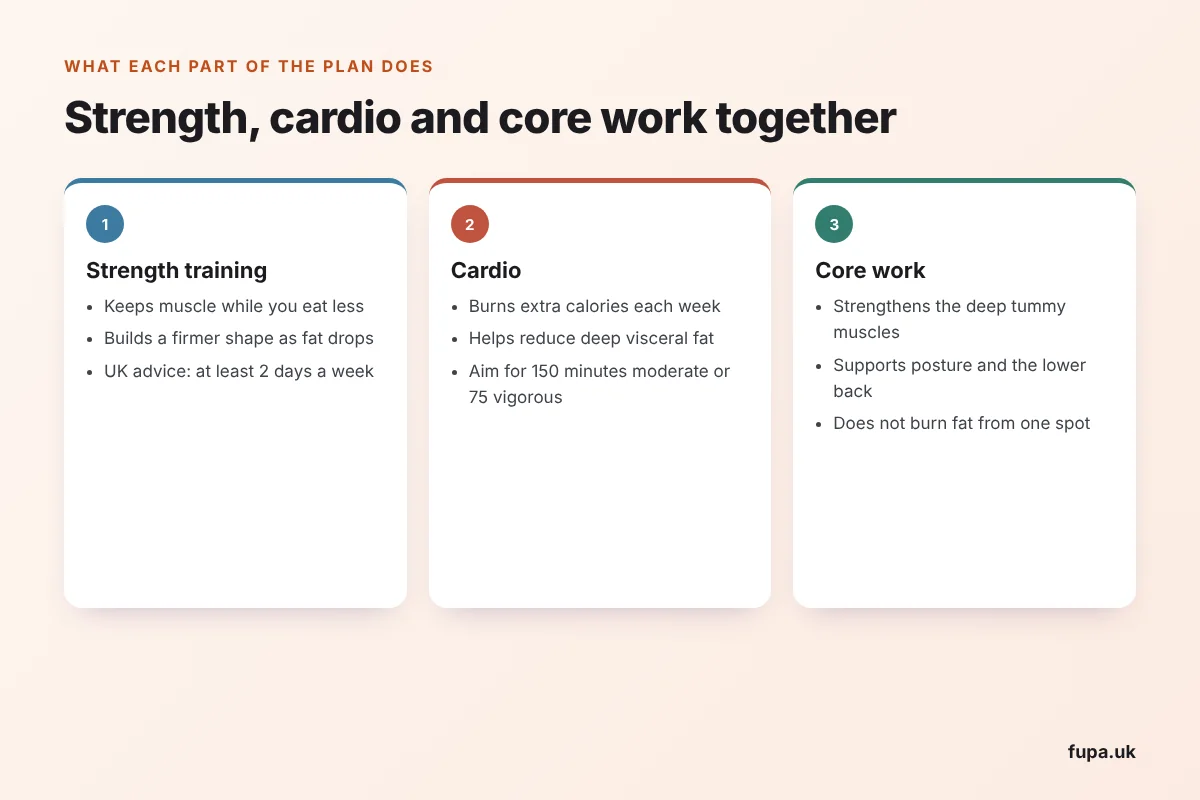
Strength work protects muscle, cardio adds to your calorie burn and core work makes your trunk stronger and more stable. Leaving out any one of them makes the plan less effective. Our guide to FUPA exercises covers which moves help the lower belly area most and which are a waste of time. For a side by side ranking of individual moves, see our list of the best exercises for lower belly fat.
How Much Exercise You Need Each Week
The UK activity guidelines
The UK Chief Medical Officers advise adults to do at least 150 minutes of moderate intensity activity a week, or 75 minutes of vigorous activity, or a mix of both. The NHS physical activity guidelines also advise strengthening activities that work all the major muscle groups on at least two days a week, and breaking up long periods of sitting.
Moderate versus vigorous effort
A simple test helps. During moderate activity, such as brisk walking or easy cycling, you can still talk but you cannot sing. During vigorous activity, such as running, fast cycling or hard intervals, you cannot say more than a few words without pausing for breath. One minute of vigorous effort counts roughly the same as two minutes of moderate effort.
More is helpful, but only if you recover
Going beyond 150 minutes can add to your weekly calorie burn, but piling on extra sessions too soon raises the risk of injury and burnout. Build up gradually and keep at least one easy or rest day each week.
The Weekly Workout Plan for Belly Fat
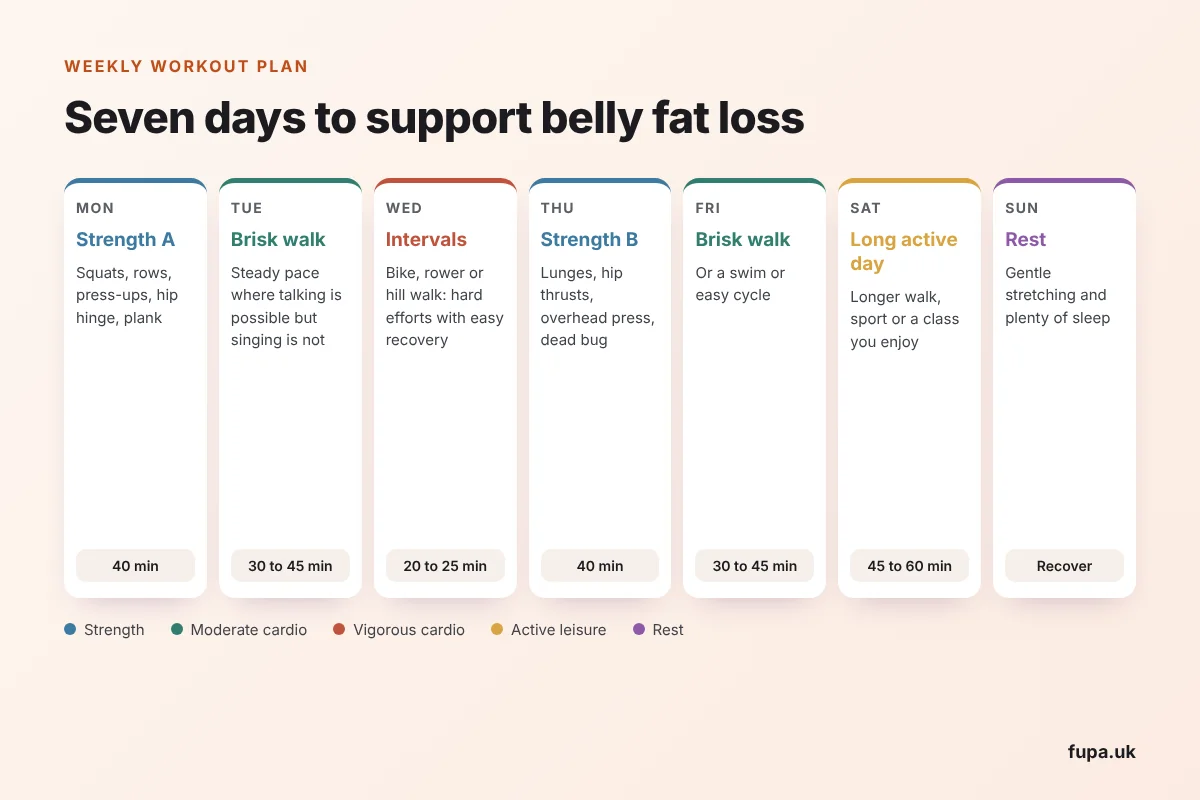
This plan meets the UK guidelines with room to spare and takes around four to five hours a week in total. You can swap days around to suit your routine, but try not to put the two strength sessions back to back.
| Day | Session | Time | Effort |
|---|---|---|---|
| Monday | Strength session A (full body) | 40 minutes | Moderate to hard |
| Tuesday | Brisk walk | 30 to 45 minutes | Moderate |
| Wednesday | Interval session | 20 to 25 minutes | Vigorous |
| Thursday | Strength session B (full body) | 40 minutes | Moderate to hard |
| Friday | Brisk walk, swim or easy cycle | 30 to 45 minutes | Moderate |
| Saturday | Long active day: longer walk, sport or class | 45 to 60 minutes | Moderate |
| Sunday | Rest, gentle stretching | Optional | Easy |
Strength days
The two strength sessions are the backbone of the plan. They train every major muscle group, which helps you hold on to muscle while you eat a little less. More muscle also gives your lower body and midsection a firmer shape as fat comes off.
Cardio days
The walks, the interval session and the long active day add to your weekly calorie burn without leaving you too tired to lift well. Our comparison of HIIT vs steady cardio for a FUPA explains how the two styles compare and why most people do best with a mix.
Rest day
Rest is when your muscles repair and adapt. A rest day also keeps your appetite and energy steady, which makes the rest of the week easier to stick to.
The Workouts in Detail
Strength session A
Warm up for five minutes with marching, arm circles and bodyweight squats. Then complete three rounds of the following, resting about 60 to 90 seconds between exercises:
- Goblet squat or bodyweight squat: 10 to 12 reps
- Dumbbell row or resistance band row: 10 to 12 reps each side
- Press-ups, on the knees or against a wall if needed: 8 to 12 reps
- Romanian deadlift with dumbbells or a hip hinge with a band: 10 to 12 reps
- Forearm plank: 20 to 40 seconds
Strength session B
Use the same warm up, then complete three rounds of:
- Reverse lunge or split squat: 8 to 10 reps each leg
- Glute bridge or hip thrust: 12 to 15 reps
- Overhead press with dumbbells or a band: 10 to 12 reps
- Lat pulldown or band pull-apart: 12 to 15 reps
- Dead bug: 8 to 10 slow reps each side
Choose a weight that makes the last two reps of each set feel hard but keeps your form clean. When you can do the top of the rep range easily for all three rounds, add a little weight or an extra round. Our guide to hip thrusts for a FUPA shows how to set up that move safely.
Interval session
Use an exercise bike, a rowing machine, a cross trainer or a steep hill. After a five minute easy warm up, work hard for 30 seconds, then go easy for 90 seconds. Repeat six to eight times, then cool down for five minutes. If you are new to exercise, start with four rounds and build up.
Core finisher
On two or three days a week, add five minutes of core work at the end of a session: side planks, bird dogs and slow reverse crunches. These moves strengthen the deep tummy muscles that support your lower back and posture. They will not burn the fat over your lower belly, but they help you look and feel stronger as the fat comes off.
How to Adapt the Plan
If you are a complete beginner
Start with two strength sessions using bodyweight only and three brisk walks of 20 to 30 minutes. Skip the interval session for the first four weeks. Add five minutes to each walk every week until you reach the full plan.
If you have a larger body or sore joints
Choose low impact options such as cycling, swimming, aqua aerobics or a cross trainer instead of running or jumping. Seated or supported strength moves still work the muscles well. Comfortable, supportive clothing helps too; our guide to gym clothes for a FUPA covers what to look for.
If you have had a baby
Wait until you have had your postnatal check, usually around six to eight weeks after the birth, and start with pelvic floor exercises and gentle walking. Build up slowly, and if you have tummy muscle separation or pelvic floor symptoms, ask for a referral to a women’s health physiotherapist. Our guide to a FUPA after pregnancy explains more.
If you are short on time
Two 30 minute strength sessions and a daily 20 minute brisk walk still meets the guidelines. Short bursts of activity count, so a ten minute walk after each meal adds up over the week.
Make Your Workouts Count: Food, Sleep and Steps
Pair training with a modest calorie deficit
Exercise alone burns fewer calories than most people expect, and it is easy to eat them back. Eating a little less than your body uses each day is what drives fat loss. Our guide to a calorie deficit for a FUPA shows how to set a realistic target.
Eat enough protein
Protein helps your muscles recover from strength training and keeps you fuller for longer. Include a source such as eggs, fish, chicken, beans, lentils, tofu or Greek yoghurt at every meal. See our guide to protein for FUPA fat loss for amounts.
Move more between workouts
Everyday movement, such as walking, climbing stairs and housework, can burn as many calories as your planned workouts. Our guide to walking to lose a FUPA shows how to build more steps into your day.
Protect your sleep
Short sleep tends to increase hunger and cravings and makes training feel harder. Aim for seven to nine hours where you can. Our guide to FUPA and sleep explains the link.
How to Track Your Progress
Measure more than your weight
As you build muscle and lose fat, the scales may move slowly even when your shape is changing. Measure your waist and the widest part of your lower belly once a month, and take photos in the same light. Our guide on how to measure a FUPA walks you through it.
Track your training too
Write down the weights, reps and times you manage each week. Seeing your squat or walking pace improve is a strong reason to keep going during weeks when the tape measure barely moves.
Give it time
Most people notice better fitness within a few weeks, a smaller waist within one to two months, and a clearly flatter lower belly after a few months of consistent effort. The lower belly is often last to change, so stay patient.
Frequently Asked Questions
What is the best fitness routine for belly fat?
A weekly routine that mixes strength training on two or more days with around 150 minutes of moderate cardio works best for most people. Pair it with a modest calorie deficit, because exercise alone rarely shifts belly fat.
Can exercise alone get rid of belly fat?
It can help, but it is hard to burn enough calories through exercise alone. Most people lose belly fat faster and more reliably when they combine regular training with eating a little less.
Do sit-ups and crunches burn belly fat?
No. They strengthen your abdominal muscles, but research shows they do not reduce the fat that sits over those muscles. Overall fat loss is what makes the belly smaller.
Is cardio or weights better for belly fat?
Both help. Cardio adds to the calories you burn each week, while weights help you keep muscle as you lose fat. A plan that includes both usually works better than either on its own.
How many days a week should I work out to lose belly fat?
Aim to be active on most days. A good target is two strength sessions plus three or four cardio sessions or brisk walks, with at least one rest or easy day each week.
The Bottom Line
Consistency beats intensity
The best fitness plan for belly fat is one you can keep doing for months. Train your whole body with weights twice a week, build up to at least 150 minutes of moderate cardio, add a little core work and pair it all with sensible eating and good sleep. Your lower belly may be the last area to change, but it will respond to steady, whole body fat loss. For the complete picture, read our guides on burning lower belly fat and getting rid of a FUPA.