
Can You Lose Belly Fat Without Exercise?
Page Contents
- Key Takeaways
- Can You Really Lose Belly Fat Without Exercise?
- The energy balance in plain terms
- Why belly fat responds
- Where the limits are
- Step 1: Create a Steady Calorie Deficit
- How big a deficit
- Easy ways to find 600 calories
- Avoid crash diets
- Step 2: Build Meals Around Protein and Fibre
- Protein keeps you full and protects muscle
- Fibre slows hunger
- A simple plate model
- Step 3: Cut Liquid Calories and Alcohol
- Drinks add up quickly
- Alcohol and the belly
- Step 4: Move More Without Exercising
- What NEAT means
- What the research found
- Easy ways to raise NEAT
- Step 5: Protect Your Sleep
- Why sleep matters for belly fat
- Simple sleep habits
- Step 6: Manage Stress
- Stress, cortisol and eating
- Practical ways to lower stress
- A Week Without Exercise: What It Looks Like
- What results to expect
- When Exercise Still Helps
- Keeping muscle as you lose fat
- Keeping the weight off
- If you cannot exercise for health reasons
- Frequently Asked Questions
- Can you lose belly fat with diet alone?
- How fast can I lose belly fat without exercise?
- What is NEAT and how does it help?
- Which foods help reduce belly fat?
- Will my lower belly be the last place to slim down?
- The Bottom Line
- Diet and daily life can do the heavy lifting
Yes, you can lose belly fat without exercise. Fat loss happens when you take in less energy than you use, and food changes the intake side of that equation far more easily than workouts change the output side. If you cannot train because of injury, illness, pain, caring duties or long working days, a plan built on diet, everyday movement, sleep and stress control can still bring your waist down.
This guide explains how to lose belly fat without exercise, step by step, what to expect, and where formal exercise still helps once you are able to add it. It is part of our wider guide on how to burn lower belly fat.
This guide is general information, not medical advice. If you have a long term health condition, take regular medication, are pregnant, or have a history of disordered eating, speak to your GP before changing how you eat.
Key Takeaways
- A calorie deficit is the one thing every fat loss plan needs, and you can create it with food alone.
- The NHS suggests cutting around 600 calories a day as a safe, steady way to lose weight.
- Everyday movement outside the gym, known as NEAT, burns energy without counting as exercise.
- Poor sleep, high stress and alcohol all make belly fat harder to shift.
- You cannot choose where fat comes off first, but belly fat falls as overall body fat falls.
Can You Really Lose Belly Fat Without Exercise?
The energy balance in plain terms
Your body stores spare energy as fat and draws on that store when food falls short. Exercise raises how much energy you use, but food decides how much comes in. Cutting out a daily chocolate bar and a sugary drink can save more energy than a 30 minute walk burns, and it takes no time at all. That is why diet changes usually drive most of the weight loss in the early months.
Why belly fat responds
You cannot spot reduce fat by choosing where it comes off. As your overall body fat falls, the fat around your middle falls with it. The deeper visceral fat around the organs often responds well to weight loss, which is good news for health. The softer fat over the lower belly and the pubic area can be slower, which our guide on stubborn lower belly fat explains.
Where the limits are
Without any physical activity you lose some muscle along with fat, especially as you get older. You also miss out on the heart, mood and blood sugar benefits that come from moving more. That is why this plan leans on everyday movement, and why adding exercise later is worth it if your situation allows.
Step 1: Create a Steady Calorie Deficit
How big a deficit
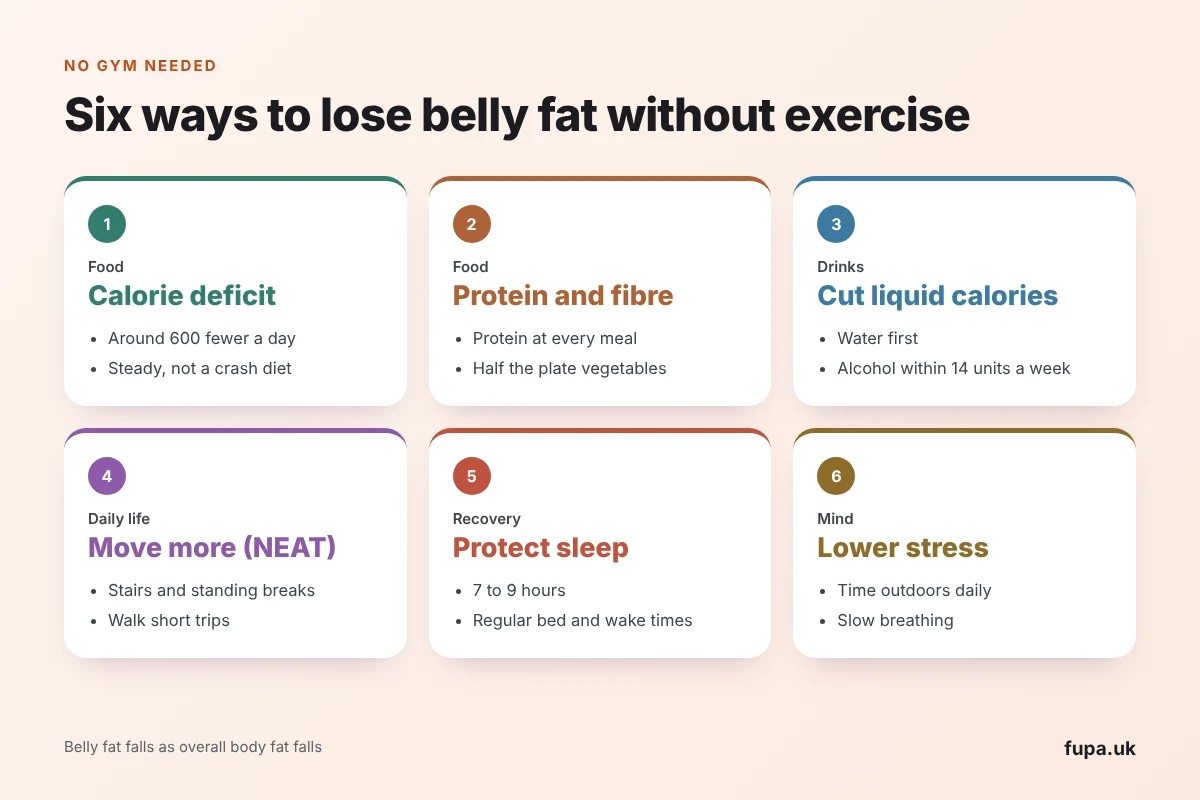
The NHS calorie counting guidance uses 2,000 calories a day for women and 2,500 for men as the amount needed to maintain a healthy weight, and suggests cutting around 600 calories a day as a safe and sustainable way to lose weight. Your own needs depend on your size, age and activity, so treat those figures as a starting point. Our guide to a calorie deficit for a FUPA shows how to work out your own number.
Easy ways to find 600 calories
- Swap sugary drinks and juice for water, sparkling water or sugar free versions.
- Use smaller plates and serve vegetables first, so they take up half the plate.
- Cut down on biscuits, crisps and pastries as everyday snacks.
- Measure cooking oil with a spoon rather than pouring it.
- Choose grilled, baked or steamed food over fried food when eating out.
Avoid crash diets
Very low calorie diets are hard to stick to, raise the risk of muscle loss and often end in weight regain. Unless your GP has recommended a supervised plan, aim for a deficit you could keep up for months, not days.
Step 2: Build Meals Around Protein and Fibre
Protein keeps you full and protects muscle
Protein is the most filling nutrient, and eating enough of it helps you hold on to muscle while you lose fat. This matters even more when you are not lifting weights. Include a palm sized portion of lean meat, fish, eggs, Greek yoghurt, tofu, beans or lentils at each meal. Our guide to protein for fat loss gives more detail.
Fibre slows hunger
Fibre adds bulk to meals for few calories and helps you feel satisfied. Most adults in the UK eat well below the 30g a day the NHS recommends. Vegetables, fruit, oats, wholegrain bread, beans and lentils are easy places to start. Our guide to fibre and belly fat lists the best UK sources.
A simple plate model
Fill half your plate with vegetables or salad, a quarter with protein and a quarter with wholegrain carbohydrate such as brown rice, potatoes with the skin on or wholemeal pasta. This keeps portions in check without weighing everything.
Step 3: Cut Liquid Calories and Alcohol
Drinks add up quickly
Calories from drinks do not fill you up the way food does, so they are easy to overdo. Fizzy drinks, fruit juices, smoothies, large milky coffees and syrups can add hundreds of calories a day without you noticing. No drink burns belly fat, as our check of drinks that burn belly fat shows, but swapping high calorie drinks for water is one of the easiest changes you can make.
Alcohol and the belly
Alcohol is high in calories, lowers your guard around food and disturbs sleep. The UK Chief Medical Officers advise not regularly drinking more than 14 units a week, spread over three or more days. Cutting back often makes a noticeable difference to the waist, which our guide to FUPA and alcohol covers.
Step 4: Move More Without Exercising
What NEAT means
NEAT stands for non exercise activity thermogenesis. It is the energy you use for everything that is not sleeping, eating or planned exercise: standing, walking around the house, cooking, cleaning, gardening, climbing stairs and even fidgeting. For most people it burns more energy across a day than a workout does.
What the research found
A well known study led by James Levine at the Mayo Clinic, published in Science in 1999, overfed 16 healthy adults by around 1,000 calories a day for eight weeks. Weight gain ranged from under 1kg to about 7kg. The people whose everyday movement rose the most, by up to 692 calories a day, gained the least fat. Small movements, repeated all day, made a real difference.
Easy ways to raise NEAT
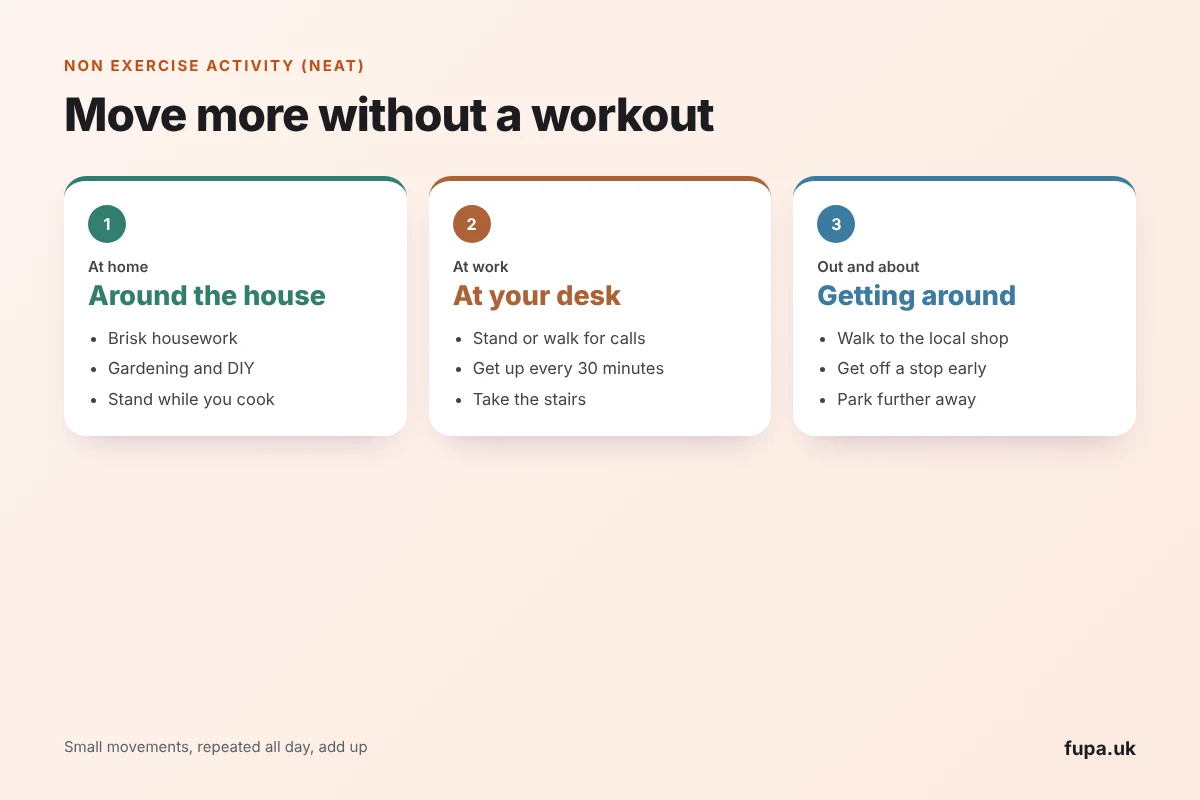
- Stand or walk during phone calls.
- Take the stairs instead of the lift where you can.
- Get off the bus a stop early or park further away.
- Set a timer to get up and move for a few minutes every half hour when you sit for long periods.
- Do housework, gardening and DIY at a brisk pace.
- Walk to the local shop rather than driving.
If you can manage gentle walking, our guide to walking to lose a FUPA shows how to build up step by step.
Step 5: Protect Your Sleep
Why sleep matters for belly fat
Short or broken sleep affects the hormones that control hunger and fullness, so you tend to feel hungrier and crave high calorie food the next day. Tiredness also makes you move less. Most adults need around 7 to 9 hours a night.
Simple sleep habits
- Go to bed and get up at roughly the same time every day.
- Keep your bedroom cool, dark and quiet.
- Avoid caffeine from mid afternoon onwards.
- Put your phone away for the last half hour before bed.
Our guide to FUPA and sleep explains the link in more depth.
Step 6: Manage Stress
Stress, cortisol and eating
Long term stress keeps the hormone cortisol raised, and research links high cortisol with more fat stored around the middle. Stress also drives comfort eating and poor sleep. You cannot remove every source of stress, but you can lower its effect.
Practical ways to lower stress
- Spend time outdoors each day, even a short walk to the end of the road.
- Try slow breathing: breathe in for four counts and out for six, for a few minutes.
- Plan meals ahead so stressful days do not end with a takeaway.
- Talk to your GP if stress, low mood or anxiety are hard to manage.
Our guide to FUPA and cortisol covers this topic in full.
A Week Without Exercise: What It Looks Like
The table shows how the six steps fit into an ordinary week. None of them involve a workout.
| Area | Daily habit | Why it helps |
|---|---|---|
| Calories | Around 600 fewer than you need to maintain | Creates the deficit that releases stored fat |
| Protein | A palm sized portion at each meal | Keeps you full and protects muscle |
| Fibre | Half the plate as vegetables, wholegrains daily | Slows hunger and supports gut health |
| Drinks | Water first, alcohol within 14 units a week | Removes easy hidden calories |
| Everyday movement | Stairs, standing breaks, short walks | Raises energy use without exercise |
| Sleep | 7 to 9 hours, regular times | Steadies hunger hormones and energy |
| Stress | Daily time outdoors and slow breathing | Lowers stress eating and cortisol |
What results to expect
A steady deficit usually brings a gradual drop in weight and waist size over weeks and months, not days. Measure your waist once a week at the same time of day rather than weighing yourself daily. Our guide on how long it takes to lose lower belly fat sets out a realistic timeline.
When Exercise Still Helps
Keeping muscle as you lose fat
Strength training helps you keep muscle while you lose fat, and it does not have to mean a gym. Standing moves, chair exercises and resistance bands all count. Our guide to standing ab exercises is a gentle place to start once you feel ready.
Keeping the weight off
Regular activity is strongly linked with keeping weight off after you lose it. When your circumstances change, adding even two short strength sessions and some brisk walking each week makes the results easier to hold on to.
If you cannot exercise for health reasons
Talk to your GP. They can suggest safe activity for your condition, refer you to a physiotherapist or point you to local weight management support. Many people with long term pain or limited mobility can still do seated or water based activity.
Frequently Asked Questions
Can you lose belly fat with diet alone?
Yes. A steady calorie deficit through diet will reduce body fat, including belly fat. Adding everyday movement, good sleep and lower stress makes the process easier and protects more of your muscle.
How fast can I lose belly fat without exercise?
It depends on your starting point and the size of your deficit. A steady deficit of around 600 calories a day usually brings gradual weight and waist loss over weeks and months. Fast crash diets rarely last.
What is NEAT and how does it help?
NEAT is the energy you burn through everyday movement such as walking, standing, housework and fidgeting. Raising it adds to your daily energy use without any formal exercise.
Which foods help reduce belly fat?
No single food burns belly fat. Meals built around protein, vegetables, fruit, wholegrains, beans and lentils help you feel full on fewer calories, which makes a deficit easier to keep.
Will my lower belly be the last place to slim down?
Often, yes. The fat over the lower belly and pubic area is commonly among the last to change. Keep going with your plan, as it does come down as overall body fat falls.
The Bottom Line
Diet and daily life can do the heavy lifting
You can lose belly fat without exercise by eating a little less, building meals around protein and fibre, cutting liquid calories, moving more in everyday life, sleeping well and managing stress. Exercise adds extra benefits when you can fit it in, but it is not a requirement for getting started. For the full method, see our guide on how to get rid of a FUPA.