Standing Ab Exercises: Core Work Without Getting on the Floor
Page Contents
- Key Takeaways
- Why Choose Standing Ab Exercises?
- Easier on joints and confidence
- Closer to everyday movement
- Good for posture
- How Your Core Works When You Stand
- Anti movement is ab training
- What the research shows
- How to Brace Properly
- The basic brace
- Find a neutral pelvis
- Breathe out on the effort
- 8 Standing Ab Exercises
- 1. Wall pelvic tilt
- 2. Standing marches
- 3. Standing cross body knee lift
- 4. Wall plank
- 5. Standing side bend with a weight
- 6. Pallof press
- 7. Suitcase carry
- 8. Band or cable woodchop
- Standing Ab Exercises Compared
- Which ones to start with
- A Simple Standing Abs Workout for Beginners
- The routine
- How often to do it
- How to progress
- Will Standing Ab Exercises Flatten Your Lower Belly?
- Strength is not fat loss
- What standing core work does give you
- Pair it with the right plan
- Who Standing Core Work Suits Best
- After pregnancy
- Back pain and older adults
- Frequently Asked Questions
- Do standing ab exercises work?
- Are standing ab exercises good for beginners?
- Can standing ab exercises reduce belly fat?
- How often should I do standing core exercises?
- Are standing ab exercises safe after a c-section?
- The Bottom Line
- Stand tall, brace and build slowly
Standing ab exercises train your core while you stay on your feet, so you never have to get down on the floor or back up again. They suit anyone who finds floor work awkward: people in larger bodies, people with back or knee pain, those in the months after having a baby and older adults working on balance. Done with a firm brace, standing core moves build real strength in the muscles that hold your trunk steady when you walk, lift and carry.
This guide explains how standing core work differs from floor exercises, then walks through eight standing ab exercises with form cues, a comparison table and a simple routine for beginners. It sits alongside our belly fat workout plan, which covers the cardio and strength side of fat loss, and our guide to lower ab exercises for when you are ready to add some floor moves.
This guide is general information, not medical advice. If you are pregnant, have recently given birth, have a hernia, a pelvic floor problem or back pain, speak to your GP or a physiotherapist before starting new core exercises.
Key Takeaways
- Standing ab exercises work the core in the position you use it most: upright, with your weight on your feet.
- The core has to resist movement as well as create it, so carries, presses and holds count as ab work.
- A 2009 study of standing torso exercises found that deliberately bracing the stomach raised abdominal muscle activity, so the brace is the most important skill to learn.
- Standing core moves strengthen muscle; they do not burn the fat over the lower belly on their own.
- Two or three short sessions a week, built into your strength training, is enough for most people.
Why Choose Standing Ab Exercises?
Easier on joints and confidence
Many classic ab moves start lying on your back. For some people that is the hardest part of the whole workout. Getting down to the floor and back up can be uncomfortable with a larger stomach, sore knees, hip pain or a recent caesarean scar. Standing exercises remove that barrier, so you are more likely to train regularly, and regular training is what brings results.
Closer to everyday movement
Your core spends most of the day keeping you upright: steadying you when you carry shopping in one hand, lift a child or reach across a table. Standing core work trains those exact jobs and adds balance work at the same time.
Good for posture
Learning to brace and hold a neutral pelvis while standing can change how your stomach sits. Our guide to FUPA and posture explains this in more detail.
How Your Core Works When You Stand
Anti movement is ab training
When you stand, much of your core’s job is to stop unwanted movement rather than create it. Holding a weight in one hand makes your obliques work to stop you bending to the side. Pushing a resistance band away from your chest makes your core resist twisting. These “anti” exercises are some of the most useful core moves there are, and they are naturally done standing.
What the research shows
A 2009 study by Stuart McGill and colleagues in the Journal of Strength and Conditioning Research measured muscle activity during standing torso exercises such as cable walkouts, overhead cable pushes and single leg good mornings. Muscle activity was fairly modest overall, but deliberately bracing the stomach raised it a great deal in several abdominal muscles. In plain terms, the brace turns a standing move into proper ab work. The study also found that different moves favoured different muscles, which is why a mix of exercises works best.
How to Brace Properly
The basic brace
Stand tall with your feet hip width apart and knees soft. Breathe in normally. Now tighten your stomach as if you were about to be gently prodded in the tummy, without sucking it in or holding your breath. You should feel your waist firm up all the way round. Keep breathing while you hold this. That is the brace you will use in every exercise below.
Find a neutral pelvis
Put your hands on your hip bones. Tip your pelvis forward so your lower back arches, then tuck it under so your back flattens. Neutral is roughly halfway between the two. Most people with a lower belly pouch need to tuck slightly more than feels natural at first.
Breathe out on the effort
Breathe out during the hardest part of each rep, such as when you push the band away or lift your knee. Holding your breath raises pressure inside the abdomen, which is unhelpful if you have pelvic floor weakness, a hernia or a separation of the stomach muscles.
8 Standing Ab Exercises
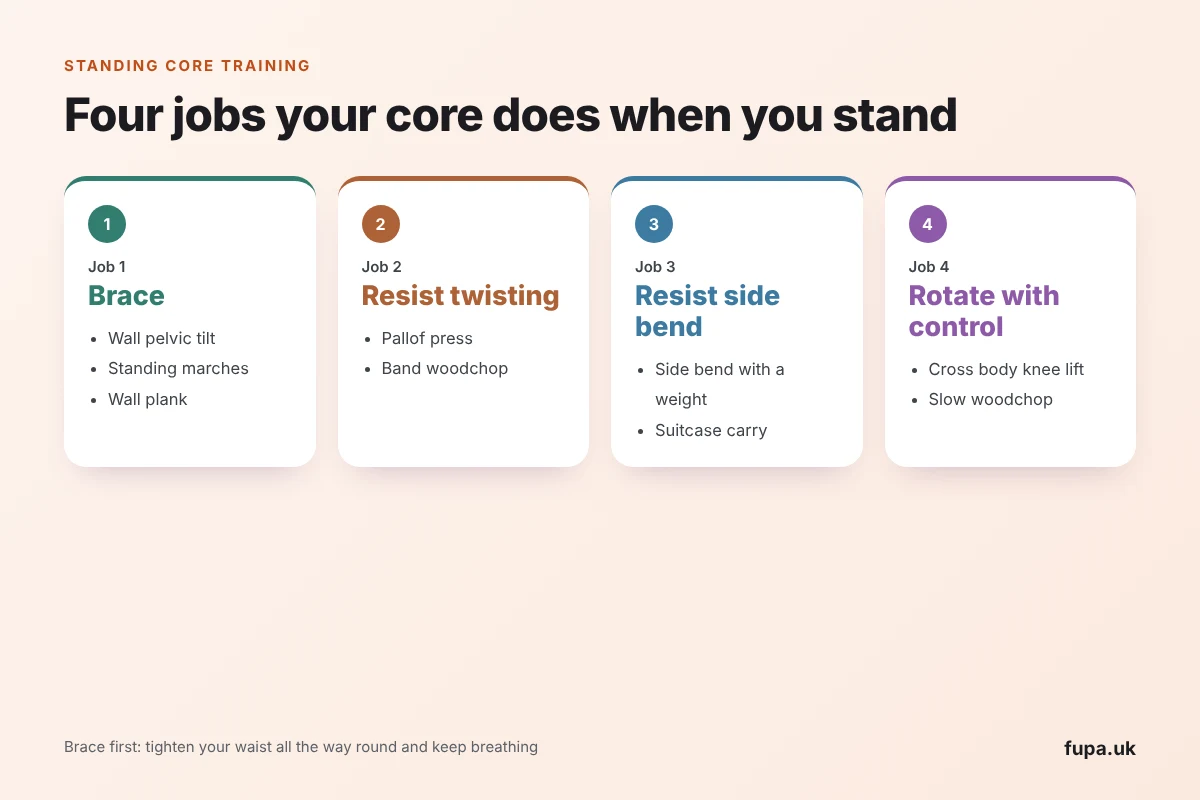
The list runs from the easiest to the most demanding. Start at the top and add the next move once you can do 10 to 12 slow, controlled reps with a steady brace.
1. Wall pelvic tilt
Stand with your back against a wall and your feet about a foot in front of it. Breathe out and gently flatten your lower back into the wall by tucking your pelvis under. Hold for three seconds, then relax. This teaches the pelvic control that every other move depends on, and it is a good place to start after pregnancy.
2. Standing marches
Stand tall, brace and slowly lift one knee to hip height, then lower it and swap legs. Keep your body still: no leaning back or tipping to the side. Hold a chair or worktop for balance if you need to. Slower is harder.
3. Standing cross body knee lift
Place your hands lightly behind your head. Lift your right knee towards your left elbow, turning your upper body slightly to meet it, then return. Swap sides. Keep the movement smooth and avoid pulling on your neck. This works the obliques and adds a little cardio if you speed it up.
4. Wall plank
Stand an arm’s length from a wall and place your forearms or hands on it at shoulder height. Walk your feet back until your body is in a straight, slanted line. Brace and hold for 15 to 30 seconds. The further your feet are from the wall, the harder it gets. McGill’s study found that a wall walkout is a gentler version of the floor exercise, which makes it a sensible stepping stone.
5. Standing side bend with a weight
Hold a dumbbell, kettlebell or full shopping bag in one hand. Slowly lean towards that side, then use the muscles on the opposite side to pull yourself back up to straight. Do all reps on one side, then swap. Keep the movement in your waist, not your hips.
6. Pallof press
Anchor a resistance band at chest height, for example in a closed door. Stand side on to the anchor, holding the band at your chest with both hands. Brace, then press your hands straight out in front of you and hold for two seconds before bringing them back. The band tries to twist you towards the anchor and your core resists. Step further away to make it harder.
7. Suitcase carry
Pick up a heavy weight in one hand, such as a kettlebell, dumbbell or a bag of shopping, and walk slowly for 20 to 30 metres while standing perfectly upright. Do not let the weight pull you sideways. Swap hands and repeat. It looks simple, but it is one of the hardest working standing core exercises for the obliques and deep core.
8. Band or cable woodchop
Anchor a band high on one side. Hold it with both hands and pull it diagonally down across your body towards the opposite hip, turning through your upper body while your hips stay mostly still. Return slowly. This trains controlled rotation, which is the movement you use when you twist to reach or lift.
Standing Ab Exercises Compared
Use the table to choose moves that match your equipment and level. Reps are a starting point; slow, controlled reps matter more than big numbers.
| Exercise | Level | Core job | Equipment | Starting dose |
|---|---|---|---|---|
| Wall pelvic tilt | Beginner | Brace and pelvic control | Wall | 2 sets of 10 |
| Standing marches | Beginner | Brace while the legs move | None | 2 sets of 10 each side |
| Cross body knee lift | Beginner | Obliques and rotation | None | 2 sets of 10 each side |
| Wall plank | Beginner | Front core hold | Wall | 3 holds of 20 seconds |
| Side bend with a weight | Intermediate | Resist side bending | Dumbbell or bag | 2 sets of 10 each side |
| Pallof press | Intermediate | Resist twisting | Resistance band | 2 sets of 8 each side |
| Suitcase carry | Intermediate | Resist side bending | Kettlebell or bag | 3 walks of 20 metres each side |
| Woodchop | Intermediate | Controlled rotation | Band or cable | 2 sets of 8 each side |
Which ones to start with
If you are new to core training, begin with wall pelvic tilts, standing marches and wall planks. Once those feel steady, add a Pallof press and a suitcase carry. Those five moves cover every job your core does when you are upright.
A Simple Standing Abs Workout for Beginners
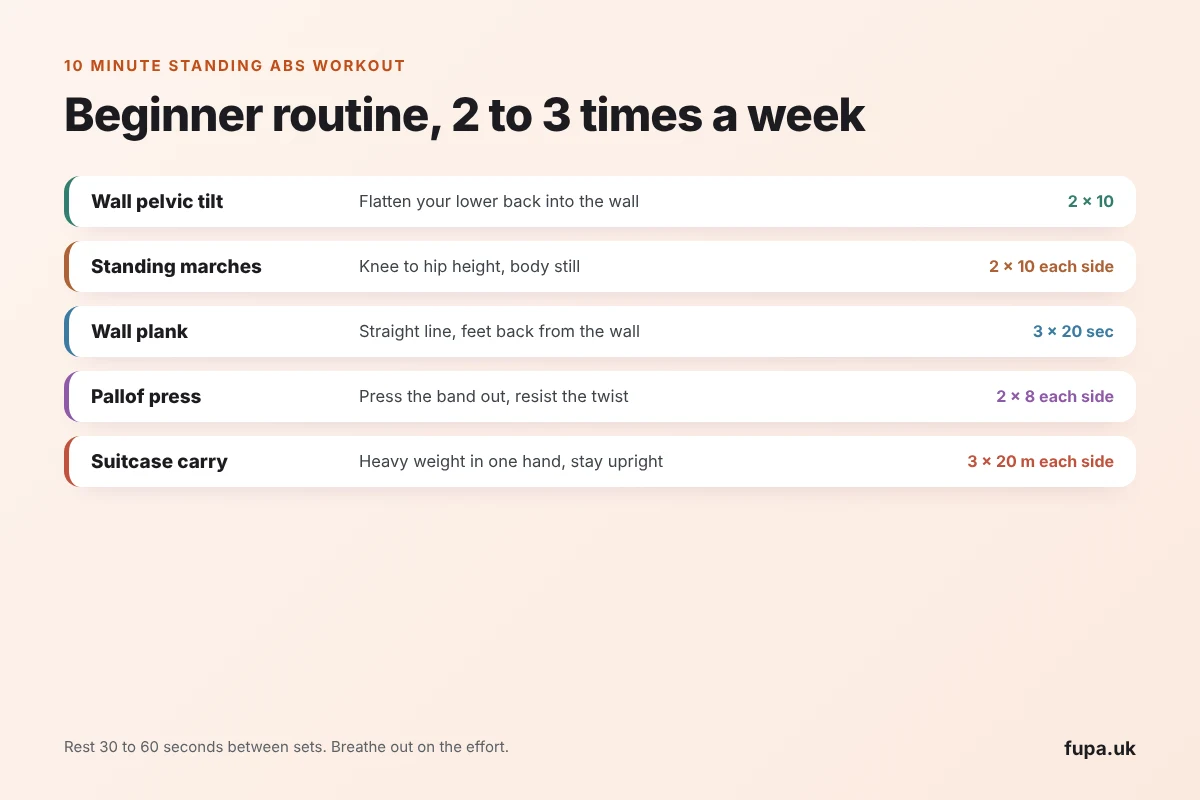
The routine
- Wall pelvic tilt: 2 sets of 10
- Standing marches: 2 sets of 10 each side
- Wall plank: 3 holds of 20 seconds
- Pallof press: 2 sets of 8 each side
- Suitcase carry: 3 walks of 20 metres each side
- Rest 30 to 60 seconds between sets
How often to do it
The NHS physical activity guidelines advise strengthening activities that work all the major muscle groups on at least 2 days a week, alongside 150 minutes of moderate activity such as brisk walking. A standing core block at the end of two or three of those sessions fits neatly into that advice.
How to progress
- Slow each rep down and pause for two seconds at the hardest point.
- Add a set, or two to three reps per set, every week or two.
- Use a heavier weight for carries and side bends, or a stronger band for presses and chops.
- Move your feet further from the wall for wall planks.
- When standing work feels easy, add one or two floor moves from our lower ab exercises guide.
Will Standing Ab Exercises Flatten Your Lower Belly?
Strength is not fat loss
Training a muscle does not burn the fat that sits on top of it. Fat comes off the whole body when you use more energy than you eat, and the lower belly and the fat pad above the pubic bone are often the last areas to change. Our main guide on how to burn lower belly fat explains the full method.
What standing core work does give you
A stronger, better controlled core helps you hold a neutral pelvis, which can make your stomach sit flatter. It supports your back during cardio and lifting, so you can train harder for longer. It also makes the stomach wall firmer, which shows more as body fat falls.
Pair it with the right plan
For fat loss, combine standing core moves with regular walking or other cardio, full body strength training and a modest calorie deficit. Our guide on how to get rid of a FUPA brings these together, and our ranking of the best exercises for lower belly fat shows which moves burn the most energy.
Who Standing Core Work Suits Best
After pregnancy
Wall pelvic tilts, standing marches and gentle Pallof presses are often comfortable early options once you have been cleared to exercise. Many people have a gap between the two sides of the stomach muscles after pregnancy, so check for this first using our guide on FUPA vs diastasis recti, and ask your GP about a referral to a pelvic health physiotherapist if you have leaking, heaviness or doming of the stomach.
Back pain and older adults
Standing anti movement exercises such as carries and Pallof presses ask the spine to stay still, which many people with back pain find easier than repeated bending. They also train balance, which matters more with age. Stop any move that causes sharp or spreading pain and ask a physiotherapist for advice. If you notice a bulge in your groin or near your belly button when you strain or cough, see your GP before carrying on.
Frequently Asked Questions
Do standing ab exercises work?
Yes. Standing ab exercises strengthen the core in the upright position you use most of the day. Bracing the stomach makes them far more effective, and moves such as carries and Pallof presses work the deep core and obliques hard.
Are standing ab exercises good for beginners?
They are a very good starting point. Wall pelvic tilts, standing marches and wall planks need no equipment and no getting down on the floor, and you can hold a chair for balance while you learn.
Can standing ab exercises reduce belly fat?
Not on their own. They strengthen the muscles under the fat but do not burn the fat itself. Belly fat comes down with a calorie deficit, regular activity and time.
How often should I do standing core exercises?
Two or three short sessions a week is enough for most people, ideally as part of your strength training. Leave a day between sessions so your muscles can recover.
Are standing ab exercises safe after a c-section?
Gentle moves such as wall pelvic tilts and standing marches are often suitable once your GP or midwife has cleared you to exercise, which is usually from around the six week check. Build up slowly and see a pelvic health physiotherapist if anything feels wrong.
The Bottom Line
Stand tall, brace and build slowly
Standing ab exercises give you real core training without the floor. Learn the brace, start with wall pelvic tilts, marches and wall planks, then add presses, carries and chops as you get stronger. They will make your core steadier and your stomach firmer, and when you pair them with the cardio and strength sessions in our belly fat workout plan and a modest calorie deficit, your lower belly has the best chance to change.