Do Crunches Burn Belly Fat? What the Research Says
Page Contents
- Key Takeaways
- Do Crunches Burn Belly Fat? The Short Answer
- Why the idea is so appealing
- How your body really uses fat
- Crunches burn very little energy
- What the Research Says About Crunches and Belly Fat
- The 27-day sit-up study
- The 6-week abdominal exercise trial
- What newer studies add
- What Crunches Are Good For
- Stronger, more enduring abs
- Posture and support
- Visible abs once fat is lower
- What Burns Belly Fat Instead
- A modest calorie deficit
- Regular whole-body activity
- Strength training for the whole body
- Sleep, protein and fibre
- How to Fit Crunches and Core Work Into Your Week
- Keep it short and regular
- Mix in better core exercises
- Crunch form tips
- When Crunches May Not Suit You
- After pregnancy or with diastasis recti
- Back pain, hernias and recent surgery
- Frequently Asked Questions
- Do crunches burn belly fat?
- Do sit-ups help lose lower belly fat?
- Is spot reduction a myth?
- How many crunches a day should I do to lose belly fat?
- What is the best exercise to burn belly fat?
- The Bottom Line
- Train your core, but burn fat with the whole body
Do crunches burn belly fat? It is one of the most common questions people ask when they start trying to flatten their stomach, and the answer is a clear no, at least not in the way most people hope. Crunches strengthen the muscles under your belly fat, but they do not choose which fat your body burns. Research going back decades shows that hundreds or even thousands of crunches and sit-ups leave belly fat and waist size almost unchanged when nothing else changes.
This guide explains what the studies actually found, why spot reduction does not work, what crunches are still good for, and what to do instead if your goal is a smaller lower belly. It is part of our weekly workout plan for belly fat.
This guide is general information, not medical advice. If you have back pain, a hernia, diastasis recti or have recently had a baby or surgery, check with your GP or a physiotherapist before starting ab exercises.
Key Takeaways
- Crunches and sit-ups do not burn fat from the belly specifically. Your body draws fat for energy from all over, not from the muscle you are working.
- In a 27-day trial, 5,004 sit-ups shrank fat cells by a similar amount at the belly, upper back and buttocks, with no change in waist girth.
- In a 6-week trial, a daily ab routine did not change belly fat, waist size or body fat, although ab endurance improved.
- Belly fat shrinks through overall fat loss: a modest calorie deficit, regular activity and strength training.
- Crunches are still useful for core strength, posture and everyday movement, so keep a little core work in your week.
Do Crunches Burn Belly Fat? The Short Answer
Why the idea is so appealing
The logic seems simple. If you feel a burn in your stomach while doing crunches, surely that burn is melting the fat on top? This idea is called spot reduction, and it is behind decades of ab gadgets, belly belts and “lower belly blaster” workouts. Unfortunately, the burning feeling comes from tired muscles, not from fat being used up in that spot.
How your body really uses fat
When you need extra energy, your body releases stored fat from fat cells into the bloodstream as fatty acids. These travel round the body and are used by whichever muscles are working. The fat does not have to come from the area next to the moving muscle, and in practice it comes from fat stores everywhere. Where you lose fat first, and last, is mostly decided by your genes, sex, age and hormones. That is why the lower belly is often the last place fat leaves, whatever exercise you choose.
Crunches burn very little energy
Crunches use a small group of muscles for short bursts, so they burn far fewer calories than activities that use your whole body, such as brisk walking, cycling, swimming or lifting weights. Even if every calorie burned during crunches came from belly fat, which it does not, the total would be tiny compared with what you can change through diet and larger movements.
What the Research Says About Crunches and Belly Fat
The 27-day sit-up study
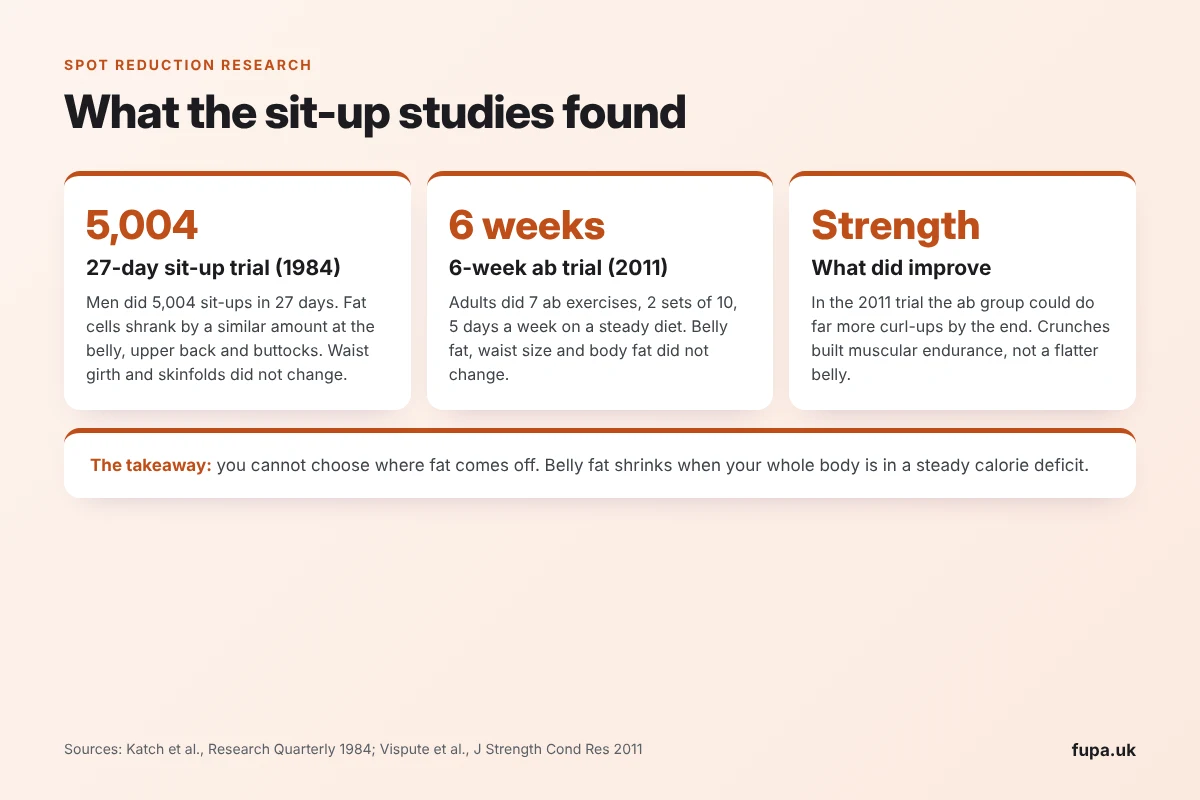
One of the best known studies was published in Research Quarterly for Exercise and Sport in 1984. Thirteen men followed a progressive sit-up programme five days a week for 27 days, completing 5,004 sit-ups in total, while six men acted as a control group. Researchers took fat samples from the abdomen, upper back and buttocks before and after. Fat cells got smaller at all three sites by a similar amount, so the sit-ups did not target belly fat. Body weight, total body fat, skinfolds and waist girth did not change.
The 6-week abdominal exercise trial
A randomised trial published in the Journal of Strength and Conditioning Research in 2011 tested the idea again. Twenty-four healthy, inactive adults aged 18 to 40 were split into two groups. One group did seven ab exercises, two sets of ten repetitions, five days a week for six weeks, while the other did nothing extra. Both kept their diet steady. According to the study abstract on PubMed, the ab routine had no effect on body weight, body fat percentage, belly fat, waist circumference or abdominal skinfolds. The only clear change was better ab endurance.
What newer studies add
A few recent studies have suggested that adding ab work after cardio might shift slightly more fat from the trunk. These studies are small, the effects are modest, and they still relied on a full workout and overall fat loss. The weight of evidence remains the same: you cannot pick where fat comes off, and ab exercise alone does not shrink the belly. Our page on FUPA myths and facts covers other common claims.
| Study | What people did | Belly fat result | What did improve |
|---|---|---|---|
| Sit-up trial, 1984 | 5,004 sit-ups over 27 days | No change in waist girth or skinfolds; fat cells shrank evenly at belly, back and buttocks | Sit-up fitness |
| Ab exercise trial, 2011 | 7 ab exercises, 2 sets of 10, 5 days a week for 6 weeks | No change in belly fat, waist size or body fat | Ab muscular endurance |
What Crunches Are Good For
Stronger, more enduring abs
Crunches work the rectus abdominis, the long muscle down the front of your stomach. Stronger abs help you sit up, get out of bed and brace when you lift. They also improve how much work your core can handle before it tires, which helps with sport and daily tasks.
Posture and support
A strong core works with your back and hip muscles to hold your trunk steady. Many people find this helps them stand taller and feel more supported, which can make the lower belly look a little flatter even before any fat is lost. Our guide to a FUPA and posture explains why a forward tilt of the pelvis can make the lower belly stick out more.
Visible abs once fat is lower
Muscle shape only shows through when the fat on top is thin enough. Crunches will not burn that fat, but if you lose fat overall, toned abs underneath will make your stomach look firmer. Think of core work as the finishing layer rather than the main fat loss tool.
What Burns Belly Fat Instead
A modest calorie deficit
Fat loss happens when you take in slightly less energy than you use over weeks and months. A small deficit you can keep up is better than a harsh diet you abandon after a fortnight. Our guide to a calorie deficit for a FUPA shows how to set a sensible starting point, and our main guide on how to burn lower belly fat brings the whole plan together.
Regular whole-body activity
The NHS physical activity guidelines advise adults to do at least 150 minutes of moderate activity or 75 minutes of vigorous activity a week, plus strengthening activities on at least 2 days. Brisk walking, cycling, swimming, running and dance classes all count. These use far more energy than crunches and help reduce the deeper visceral fat around your organs.
Strength training for the whole body
Squats, lunges, deadlifts, rows, presses and hip thrusts work large muscle groups and help you keep muscle while you lose fat. More muscle means you use a little more energy every day. Our list of the best exercises for lower belly fat ranks moves by how much they help with overall fat loss and core strength.
Sleep, protein and fibre
Short sleep makes you hungrier the next day, while protein and fibre help you feel full on fewer calories. Aim for 7 to 9 hours of sleep, protein at every meal and the NHS target of 30g of fibre a day. These habits make the deficit far easier to keep.

How to Fit Crunches and Core Work Into Your Week
Keep it short and regular
You do not need hundreds of crunches. Two or three short core sessions of about 10 minutes a week, added to the end of a walk or strength workout, are plenty for most people. Focus on slow, controlled reps rather than speed.
Mix in better core exercises
Crunches only train one movement. A balanced core routine also trains your deep stomach muscles and your ability to resist twisting and arching. Good options include:
- Dead bug: lie on your back, arms up and knees bent at 90 degrees, then slowly lower opposite arm and leg while keeping your lower back still.
- Plank: hold a straight line from head to heels on your forearms for 20 to 40 seconds.
- Reverse crunch: curl your hips up off the floor using your lower abs rather than swinging your legs.
- Side plank: hold on one forearm with your hips lifted to train the obliques.
- Pallof press or standing cable press: resist a band pulling you sideways to train anti-rotation.
Our guide to lower ab exercises shows form tips and progressions for each one, and our standing ab exercises are a good option if getting on the floor is difficult.
Crunch form tips
If you do include crunches, keep your feet flat, lightly support your head without pulling on your neck, and lift only your shoulder blades off the floor. Breathe out as you curl up. Stop if you feel pain in your back or neck, or if your stomach domes or bulges down the middle, which can be a sign of a gap between the muscles.
When Crunches May Not Suit You
After pregnancy or with diastasis recti
Many women have a gap between the two sides of the rectus abdominis after pregnancy, called diastasis recti. Traditional crunches can make the midline bulge and may not be the best place to start. Deep core and pelvic floor work usually comes first. Our guide to a FUPA vs diastasis recti explains how to check for a gap.
Back pain, hernias and recent surgery
Repeated spinal bending can aggravate some types of back pain. If you have a hernia, have had abdominal surgery recently or have ongoing back problems, ask your GP or a physiotherapist which core exercises are safe for you. Planks and dead bugs are often easier to tolerate than crunches.
Frequently Asked Questions
Do crunches burn belly fat?
No. Crunches strengthen your stomach muscles but do not burn fat from your belly specifically. Studies of daily sit-up and ab routines found no change in belly fat or waist size. Belly fat shrinks through overall fat loss from a calorie deficit and regular activity.
Do sit-ups help lose lower belly fat?
Sit-ups do not target lower belly fat. In one trial, 5,004 sit-ups over 27 days reduced fat cell size equally at the belly, upper back and buttocks, with no change in waist girth. Lower belly fat usually goes last as your overall body fat falls.
Is spot reduction a myth?
Yes, for practical purposes. When you exercise, your body releases fat from stores all over the body, not just next to the muscle being worked. Where you lose fat first is mostly set by genes, sex, age and hormones, not by the exercise you choose.
How many crunches a day should I do to lose belly fat?
No number of crunches will burn belly fat on its own. Two or three short core sessions a week are enough for strength. For fat loss, focus on a modest calorie deficit, at least 150 minutes of moderate activity a week and strength training on 2 or more days.
What is the best exercise to burn belly fat?
There is no single exercise that burns belly fat. A mix of whole-body strength training and cardio such as brisk walking, cycling, running or swimming uses the most energy. Combined with a calorie deficit, this reduces belly fat along with fat elsewhere.
The Bottom Line
Train your core, but burn fat with the whole body
Crunches do not burn belly fat. The research is consistent: ab exercise builds endurance and strength, but fat comes off the whole body through a calorie deficit and regular activity. Keep a short core routine for strength and posture, and put most of your effort into steady eating habits, walking or other cardio, and full-body strength training. For a complete week of training, see our belly fat workout plan.