
Does Running Burn Belly Fat?
Page Contents
- Key Takeaways
- Does Running Burn Belly Fat? What the Evidence Says
- Running burns energy quickly
- What the trials show for waist size
- Why you cannot spot reduce
- Visceral Fat vs Lower Belly Fat
- Visceral fat responds well to running
- Lower belly fat takes longer
- Running vs Walking, Intervals and Other Cardio
- Running or walking?
- Steady runs or intervals?
- Calories burned at different running paces
- How Much Running Helps You Lose Belly Fat?
- A weekly target
- Pair running with a calorie deficit
- Add strength training
- A Beginner Plan: NHS Couch to 5K
- How Couch to 5K works
- A sample week
- After week 9
- Running Comfortably With a FUPA
- Clothing and chafing
- Protect your joints
- After having a baby
- Frequently Asked Questions
- Does running burn belly fat?
- How long does it take to lose belly fat by running?
- Is running or walking better for belly fat?
- How many times a week should I run to lose belly fat?
- Why am I running but not losing belly fat?
- The Bottom Line
- Run for fat loss, not for one spot
Does running burn belly fat? Yes, but not in the way most people hope. Running burns a lot of energy per minute, and regular aerobic exercise is linked with a smaller waist and less fat around the organs. What running cannot do is take fat from your belly first. Your body draws on fat stores all over, and the lower belly is often one of the last places to slim down.
This guide explains what the research shows, how much running makes a difference, how running compares with walking and intervals, and how to start safely with the free NHS Couch to 5K plan. It is part of our weekly belly fat workout plan.
This guide is general information, not medical advice. If you have a heart or lung condition, joint problems, are pregnant or have not exercised for a long time, check with your GP before you start running. Stop and get help if you have chest pain, faintness or unusual breathlessness.
Key Takeaways
- Running burns belly fat as part of overall fat loss. It cannot target the belly on its own.
- A 2024 review of 116 trials found waist size and body fat fell steadily as weekly aerobic exercise went up, with clear benefits from around 150 minutes a week.
- Visceral fat, the deeper fat around your organs, tends to respond well to aerobic exercise such as running.
- Lower belly fat that sits over the pubic bone is usually stubborn and needs a steady calorie deficit as well as exercise.
- Beginners can follow the NHS Couch to 5K plan: 3 runs a week for 9 weeks, starting with 60 second runs.
Does Running Burn Belly Fat? What the Evidence Says
Running burns energy quickly
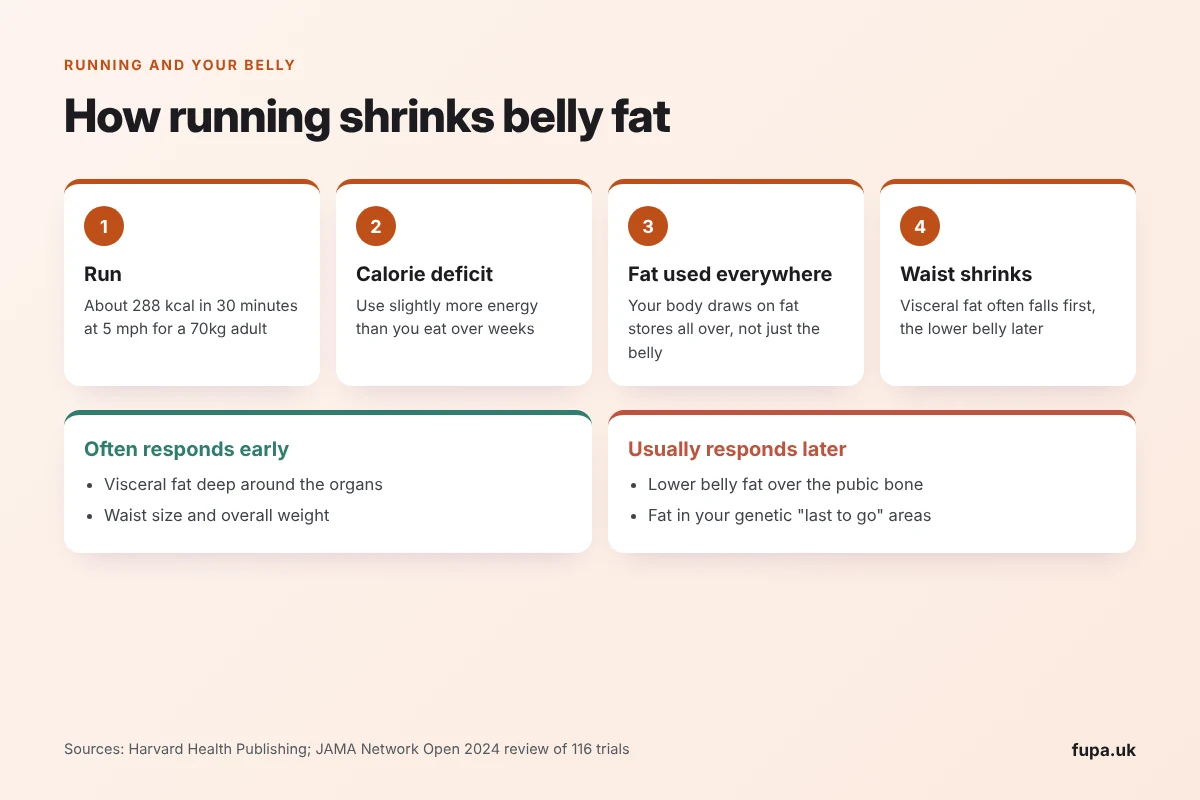
Running is one of the most efficient ways to use energy. Harvard Health Publishing estimates that 30 minutes of running at 5 mph, a 12 minute mile, burns about 240 calories for a person weighing 57kg, 288 calories at 70kg and 336 calories at 84kg. Heavier people and faster paces burn more. Over a week, three or four runs add up to a useful chunk of energy that can help create a calorie deficit.
What the trials show for waist size
A 2024 dose response review in JAMA Network Open pooled 116 randomised trials involving 6,880 adults with overweight or obesity. Each extra 30 minutes of aerobic exercise per week, such as walking or running, was linked with about 0.52kg less body weight and 0.56cm off the waist. The benefits kept growing up to around 300 minutes a week, and the authors concluded that at least 150 minutes a week at moderate intensity or above is likely to be needed for clinically important falls in waist size and body fat. Visceral fat area fell too.
Why you cannot spot reduce
Running uses muscles in your legs and hips, but the fat used to fuel it comes from stores all over your body. You cannot choose where fat leaves first. Your genes, sex, age and hormones decide the order, which is why many people notice a slimmer face or arms before their lower belly changes. Our guide to stubborn lower belly fat explains why this area is often last.
Visceral Fat vs Lower Belly Fat
Visceral fat responds well to running
Visceral fat sits deep inside the abdomen around your organs. It is the type linked with type 2 diabetes and heart disease, and it tends to respond well to aerobic exercise. A 2007 review of clinical trials in the International Journal of Obesity found that visceral fat fell in most exercise groups and suggested that at least about 10 MET hours of aerobic exercise a week was needed. That is roughly 2.5 hours of brisk walking or about 1.5 hours of light jogging. Visceral fat can shrink even before the scales move much.
Lower belly fat takes longer
The soft fat over the pubic bone, often called a FUPA, is subcutaneous fat that sits under the skin. It usually shrinks more slowly than visceral fat and often only after your overall body fat has come down. Running helps by burning energy, but a modest calorie deficit does most of the work here.
| Feature | Visceral fat | Lower belly (subcutaneous) fat |
|---|---|---|
| Where it sits | Deep inside the abdomen, around the organs | Under the skin, over the lower abdomen and pubic bone |
| Health risk | Higher, linked with diabetes and heart disease | Lower, mainly a comfort and shape concern |
| Response to running | Often responds early | Slower, usually one of the last areas to change |
| What helps most | Regular aerobic exercise and weight loss | A steady calorie deficit, strength work and time |
Running vs Walking, Intervals and Other Cardio
Running or walking?
Running burns more energy per minute than walking, so it saves time. Walking is gentler on the joints and easier to do for longer and more often, which matters more than the activity itself. If running hurts or puts you off, brisk walking is a good alternative. Our guide to walking to lose a FUPA shows how to build it up.
Steady runs or intervals?
Steady easy runs are simple and build fitness safely. Intervals, short faster efforts with recovery breaks, burn a similar amount of energy in less time but feel harder and need more recovery. Both work for fat loss when the weekly total adds up. Our comparison of HIIT vs steady cardio for a FUPA goes into the trade offs.
Calories burned at different running paces
These Harvard Health estimates show how pace and body weight change the energy used in 30 minutes of running.
| Pace (30 minutes) | 57kg | 70kg | 84kg |
|---|---|---|---|
| 5 mph (12 minute mile) | 240 kcal | 288 kcal | 336 kcal |
| 7.5 mph (8 minute mile) | 375 kcal | 450 kcal | 525 kcal |
| 10 mph (6 minute mile) | 453 kcal | 562 kcal | 671 kcal |
These figures are estimates. Your watch or app may show different numbers, and most people burn less than they think.
How Much Running Helps You Lose Belly Fat?
A weekly target
The NHS advises adults to do at least 150 minutes of moderate activity or 75 minutes of vigorous activity a week, plus strength work on at least 2 days. Running usually counts as vigorous activity. For fat loss, the research above suggests aiming for at least 150 minutes of aerobic activity a week in total, which can be a mix of runs and brisk walks.
Pair running with a calorie deficit
Running can make you hungrier, and it is easy to eat back the energy you burn. Fat loss happens when you take in slightly less energy than you use over weeks and months. Our guide to a calorie deficit for a FUPA explains how to set a modest one without feeling starved.
Add strength training
Strength work twice a week helps you keep muscle while you lose fat, which keeps your daily energy use up and improves your shape. Our guide to strength training for belly fat shows simple moves you can do on non running days.
A Beginner Plan: NHS Couch to 5K
How Couch to 5K works
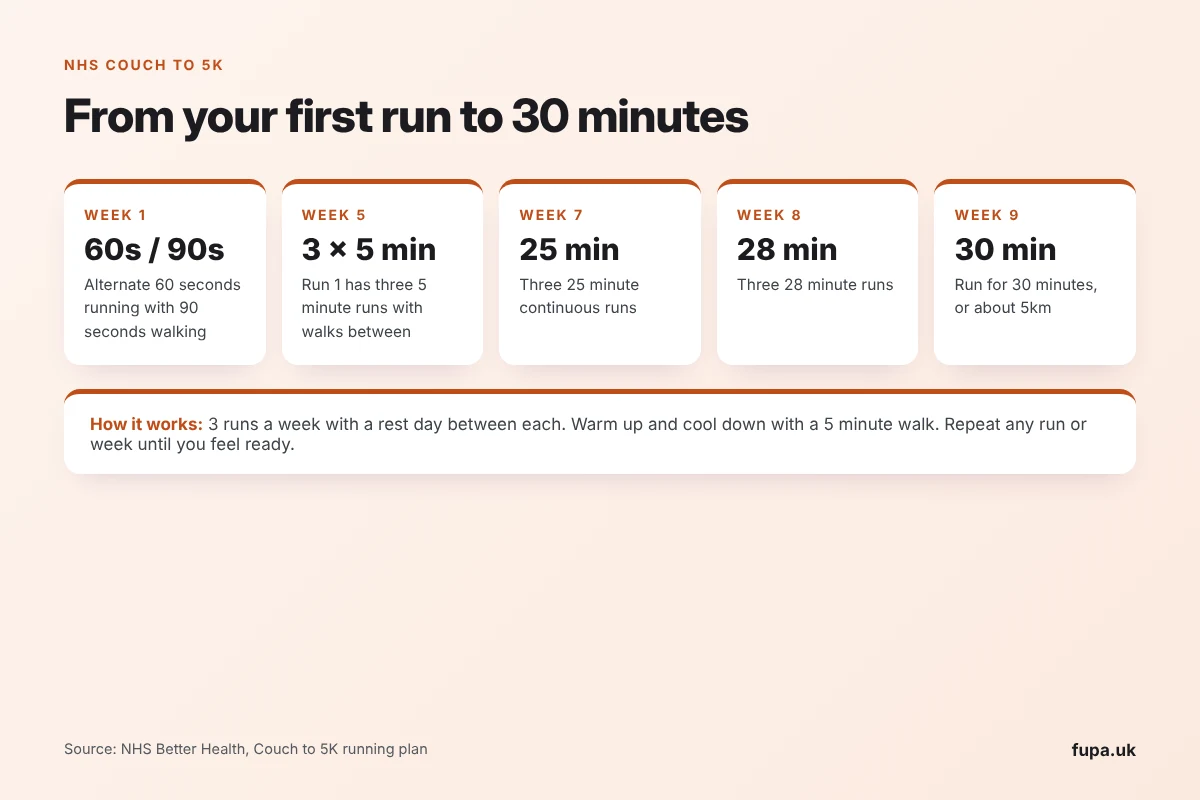
The free NHS Couch to 5K plan takes complete beginners to running for 30 minutes, or about 5km, over 9 weeks. You run 3 times a week with a rest day between each run. Week 1 alternates 60 seconds of running with 90 seconds of walking, and the runs build gradually until week 9, when you run for 30 minutes without stopping. The NHS says you can repeat any run or week and take as long as you need.
A sample week
| Day | Activity |
|---|---|
| Monday | Couch to 5K run |
| Tuesday | Strength training, 20 to 30 minutes |
| Wednesday | Couch to 5K run |
| Thursday | Brisk walk, 30 minutes |
| Friday | Rest or gentle stretching |
| Saturday | Couch to 5K run |
| Sunday | Strength training or a longer walk |
After week 9
Once you can run for 30 minutes, keep running 3 times a week. You can add a little time to one run each week, try a local parkrun, or swap one run for intervals. Keep the strength sessions going alongside.
Running Comfortably With a FUPA
Clothing and chafing
A supportive high waisted legging or running tight can stop the lower belly bouncing and reduce rubbing. Anti chafe balm on the inner thighs and under a belly fold helps on longer runs. Our guides to gym clothes for a FUPA and lower belly chafing have more tips.
Protect your joints
If you are carrying extra weight, start with the walk and run intervals, run on softer surfaces such as grass or park paths where you can, and wear trainers that fit well. Mild muscle soreness is normal at first. Sharp or lasting joint pain is a sign to rest and get it checked. If running is too hard on your joints, cycling is a lower-impact way to burn similar calories, and our guide on whether cycling burns belly fat compares indoor and outdoor options.
After having a baby
If you have had a baby, talk to your GP or physiotherapist about when to return to running, and rebuild your pelvic floor and deep core first. Leaking, heaviness or pain are signs to wait and get advice.
Frequently Asked Questions
Does running burn belly fat?
Yes, running helps you lose belly fat as part of overall fat loss. It burns a lot of energy and regular aerobic exercise is linked with a smaller waist and less visceral fat, but it cannot burn fat from your belly alone.
How long does it take to lose belly fat by running?
Many people notice a smaller waist within 8 to 12 weeks of regular running combined with a modest calorie deficit. Lower belly fat usually takes longer, often several months, because it tends to be one of the last areas to shrink.
Is running or walking better for belly fat?
Running burns more energy per minute, but walking is easier on the joints and easier to keep up. The best choice is the one you will do most weeks. Both reduce belly fat when combined with a calorie deficit.
How many times a week should I run to lose belly fat?
Three runs a week is a good target for beginners, as used in the NHS Couch to 5K plan. Aim for at least 150 minutes of aerobic activity in total each week, and add strength work on 2 days.
Why am I running but not losing belly fat?
The most common reason is eating back the energy you burn, as running can raise your appetite. Lower belly fat is also slow to shift. Track your waist measurement over weeks rather than days, and check that you are in a modest calorie deficit.
The Bottom Line
Run for fat loss, not for one spot
Does running burn belly fat? It does, by helping your whole body lose fat and by cutting the deeper visceral fat that matters most for health. The lower belly usually follows later. Run 3 times a week, build towards 150 minutes of activity, add strength work and eat in a modest calorie deficit. For a full week of training, see our belly fat workout plan.