FUPA and Lipoedema: How to Tell the Difference
Page Contents
- Key Takeaways
- What Is a FUPA?
- Ordinary fat in a common spot
- How a FUPA usually behaves
- What Is Lipoedema?
- A long-term fat disorder
- What causes it
- How common is it?
- Can Lipoedema Affect the Mons Pubis?
- What UK guidance says
- Why the two can still appear together
- Other causes of a large or painful mons
- FUPA or Lipoedema: How to Tell the Difference
- Signs that point to an ordinary FUPA
- Signs that point to lipoedema
- Lipoedema, lymphoedema and oedema
- Getting a Diagnosis in the UK
- Start with your GP
- What to bring to the appointment
- Treatment and Management
- For an ordinary FUPA
- For lipoedema
- Liposuction for lipoedema
- Frequently Asked Questions
- Can lipoedema affect the mons pubis?
- How do I know if my lower body fat is lipoedema?
- Does lipoedema go away with weight loss?
- Is lipoedema the same as lymphoedema?
- Can men get lipoedema?
- The Bottom Line
- Look at the legs, not just the lower belly
If you have searched “lipoedema mons pubis”, you may be wondering whether the soft pad of fat above your pubic bone is something more than ordinary fat. It is a fair question. Lipoedema is a real condition that is often missed for years and mistaken for being overweight, and many women with it feel they have been told to “just lose weight” when diet makes little difference to their shape. At the same time, most FUPAs are simply normal fat that responds to the same things as fat anywhere else.
This guide explains what lipoedema is, which parts of the body it usually affects, what UK guidance says about the tummy and pubic area, and the signs that point one way or the other. It is part of our hub on hormonal belly fat and related conditions.
This guide is general information, not medical advice, and it cannot diagnose lipoedema. If you think you have it, see your GP. Get urgent help from NHS 111 if a leg becomes swollen, red, hot and painful and you feel unwell, as this can be cellulitis.
Key Takeaways
- A FUPA is a pad of fat over the pubic bone. It is common, usually harmless and shrinks with overall fat loss.
- The NHS describes lipoedema as an abnormal build-up of fat in the legs and sometimes the arms, more common in women and usually equal on both sides.
- Typical signs are legs and hips out of proportion with the upper body, slim feet, soft or dimpled skin, pain, tenderness and easy bruising.
- UK guidance does not list the tummy or mons pubis as a typical lipoedema area, so a FUPA alone is not a sign of lipoedema.
- Lipoedema fat does not respond well to dieting, but healthy eating, activity and compression still help. Only a GP or specialist can diagnose it.
What Is a FUPA?
Ordinary fat in a common spot
A FUPA is the slang name for fat on the mons pubis, the soft mound over the pubic bone. Everyone has some fat here, and women naturally carry more because of oestrogen. The amount depends on genes, body fat, hormones, pregnancy and age. Our guide to what causes a FUPA covers each factor in detail.
How a FUPA usually behaves
A FUPA tends to grow and shrink with your overall weight. It feels soft, is not usually painful to touch and does not bruise easily. It often sits with a little extra fat on the lower belly, hips and thighs, but it does not make the legs look dramatically larger than the rest of the body. For most people it is completely normal, as our page on whether a FUPA is normal explains.
What Is Lipoedema?
A long-term fat disorder
The NHS page on lipoedema describes it as an abnormal build-up of fat in the legs and sometimes the arms, which can be painful and affect daily life. It is more common in women, usually affects both sides of the body equally and sometimes runs in families. Guidance from the Primary Care Dermatology Society adds that it almost exclusively affects women and usually begins between about 10 and 30 years of age.
What causes it
The exact cause is not known. The NHS is clear that lipoedema is not caused by being overweight, and that people at a healthy weight can have it. It may be linked to hormonal changes during puberty, pregnancy, the menopause or while taking the contraceptive pill, which is why symptoms often start or worsen at those times. Our guide to hormones, genetics and a FUPA covers how the same life stages shape ordinary fat too.
How common is it?
Nobody knows for sure. UK dermatology guidance notes that little research has been done on how many people are affected, and estimates vary widely. What is clear is that many women wait years for a diagnosis, and that being told they simply have obesity is one of the most common mistakes.
Can Lipoedema Affect the Mons Pubis?
What UK guidance says
NHS, primary care dermatology and Bupa guidance all describe the hips, buttocks, thighs and lower legs, and sometimes the arms, as the areas lipoedema affects. None of them lists the tummy or mons pubis as a typical lipoedema site. Bupa notes that in advanced disease the abnormal fat can spread to other areas such as the chest and arms. So the honest answer to “lipoedema mons pubis” is that the pubic fat pad is not a defining feature of the condition.
Why the two can still appear together
Someone with lipoedema can also carry ordinary fat on the lower belly and mons pubis, just like anyone else. If you have lipoedema in your hips and thighs, a FUPA can sit right next to it and the outline can look continuous. The key difference is in the legs and hips: lipoedema shows up as fat that is out of proportion, tender and resistant to dieting, not as a pubic fat pad on its own.
Other causes of a large or painful mons
If your mons pubis is swollen, firm, lumpy or painful rather than soft, other causes are more likely than lipoedema. These include post-surgical swelling, a lipoma, an infected hair follicle or, rarely, lymphoedema, which is swelling from fluid rather than fat. Our guides to a FUPA or a lipoma and FUPA pain and irritation cover these.
FUPA or Lipoedema: How to Tell the Difference
Signs that point to an ordinary FUPA
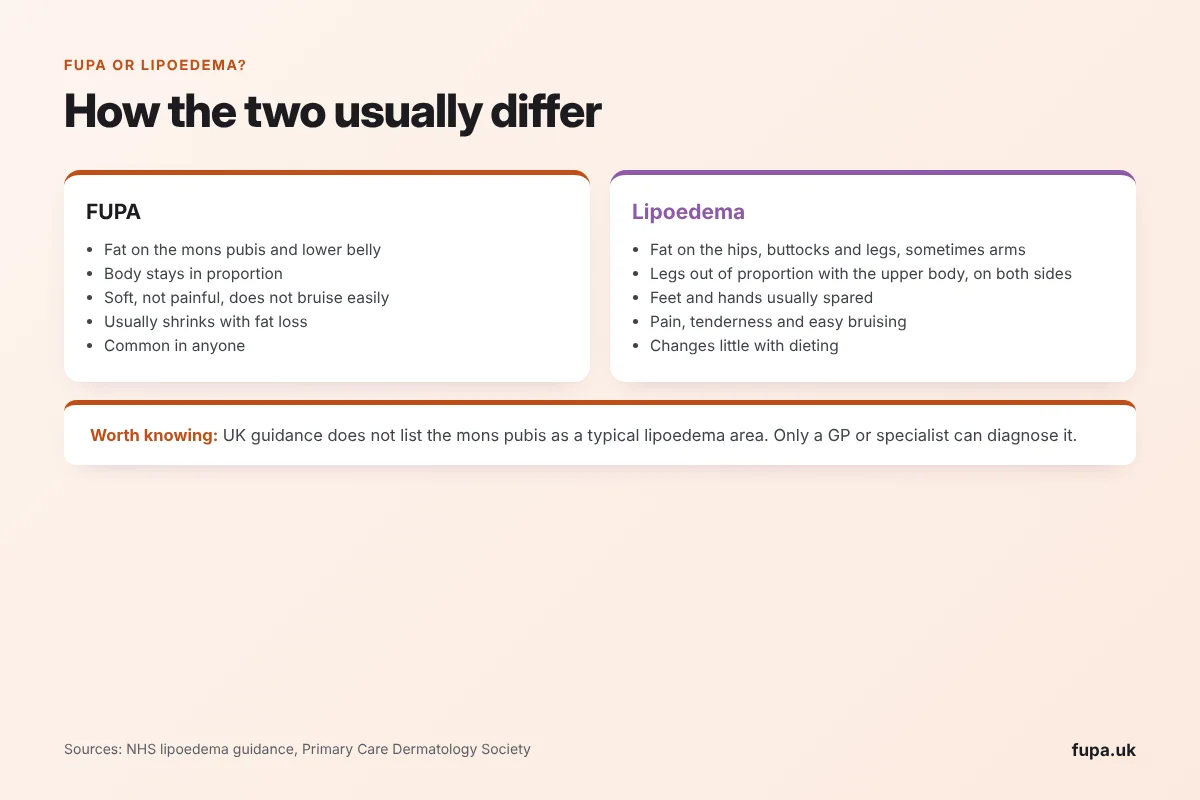
- The fat sits mainly on the lower belly and pubic mound.
- Your legs are in proportion with your upper body.
- The fat is soft, not painful to press and does not bruise easily.
- It got smaller the last time you lost weight.
Signs that point to lipoedema
- Your bottom, thighs and lower legs look out of proportion with your waist and upper body, on both sides.
- The fat stops at the ankles or wrists, leaving the feet and hands slim, sometimes described as a cuff or bracelet.
- The skin feels soft and cool and may look dimpled, like orange peel.
- Your legs ache, feel heavy or tender, and you bruise easily.
- Dieting slims your waist and face but makes little difference to your hips and legs.
| Feature | FUPA | Lipoedema |
|---|---|---|
| Main area | Mons pubis and lower belly | Hips, buttocks, thighs, lower legs, sometimes arms |
| Shape | In proportion with the rest of the body | Legs and hips out of proportion with the upper body |
| Feet and hands | Normal | Usually not affected |
| Pain and bruising | Not typical | Pain, tenderness and easy bruising are common |
| Response to weight loss | Usually shrinks | Affected areas change little |
| Who gets it | Anyone | Almost always women |
Lipoedema, lymphoedema and oedema
These names sound alike but are different. The NHS explains that lymphoedema is swelling caused by the lymphatic system not working properly and can affect any part of the body, while oedema is a build-up of fluid that often affects the ankles and feet. In lipoedema the feet are usually spared. Some people with long-standing lipoedema go on to develop lymphoedema as well, so swelling that spreads to the feet is worth mentioning to a GP. Our hub on a FUPA vs other belly fat compares more look-alikes.
Getting a Diagnosis in the UK
Start with your GP
There is no blood test or scan that confirms lipoedema. It is diagnosed from your history and an examination of where the fat sits and how it feels. Your GP may run routine blood tests to rule out other causes of weight gain, such as an underactive thyroid, and can refer you to a specialist if they suspect lipoedema. Our guide to thyroid and lower belly fat explains that test.
What to bring to the appointment
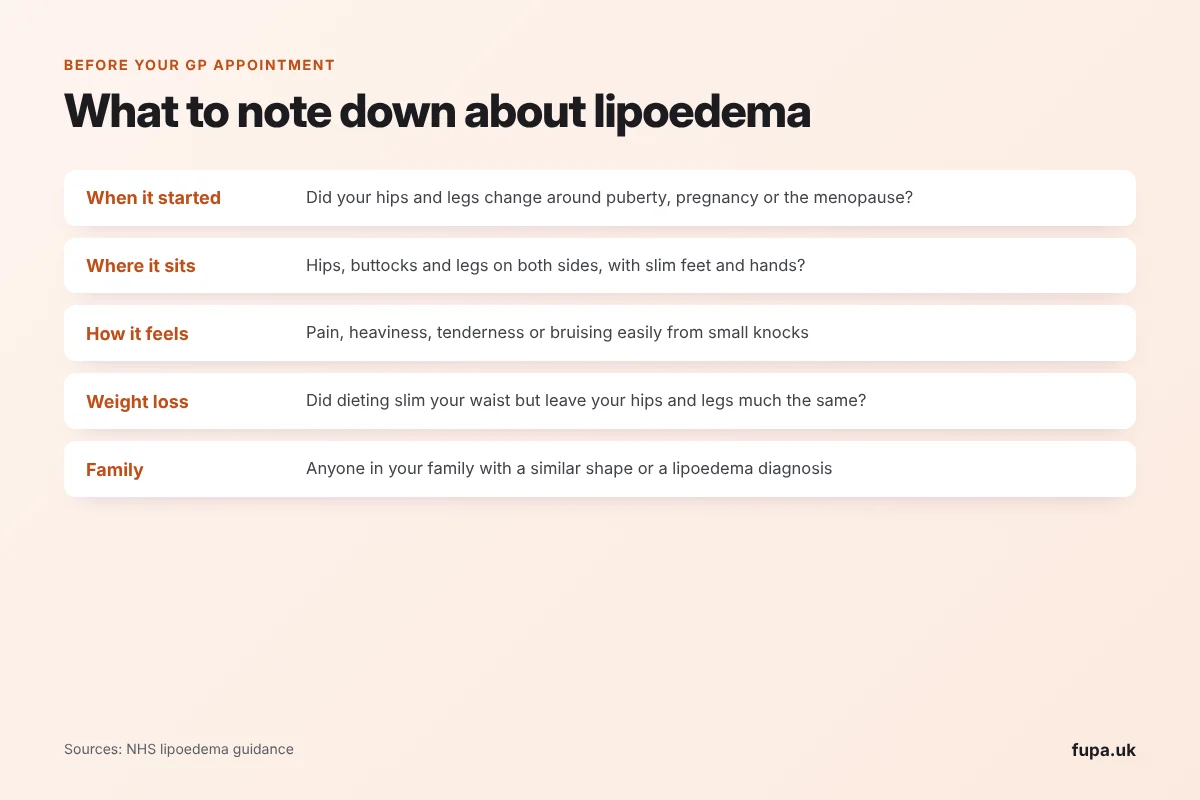
Write down when your legs started to change, whether it was around puberty, pregnancy or the menopause, whether anyone in your family has a similar shape, and how your body responded the last time you lost weight. Note any pain, heaviness or bruising. Photos over time can also help. Charities such as Lipoedema UK and Talk Lipoedema offer support and information, as the NHS suggests.
Treatment and Management
For an ordinary FUPA
A FUPA usually shrinks with steady overall fat loss through a modest calorie deficit, regular activity and strength training. Our guide on how to get rid of a FUPA sets out a full plan, and surgery such as monsplasty or FUPA liposuction is an option for fat or skin that will not shift once your weight is stable.
For lipoedema
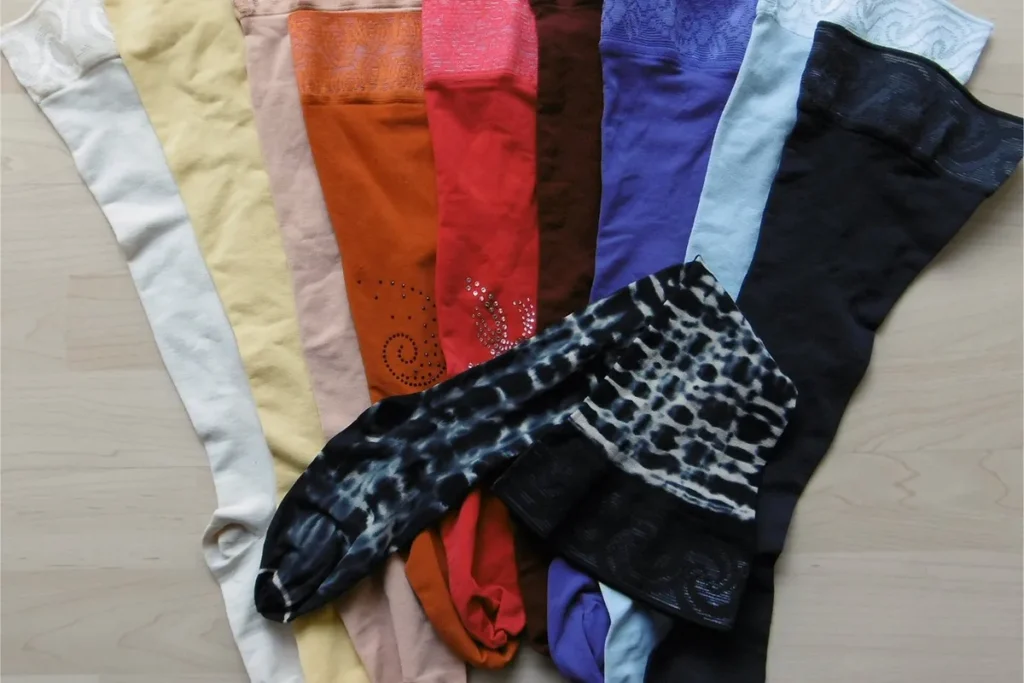
The NHS says there is no cure, but treatment can help and may stop the condition getting worse. Main treatments include healthy eating, regular exercise and keeping to a healthy weight, compression stockings or bandages fitted by a trained clinician to ease pain and make walking easier, daily moisturising to look after the skin, and counselling or CBT if the condition affects your mood. Low-impact activity such as walking, swimming and water exercise is often easiest on painful legs.
Liposuction for lipoedema
For severe symptoms, liposuction may be used to remove lipoedema fat. The NHS notes that you may need more than one operation and that it may not be available on the NHS. UK dermatology guidance adds that surgery is only considered in carefully selected patients after non-surgical treatment and has not been shown to cure the condition. This is a different operation from cosmetic liposuction of a FUPA.
Frequently Asked Questions
Can lipoedema affect the mons pubis?
UK guidance from the NHS and dermatology specialists does not list the mons pubis as a typical lipoedema area. Lipoedema mainly affects the hips, buttocks and legs, and sometimes the arms. Someone with lipoedema can also carry ordinary fat on the mons pubis, but a pubic fat pad on its own is not a sign of the condition.
How do I know if my lower body fat is lipoedema?
Typical signs are hips and legs that are out of proportion with your upper body on both sides, slim feet, soft dimpled skin, pain, tenderness and easy bruising, and little change in those areas when you lose weight. Only a GP or specialist can diagnose it, so book an appointment if this sounds familiar.
Does lipoedema go away with weight loss?
No. The NHS says lipoedema is not caused by being overweight, and dieting usually makes little difference to the affected fat. Healthy eating, exercise and a stable weight still help with symptoms and overall health, and may stop the condition getting worse.
Is lipoedema the same as lymphoedema?
No. Lipoedema is a build-up of fat, while lymphoedema is swelling caused by the lymphatic system not draining fluid properly. Lymphoedema can affect any part of the body, including the feet, which are usually spared in lipoedema. Some people with long-standing lipoedema develop lymphoedema too.
Can men get lipoedema?
It is very rare. UK guidance says lipoedema almost exclusively affects women. A man with a large pubic fat pad is far more likely to have ordinary fat, which our guide to a FUPA in men covers.
The Bottom Line
Look at the legs, not just the lower belly
A FUPA is usually ordinary fat that responds to overall fat loss, while lipoedema is a separate condition that mainly affects the hips, buttocks and legs, often with pain and easy bruising. UK guidance does not list the mons pubis as a typical lipoedema area, so the clearest clues are in the shape and feel of your legs. If your lower body is out of proportion, tender and resistant to dieting, see your GP and ask about lipoedema. For more on conditions that change the lower belly, see our guide to hormonal belly fat.